
Why Korean Learners Should Study Handwriting Even If They Type
The reader can use handwriting practice to improve recognition, recall, and block-proportion judgment even in a typing-first world.
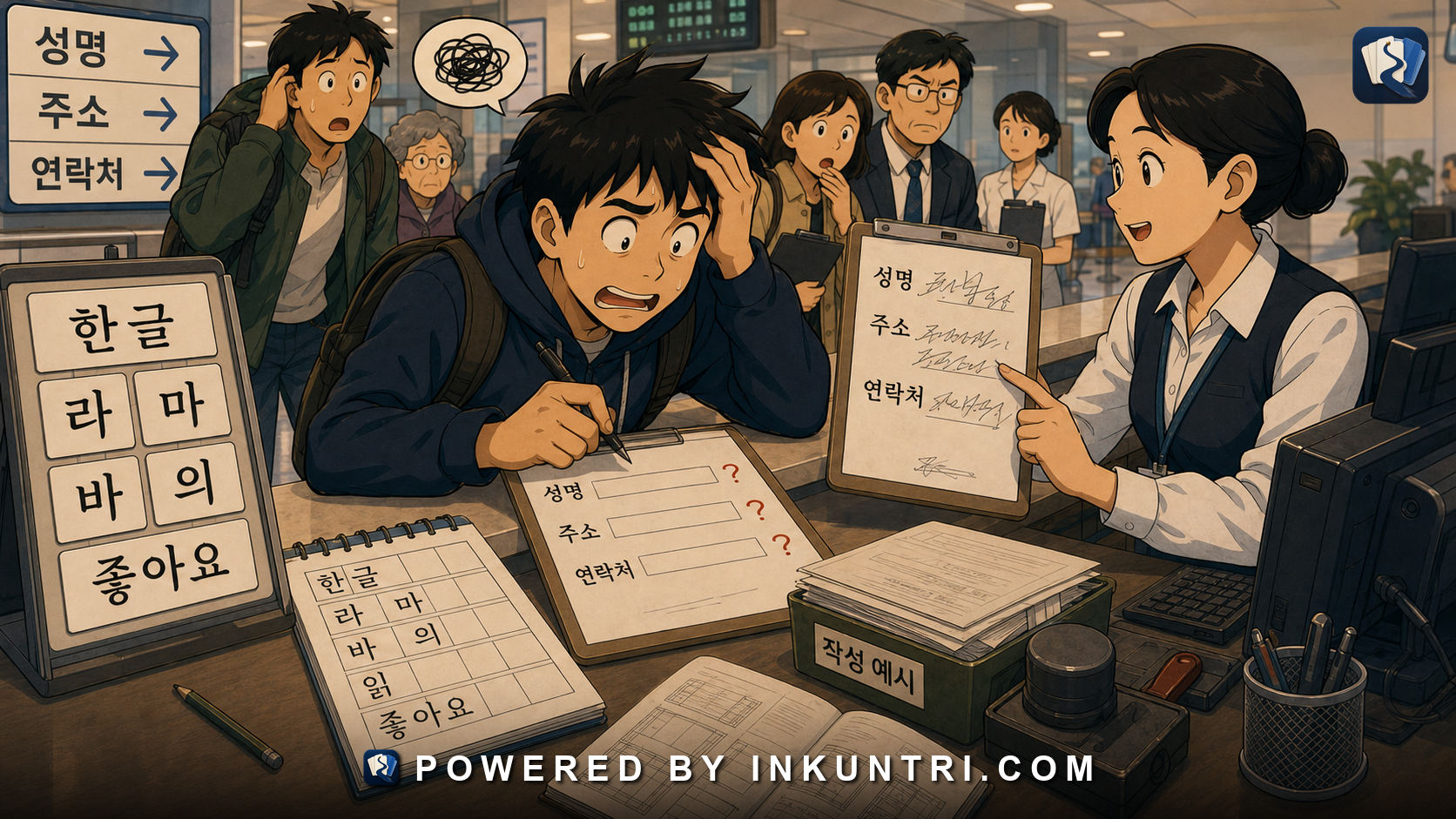
Core examples: 라/마; 바/마; 의; 읽; 좋아요; 성명; 주소; 연락처; 한글.
Typing fluency is not the same as script fluency
A learner can type Korean comfortably and still freeze when a clinic form asks for 성명, 주소, and 연락처 in a quick handwritten style. That disconnect surprises many people because Hangul is often introduced as an alphabet you can learn in an afternoon. The alphabet can indeed be learned quickly. But recognizing neat printed Hangul and recognizing handwritten Hangul are not the same skill.
Handwriting matters because real Korean still appears in handwritten forms: delivery notes, classroom corrections, restaurant order slips, postcards, whiteboard notes, labels, market signs, teacher feedback, sticky notes, and informal instructions. Even in a digital country, handwriting survives wherever speed, authority, intimacy, or temporary information matters.
The point is not nostalgia. You do not need to become a calligrapher. You need enough production experience to understand how printed blocks deform when a person writes quickly.
Handwriting practice is not mainly about writing beautifully. It is about seeing Hangul as a flexible structure rather than as a font.
Printed Hangul hides the problem
Printed fonts make syllable blocks look stable. 한글, 좋아요, 연락처, and 읽다 appear as clean square units. The spaces between strokes are regular. The circle ㅇ is clear. ㄹ keeps its printed shape. ㅁ and ㅂ are not easily confused.
Handwriting changes all of that. Fast ㄹ may look flatter, loopier, or more compressed than the printed letter. ㅁ may close imperfectly. ㅂ may lose clear separation between its internal strokes. ㅇ may become small, oval, or almost a hook in fast writing. Final consonants may be squeezed under the vowel. A block with batchim, such as 읽 or 값, can become visually dense.
This is why learners often confuse 라 and 마, 바 and 마, or handwritten 의 with something less familiar. The problem is not that Korean handwriting is chaotic. The problem is that beginners have often memorized font shapes rather than structural relationships.
The useful mechanics: stroke groups and block balance
Hangul handwriting has two linked goals: write the letters correctly and keep the block readable. A syllable block is not just a sequence of strokes; it is a small layout problem.
In 한, the ㅎ, ㅏ, and ㄴ must fit together so the block still looks like one syllable. In 좋, the ㅈ, ㅗ, and ㅎ compete for vertical space. In 읽, the final ㄺ makes the bottom of the block dense. In 의, the vowel sequence requires the writer to balance ㅇ with ㅡ and ㅣ without letting the block become too wide.
Beginners often focus only on the letter and forget the block. They write ㄱ, ㅏ, and ㄴ correctly as separate pieces but make 한 too wide, too tall, or too uneven. Native handwriting is not perfect, but it usually preserves the relationships that let the reader identify the block quickly.
A useful learner target is not artistic regularity. It is proportion: initial consonant, vowel, and final consonant should each occupy a plausible space.
Stroke order is a recognition tool
Stroke order is sometimes presented as a rule for obedience. That framing is not very useful. The practical reason to learn conventional stroke order is that it explains the shapes that appear in fast handwriting.
When people write ㄹ quickly, the path of the pen affects the final shape. When they write ㅁ or ㅂ quickly, the order and direction of strokes affect which corners remain clear and which parts merge. If you have only seen printed forms, fast handwriting looks arbitrary. If you have written the letters yourself, many distortions become predictable.
The same applies to digital handwriting recognition. Phones and tablets often rely partly on stroke sequence and stroke direction. If your written block looks correct at the end but was produced in an unusual path, recognition may be less reliable.
Handwriting helps memory in a different way from typing
Typing Korean on a two-set keyboard trains sound order and jamo composition. That is valuable. You learn that ㄱ + ㅏ + ㄴ becomes 간 and that block assembly happens automatically.
Handwriting trains a different layer. It makes you decide how much space a letter needs inside a block. It makes batchim feel physically lower and more compressed. It makes you notice that ㅗ and ㅜ change the shape of the block differently from ㅏ and ㅓ. It makes you produce the visual structure rather than merely select keys.
For many learners, handwriting also improves recall. When you write 성명, 주소, 연락처, and 생년월일 by hand, you remember them not only as typed strings but as recurring field labels on real forms. That makes them easier to recognize later when the handwriting is imperfect.
Where handwriting appears outside textbooks
Real handwriting is genre-specific.
A teacher’s correction on a student paper may be compact but legible. A restaurant order slip may use abbreviations, numbers, arrows, and dish names written for staff, not learners. A handwritten sign may exaggerate letters for visibility. A postal label may mix printed and handwritten forms. A whiteboard note may simplify strokes because it is meant to be read from a distance.
Learners should collect these contexts mentally. Handwritten Korean on a form is not the same as handwritten Korean on a cafe chalkboard. The purpose shapes the writing.
Common learner confusions
Some confusions come from similar printed forms. Others come from handwritten compression.
| Pair or form | Why it causes trouble | What to check |
|---|---|---|
| 라 / 마 | fast ㄹ and ㅁ can be visually compressed | look for open movement versus closed box |
| 바 / 마 | ㅂ and ㅁ may both look boxy in quick writing | look for internal vertical structure in ㅂ |
| 의 | ㅇ + ㅡ + ㅣ can spread or compress | identify the vowel pieces before guessing |
| 읽 | dense final ㄺ can hide the block structure | separate top vowel from bottom final cluster |
| 좋아요 | ㅎ may weaken in speech but remains in spelling | do not let pronunciation erase written ㅎ |
The key habit is to reconstruct the block rather than guess from the whole silhouette.
A learner workflow: practical handwriting routine
Use a small, focused routine rather than copying pages mindlessly.
- Choose five high-frequency words from real contexts: 성명, 주소, 연락처, 좋아요, 한글.
- Write each word slowly while saying the jamo order.
- Write each word again at normal note-taking speed.
- Compare your version with a printed font and with a handwritten model.
- Circle the parts that become unclear: final consonants, ㅇ, ㄹ, ㅁ, ㅂ, or compound vowels.
- Rewrite only those problem blocks, not the whole page.
- After a day, test recognition by reading messy handwritten samples.
This routine keeps handwriting tied to reading. You are not practicing strokes for their own sake. You are building recognition resilience.
Mini practice: read the block, not the font
Take these words and rewrite them in three styles: careful, normal, and fast.
| Word | What to preserve | Likely danger in fast writing |
|---|---|---|
| 성명 | two separate syllable blocks | ㅁ in 명 becoming unclear |
| 주소 | ㅈ + ㅜ and ㅅ + ㅗ distinction | rounded ㅅ looking like a weak ㅇ |
| 연락처 | ㄴ/ㄹ relationship and final ㄱ | over-compressing 락 |
| 좋아요 | ㅎ and ㅇ positions | making 좋아요 look like 조아요 |
| 읽 | final ㄺ cluster | turning the block into an unreadable box |
Then reverse the task: look at your fast version after several hours and see whether you can still read it. If you cannot, the problem is not speed; it is block balance.
A strong tool for this article would show the same Korean words in four layers.
Suggested functions:
- Printed layer: clean textbook font.
- Careful handwriting layer: slow learner-friendly form.
- Fast handwriting layer: realistic compressed form.
- Learner-error layer: common distortions and how to repair them.
- Block-proportion overlay: initial, vowel, and final zones.
- Recognition quiz: users identify handwritten words before seeing the printed answer.
Final rule
Do not study handwriting because Korean is old-fashioned. Study it because print, typing, and handwriting reveal different parts of Hangul literacy.
Typing teaches jamo input. Printing teaches standard shapes. Handwriting teaches proportion, deformation, and recognition under real-world conditions.
Related reading
When CJK Comparison Helps Korean Learners and When It Becomes Noise
The reader can decide when Chinese/Japanese comparison accelerates Korean learning and when it creates false friends, grammar transfer, register mistakes, or institutional confusion.
Sino-Korean Character Families Without Requiring Full Hanja Literacy
The reader can build Sino-Korean word families from recurring syllables without requiring full Hanja literacy.
Hanja Beneath Hangul: The Hidden Sino-Korean Layer
The reader can recognize the Sino-Korean layer behind Hangul words without needing to become a full Hanja reader on day one.
Korean Romanization Systems and Why They Frustrate Everyone
The reader can navigate Korean romanization without confusing it with Korean spelling or pronunciation itself.
How Classical Chinese Shaped Korean Elite Literacy
The reader can recognize how Classical Chinese shaped Korean elite literacy, Sino-Korean vocabulary, education, moral terminology, historical documents, and modern academic abstraction without confusing Hanja...
Procurement Korean: 입찰, 제안서, 낙찰, 심사
The reader can read Korean procurement notices by identifying bid stages, proposal documents, eligibility, evaluation criteria, preferred negotiator status, award, contract, and procedural deadlines.