
Sino-Korean Character Families Without Requiring Full Hanja Literacy
The reader can build Sino-Korean word families from recurring syllables without requiring full Hanja literacy.
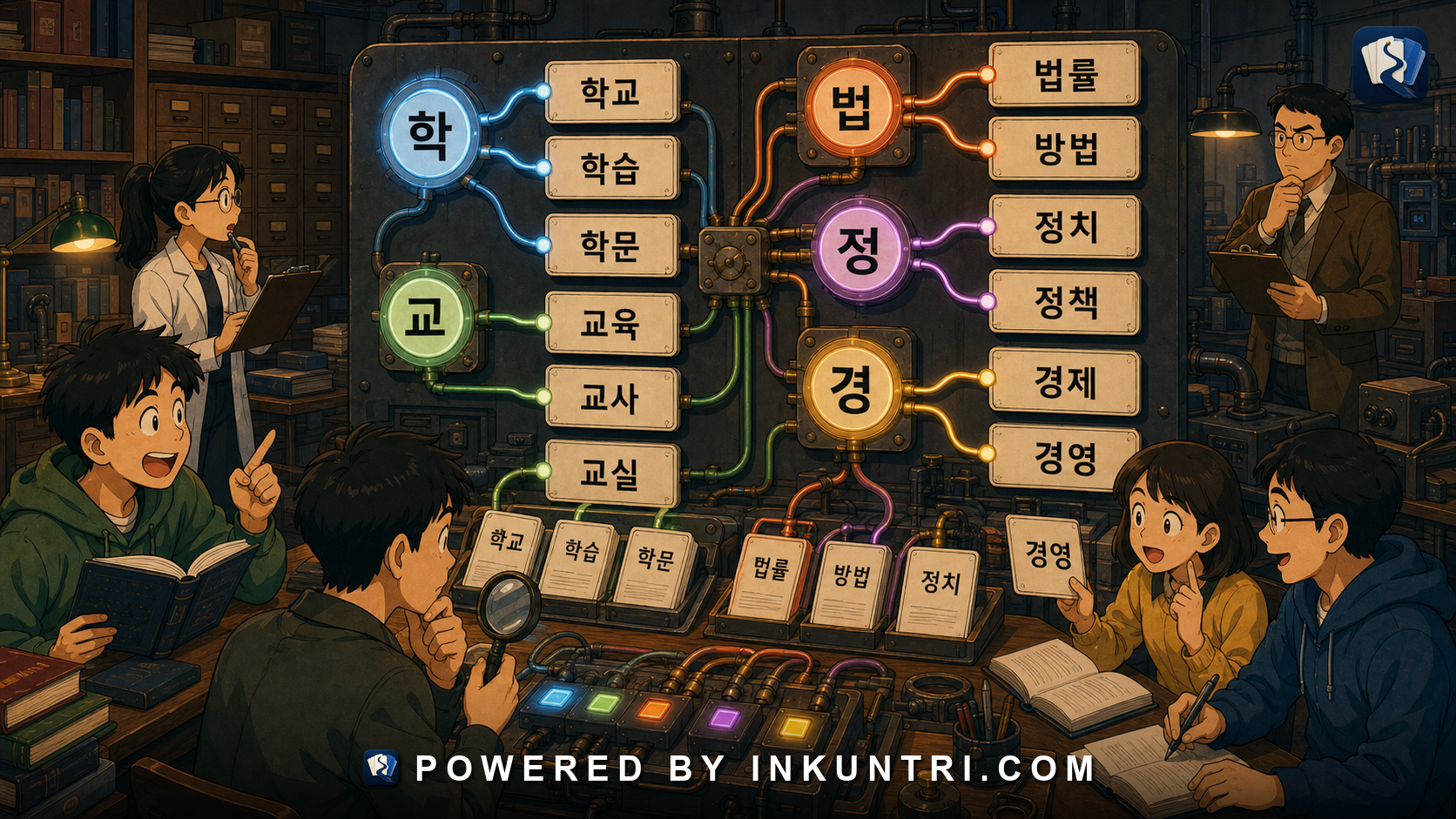
Core examples: 학: 학교/학습/학문; 교: 교육/교사/교실; 법: 법률/방법; 정: 정치/정책; 경: 경제/경영.
You do not need full Hanja literacy to get Hanja benefits
Many Korean learners hear that Hanja is useful and think they must either ignore it completely or begin a full character curriculum. That is a false choice.
A learner can use the Sino-Korean layer without becoming a full Hanja reader on day one. The practical skill is to notice recurring Hangul syllables that often correspond to Hanja roots, verify them when useful, and build word families.
학교, 학습, 학문, 학생, 대학 are easier to remember when you see that 학 often belongs to the learning/study family. 교육, 교사, 교실, 학교 become easier when you notice 교 as a teaching/school-related element in many words. 법률 and 방법 both contain 법-like elements, but they do not always work the same way semantically. This is where verification matters.
Hanja-lite study means using character roots as vocabulary evidence, not pretending that sound alone always gives meaning.
The value is in networks
If you memorize 학습, 교육, 연구, 정책, 경제, and 사회 as isolated words, Korean academic vocabulary feels endless. If you build families, patterns appear.
| Syllable | Common Hanja family idea | Example words |
|---|---|---|
| 학 | learning/study | 학교, 학생, 학습, 학문, 대학 |
| 교 | teaching/school/religion depending on character | 교육, 교사, 교실, 학교, 종교 |
| 법 | law/method depending on character | 법률, 법원, 방법, 문법 |
| 정 | politics/government/correctness/feeling depending on character | 정치, 정책, 정답, 감정 |
| 경 | economy/management/capital/scripture/path depending on character | 경제, 경영, 경기, 경전 |
The table itself shows the danger. A single Hangul syllable can represent multiple Hanja. 정 is not one root. 경 is not one root. 법 may be law in one word and method in another. The network helps only when checked.
Homophonous roots are the main trap
Korean has many Sino-Korean syllables that sound the same but come from different characters. If you assume every 학 or 정 or 경 has one meaning, you will overgeneralize.
For example, 정 in 정책 and 정 in 감정 are not the same semantic root. 경 in 경제 and 경 in 경전 are not the same. 사 in 사회, 회사, 의사, 역사, and 사전 can represent different roots.
This does not make Hanja-lite useless. It means the workflow must include dictionary confirmation.
Dictionary Hanja fields are your friend
Many Korean dictionaries show Hanja for Sino-Korean words. You can use this selectively. You do not need to handwrite the character. You only need to confirm whether two words share the same underlying root.
A good practice is to build small clusters:
- 학(學): 학교, 학생, 학습, 학문, 대학
- 교(敎): 교육, 교사, 교재 in many contexts
- 법(法): 법률, 법원, 문법, 방법
- 정(政): 정치, 정책, 정부
- 경(經): 경제, 경영, 경험 in some roots, but verify each word
Then mark false friends or different-character homophones.
Character families help with formal Korean
News, government documents, academic writing, and school texts contain many Sino-Korean compounds. Character-family awareness makes these texts less opaque.
If you know 정 often appears in policy/government words, then 정책, 정부, 정치, 행정 become easier to group. If you know 경 appears in economic and management terms in certain roots, 경제, 경영, 경기, 경상 may begin to connect, though each must be learned in context.
This is not etymology for fun. It is memory compression.
Do not produce words by guessing
A dangerous learner move is to combine syllables and hope the result is a real word. Korean has productive Sino-Korean compounding, but learners should not invent formal terms from roots unless they have seen the word in real use.
Use Hanja families to recognize and remember. Use dictionaries and corpora to confirm production.
A character-family routine
Use this workflow:
- Choose one recurring syllable from words you already know.
- Collect five to ten compounds containing that syllable.
- Check dictionary Hanja fields for each word.
- Split the list into same-character family and homophonous outsiders.
- Add one example sentence for each high-value word.
- Review the family as a network, not as isolated flashcards.
- Stop before the list becomes too large to use.
Mini practice: group and verify
| Word set | First guess | What to verify |
|---|---|---|
| 학교, 학생, 학습, 학문 | likely shared 학 family | confirm 學 where useful |
| 교육, 교사, 교실 | teaching/school family | check which 교 appears |
| 법률, 법원, 문법, 방법 | law/method family | note 法 can appear in law and method/grammar words |
| 정치, 정책, 정부 | government/politics family | confirm 政-related roots |
| 경제, 경영, 경기 | economy/management domain | verify each Hanja before overgeneralizing |
| 감정, 정답, 정책 | all contain 정 | likely not one family; split them |
Suggested functions:
- Input syllable: user enters 학, 교, 법, 정, 경.
- Word collector: shows common compounds.
- Hanja verification: groups words by underlying character.
- False-friend warning: highlights same-sound different-root cases.
- Domain tags: school, law, politics, economy, emotion, method.
- Flashcard export: word cards with optional Hanja note.
Final rule
Use Hanja roots to connect Korean vocabulary, not to replace vocabulary learning.
Spot recurring syllables, verify the character when it matters, build families, and discard guesses that the dictionary does not support.
Related reading
When CJK Comparison Helps Korean Learners and When It Becomes Noise
The reader can decide when Chinese/Japanese comparison accelerates Korean learning and when it creates false friends, grammar transfer, register mistakes, or institutional confusion.
Hanja Beneath Hangul: The Hidden Sino-Korean Layer
The reader can recognize the Sino-Korean layer behind Hangul words without needing to become a full Hanja reader on day one.
How Sino-Korean Vocabulary Creates Formal and Technical Korean
The reader can use Sino-Korean roots to decode formal and technical Korean while avoiding false confidence.
Near-Synonym Field Guide: 고치다, 치료하다, 수정하다, 개선하다
The reader can choose the Korean repair verb based on whether the target is a machine, habit, illness, document, error, system, policy, or condition.
Why Knowing Chinese Helps Korean—and Where It Misleads You
The reader can use Chinese knowledge as a Korean vocabulary advantage while protecting against false friends, collocation errors, and Hangul-only ambiguity.
Designing Korean Anki Cards for Grammar, Vocabulary, Sound Change, and Context
The reader can design spaced-repetition cards that test Korean use, recognition, listening, sound change, and context instead of memorizing isolated glosses.