
Hanja Beneath Hangul: The Hidden Sino-Korean Layer
The reader can recognize the Sino-Korean layer behind Hangul words without needing to become a full Hanja reader on day one.
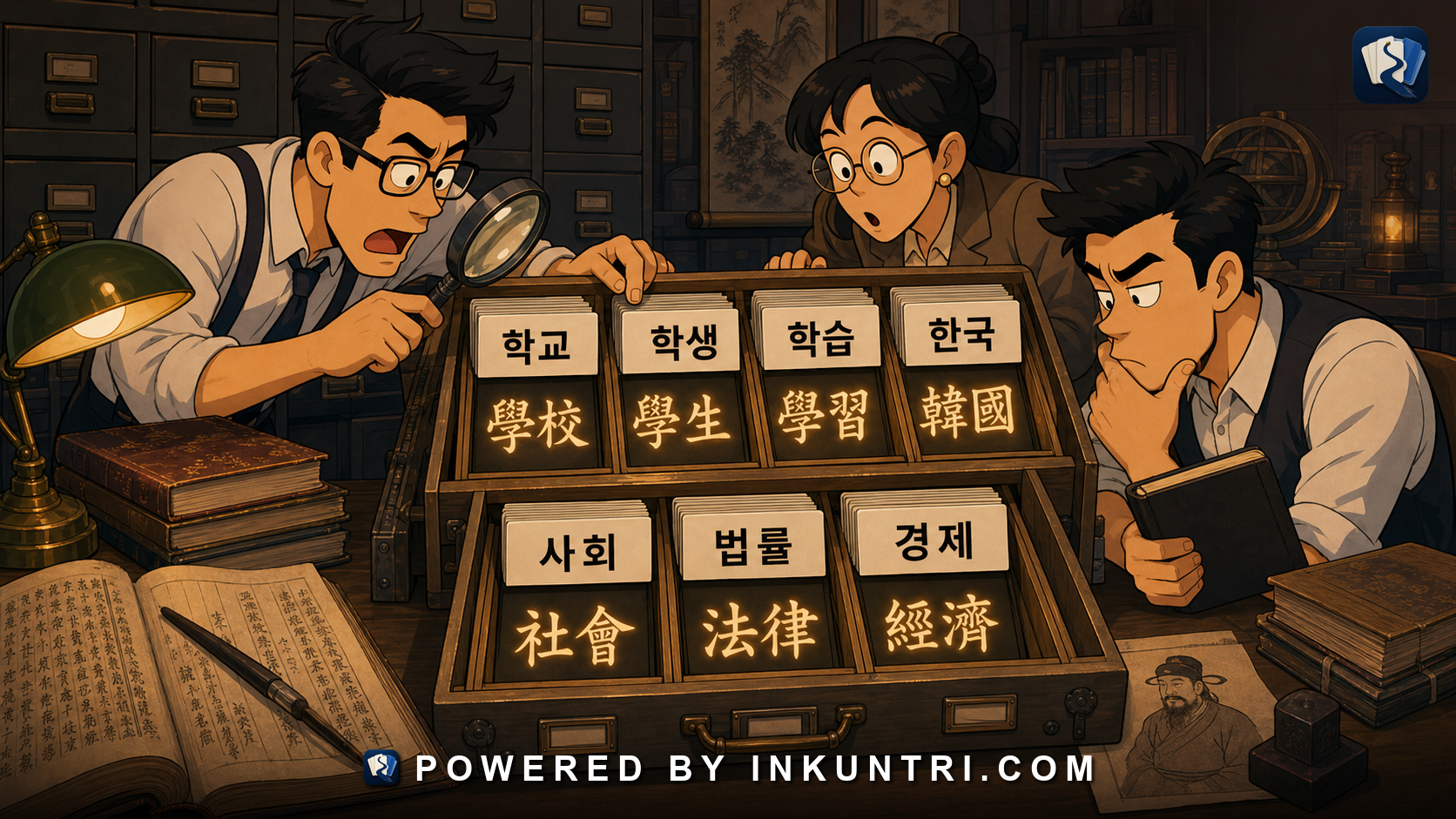
Core examples: 학교(學校); 학생(學生); 학습(學習); 한국(韓國); 사회(社會); 법률(法律); 경제(經濟).
Hangul can hide word families
Hangul makes Korean readable without Chinese characters. That is one of its great strengths. But Hangul-only writing can also hide the structure of Sino-Korean vocabulary.
A beginner may learn 학교, 학생, 학습, 학문, 대학, and 유학 as unrelated Hangul words. In fact, many of them share the same Hanja root 學, read 학 in Korean and associated with learning or study.
The learner does not need to write 學 by hand to benefit from this. Even a “Hanja-lite” awareness can turn isolated vocabulary into families.
Compare:
| Hangul | Hanja | Basic meaning |
|---|---|---|
| 학교 | 學校 | school |
| 학생 | 學生 | student |
| 학습 | 學習 | learning; study |
| 학문 | 學問 | scholarship; academic learning |
| 대학 | 大學 | university |
| 유학 | 留學 | study abroad |
The shared syllable 학 is not a coincidence. It is a recurring Sino-Korean morpheme.
Sino-Korean words are not “Chinese words in Korean” in a simple sense
Korean has a large layer of vocabulary historically derived from Chinese characters. These words are pronounced with Korean readings, used in Korean grammar, and often have meanings shaped by Korean usage.
학교 is a Korean word. It is not pronounced like Mandarin xuéxiào or Japanese gakkō, even though all three are historically connected through the characters 學校/学校. The shared character background helps comparison, but each language has its own pronunciation and usage.
This matters because cross-CJK knowledge can help or mislead. If you know Chinese or Japanese, you may recognize many roots. But you still have to learn Korean readings, Korean collocations, and Korean register.
Hanja readings are syllable-sized clues
Many Sino-Korean morphemes correspond to one Hangul syllable and one Hanja character.
Examples:
| Hangul syllable | Hanja | Meaning field | Example words |
|---|---|---|---|
| 학 | 學 | learning | 학교, 학생, 학습 |
| 국 | 國 | country | 한국, 미국, 국가, 국제 |
| 사 | 社 | society/company-related in some words | 사회, 회사 |
| 법 | 法 | law, method | 법률, 방법, 헌법 |
| 경 | 經 | economy/classic/manage contexts | 경제, 경영, 경험 in a different root case depending on Hanja |
| 정 | 政 / 情 / 正 and others | politics, feeling, correctness, etc. | 정치, 감정, 정답 |
The last row shows the danger. One Hangul syllable can correspond to many Hanja. 정 is not one root. It can represent 政 in politics, 情 in feeling, 正 in correctness, and many other characters.
So Hanja awareness helps, but sound alone is not enough. You must verify the character or learn the word family through real examples.
The invisible layer explains academic vocabulary
Sino-Korean words dominate many formal, academic, legal, governmental, and news domains.
Examples:
- 경제 — economy
- 정치 — politics
- 사회 — society
- 법률 — law
- 교육 — education
- 문화 — culture
- 역사 — history
- 과학 — science
- 정보 — information
- 제도 — system/institution
A learner who only memorizes these as sound strings works too hard. The syllables often recur productively.
법 appears in:
- 법률 — law, legal rules
- 방법 — method
- 헌법 — constitution
- 불법 — illegal
- 합법 — legal
- 법원 — court
국 appears in:
- 한국 — Korea
- 미국 — United States
- 중국 — China
- 국가 — state/country
- 국제 — international
- 국내 — domestic
- 국회 — National Assembly
Once you see the root network, vocabulary becomes less random.
But Hanja guessing has limits
Hanja-lite study is powerful only if it remains humble.
First, homophones are common. The syllable 사 can correspond to many characters: 社, 事, 私, 四, 死, 師, 使, and more. If you see 사 in a word, you cannot automatically assign one meaning.
Second, modern word meanings can shift. 경제 is not understood by adding naive meanings of 經 and 濟. It is the Korean word for economy/economic, with modern collocations such as 경제 발전, 시장경제, 경제학.
Third, not all Korean vocabulary is Sino-Korean. Native Korean words such as 사람, 먹다, 가다, 좋다, 마음, 나라, and 바람 are not explained by Hanja in the same way. Loanwords such as 커피, 버스, 컴퓨터, and 스마트폰 follow different patterns.
Fourth, some words mix layers or have multiple etymological explanations that do not help ordinary usage.
The rule is: use Hanja to organize evidence, not to invent meanings.
Dictionary Hanja fields are your friend
Many Korean dictionaries list Hanja for Sino-Korean words. This is one of the safest ways to build root awareness.
When you look up 학교, note 學校. Then collect related words with 學. When you look up 법률, note 法律. Then compare 법원, 방법, 헌법, 불법, 합법.
A good workflow:
- Learn the Hangul word and its Korean pronunciation first.
- Check whether the dictionary lists Hanja.
- Record the Hanja only if it helps connect related words.
- Build a small family of examples.
- Watch for homophones and false connections.
Do not turn every vocabulary lookup into a full character lesson. That will slow you down. Focus on high-frequency roots that recur across many useful words.
Hanja helps with formal register
Many Sino-Korean words sound more formal, abstract, bureaucratic, or academic than native Korean alternatives. This is not a perfect rule, but it is a strong tendency.
Compare rough pairs:
| More native/basic | More Sino-Korean/formal |
|---|---|
| 나라 | 국가 |
| 말 | 언어 |
| 생각 | 사상 / 의견, depending on context |
| 법 | 법률 |
| 가르치다 | 교육하다 |
| 배우다 | 학습하다 |
These pairs are not interchangeable. 국가 is not simply a fancy 나라 in every sentence. 교육하다 is not always the same as 가르치다. But noticing the Sino-Korean layer helps explain why certain texts feel formal.
News, law, academic writing, government pages, museum labels, and policy documents rely heavily on this layer.
Cross-CJK comparison can give leverage
Learners who know Chinese characters or Japanese kanji can gain a head start.
한국 is 韓國/韩国, Japanese 韓国. 학교 is 學校/学校, Japanese 学校. 경제 is 經濟/经济, Japanese 経済. These relationships can make Korean vocabulary easier to remember.
But pronunciation differs:
- 學校: Korean 학교, Mandarin xuéxiào, Japanese gakkō
- 經濟: Korean 경제, Mandarin jīngjì, Japanese keizai
- 社會: Korean 사회, Mandarin shèhuì, Japanese shakai
The shared character layer is a bridge, not a substitute for Korean.
A Hanja-lite workflow
Use this routine:
- Spot a recurring syllable. 학 in 학교, 학생, 학습.
- Check the dictionary Hanja. Confirm 學 rather than assuming.
- Build a family. Add 학교, 학생, 학문, 대학, 유학.
- Write a meaning label. 학 = learning/study, not a full English word every time.
- Look for homophones. If another 학 appears, verify it.
- Learn real collocations. 학교에 가다, 학생증, 학습 자료, 대학원.
The goal is not to become a classical Chinese scholar before reading Korean. The goal is to stop treating formal Korean vocabulary as unrelated noise.
Mini practice: build one Sino-Korean family, then test it
Start with 학. Collect words, then verify the Hanja instead of trusting sound alone.
| Hangul word | Likely Hanja | Meaning pattern |
|---|---|---|
| 학교 | 學校 | school |
| 학생 | 學生 | student |
| 학습 | 學習 | learning/study |
| 학문 | 學問 | scholarship/academic learning |
| 대학 | 大學 | university |
Now compare a homophonous syllable problem. 사 can correspond to many Hanja and native words. 사회(社會), 사과(謝過/沙果 depending on meaning), 사장(社長), and 사다 are not one family just because they share 사. Hanja-lite study gives leverage only when it is verified word by word.
A strong tool for this article would let users click a Hangul syllable and see possible Hanja families.
Suggested functions:
- Hangul input: User enters 학교, 학생, 경제, 사회, 법률.
- Hanja display: Show the characters where dictionary-supported.
- Family network: Connect 학 to 學 words, 법 to 法 words, 국 to 國 words.
- Homophone warning: Show that 정, 사, 수, 전, and 도 can map to multiple roots.
- Cross-CJK view: Optional Mandarin/Japanese comparison without making it the center.
- Vocabulary export: Create word-family cards with examples and register notes.
Final rule
Hangul lets you read Korean without Hanja. Hanja awareness lets you see many hidden word families beneath Hangul.
Do not start by memorizing thousands of characters. Start by noticing recurring Sino-Korean syllables, checking dictionary Hanja, and building useful families. Treat Hanja as a structural tool, not a guessing machine.
The payoff is large: formal Korean stops looking like a list of unrelated two-syllable words and starts to reveal its architecture.
Related reading
When CJK Comparison Helps Korean Learners and When It Becomes Noise
The reader can decide when Chinese/Japanese comparison accelerates Korean learning and when it creates false friends, grammar transfer, register mistakes, or institutional confusion.
Near-Synonym Field Guide: 고치다, 치료하다, 수정하다, 개선하다
The reader can choose the Korean repair verb based on whether the target is a machine, habit, illness, document, error, system, policy, or condition.
Why Knowing Chinese Helps Korean—and Where It Misleads You
The reader can use Chinese knowledge as a Korean vocabulary advantage while protecting against false friends, collocation errors, and Hangul-only ambiguity.
A Serious Learner’s Guide to Korean Dictionaries
The reader can choose the right dictionary type for meaning, usage, Hanja layer, pronunciation, collocation, example sentences, and domain terminology.
Building a Korean Reader Workflow From News, Essays, Dramas, and Forms
The reader can build a balanced Korean reading workflow that combines polished prose, spoken dialogue, domain documents, and repeatable annotation habits.
How to Compare Seoul, Regional, and North-South Usage Responsibly
The reader can compare Korean usage varieties without turning difference into stereotype, superiority, or unsupported anecdote.