
Acronyms and Initialisms in Korean: English Letters Inside Hangul Text
The reader can understand how English-letter acronyms and initialisms function inside Korean texts.
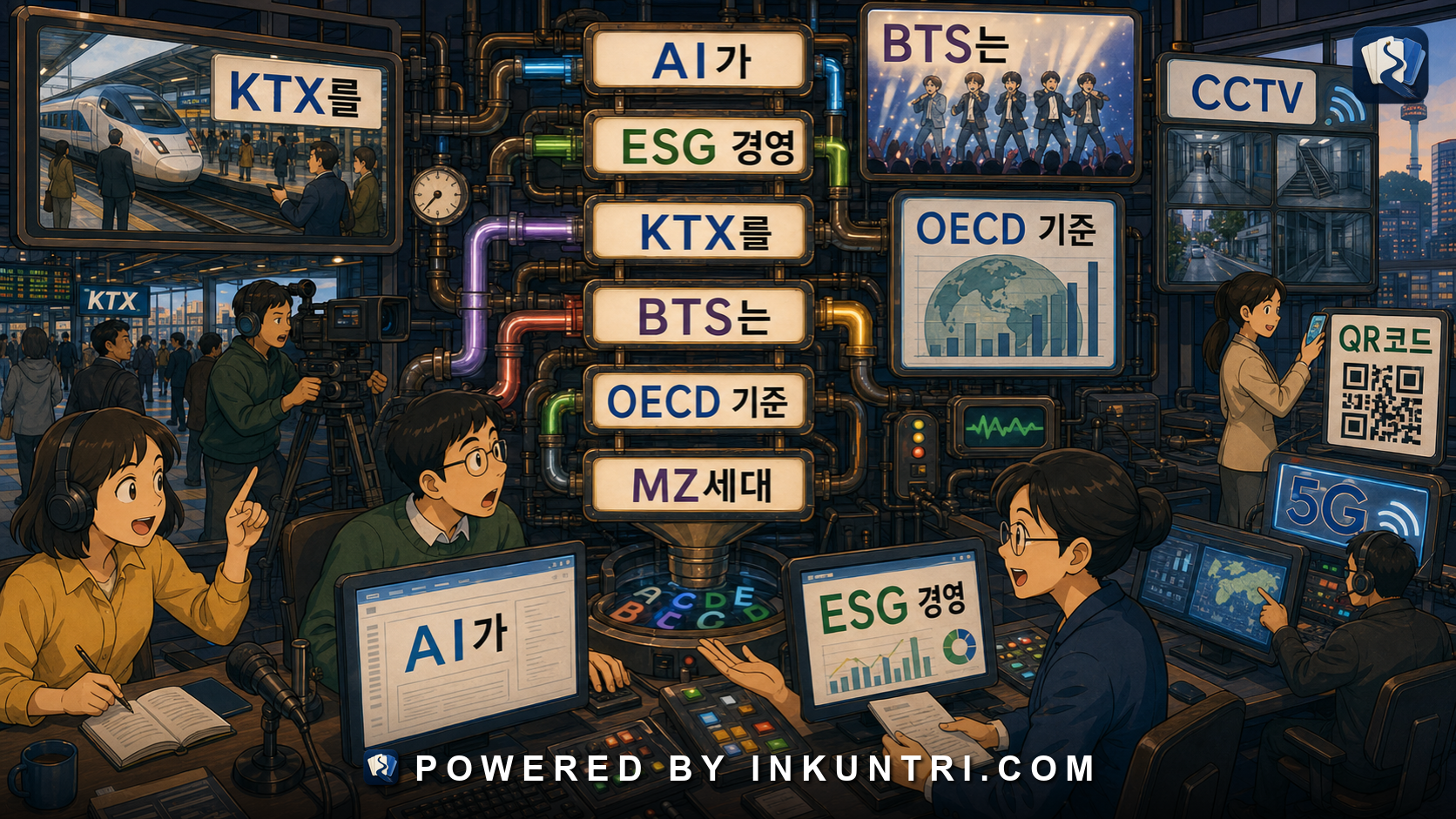
Core examples: AI가; ESG 경영; KTX를; BTS는; OECD 기준; MZ세대; CCTV; QR코드.
Korean text is often not purely Hangul
A Korean sentence can be mostly Hangul and still contain AI, ESG, KTX, BTS, OECD, CCTV, QR, 5G, or MZ. Learners sometimes treat these Latin-letter blocks as interruptions, as if the Korean sentence briefly stops and English takes over.
That is not how Korean readers usually process them. Acronyms and initialisms can behave like Korean lexical items inside Korean grammar. They can take Korean particles, combine with Korean nouns, appear in headlines, form hybrid compounds, and carry domain-specific meanings.
Consider:
- AI가 만든 서비스
- ESG 경영
- KTX를 탔다
- BTS는 세계적으로 유명하다
- OECD 기준
- MZ세대
- QR코드
The non-Hangul element is not outside the sentence. It is part of the sentence architecture.
The particle attaches to the spoken form
One of the most important practical issues is particle choice. Korean particles often depend on whether the preceding spoken form ends in a consonant or vowel. With Latin-letter acronyms, the writer has to decide how the acronym is pronounced in Korean.
AI is normally read 에이아이, ending in a vowel-like sound. So AI가 is natural, not AI이. BTS is read 비티에스, ending in 스, which has no final batchim in Korean syllable structure. So BTS는 is natural. KTX is read 케이티엑스, ending in 스, so KTX를 is natural.
The visible Latin letter does not decide the particle by itself. The Korean reading does.
| Written form | Korean reading | Natural particle example |
|---|---|---|
| AI | 에이아이 | AI가, AI를 |
| ESG | 이에스지 | ESG가, ESG는 |
| KTX | 케이티엑스 | KTX가, KTX를 |
| BTS | 비티에스 | BTS는, BTS를 |
| QR | 큐알 | QR이, QR을 may appear when read as ending in ㄹ |
QR is a good caution case. If the Korean reading ends in 알, particle choice may follow that final ㄹ. Some forms vary with style and pronunciation assumptions, so checking real usage is better than guessing.
The safe rule is not “look at the final English letter.” It is: say the item the way Korean readers in that domain usually say it, then choose the particle by the Korean sound. When the acronym is unfamiliar, search real Korean examples before imitating it in published writing.
Acronyms carry domains
Acronyms are not just sound blocks. They identify domains.
AI belongs to technology, education, business, policy, and media. ESG belongs to business, investing, corporate responsibility, and public institutions. KTX belongs to transportation. BTS belongs to entertainment and global culture. OECD belongs to policy, economics, education, and comparative statistics. CCTV belongs to safety, surveillance, buildings, and public notices. QR코드 belongs to apps, payment, menus, tickets, and forms.
When you meet an acronym, first identify the domain. That often tells you whether it should be read letter by letter, expanded into a Korean phrase, treated as a brand, or understood as a fixed hybrid word.
Hybrid compounds are normal
Korean freely combines Latin letters with Hangul nouns:
- AI 기술
- ESG 경영
- KTX 승차권
- BTS 팬
- OECD 국가
- MZ세대
- CCTV 설치
- QR코드
Some compounds are transparent. QR코드 is a code associated with QR. CCTV 설치 means installation of CCTV. Others become social labels. MZ세대 refers to a generational category in Korean discourse and does not behave exactly like a neutral English acronym.
The learner’s job is to treat the whole compound as Korean usage, not as an English phrase pasted into Korean.
Pronunciation may be letter-by-letter, Koreanized, or branded
Many acronyms are read as English-style letter names adapted into Korean: AI as 에이아이, ESG as 이에스지, OECD as 오이시디 or 오이씨디-like forms depending on speaker and convention. Some names have official brand pronunciations. Some are read as a Koreanized word if they are lexicalized.
Do not assume that knowing English pronunciation solves the Korean reading. Korean speakers read these forms inside Korean phonology and Korean discourse.
Acronyms in news and business writing
News and business Korean often uses acronyms for compression. A headline may say AI 규제, ESG 공시, OECD 전망, or MZ 소비. These are not casual shortcuts; they are part of formal domain language.
That means acronyms can raise the register of a text rather than lower it. A business report full of ESG, KPI, ROI, and AI may be more formal, not less. A learner who skips acronyms as “English bits” may miss the main topic of the paragraph.
Acronyms in public space
Public signs use acronyms when the Latin-letter form is more recognizable than a Korean expansion:
- CCTV 작동 중
- QR코드 스캔
- KTX 승강장
- Wi-Fi 이용 가능
These signs are excellent reading practice because they show how Korean particles, nouns, and instructions wrap around non-Hangul elements.
A learner workflow: acronym-reading routine
Use this routine:
- Identify the acronym or initialism.
- Identify its domain: tech, transport, entertainment, policy, business, safety, or everyday service.
- Decide whether it is read letter-by-letter, as a brand, or as a hybrid Korean word.
- Attach particles by the Korean spoken ending, not by English spelling.
- Look for a following Korean noun that completes the compound: 경영, 기준, 세대, 코드, 설치, 서비스.
- If the acronym is central to the text, learn the compound as a unit.
Mini practice: parse the hybrid phrase
| Phrase | Domain | What to notice |
|---|---|---|
| AI가 만든 서비스 | technology | AI takes 가 as a Korean subject-like noun |
| ESG 경영 | business | acronym modifies a Korean noun |
| KTX를 탔다 | transport | object particle follows Korean reading |
| BTS는 유명하다 | entertainment | topic particle attaches to the acronym block |
| OECD 기준 | policy/statistics | acronym names an institution or comparison frame |
| MZ세대 | social discourse | fixed hybrid label, not just English letters |
| CCTV 설치 | safety/building | Latin block plus Sino-Korean noun |
| QR코드 | digital service | hybrid compound often treated as one item |
Suggested functions:
- Acronym detector: highlights Latin-letter blocks inside Korean text.
- Pronunciation layer: shows likely Korean reading.
- Particle helper: predicts 은/는, 이/가, 을/를 based on spoken ending.
- Domain tag: labels technology, policy, entertainment, transport, business, or public safety.
- Compound builder: shows how the acronym combines with Korean nouns.
Final rule
Do not treat English-letter acronyms in Korean as foreign debris. Treat them as Korean sentence material.
Read the acronym, decide its Korean pronunciation, attach the particle by sound, and learn the hybrid compound in its domain.
Related reading
When CJK Comparison Helps Korean Learners and When It Becomes Noise
The reader can decide when Chinese/Japanese comparison accelerates Korean learning and when it creates false friends, grammar transfer, register mistakes, or institutional confusion.
Language Policy, Standardization, and Spacing Rules in Korea
The reader can understand Korean correctness debates as interactions among official norms, dictionaries, school practice, actual usage, and genre.
Sino-Korean Character Families Without Requiring Full Hanja Literacy
The reader can build Sino-Korean word families from recurring syllables without requiring full Hanja literacy.
Color Words in Korean: Tradition, Marketing, and Politics
The reader can classify Korean color words as literal description, traditional symbolism, political label, marketing style, or fixed expression.
Hanja Beneath Hangul: The Hidden Sino-Korean Layer
The reader can recognize the Sino-Korean layer behind Hangul words without needing to become a full Hanja reader on day one.
Hangul Typography: Fonts, Blocks, Line Breaks, and Digital Design
The reader can notice how Hangul typography affects legibility, tone, branding, and digital reading.