
Why Some Chinese Characters Have Multiple Pronunciations
The reader understands 多音字 as a normal outcome of history, grammar, meaning, and lexicalization rather than random exceptions.
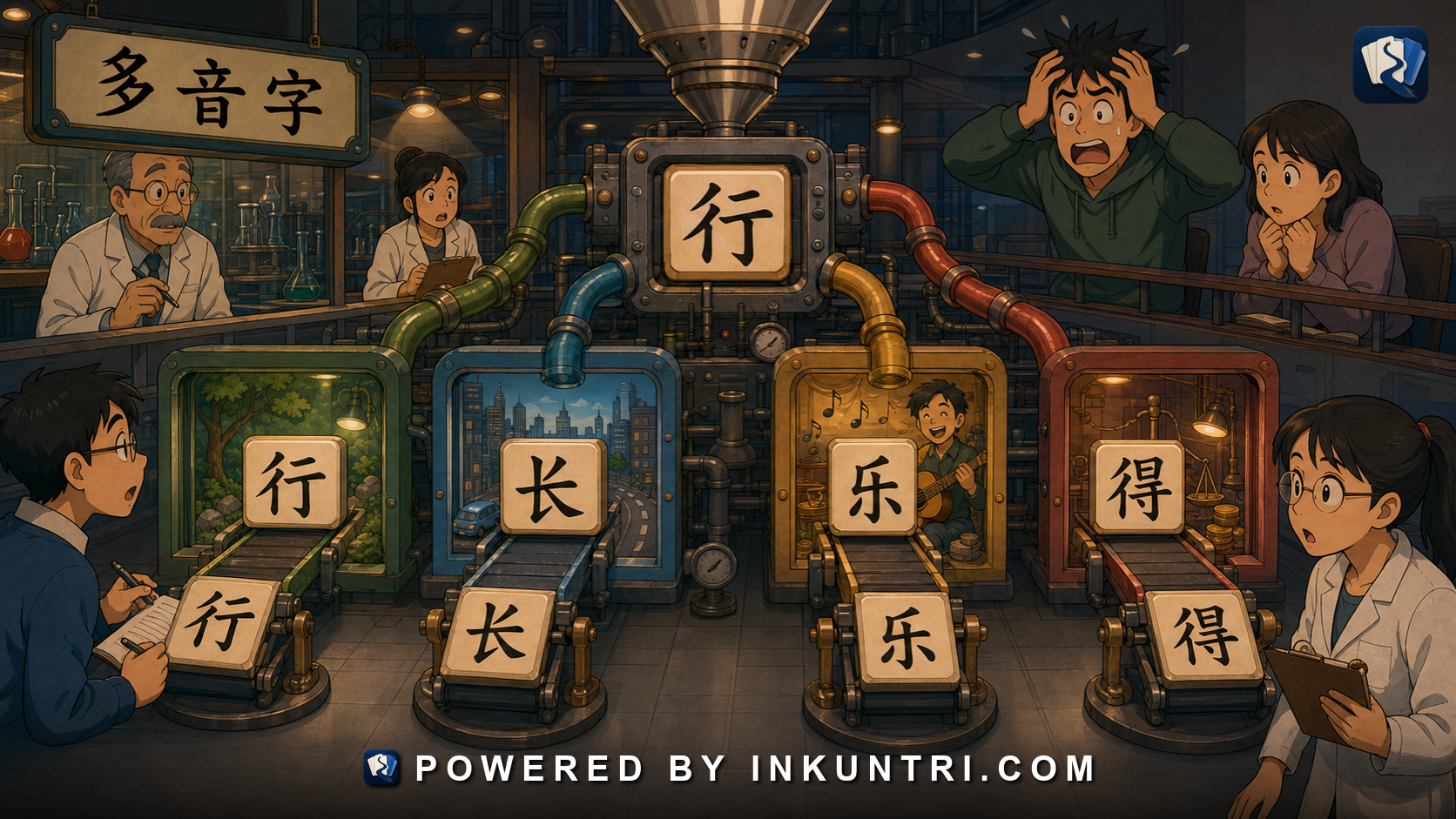
Core examples: 行 háng/xíng, 长 cháng/zhǎng, 乐 lè/yuè, 重 zhòng/chóng, 好 hǎo/hào, 还 hái/huán, 得 de/dé/děi.
The problem is real, but it is not random
Sooner or later, every serious Chinese learner meets a character that refuses to behave.
You learned 行 as xíng in 不行, 行走, and 可以吗?行。Then 银行 appears, and suddenly the same written form is pronounced háng. You learned 长 as cháng in 长城 and 长短, then 长大 and 校长 force zhǎng. You learned 乐 as lè in 快乐, then 音乐 is yuè. You learn 得 as de in 跑得快, then 得到 is dédào, and 我得走了 is děi zǒu le.
At first this feels like a trap. The character looks the same. Why should the sound change?
The answer is that a Chinese character is not always one word. A character is a written unit. It may write more than one word, more than one morpheme, or more than one historically related meaning. When those meanings, words, or grammatical functions have different pronunciations, the same written character can carry different readings.
That is the basic logic of 多音字: characters with multiple pronunciations.
The beginner’s mistake is to treat 多音字 as a list of exceptions. The stronger approach is to ask three questions:
- What word is this character part of?
- What meaning or grammatical function does it have here?
- Is this reading attached to a stable word family?
Pronunciation is not chosen by staring harder at the character. It is chosen by reading the word.
What counts as 多音字
A 多音字 is a character that has more than one accepted pronunciation in a given standard or dictionary system.
For Mandarin learners, that usually means more than one standard Mandarin reading. For example:
| Character | Reading | Common use |
|---|---|---|
| 行 | xíng | to walk; to do; okay; conduct; feasible |
| 行 | háng | line; row; trade; profession; bank-related compounds |
| 长 | cháng | long; length; lasting |
| 长 | zhǎng | to grow; chief; elder |
| 乐 | lè | happy; enjoy; pleasure |
| 乐 | yuè | music |
| 重 | zhòng | heavy; important; serious |
| 重 | chóng | again; repeat; layer |
| 好 | hǎo | good; well; fine |
| 好 | hào | to like; to be fond of; prone to |
| 还 | hái | still; also; yet |
| 还 | huán | to return; give back |
| 得 | de | structural particle after a verb/adjective |
| 得 | dé | to get; obtain; result in |
| 得 | děi | must; have to, colloquial |
This is different from tone sandhi. In 你好, the first third tone is pronounced with a second-tone-like contour because of the following third tone. But 你 is still underlyingly nǐ. That is a pronunciation adjustment caused by neighboring tones, not a separate dictionary reading.
It is also different from regional accent. A speaker from one region may pronounce certain initials or finals differently from a speaker from another region, but that does not automatically make the character a 多音字 in standard Mandarin.
It is also different from ordinary speed reduction. In fast speech, a particle may become lighter, shorter, or less clear. That is not the same as a character having a separate lexical reading.
A useful learner definition is this:
多音字 = same written character + different dictionary readings + readings tied to words, meanings, or grammatical functions.Characters are written units, not pronunciation promises
The reason 多音字 feels strange to English speakers is that English letters and Chinese characters make different kinds of promises.
An English word like read can also have two pronunciations: present-tense read and past-tense read. The spelling stays the same, but grammar tells you which sound to use. English has many cases like this: lead the verb and lead the metal, wind the noun and wind the verb, minute the time unit and minute meaning tiny.
Chinese characters create a different but related problem. A character can write several words or morphemes that later became graphically identical. The writing system preserves one visible form, while spoken language keeps distinctions in sound.
So 多音字 are not evidence that Chinese is chaotic. They are evidence that writing and speech do not map one-to-one.
That same principle appears all over Chinese literacy:
- one character may be one word: 人 rén, 马 mǎ, 水 shuǐ
- one character may be a bound morpheme that usually appears inside words: 语 yǔ in 语言, 汉语
- two characters may form one ordinary word: 学校 xuéxiào, 经济 jīngjì
- one character may write several different words or functions: 得 de/dé/děi, 行 xíng/háng
When the word changes, the reading may change.
Source 1: different words share a character
The cleanest source of multiple pronunciations is simple: different words are written with the same character.
Take 行.
In one family, 行 is connected with movement, action, conduct, feasibility, or being acceptable:
| Word | Pronunciation | Meaning |
|---|---|---|
| 行走 | xíngzǒu | to walk; move on foot |
| 行为 | xíngwéi | behavior; conduct |
| 可行 | kěxíng | feasible |
| 不行 | bù xíng | not okay; will not work |
| 旅行 | lǚxíng | travel |
| 行人 | xíngrén | pedestrian |
In another family, 行 is connected with lines, rows, trades, industries, and institutions:
| Word | Pronunciation | Meaning |
|---|---|---|
| 银行 | yínháng | bank |
| 行业 | hángyè | industry; trade |
| 行情 | hángqíng | market situation; quotation |
| 行家 | hángjiā | expert; insider |
| 一行字 | yì háng zì | one line of characters |
| 同行 | tóngháng | person in the same trade; colleague in the same line |
The character did not “decide” to change pronunciation in 银行. 银行 is a word. The word uses the háng reading.
This is why flashcard decks that show only isolated characters can mislead learners. A card that says 行 = xíng is not wrong, but it is incomplete. 行 is better learned through word families.
Source 2: meaning splits
Sometimes the reading changes with a meaning distinction that is easy to describe.
长 is the best beginner example.
When 长 means long, length, or lasting over time, it is usually cháng:
| Word | Pronunciation | Meaning |
|---|---|---|
| 长短 | chángduǎn | length; long and short |
| 长城 | Chángchéng | the Great Wall |
| 长江 | Cháng Jiāng | the Yangtze River |
| 长期 | chángqī | long-term |
| 长时间 | cháng shíjiān | a long time |
When 长 means grow, develop, chief, senior person, or elder, it is usually zhǎng:
| Word | Pronunciation | Meaning |
|---|---|---|
| 长大 | zhǎngdà | to grow up |
| 生长 | shēngzhǎng | to grow; growth |
| 成长 | chéngzhǎng | to mature; grow up |
| 校长 | xiàozhǎng | school principal |
| 家长 | jiāzhǎng | parent; guardian |
| 长辈 | zhǎngbèi | elder; senior generation |
This distinction is not random. It is semantically organized. The learner’s job is not to ask “what sound does 长 have?” The better question is: “Is this the length family or the growth/leader family?”
Source 3: grammar changes the reading
得 is a grammar-heavy 多音字. It is not just a meaning split. Its readings are tied to different functions.
| Function | Reading | Examples | Learner note |
|---|---|---|---|
| Structural particle after a verb/adjective | de | 跑得快, 说得清楚, 高兴得很 | Often unstressed; marks degree, manner, or result. |
| Lexical verb meaning get/obtain/result in | dé | 得到, 得分, 获得, 得意 | Full tone; part of ordinary words. |
| Colloquial modal meaning must/have to | děi | 我得走了, 你得小心 | Full tone; common in speech. |
Compare:
他说得很清楚。
Tā shuō de hěn qīngchu.
He speaks very clearly.
Here 得 is a structural particle. It sits after the verb and introduces a complement.
他得到了一个机会。
Tā dédào le yí gè jīhuì.
He got an opportunity.
Here 得 is part of 得到, a lexical verb.
我得先走。
Wǒ děi xiān zǒu.
I have to leave first.
Here 得 is a modal-like colloquial verb meaning “must” or “have to.”
This is why pronunciation belongs to sentence analysis. If you do not know what job 得 is doing, you cannot reliably pronounce it.
Source 4: word families and lexicalization
Some readings are not easy to predict from a broad meaning alone because the reading is locked into particular words.
乐 has a clear split for learners:
| Reading | Word family | Examples |
|---|---|---|
| lè | happiness, pleasure, enjoyment | 快乐, 乐观, 乐意, 可乐 |
| yuè | music | 音乐, 乐器, 乐队, 民乐, 乐谱 |
That looks clean. But the practical method is still word-based. You do not see 乐 and reason from first principles every time. You learn 快乐 as kuàilè and 音乐 as yīnyuè.
重 also looks mostly clean:
| Reading | Word family | Examples |
|---|---|---|
| zhòng | heavy, important, serious, emphasis | 重要, 重量, 重点, 重视, 严重 |
| chóng | again, repeat, duplicate, layer | 重新, 重复, 重来, 重写, 重叠 |
But real text can compress clues. A headline may contain several 重 characters with different readings:
重庆重新发布重要通知。
Chóngqìng chóngxīn fābù zhòngyào tōngzhī.
Chongqing reissued an important notice.
Three appearances of 重, two readings:
| Form | Word | Reading | Why |
|---|---|---|---|
| 重 | 重庆 | Chóng | place name |
| 重 | 重新 | chóng | again |
| 重 | 重要 | zhòng | important |
The character alone cannot solve the sentence. The words solve it.
Source 5: literary and colloquial readings
Some 多音字 preserve older distinctions between literary and colloquial readings, or between formal compounds and everyday speech.
A classic example is 薄:
| Word | Common reading | Meaning/use |
|---|---|---|
| 薄片 | báo piàn | thin slice; everyday adjective use |
| 薄纸 | báo zhǐ | thin paper |
| 薄弱 | bóruò | weak; formal compound |
| 淡薄 | dànbó | thin/weak/faint; formal compound |
| 薄荷 | bòhe | mint, fixed word |
Another useful example is 剥:
| Word | Reading | Use |
|---|---|---|
| 剥皮 | bāo pí | peel skin; often colloquial action |
| 剥花生 | bāo huāshēng | shell peanuts |
| 剥削 | bōxuē | exploit; formal compound |
| 剥夺 | bōduó | deprive; formal compound |
Learners do not need to master the historical story behind every case at the beginning. But they should recognize the pattern: formal compounds, colloquial verbs, fixed words, and inherited readings may diverge.
The practical rule is simple:
When a character has several readings, memorize high-frequency words under each reading.Do not memorize “薄 = báo/bó/bò” as a naked fact and call the job done. Learn 薄片, 薄弱, 薄荷.
Source 6: names and proper nouns
Proper nouns can preserve readings that ordinary vocabulary does not make obvious.
重庆 is Chóngqìng. 乐山 is Lèshān. 长安 is Cháng’ān. Some surnames, place names, and historical names preserve established readings that are not chosen by general learner rules.
This matters because names often appear without much context:
重庆市
乐山市
长安区
单县
尉迟
A learner may not be able to infer the reading from grammar. The correct move is to look it up as a name.
The same advice applies to personal names. Some name characters have rare or special readings, and families may have established pronunciations. For respectful use, ask or verify rather than guessing.
Do not confuse 多音字 with one-character-many-tones caused by context
Mandarin also has predictable pronunciation changes that are not usually listed as separate lexical readings.
The most important are:
| Phenomenon | Example | What changes | Why it is different from 多音字 |
|---|---|---|---|
| Third-tone sandhi | 你好 nǐ hǎo → ní hǎo in flow | contour of 你 | The dictionary reading remains nǐ. |
| 不 tone change | 不去 bú qù, 不好 bù hǎo | tone of 不 before fourth tone | Predictable sandhi; not a separate word meaning. |
| 一 tone change | 一个 yí gè, 一天 yì tiān | tone of 一 by environment | Predictable sandhi and rhythm. |
| Neutral tone | 妈妈 māma, 朋友 péngyou | loss of full tone on second syllable | Often word-specific, but not the same as unrelated lexical readings. |
In practice, learners still have to pronounce these correctly. But for reading, it helps to keep categories clean:
- 多音字: dictionary readings tied to words, meanings, or grammar
- sandhi: predictable adjustment in connected speech
- neutral tone: unstressed syllable behavior, often lexicalized
- accent variation: regional pronunciation difference
When you mix these categories, Mandarin starts to feel more chaotic than it is.
Learn words, not isolated pronunciation menus
A common classroom handout lists 多音字 like this:
行 háng / xíng
长 cháng / zhǎng
重 chóng / zhòng
乐 lè / yuè
That is useful only as an index. It is not enough for reading.
A stronger learner notebook looks like this:
行 xíng family:
- 不行 bù xíng = not okay
- 行走 xíngzǒu = walk
- 行为 xíngwéi = behavior
- 可行 kěxíng = feasible
- 旅行 lǚxíng = travel

行 háng family:
- 银行 yínháng = bank
- 行业 hángyè = industry
- 行家 hángjiā = expert
- 一行字 yì háng zì = one line of characters
This format does three things at once:
- It ties sound to words.
- It ties words to meaning families.
- It reduces the need to guess in live reading.
The goal is not to memorize every possible reading of every character. The goal is to build fast recognition for the readings that appear in real text.
A workflow for reading 多音字
When you meet a character with more than one possible reading, use this workflow.
Step 1: Segment the word
Do not choose the pronunciation character by character. First identify the word.
音乐很好听。Segment:
音乐 / 很 / 好听Now 乐 is part of 音乐, so it is yuè.
他今天很快乐。Segment:
他 / 今天 / 很 / 快乐Now 乐 is part of 快乐, so it is lè.
Step 2: Identify the meaning family
Ask what the word means in context.
这个箱子很重。重 describes physical heaviness. Read zhòng.
请重新填写。重新 means again, anew. Read chóng.
Step 3: Check grammar
For characters like 得, grammar is decisive.
跑得快得 introduces a complement. Read de.
得到了得 is part of 得到. Read dé.
得走了得 means have to. Read děi.
Step 4: Confirm in a dictionary
Do not treat your guess as a fact. Confirm the word in a dictionary or reader tool, especially when reading aloud, teaching, recording, or handling names.
Digital tools are useful here, but they can still mis-segment text. If a tool gives a surprising reading, check the word boundary.
Step 5: Record the word, not just the character
Your vocabulary note should be:
银行 yínháng = bank
行业 hángyè = industry
行走 xíngzǒu = to walk
not only:
行 = háng/xíngThe first note helps you read. The second note helps you remember that a problem exists.
High-frequency mini-reference
This table is not a full dictionary. It is a learner triage list: common characters whose alternate readings appear often enough to deserve early attention.
| Character | Reading | Common words | Quick rule |
|---|---|---|---|
| 行 | xíng | 不行, 可行, 行为, 行走, 旅行, 行人 | action, movement, feasibility, okay |
| 行 | háng | 银行, 行业, 行家, 一行字, 同行 | line, row, trade, profession, bank |
| 长 | cháng | 长城, 长短, 长期, 长江, 长时间 | long, length, lasting |
| 长 | zhǎng | 长大, 生长, 成长, 校长, 家长 | grow, chief, elder |
| 乐 | lè | 快乐, 乐观, 乐意, 可乐 | happy, pleasure, enjoyment |
| 乐 | yuè | 音乐, 乐器, 乐队, 乐谱, 民乐 | music |
| 重 | zhòng | 重要, 重量, 重点, 重视, 严重 | heavy, important, serious |
| 重 | chóng | 重新, 重复, 重来, 重写, 重叠 | again, repeat, layer |
| 好 | hǎo | 好人, 很好, 好吃, 好看 | good, well, positive quality |
| 好 | hào | 好学, 好奇, 爱好, 好客 | to like, be fond of, be inclined to |
| 还 | hái | 还有, 还是, 还没, 还可以 | still, also, yet |
| 还 | huán | 还书, 还钱, 归还, 还给 | return, give back |
| 得 | de | 跑得快, 说得好, 累得不行 | structural particle |
| 得 | dé | 得到, 获得, 得分, 得意 | get, obtain, result |
| 得 | děi | 我得走, 你得小心 | must, have to |
| 只 | zhī | 一只猫, 船只 | classifier for animals/objects; vessel in formal use |
| 只 | zhǐ | 只有, 只是, 只要 | only, merely |
| 为 | wéi | 认为, 成为, 以为, 作为 | act as, become, think as |
| 为 | wèi | 为了, 因为, 为人民服务 | for, because of, on behalf of |
| 地 | dì | 土地, 地方, 地铁, 地面 | ground, place, earth |
| 地 | de | 慢慢地说, 高兴地笑 | adverbial particle in standard writing |
Notice the pattern: most entries are word families, not isolated sound labels.
What learners should not do
Do not assume the first dictionary pronunciation is always right in every word. Dictionaries usually list multiple readings, but the word entry decides the reading.
Do not use Pinyin input candidate order as proof. Input methods are frequency-based and context-sensitive. They are not pronunciation teachers.
Do not pronounce every occurrence of a character with the reading you learned first. That habit is especially dangerous with 行, 长, 重, 乐, 得, 好, 为, and 还.
Do not overcorrect. Once you learn that 多音字 exist, you may start doubting every common character. Most characters in a normal sentence are not ambiguous for pronunciation once you know the word. The aim is alertness, not paranoia.
Do not build giant isolated-character lists without example words. They feel productive, but they do not train the real skill.
What to remember
多音字 are not random traps. They are normal consequences of a writing system in which one character can represent different words, meanings, and grammatical functions.
The reading is usually determined by the word, not by the character alone. That is why the best learning unit is the word family:
快乐 lè, 音乐 yuè
重要 zhòng, 重新 chóng
长城 cháng, 长大 zhǎng
银行 háng, 行走 xíng
When in doubt, segment first, identify the meaning or function, confirm in a dictionary, and save the example as a word. Serious readers do not defeat 多音字 by memorizing panic lists. They defeat them by learning how characters behave inside real words.
Build a radical/function heat map repurposed as a polyphonic character map.
User flow
The user clicks a character such as 行.
The display shows pronunciation clusters:
行
├── xíng: 行走, 行为, 旅行, 不行, 可行, 行人
└── háng: 银行, 行业, 行家, 一行字, 同行
Each cluster includes:
- Pinyin and audio
- word examples
- meaning-family label
- sentence examples
- “common trap” warning
Sentence mode
The user sees a sentence:
他在银行工作。The system asks:
How do you read 行 here?The user chooses xíng or háng. The tool then reveals:
银行 = yínháng = bank. 行 belongs to the bank/trade/line family here.Good design principle
Do not show pronunciations as a flat menu only. Show them as clusters of words. The tool should train the learner to ask “which word is this?” before “which sound is this?”
For production fact-checking, consult:
- 国家语委科研网, 《普通话异读词审音表》查询: https://gf.ywky.edu.cn/yi_du_ci
- 全国标准信息公共服务平台, GB/T 16159-2012《汉语拼音正词法基本规则》: https://std.samr.gov.cn/gb/search/gbDetailed?id=71F772D7E196D3A7E05397BE0A0AB82A
Related reading
Influencer Commerce Vocabulary in Mandarin
The reader can understand Chinese influencer-commerce language across live streams, product promotion, affiliate links, commissions, and buyer claims.
Memes, Homophones, and Political Caution in Chinese Online Culture
The reader can understand how Chinese online users use homophones, euphemisms, abbreviations, and layered jokes to manage sensitivity, moderation, and community recognition.
Chinese Characters Abroad: Hanzi, Kanji, Hanja, and the Shared Scriptworld
The reader understands the shared character tradition across China, Japan, and Korea while respecting each language’s independent grammar, pronunciation, and history.
Designing Chinese Anki Cards for Words, Characters, and Collocations
The reader can design Chinese flashcards that train recognition, pronunciation, meaning, collocation, character form, and contextual use without turning review into trivia.
When a Character Is Also a Word: 字, 词, and the Limits of English Categories
The reader stops equating “character” with “word” and learns to think in terms of characters, morphemes, words, and compounds.
How Punctuation Changed Modern Written Chinese
The reader understands modern Chinese punctuation as a historical layer that reshaped reading rhythm, sentence structure, and translation.