
When a Character Is Also a Word: 字, 词, and the Limits of English Categories
The reader stops equating “character” with “word” and learns to think in terms of characters, morphemes, words, and compounds.
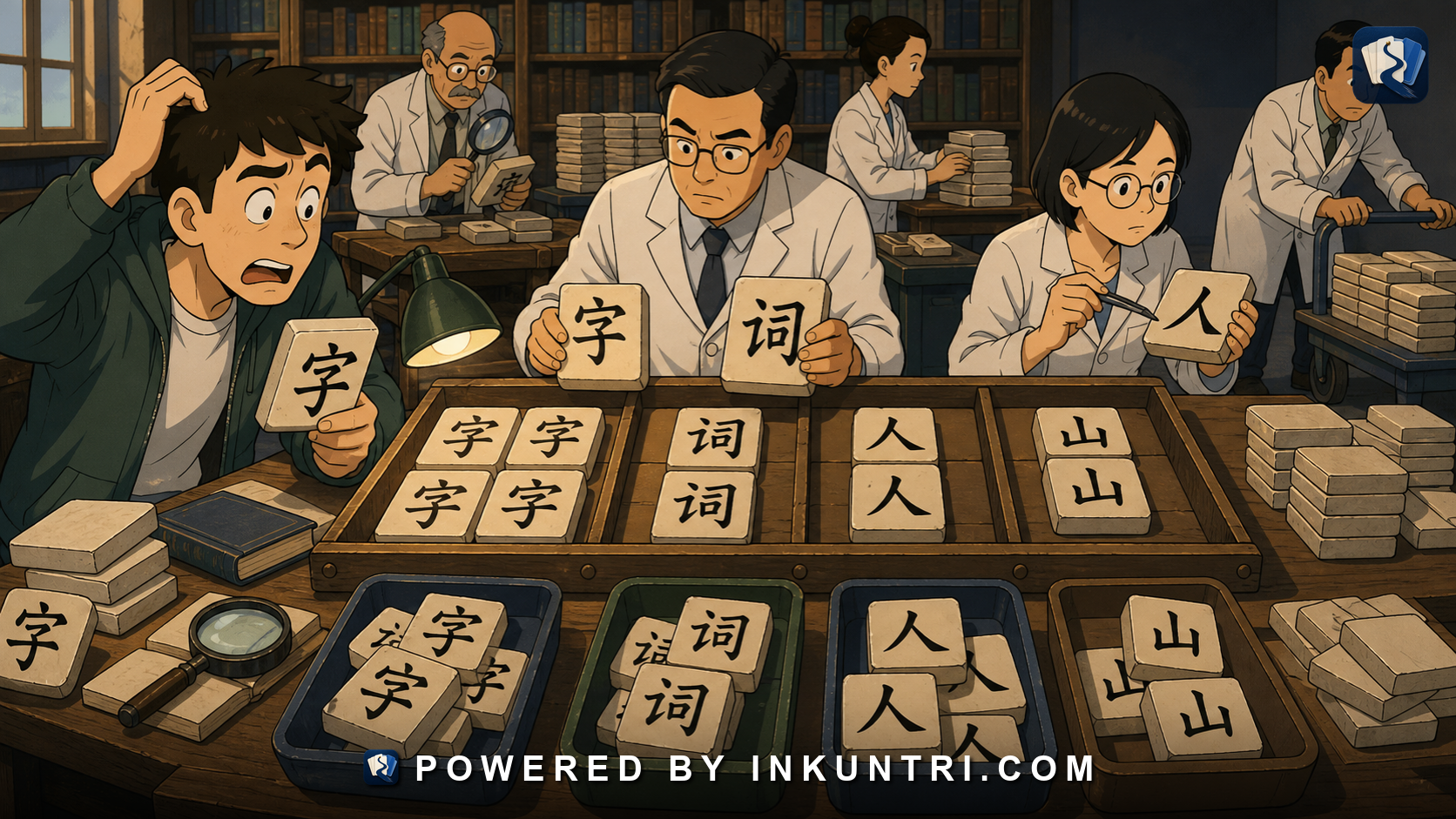
Core examples: 人, 马, 学, 语, 语言, 学校, 葡萄, 玻璃, 经济, 共和国.
The beginner mistake that never quite goes away
A beginner opens a Chinese textbook and sees a page of characters with no spaces between words. English has letters and words. Chinese has characters. It is tempting to line up the categories like this:
- English letter = Chinese character
- English word = Chinese character or maybe Chinese word
Both analogies break.
A Chinese character is not like an English letter. The character 人 is not a small sound fragment like the letter r. It has a pronunciation, rén, and a meaning, “person.” The character 山 has a pronunciation, shān, and a meaning, “mountain.” Many characters are tied to morphemes, the smallest meaningful units of language.
But a Chinese character is also not automatically a word. The word 学校 means “school” and is written with two characters, 学 and 校. The word 语言 means “language” and is written with two characters, 语 and 言. The word 葡萄 means “grape” and is written with two characters whose individual modern meanings are not useful to most readers. The word 共和国 means “republic” and is written with three characters.
So the first rule is:
A character is a written unit. A word is a lexical unit. Sometimes they match. Often they do not.
Chinese literacy becomes much clearer once you stop asking “What does this character mean as a word?” every time and start asking a better set of questions:
- Is this a character?
- Is it a morpheme?
- Can it stand alone as a word?
- Is it bound inside compounds?
- Is the full word more important than the parts?
字 and 词 are different categories
The Chinese term 字 usually refers to a written character. When someone asks 这个字怎么读? they are asking “How do you read/pronounce this character?” When a teacher says 这个字写错了, they mean “This character is written incorrectly.”
The term 词 refers to a word or lexical item. 词语 means words and expressions. 词典 is a word dictionary. When someone asks 这个词是什么意思? they are asking “What does this word mean?”
The distinction matters because Chinese text is written as a continuous sequence of characters, not as a sequence of words separated by spaces. Readers must identify word boundaries from knowledge of vocabulary, grammar, and context.
Consider this sentence:
我在学校学汉语。 Wǒ zài xuéxiào xué Hànyǔ. I study Chinese at school.
Character by character:
我 | 在 | 学 | 校 | 学 | 汉 | 语
Word by word:
我 | 在 | 学校 | 学 | 汉语
The character 学 appears twice. In 学校, it is part of the word “school.” In 学, it is a verb meaning “to study/learn.” The character 语 appears inside 汉语, the word “Chinese language.” A character-level reading is useful, but it is not enough. You need word segmentation.
Four units learners should keep separate
A practical learner needs four categories.
1. Character
A character is a written graph: 人, 马, 学, 语, 国, 书, 爱.
Characters are visible units. You can count them in a sentence. You can write them in boxes. You can look them up by radical, stroke count, handwriting input, pronunciation, or copy-paste.
But “visible unit” does not mean “word.”
2. Syllable
In modern Mandarin, most characters correspond to one syllable in a given reading: 人 rén, 马 mǎ, 学 xué, 语 yǔ. Some characters have multiple pronunciations depending on the word, such as 行 háng/xíng or 乐 lè/yuè.
The character-syllable relationship is strong in Mandarin, but it is not the same as the character-word relationship. A two-character word is usually two syllables. That does not make it two separate words.
3. Morpheme
A morpheme is the smallest unit of meaning. Many Chinese characters represent morphemes. 人 means person. 马 means horse. 学 can mean study/learning. 国 can mean country. 语 can mean language/speech in many compounds.
Some morphemes can stand alone. Others are bound: they normally appear inside larger words.
4. Word
A word is a unit of use in the language. It is what you store, retrieve, pronounce, and combine in actual communication.
A word may be one character:
- 人 — person
- 马 — horse
- 书 — book
- 学 — to study/learn, in many contexts
- 来 — to come
- 去 — to go
A word may be two characters:
- 学校 — school
- 语言 — language
- 朋友 — friend
- 经济 — economy
- 玻璃 — glass
- 葡萄 — grape
A word may be three or more characters:
- 共和国 — republic
- 图书馆 — library
- 研究生 — graduate student
- 现代化 — modernization
Once you understand this, Chinese stops looking like a wall of “word-characters.” It becomes a string of characters that must be grouped into words.
When one character is a word
Some characters can function as independent words in ordinary modern Mandarin.
人 rén can mean “person” or “people”:
这里人很多。 There are many people here.
马 mǎ can mean “horse”:
他喜欢马。 He likes horses.
书 shū can mean “book”:
我买了一本书。 I bought a book.
水 shuǐ can mean “water”:
我要喝水。 I want to drink water.
In these cases, character, syllable, morpheme, and word line up neatly. That neat alignment is real. It is just not universal.
A beginner who learns 人 = person is not wrong. The mistake is assuming that all characters behave like 人.
When a character is a morpheme but not usually a standalone word
Many characters are meaningful but normally appear inside compounds.
Take 语. It relates to speech or language and appears in words like:
- 语言 — language
- 汉语 — Chinese language
- 英语 — English language
- 语法 — grammar
- 口语 — spoken language
Can 语 appear alone? Yes, in certain literary, formal, technical, or compressed contexts. But for ordinary learners, it is more useful to treat it as a productive morpheme that helps build words.
The same is true of many characters that carry meaning but are not the natural standalone word in everyday speech. They are not meaningless; they are not independent in the same way as 人 or 水 either.
This is one reason character study helps. If you know that 语 is associated with language/speech, then 汉语, 英语, 语法, 口语, and 外语 become easier to connect. But if you try to speak by assembling character meanings mechanically, you will sound unnatural.
When the word is more important than the character meanings
Some words are made of characters whose individual meanings do not help much in modern Mandarin.
葡萄 means grape. Most learners should not try to interpret 葡 and 萄 separately. In modern everyday use, they function together as a word.
玻璃 means glass. Again, the word matters more than a character-by-character explanation.
These are sometimes compared to English words like cranberry, where cran does not function as an ordinary independent word in modern English. You can analyze the spelling historically, but you do not learn cranberry by treating cran and berry as equal modern building blocks.
Chinese has many words where the characters are best learned as part of a lexical unit. This is especially common with:
- transliterated or borrowed words,
- old compounds whose parts have shifted in meaning,
- words with bound morphemes,
- plant and animal names,
- technical terms,
- fixed expressions.
The practical rule is simple: when the character meanings do not give you a reliable modern meaning, learn the whole word first.
Compound words: where Chinese starts to feel powerful
Chinese uses compounds heavily. A compound word is built from meaningful parts, but the whole word is still a word.
学校 combines 学, associated with learning/study, and 校, associated with school/institution. The result is 学校, “school.”
语言 combines 语 and 言, both associated with speech/language, into the word “language.”
共和国 combines 共和 and 国 into “republic.” The character 国 means country/state, and 共和 relates to republican/shared governance. But a learner should still learn 共和国 as the standard word “republic,” not produce it from scratch every time.
经济 is especially useful as a warning. In modern Chinese, 经济 means economy, economic, or economical depending on context. Historically, the characters have older meanings connected to managing and ordering affairs, but modern learners should not rely on a naive breakdown to understand contemporary usage. 经济 is a word. Learn its modern meanings, collocations, and contexts: 经济发展, 经济学, 市场经济, 经济条件.
Characters give evidence. Words give usage.
Why English categories mislead
English trains readers to expect spaces between words and letters inside words. Because of that, English-speaking learners often want Chinese to provide a stable equivalent for “letter” and “word.”
But Chinese characters do several jobs that English letters do not:
- They usually represent syllables.
- They often represent morphemes.
- They carry visual component structure.
- They can sometimes stand alone as words.
- They can combine into compounds.
- They can be reused across large word families.
At the same time, Chinese words do not announce themselves with spaces. A reader must know that 学校 is one word in 我在学校学汉语, while 学 is a separate word later in the same sentence.
This is why beginners often produce strange translations. They read 飞机 as “fly machine” because 飞 means fly and 机 can mean machine. That analysis is not useless; it helps explain why 飞机 means airplane. But 飞机 is the word. In normal reading, you do not pause and rebuild it from “fly-machine” every time.
The English analogy should be replaced with a Chinese-aware model:
| Unit | What it means for learners | Example |
|---|---|---|
| Character | Written unit | 学 |
| Syllable | Pronounced unit in a word | xué |
| Morpheme | Meaning-bearing unit | 学 “study/learning” |
| Word | Unit of actual use | 学, 学校, 学生, 学习 |
| Compound | Multi-morpheme word | 学校, 语言, 共和国 |
Segmentation: the hidden skill in reading
Because Chinese is normally written without spaces, reading requires segmentation. Segmentation means deciding where the words are.
Take this sentence:
他在图书馆学习经济。 Tā zài túshūguǎn xuéxí jīngjì. He studies economics at the library.
Character sequence:
他 在 图 书 馆 学 习 经 济
Word segmentation:
他 | 在 | 图书馆 | 学习 | 经济
If you read character by character, 图 书 馆 looks like “picture-book-building,” 学 习 like “study-practice,” and 经 济 like whatever dictionary meanings you happen to find for 经 and 济. Those pieces have histories and patterns, but fluent reading groups them quickly into words.
Segmentation also matters for ambiguity. A character string may allow more than one grouping. Context usually resolves it, but computers, dictionaries, and learners can stumble.
For example:
我喜欢研究生活。
Depending on context, the middle can be grouped differently:
- 研究 | 生活 — to study life
- 研究生 | 活 — graduate students live / graduate student + live, in a different sentence frame
The sentence above is artificial without more context, but it illustrates the point: word boundaries are not printed for you. You infer them.
Dictionary use: character dictionary vs word dictionary
A common learner habit is to tap every unknown character in a dictionary app and collect individual meanings. That can help at first, but it becomes dangerous if it replaces word lookup.
Suppose you see 共和国.
A character lookup gives:
- 共 — together; common
- 和 — and; harmony
- 国 — country
That is interesting, but it does not give the word “republic” as cleanly as a word dictionary does. The unit you need is 共和国.
Suppose you see 玻璃.
A character lookup may not help much. You need the word: glass.
Suppose you see 学校.
Character lookup helps: 学 relates to learning, 校 to school/institution. But the word 学校 is still the unit to memorize.
Use this dictionary workflow:
- Try to identify the word, not only the character.
- Look up the whole word first.
- Then inspect characters if they recur in other words.
- Add character notes only when they help future vocabulary.
A dictionary is not just a machine for translating characters. It is a tool for discovering which strings are words.
Flashcards: why character-only decks fail
Character flashcards are seductive. One side shows 语. The other side says “language.” It feels clean.
But knowing 语 does not mean you can use 语言, 汉语, 英语, 语法, 口语, 外语, and 成语 correctly. It helps, but it is not enough.
For most learners, word cards should dominate. A good card teaches a usable unit:
- 语言 — language
- 汉语 — Chinese language
- 学校 — school
- 经济 — economy; economic
- 共和国 — republic
Character cards are useful when a character recurs across many words and gives you real leverage:
- 国 in 中国, 美国, 国家, 共和国, 国际
- 学 in 学校, 学生, 学习, 大学, 汉学
- 语 in 汉语, 英语, 语言, 语法, 口语
The best system combines both:
- Learn words as units of use.
- Learn characters as recurring evidence.
- Link characters to multiple real words.
- Avoid inventing meanings from isolated characters when the whole word is conventional.
Vocabulary acquisition: learn collocations, not just meanings
Words live with other words. 经济 is not just “economy.” It appears in patterns:
- 经济发展 — economic development
- 经济学 — economics
- 市场经济 — market economy
- 经济条件 — economic conditions
- 经济实惠 — economical; good value
语言 appears in patterns:
- 语言学习 — language learning
- 语言能力 — language ability
- 语言环境 — language environment
- 语言学 — linguistics
学校 appears in patterns:
- 去学校 — go to school
- 在学校 — at school
- 学校门口 — school entrance
- 中小学 — primary and secondary schools
A learner who only memorizes characters may know pieces but fail to recognize these word-level habits. A learner who only memorizes whole words may miss helpful character families. The goal is not to choose one. The goal is to give each unit the right job.
Three types of character-word relationship
A simple classification helps.
Type 1: Character = common standalone word
Examples:
| Character | Pinyin | Word meaning |
|---|---|---|
| 人 | rén | person; people |
| 马 | mǎ | horse |
| 水 | shuǐ | water |
| 书 | shū | book |
| 家 | jiā | home; family |
These are beginner-friendly because the character and word line up.
Type 2: Character = meaningful morpheme inside many words
Examples:
| Character | Meaning field | Words |
|---|---|---|
| 学 | learning/study | 学校, 学生, 学习, 大学 |
| 语 | language/speech | 语言, 汉语, 英语, 语法 |
| 国 | country/state | 中国, 美国, 国家, 共和国 |
| 电 | electricity/electronic | 电话, 电脑, 电影, 电梯 |
These are high-value characters. They help you build networks.
Type 3: Character mainly matters as part of a word
Examples:
| Word | Meaning | Learner note |
|---|---|---|
| 葡萄 | grape | Learn as a whole word. |
| 玻璃 | glass | Learn as a whole word. |
| 蝴蝶 | butterfly | Learn as a whole word. |
| 沙发 | sofa | Loanword; learn as a whole word. |
These characters may have historical explanations or occur in related words, but beginners should not force standalone meanings onto them.
Example bank walkthrough
人
人 is a character, a morpheme, and often a word. It appears alone and in compounds:
- 人 — person; people
- 人口 — population
- 人民 — people
- 工人 — worker
- 个人 — individual
Learner action: learn 人 as a standalone word and as a productive character in compounds.
马
马 can stand alone as “horse,” and it appears in words such as:
- 马上 — immediately; at once
- 马路 — road
- 马车 — horse cart
- 马力 — horsepower
Learner action: learn the standalone meaning, but do not assume every 马 word is literally about horses in modern usage. 马上 is not normally processed as “on a horse” in everyday Mandarin.
学
学 can be a verb “to study/learn,” and a morpheme in many words:
- 学 — to study
- 学习 — to study; learning
- 学校 — school
- 学生 — student
- 大学 — university
- 汉学 — Sinology / Chinese studies
Learner action: treat 学 as high-value. It is worth learning deeply because it explains many words.
语
语 is strongly associated with speech and language:
- 语言 — language
- 汉语 — Chinese language
- 英语 — English language
- 语法 — grammar
- 成语 — idiom
- 口语 — spoken language
Learner action: learn 语 as a productive morpheme, but learn its compounds as actual vocabulary.
语言
语言 is a word meaning “language.” The parts 语 and 言 both relate to speech, but the modern word is the unit you need.
Learner action: do not translate 语言 as “speech-speech.” Learn 语言 as “language.”
学校
学校 is the ordinary word for “school.” The characters are meaningful, but the word is conventional.
Learner action: learn 学校 as a word and use 学 to connect it with 学生, 学习, and 大学.
葡萄
葡萄 means “grape.” The individual characters are not useful standalone vocabulary for most modern learners.
Learner action: learn 葡萄 as one word. Do not over-analyze.
玻璃
玻璃 means “glass.” Like 葡萄, it should be learned as a whole word.
Learner action: add the word to vocabulary; do not build sentences from separate imagined meanings of 玻 and 璃.
经济
经济 means economy/economic/economical depending on context. The modern word is far more important than a naive character breakdown.
Learner action: learn collocations: 经济发展, 经济学, 市场经济, 经济条件.
共和国
共和国 means republic. It is analyzable, but it should still be learned as a word.
Learner action: learn the full political term and then notice 国 in related words such as 国家, 中国, 美国, 国际.
A practical rule for serious learners
Use this rule:
Learn characters as evidence. Learn words as units of use.
Characters are evidence because they tell you about recurring morphemes, visual structure, sound clues, semantic fields, and word families. Words are units of use because they are what you actually understand, say, write, search, translate, and remember in context.
When you meet a new item, ask:
- What is the whole word?
- Can the characters stand alone?
- Do the characters recur in other useful words?
- Is this a transparent compound or a word I should learn whole?
- What sentences does this word appear in?
This method prevents two common errors.
First, it prevents character atomization: breaking every word into pieces until the real word disappears. 飞机 becomes “fly machine,” 学校 becomes “study school,” and 经济 becomes a guessing game.
Second, it prevents word memorization without structure: learning hundreds of words as unrelated sounds and shapes when characters could have helped connect them.
You need both.
A strong visual tool for this article would show the same sentence at multiple levels.
Example sentence:
我在学校学汉语,也喜欢研究经济。 I study Chinese at school and also like studying economics.
Character view:
我 | 在 | 学 | 校 | 学 | 汉 | 语 | 也 | 喜 | 欢 | 研 | 究 | 经 | 济
Word view:
我 | 在 | 学校 | 学 | 汉语 | 也 | 喜欢 | 研究 | 经济
Morpheme notes:
- 学 appears in 学校 and as the verb 学.
- 汉语 is a word meaning Chinese language.
- 喜欢 is a two-character word meaning like.
- 研究 is a word meaning research/study.
- 经济 is a word meaning economy/economic.
Suggested functions:
- Toggle levels: character, morpheme, word, phrase.
- Heat map: mark characters that are common standalone words, productive bound morphemes, or mostly word-internal in modern use.
- Dictionary mode: click a word first, then inspect characters.
- Flashcard export: generate word cards with optional character-family notes.
- Ambiguity mode: show sentences where different segmentation changes meaning.
Final rule
Chinese characters are powerful because they often carry meaning. Chinese words are powerful because they carry actual usage.
Do not reduce characters to letters. Do not inflate every character into a word. Learn 字 as written units, 词 as lexical units, morphemes as meaning-bearing pieces, and compounds as words built from pieces.
When a character is also a word, enjoy the simplicity. When it is only part of a word, learn the word. When the parts help, use them. When the parts mislead, trust the whole.
That is the difference between collecting character meanings and actually reading Chinese.
These drafts are written as publication-ready educational articles rather than academic papers. The following references were consulted for technical sanity checks and example validation:
- 《简化字总表(1986年版)》, especially its description of simplified characters, simplified components, and component application scope.
- CJKI, “Chinese to Chinese Conversion,” especially examples of simplified-to-traditional one-to-many mappings such as 发 → 發/髮, 干 → 乾/幹/干, 面 → 麵/面, and 后 → 後/后.
- ChineseNLP documentation on Chinese word segmentation, especially the point that written Chinese lacks spaces between words and segmentation divides character sequences into word sequences.
- Giorgio Francesco Arcodia, “Chinese: A Language of Compound Words?”, for the broad issue of Mandarin compounding and disyllabic word formation.
- San Duanmu’s review of Jerome Packard’s The Morphology of Chinese, for the general linguistic point that Chinese morphemes often correspond to single orthographic characters while wordhood remains a separate morphological question.
Related reading
Influencer Commerce Vocabulary in Mandarin
The reader can understand Chinese influencer-commerce language across live streams, product promotion, affiliate links, commissions, and buyer claims.
Memes, Homophones, and Political Caution in Chinese Online Culture
The reader can understand how Chinese online users use homophones, euphemisms, abbreviations, and layered jokes to manage sensitivity, moderation, and community recognition.
Chinese Characters Abroad: Hanzi, Kanji, Hanja, and the Shared Scriptworld
The reader understands the shared character tradition across China, Japan, and Korea while respecting each language’s independent grammar, pronunciation, and history.
Designing Chinese Anki Cards for Words, Characters, and Collocations
The reader can design Chinese flashcards that train recognition, pronunciation, meaning, collocation, character form, and contextual use without turning review into trivia.
How Punctuation Changed Modern Written Chinese
The reader understands modern Chinese punctuation as a historical layer that reshaped reading rhythm, sentence structure, and translation.
Political Slogans and Four-Character Style Across East Asia
The reader understands how four-character rhythm and classical-style compression shape political and public language across Chinese, Japanese, and Korean contexts.