
How Punctuation Changed Modern Written Chinese
The reader understands modern Chinese punctuation as a historical layer that reshaped reading rhythm, sentence structure, and translation.
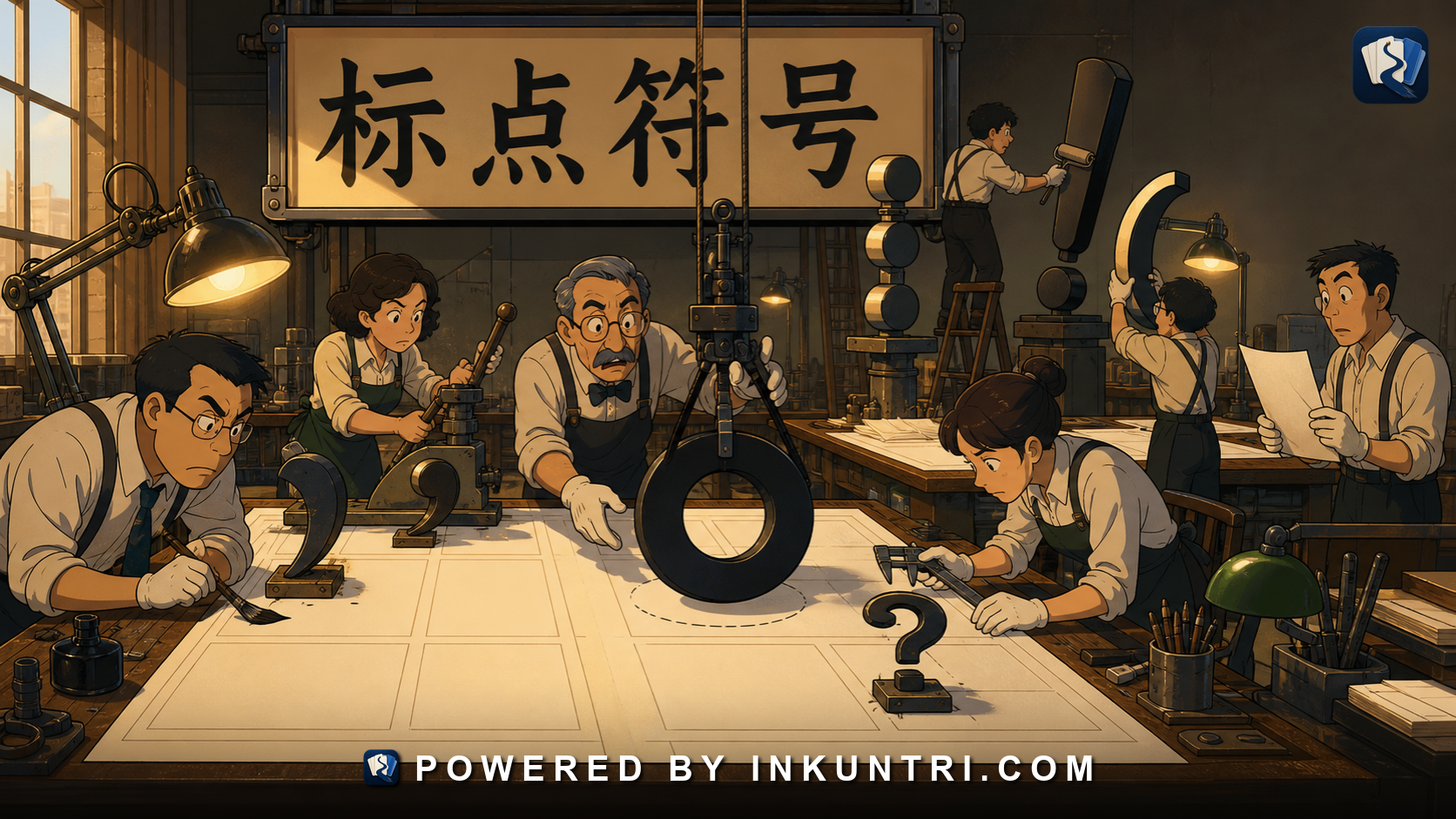
Core examples: 、, 。, ,, :, ;, 《》, “”, 「」, list-heavy policy sentences.
Punctuation is not decoration
A learner can recognize every character in a Chinese sentence and still misread the sentence because of punctuation.
That sounds strange if you grew up treating punctuation as a set of small marks added after the “real words.” But punctuation does more than decorate writing. It tells readers where one unit ends and another begins. It tells them whether a phrase is a list, a title, a quotation, an aside, or the second half of a contrast. It can turn a long run of characters from a fog into a readable paragraph.
Modern written Chinese depends on punctuation much more than many learners notice. Chinese does not put spaces between words. Classical and premodern written materials often did not use the modern punctuation system that readers now expect. Readers, teachers, commentators, editors, and printers supplied boundaries through training, context, marks, layout, or commentary. Modern punctuation made many of those boundaries visible on the page.
So a serious reader should not ask only, “What does this character mean?” The better question is often, “What unit does this mark create?”
Consider this run of characters:
老师说今天不考试学生们都松了一口气然后班长提醒大家明天要交作业A learner may translate word by word: teacher said today not exam students all relaxed then class monitor reminded everyone tomorrow must submit homework. The basic meaning is available, but the structure is not.
Now compare two punctuated versions:
老师说:“今天不考试。”学生们都松了一口气,然后班长提醒大家:“明天要交作业。”老师说今天不考试,学生们都松了一口气,然后班长提醒大家明天要交作业。The first version makes two direct quotations visible. The second treats the reported content as embedded information. The characters are almost the same, but the reading experience changes. Punctuation has become grammar on the page.
That is the central point: modern Chinese punctuation is a reading technology. It is part of how modern prose became modern prose.
From 句读 to 标点符号
The older term 句读 is useful. In broad learner terms, 句读 refers to the segmentation of a text into pauses and units: where a sentence-like unit stops, where a smaller pause occurs, and how the text should be read aloud or interpreted. Classical literacy involved knowing how to break text into meaningful chunks.
Modern 标点符号 is different. It is a standardized family of visible marks used in modern writing and publishing. It does not simply reproduce oral pauses. It marks sentence endings, internal pauses, quotations, book titles, explanations, lists, questions, exclamations, and other functions.
This distinction matters because learners often imagine that punctuation is “obvious.” It is not. Punctuation is editorial. It can embody an interpretation.
Take a short classical-style example:
下雨天留客天留我不留Depending on how it is segmented, this can be read in sharply different ways. A traditional classroom puzzle might punctuate it as:
下雨天,留客天。留我不?留。or:
下雨天,留客天,留我不留?The exact wording is less important than the lesson: where you place pauses and sentence boundaries changes the reading. In modern prose, punctuation does much of that work visibly.
Modern punctuation also changed translation practice. A translator working from punctuated modern Chinese inherits an editor’s structure. A translator working from an unpunctuated classical passage must decide where units begin and end before translating at all. The first task is not vocabulary; it is segmentation.
The main punctuation family
Modern Chinese punctuation includes marks that look familiar to English readers and marks that do not. Some familiar marks also behave differently because they occupy a Chinese character-sized space or have different regional conventions.
| Mark | Chinese name | Core function | Learner note |
|---|---|---|---|
| 。 | 句号 | Ends a sentence-like unit | The normal Chinese full stop, not a small English period. |
| , | 逗号 | Marks a pause inside a sentence | Often used more frequently than English comma rules would allow. |
| 、 | 顿号 | Separates parallel items in a list | High-value mark for reading lists, menus, policies, and descriptions. |
| ; | 分号 | Separates larger parallel clauses or list sections | Common in formal and list-heavy prose. |
| : | 冒号 | Introduces explanation, quotation, list, or specification | Often signals that the real payload is coming next. |
| ? | 问号 | Marks a question | Used at the end of direct questions. |
| ! | 感叹号 / 叹号 | Marks exclamation or strong feeling | More common in informal, promotional, or emphatic text. |
| “ ” / ‘ ’ | 引号 | Marks quotation or special use | Mainland horizontal text commonly uses curly quotation marks. |
| 「 」 / 『 』 | 引号 | Marks quotation, especially in Taiwan/Hong Kong/traditional contexts | Common in traditional Chinese publishing and vertical layouts. |
| 《 》 | 书名号 | Marks titles of books, films, laws, articles, songs, documents, etc. | Do not automatically translate as italics; it is a visible title marker. |
| …… | 省略号 | Ellipsis | Usually written as six dots, visually occupying two character spaces. |
| —— | 破折号 | Dash | Often visually longer than English em dash usage. |
| ( ) | 括号 | Parenthetical information | Full-width forms are common in Chinese text. |
The table is not just reference material. It is a reading method. When a sentence feels dense, do not only look up words. First, scan the punctuation. Find the full stop, colon, semicolon, list comma, title marks, and quotation marks. They tell you how the sentence wants to be grouped.
The full stop: 。
The Chinese full stop 。 is one of the first marks learners should internalize. It does not look like the English period. It occupies a CJK punctuation space and visually separates sentence-like units in modern Chinese prose.
Compare:
今天下雨。我不去了。with:
今天下雨,我不去了。Both are possible, but they feel different. The first has two separate sentence units: “It is raining today. I am not going.” The second presents cause and decision in one flow: “It is raining today, so I’m not going,” even though 所以 is not written.
This is one reason Chinese punctuation matters for translation. English may require conjunctions or sentence splitting where Chinese lets punctuation and discourse relation do more of the work.
A learner should not translate every Chinese comma as an English comma or every Chinese full stop as an English period without thinking. The punctuation marks give structure, but English may express the same structure differently.
The comma: ,
The Chinese comma , is one of the marks that most strongly changes reading rhythm. In modern Chinese, commas often connect clauses and phrases in ways that would be considered comma splices in formal English. That does not mean Chinese prose is careless. It means Chinese and English distribute sentence boundaries differently.
Consider:
他看了看手机,发现已经八点了,赶紧出门。A natural English translation might be:
He checked his phone, saw that it was already eight, and hurried out.
The Chinese uses commas to link a sequence of events. English may use commas plus “and,” a participial structure, or even separate sentences.
Now consider a more formal sentence:
近年来,随着城市人口增加,公共交通压力不断上升,相关部门开始推进多项改革。The commas guide the reader through background, cause, trend, and main action:
- 近年来: time frame
- 随着城市人口增加: background condition
- 公共交通压力不断上升: developing situation
- 相关部门开始推进多项改革: main event
If you read only character by character, the sentence feels long. If you read by comma-delimited chunks, it becomes manageable.
The enumerative comma: 、
The mark 、 is called 顿号. It is one of the most important marks for learners because it signals a list of parallel items inside a phrase.
学校、医院、图书馆和体育馆都在附近。The items are:
学校 / 医院 / 图书馆 / 体育馆A normal comma would create a looser pause. 顿号 tells you that the items are tightly parallel. It appears constantly in policy language, product descriptions, forms, menus, résumés, academic prose, and news.
A list-heavy policy sentence might look like this:
为进一步加强校园安全管理,规范车辆通行、人员登记、物品存放、应急处置等工作,现将有关事项通知如下:Break it this way:
| Segment | Function |
|---|---|
| 为进一步加强校园安全管理 | purpose: to strengthen campus safety management |
| 规范车辆通行、人员登记、物品存放、应急处置等工作 | list of areas being regulated |
| 现将有关事项通知如下 | official notice formula: the relevant matters are hereby notified as follows |
| : | colon introducing the following items |
The 顿号 makes the list visible. Without it, the sentence becomes much harder to parse.
Do not confuse 顿号 with an English comma. It is closer to a list separator within a Chinese noun phrase. In translation, it may become commas, semicolons, bullets, or a list depending on the sentence.
The semicolon: ;
The Chinese semicolon ; often appears in formal writing where several large parallel units need to stay inside a single sentence or paragraph.
Example:
申请人应如实填写个人信息;提交有效身份证件;按规定时间参加面试;逾期未办理的,视为自动放弃。The semicolons separate major procedural obligations:
- fill in personal information truthfully
- submit valid ID documents
- attend the interview at the required time
- failure to complete on time is treated as voluntary withdrawal
English might use semicolons, bullets, or separate numbered items. Chinese official prose often keeps such material compact, and semicolons prevent the sentence from turning into an unreadable chain of commas.
For learners, the semicolon is a warning: you are probably reading parallel clauses, not one simple sentence.
The colon: :
The colon : is a payload marker. When you see it, expect explanation, quotation, specification, or a list.
会议强调:安全生产责任必须落实到人。The part before the colon frames the source or speech act. The part after the colon carries the content.
请携带以下材料:身份证、报名表、近期照片。The colon introduces the list. The 顿号 separates list items.
Colons are especially important in official notices, academic writing, news summaries, and forms. They often mean “everything before this is setup; everything after this is the thing you need.”
Quotation marks: “ ”, ‘ ’, 「 」, 『 』
Chinese quotation marks are not uniform across all regions and writing modes. Mainland horizontal text commonly uses “ ” and ‘ ’. Taiwan and Hong Kong publishing often use 「 」 and 『 』, especially in traditional-character contexts. Vertical text can involve additional layout conventions.
A simplified Mainland-style example:
他说:“我明天再来。”A traditional-style example:
他說:「我明天再來。」Do not treat this as merely font flavor. Quotation marks tell you whether something is direct speech, quoted wording, a term under discussion, irony, or a special label.
所谓“免费服务”,其实包含多项附加收费。Here the quotation marks do not necessarily quote a speaker. They mark the phrase 免费服务 as a term being questioned or treated specially. In English, this might become scare quotes: so-called “free service.”
Title marks: 《》
The 书名号 is one of the most Chinese-looking punctuation conventions for English readers. It marks titles:
《红楼梦》
《人民日报》
《中华人民共和国民法典》
《流浪地球》
English often uses italics or quotation marks for titles, depending on style guide and work type. Chinese uses visible title marks. That changes the reading experience. A title in Chinese does not need italics to stand out; the brackets do the job.
This matters in news and academic prose:
根据《中华人民共和国民法典》相关规定,合同当事人应当遵循诚信原则。The title marks tell you that 中华人民共和国民法典 is the name of a legal text, not just a descriptive noun phrase.
Some regional or editorial systems distinguish larger works and smaller works with 《》 and 〈〉. You may see 〈〉 for article, chapter, poem, or smaller title units in some traditional publishing contexts. The safest learner rule is simple: when you see title marks, treat the enclosed text as a named work, document, law, film, article, song, or formal title until context proves otherwise.
Punctuation and apposition
Chinese often stacks nouns, titles, names, and explanatory phrases compactly. Punctuation helps you see whether two expressions refer to the same thing.
公司创始人张明表示,未来三年将继续扩大海外业务。Here 公司创始人 and 张明 form a title-plus-name unit: “company founder Zhang Ming.” No comma is needed.
But compare:
张明,公司创始人,表示未来三年将继续扩大海外业务。Now 公司创始人 is parenthetical apposition: “Zhang Ming, the company’s founder, said…”
Modern Chinese is often less comma-heavy around apposition than English, but punctuation can still change emphasis and structure. Learners should ask: is this title attached to the name, or is it an inserted explanation?
Punctuation and long official sentences
Official Chinese often feels difficult not because every word is rare, but because many functions are compressed into one sentence.
各单位要结合实际,认真落实安全责任,完善应急预案,加强人员培训,确保各项工作有序开展。A naive word-by-word reading gives a long chain. A punctuation-aware reading finds the structure:
| Chunk | Function |
|---|---|
| 各单位要结合实际 | all units should act according to actual conditions |
| 认真落实安全责任 | implement safety responsibilities carefully |
| 完善应急预案 | improve emergency plans |
| 加强人员培训 | strengthen personnel training |
| 确保各项工作有序开展 | ensure orderly implementation of all work |
The commas separate a sequence of required actions. The subject 各单位 controls the whole chain. English translation may need bullets or repeated verbs.
A more complex version might use 顿号 and semicolons:
各单位要加强办公区、宿舍区、食堂等重点区域管理;完善值班、巡查、报告等工作制度;发现问题及时整改。Here:
- semicolons divide large action areas
- 顿号 divides smaller list items inside each action area
- 等 tells you the list is not exhaustive
This is exactly the kind of sentence where punctuation is not optional. It is the map.
Punctuation in news prose
News writing uses punctuation to manage source, stance, and compression.
专家表示,近期气温波动较大,公众应注意增减衣物。The first comma separates source from content. The second separates background from recommendation.
多地发布高温预警:户外作业需注意防暑降温。The colon creates a headline-like relationship: event first, practical consequence second.
“新规不是限制消费,而是规范市场秩序。”相关负责人表示。Quotation marks frame the official wording. The attribution follows. English may prefer “said the official,” but Chinese frequently places attribution after the quote.
Learners should read news punctuation with three questions:
- Who is the source?
- Which words are being quoted or summarized?
- Is the punctuation creating contrast, explanation, list structure, or emphasis?
Punctuation in academic prose
Academic Chinese often uses punctuation to layer definitions, qualifications, and examples.
本文所说的“语体”,不是指单纯的口语或书面语差异,而是指在特定交际场景中形成的语言选择模式。The quotation marks mark a term. The comma after 语体 frames the topic. 不是……而是…… creates contrast. The punctuation helps the reader hold the definition together.
研究对象包括三类文本:新闻报道、政府公告、教材说明。The colon introduces the classification. The 顿号 marks the three categories.
第一,样本数量有限;第二,地区分布不均;第三,后续研究仍需扩大语料范围。The semicolons separate three parallel limitations. English might use numbered sentences. Chinese can keep the parallel structure in one sentence.
Punctuation in signs and notices
Public notices often use punctuation sparingly, but when they do use it, the marks are functional.
温馨提示:请勿在电梯内吸烟、吐痰、乱扔垃圾。The colon says the notice label is over and the instruction begins. 顿号 separates banned actions.
非工作人员,请勿入内。The comma separates the target group from the instruction: non-staff, please do not enter.
小心地滑!The exclamation mark strengthens warning force.
A sign reader should not expect full grammar. Signs compress. Punctuation often tells you the function faster than the words do.
Chinese and English punctuation habits are not identical
Learners often make one of two mistakes. They either ignore punctuation because “Chinese has no spaces,” or they map Chinese punctuation directly onto English punctuation. Both habits fail.
A Chinese comma can connect clauses in ways that English may not. A Chinese title mark may become italics, quotation marks, or capitalization in English. A 顿号 may become commas, semicolons, or bullets. A Chinese full stop may become a comma in English if the English sentence needs subordination.
The reverse is also true. English learners writing Chinese often overuse spaces, underuse 顿号, use English quotation marks inconsistently, or write titles without 书名号. These errors do not always block meaning, but they make the writing look less natural and sometimes harder to parse.
Here is a simple conversion table for thinking, not mechanical translation:
| Chinese mark | Often becomes in English | Warning |
|---|---|---|
| 。 | period | Sometimes English needs a semicolon, colon, or conjunction. |
| , | comma, conjunction, clause boundary | Do not automatically preserve every comma. |
| 、 | comma in a list | May become bullets in clear translation. |
| ; | semicolon, period, bullet separation | Formal Chinese may keep more parallel units in one sentence. |
| : | colon, “as follows,” “said,” “including” | Translate the function, not only the mark. |
| 《》 | italics, title case, quotation marks | Depends on English style and type of work. |
| “ ” | quotation marks | May mark a term, irony, or special usage rather than literal speech. |
A practical reading method
When facing a dense Chinese paragraph, use this sequence.
Step 1: Circle the sentence-ending marks
Find 。?! first. These give you the largest units.
Step 2: Identify colons
Colons often announce lists, definitions, explanations, official wording, or quoted content. In official writing, the main point often comes after the colon.
Step 3: Separate list marks from clause commas
Look for 顿号. Items separated by 顿号 are usually parallel. Do not read them as unrelated clauses.
Step 4: Treat semicolons as major hinges
If a sentence has semicolons, break it into large parallel sections before translating.
Step 5: Mark quotes and titles
Quotation marks and title marks protect units. Do not split the inside too early. First ask: is this a quote, term, title, law, document, book, article, or special label?
Step 6: Translate punctuation functions, not just punctuation shapes
A good English translation may change commas into conjunctions, semicolons into bullets, or title marks into italics. The point is to preserve the structure and function.
Punctuation lab
Use this paragraph as a practice object.
No punctuation:
为进一步规范校园管理保障师生安全学校决定自即日起加强门卫登记车辆通行物品存放和应急处置等工作请各部门认真落实Textbook-style punctuation:
为进一步规范校园管理,保障师生安全,学校决定自即日起加强门卫登记、车辆通行、物品存放和应急处置等工作。请各部门认真落实。Notice-style punctuation:
为进一步规范校园管理、保障师生安全,学校决定:自即日起,加强门卫登记、车辆通行、物品存放和应急处置等工作。请各部门认真落实。More list-heavy official style:
为进一步规范校园管理、保障师生安全,学校决定自即日起加强以下工作:一、门卫登记;二、车辆通行;三、物品存放;四、应急处置。请各部门认真落实。All four versions use the same basic material. They do not feel the same. Punctuation changes the text’s genre, rhythm, and clarity.
What to remember
Modern Chinese punctuation is not a side topic. It is one of the main tools that turns continuous characters into readable modern prose.
For learners, the high-value marks are 。, ,, 、, :, ;, quotation marks, and title marks. Learn them not as symbols but as instructions:
- stop here
- pause here
- list items here
- explanation coming
- parallel clause boundary
- quoted or special wording
- title or named work
Once you read punctuation this way, long Chinese sentences become less intimidating. They are still long. They may still contain unfamiliar words. But they are no longer a wall of characters. They are organized text.
Build a tool that displays the same paragraph in four modes:
- no punctuation
- standard textbook punctuation
- newspaper punctuation
- official-notice punctuation
Core interactions:
- toggle sentence boundaries
- highlight 顿号 lists
- identify colon payloads
- compare Mainland-style quotation marks with Taiwan/Hong Kong-style corner brackets
- convert a dense policy sentence into bullets
- let users drag punctuation into an unpunctuated paragraph and compare suggested readings
Suggested sample strings:
请携带身份证、报名表、近期照片。会议指出,各单位要结合实际,完善制度,加强培训,确保工作落实。根据《中华人民共和国民法典》相关规定,当事人应当遵循诚信原则。For production fact-checking, consult:
- W3C, Requirements for Chinese Text Layout / 中文排版需求: https://www.w3.org/TR/clreq/
- GB/T 15834—2011, 标点符号用法 / General Rules for Punctuation: https://archive.org/details/GB-T15834-2011
- Taiwan Ministry of Education, 重訂標點符號手冊 for region-specific punctuation practices.
Related reading
Chinese Characters Abroad: Hanzi, Kanji, Hanja, and the Shared Scriptworld
The reader understands the shared character tradition across China, Japan, and Korea while respecting each language’s independent grammar, pronunciation, and history.
Designing Chinese Anki Cards for Words, Characters, and Collocations
The reader can design Chinese flashcards that train recognition, pronunciation, meaning, collocation, character form, and contextual use without turning review into trivia.
Political Slogans and Four-Character Style Across East Asia
The reader understands how four-character rhythm and classical-style compression shape political and public language across Chinese, Japanese, and Korean contexts.
From Flashcards to Literacy: When Chinese Study Must Leave the Card
The reader can recognize when flashcards are helping and when they are delaying real Chinese literacy, then shift toward connected reading and listening.
A Serious Learner’s Guide to Chinese Dictionaries
The reader can use Chinese dictionaries more deeply by reading definitions, parts of speech, usage notes, examples, synonyms, variants, and register labels.
Chinese Pronunciation Self-Diagnosis With Recording and Native Models
The reader can diagnose Mandarin pronunciation problems through recording, comparison, targeted drills, and structured feedback rather than vague “tone practice.”