
Phono-Semantic Compounds in Practice: Reading Hints Hidden in Hanzi
The reader can identify semantic and phonetic components in many characters and use them as cautious reading clues.
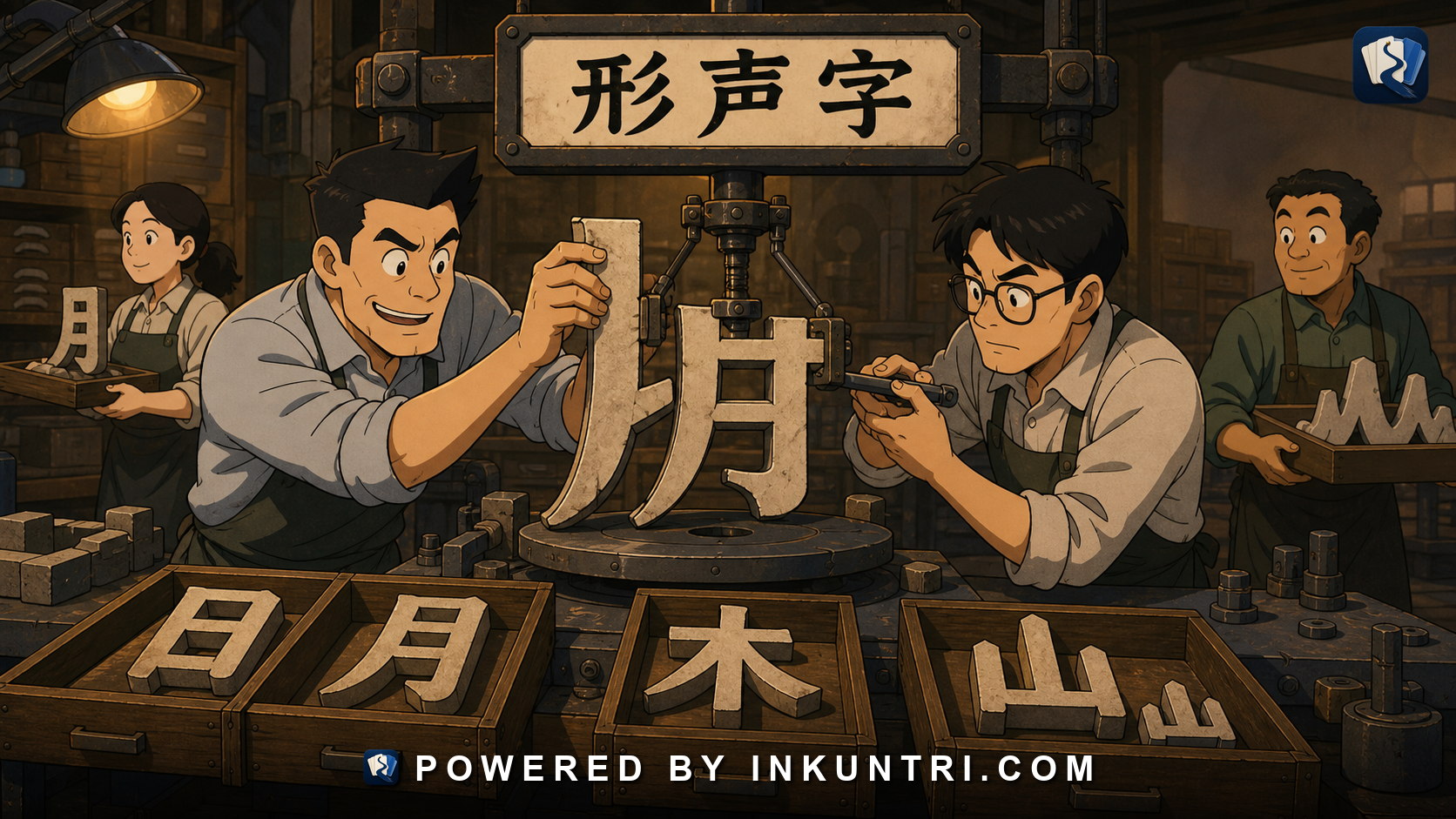
Core examples: 河, 湖, 洋, 语, 说, 请, 情, 晴, 清, 铜, 病, 饭.
The real secret is not pictographs
Many learners meet Chinese characters through pictures: 日 is the sun, 月 is the moon, 木 is a tree, 山 is a mountain. This introduction is memorable, and it is not wrong. Early character forms often did grow out of drawing, symbol, and visual association.
But if you keep explaining Chinese writing mainly through pictographs, you will run into a wall.
Most useful characters are not little pictures. They are built from parts. More specifically, a huge portion of Chinese characters are 形声字 — phono-semantic compounds. The term is easier than it looks:
- 形 points to form, category, or meaning.
- 声 points to sound.
- 字 means character.
A 形声字 usually contains one component that hints at the meaning field and another component that hints at the pronunciation. The hint may be excellent, weak, historically hidden, or misleading in modern Mandarin. But the existence of the hint changes how you should learn characters.
A beginner sees 河 and thinks, “That is a complicated symbol.” A more informed learner sees 氵 and 可 and asks two better questions:
- Does 氵 suggest water, liquid, river, or flow?
- Does 可 give any sound clue?
The answer is yes, cautiously. 河 means river and is pronounced hé. The semantic component 氵 points to water. The phonetic component 可 is pronounced kě in modern Mandarin, so it is not an exact match, but it is not a random piece either. It is a sound-related component whose relationship has shifted over time.
That is the mindset this article teaches: not superstition, not mnemonic fantasy, not blind trust, but component-aware reading.
What a phono-semantic compound does
A clean example is 洋.
| Character | Semantic component | Phonetic component | Pinyin | Meaning |
|---|---|---|---|---|
| 洋 | 氵 water/liquid | 羊 yáng | yáng | ocean; foreign; vast |
氵 tells you the character belongs near water. 羊 tells you the pronunciation is close to yáng. The result is 洋, also pronounced yáng.
This is the kind of example teachers love because everything lines up neatly. But the system is useful even when it is less neat.
病 is built with 疒, the sickness component, and 丙, pronounced bǐng. The whole character 病 is bìng. The tone differs, but the syllable relationship is obvious. 饭 has 饣, the food/eating component, and 反 fǎn. The whole character 饭 is fàn. Again, the tone differs, but the sound clue is still useful.
Then there are characters such as 语 and 说. 语 is yǔ, while its right-side component 吾 is wú. 说 is shuō, while 兑 is duì. These are not helpful if you expect a modern Mandarin match. They become more understandable only when you remember that characters were formed across long periods of sound change and that modern Mandarin is not the same sound system in which many characters were created.
So the rule is not “the phonetic component tells you the pronunciation.” The rule is more precise:
A phonetic component gives a historically grounded sound clue. In modern Mandarin, that clue may range from exact to barely visible.
Semantic components are category hints, not definitions
The semantic component usually points toward a broad domain. It does not give a dictionary definition.
氵 often suggests water, liquid, rivers, washing, moisture, or fluid movement. It appears in 河, 湖, 洋, 海, 洗, 油, 汗, 泪, and many more. That does not mean every 氵 character means “water.” It means the character likely has some historical or semantic connection to a liquid, body of water, washing, wetness, or flow.
讠, the simplified speech component corresponding to traditional 訁, often suggests speaking, language, asking, telling, arguing, or verbal action. It appears in 语, 说, 请, 话, 论, 认, 讲, and 读.
扌 often points to hand action: 打, 拉, 推, 提, 拿 in compounds, 找, 把, 抓, 按. But it does not define the whole word. 报, for example, is not simply “hand.” The hand component is a doorway into a semantic field, not a complete meaning.
忄 and 心 often point to emotion, thought, mental state, intention, or inner life: 情, 怕, 忙, 快, 想, 念, 感, 恨. But again, the exact word must be learned.
A useful learner habit is to translate semantic components as topic tags, not meanings. 氵 tags water/liquid. 讠 tags speech/language. 扌 tags hand/action. 忄 tags emotion/mind. 钅 tags metal. 疒 tags illness. 饣 tags food/eating.
A tag helps you orient yourself. It does not replace vocabulary.
Do not call every component a radical
Learners often use “radical” for every visible piece of a character. That is understandable, but it creates confusion.
A component is any recurring piece of a character. A semantic component is a component that helps indicate meaning field. A phonetic component is a component that helps indicate sound. A 部首 or dictionary radical is traditionally an indexing category used to organize characters in dictionaries.
These overlap, but they are not identical.
For example, in 清, 氵 is the dictionary radical and also the semantic component. 青 is the phonetic component. That is tidy.
In other characters, the dictionary radical may not be the part that is most useful for meaning or sound. In still other cases, a component that looks meaningful today may be a fossilized graphic piece whose original role is not obvious to modern learners.
For practical learning, use the broader word component unless you specifically mean dictionary lookup. This keeps you from making two errors:
- Treating every recurring shape as a meaning clue.
- Forgetting that many recurring shapes are sound clues.
Chinese characters are not made of “radicals” in the loose English-learning-app sense. They are made of components that can perform different jobs.
The basic division of labor
A phono-semantic character often answers two questions at once:
| Question | Component type | Example |
|---|---|---|
| What kind of thing or action is this related to? | Semantic component | 氵 in 河, 湖, 洋 |
| Roughly what might it sound like? | Phonetic component | 胡 in 湖, 羊 in 洋 |
湖 is a particularly friendly example:
- 氵 points to water.
- 胡 is pronounced hú.
- 湖 is pronounced hú and means lake.
铜 is also friendly:
- 钅 points to metal.
- 同 is pronounced tóng.
- 铜 is pronounced tóng and means copper.
晴 is friendly but requires tone caution:
- 日 points to sun/day/weather/light.
- 青 is qīng.
- 晴 is qíng and means clear/fine weather.
请 is also useful:
- 讠 points to speech or verbal action.
- 青 is qīng.
- 请 is qǐng and means to request; please.
These examples teach a powerful principle: one phonetic component can appear across characters with different semantic components. The semantic component changes the domain; the phonetic component anchors the sound family.
The 青 family as a first serious example
The component 青 is a good doorway into phono-semantic thinking.
| Character | Components | Pinyin | Meaning field |
|---|---|---|---|
| 青 | base component | qīng | blue-green; green; young; fresh |
| 清 | 氵 + 青 | qīng | clear; clean; pure |
| 晴 | 日 + 青 | qíng | clear weather |
| 情 | 忄 + 青 | qíng | feeling; emotion; situation |
| 请 | 讠 + 青 | qǐng | to request; please |
| 精 | 米 + 青 | jīng | essence; refined; spirit; fine |
The first five are a learner’s dream. 青, 清, 晴, 情, and 请 all cluster around qing. Tones differ, but the relationship is obvious. The semantic components do useful work:
- 氵 + 青 → 清: clear water, clean/pure.
- 日 + 青 → 晴: clear weather, sunlight.
- 忄 + 青 → 情: feelings, mental/emotional domain.
- 讠 + 青 → 请: request, speech action.
Then 精 appears and complicates the picture. It is pronounced jīng, not qīng. It still shares the -ing final and belongs historically in the same broad sound neighborhood, but a learner who blindly pronounces every 青 character as qing will make mistakes.
This is not a failure of the system. It is the system showing you what kind of clue it is. A phonetic component is not a Pinyin spelling rule. It is a probability signal shaped by history.
Common semantic components worth learning early
You do not need to memorize hundreds of components before reading. But a small set has high return because it appears everywhere.
| Component | Traditional form where relevant | Rough domain | Examples | Learner warning |
|---|---|---|---|---|
| 氵 | 水 as full form | water, liquid, flow | 河, 湖, 洋, 海, 洗 | Domain hint, not “means water” every time. |
| 讠 | 言 / 訁 | speech, language, words | 语, 说, 请, 话, 论 | Simplified 讠 corresponds to traditional 訁. |
| 扌 | 手 | hand, handling, action | 打, 拉, 推, 提, 找 | Many meanings are extended or abstract. |
| 忄 / 心 | 心 | mind, feeling, emotion | 情, 怕, 忙, 想, 念 | 心 may appear below or as 忄 on the left. |
| 钅 | 金 / 釒 | metal, money, tools | 铜, 银, 铁, 针, 钱 | Simplified 钅 corresponds to traditional 釒. |
| 疒 | 疒 | illness, pain, bodily condition | 病, 痛, 疼, 痒, 症 | Medical domain, not always a modern medical term. |
| 饣 | 食 / 飠 | food, eating, hunger | 饭, 饮, 饿, 饱, 馆 | Simplified 饣 corresponds to traditional 飠. |
| 日 | 日 | sun, day, light, time | 晴, 明, 晚, 时, 暗 | Can be semantic, phonetic, or just part of inherited form. |
| 月 / 肉 | 月 / 肉 | moon; body/flesh in many characters | 服, 胖, 胃, 肺, 腿 | The “body” component often looks like 月. |
The warning column matters. Components give leverage only when used modestly. If you overinterpret them, they turn into folk etymology.
A component is not always in the same position
Many learner examples are left-right characters: semantic component on the left, phonetic component on the right.
- 河 = 氵 + 可
- 湖 = 氵 + 胡
- 清 = 氵 + 青
- 情 = 忄 + 青
- 铜 = 钅 + 同
- 饭 = 饣 + 反
This layout is common, but it is not universal.
Components can appear on the top, bottom, outside, inside, or in rearranged positions. Some characters surround one component with another. Some have shapes that changed through clerical script, regular script, simplification, or font design. Some characters were created by analogy to older forms and do not obey the neat pattern a learner wants.
So use position as a clue, not a law. A common beginner shortcut is “left side means meaning, right side means sound.” That is useful for many left-right characters, but it will fail often enough that you should not make it a rule.
A better rule is:
Look for a semantic domain component and a sound-bearing component. Their positions are common but not guaranteed.
Why phonetic clues are imperfect
Phonetic components disappoint learners because they expect modern Pinyin. But the system was not built for modern Pinyin. It developed across centuries of Chinese sound change, regional variation, graphic standardization, and borrowing.
Several forces create mismatch.
First, pronunciation changed. A component that was once a good clue may no longer match in modern Mandarin. The character may preserve an older sound relationship that is clearer in Middle Chinese, Old Chinese reconstructions, another Sinitic variety, or not clearly visible to the non-specialist at all.
Second, tones changed. A phonetic component often helps with syllable shape more than tone. 青 qīng, 情 qíng, 晴 qíng, and 请 qǐng share an obvious syllable relationship, but not the same tone.
Third, components can be borrowed or reanalyzed. A piece may have entered a character for one reason historically and be interpreted differently by later readers.
Fourth, simplification and variant forms can obscure relationships. A simplified form may preserve one clue and erase another. A traditional form may show a component more clearly but be harder for simplified-only learners to recognize.
None of this makes phonetic components useless. It means they need to be used like weather forecasts, not arithmetic.
Reading unknown characters with component awareness
When you meet an unfamiliar character, do not immediately make up a story. Use a disciplined process.
Step 1: Find the obvious semantic component
Ask what broad domain is suggested.
If you see 氵, think water/liquid/flow. If you see 讠, think speech/language. If you see 疒, think illness. If you see 钅, think metal. If you see 饣, think food/eating.
Do not force a complete meaning. Just tag the domain.
Step 2: Look for a possible phonetic component
Ask whether any remaining component is a character or character-like piece you know. In 湖, 胡 is hú. In 铜, 同 is tóng. In 饭, 反 is fǎn. In 病, 丙 is bǐng.
Make a guess only as a hypothesis.
Step 3: Check a dictionary
Confirm pronunciation, tone, meaning, traditional form, simplified form, and example words. This step is non-negotiable. Component logic is for making good guesses, not for skipping lookup.
Step 4: Learn the word, not only the character
河 is useful, but 河流, 黄河, 河边, and 河水 make it real. 铜 is useful, but 铜钱, 铜牌, 青铜, and 铜像 make it stick. 情 is useful, but 情况, 感情, 心情, and 事情 show its range.
Step 5: Add the component family to your memory
If a component repeats in useful words, make a small family note. 青 is worth a note. 同 is worth a note. 胡 is worth a note. 反 is worth a note. But do not turn every character into an elaborate encyclopedia entry.
Example walkthroughs
河
河 is composed of 氵 and 可. 氵 points to water. 可 is pronounced kě in modern Mandarin, while 河 is hé. The sound clue is imperfect, but the semantic clue is strong. The character means river.
Useful words:
- 河流 — river; stream
- 黄河 — the Yellow River
- 河边 — riverside
- 河南 — Henan, literally “south of the river” in historical/geographical naming
Learner action: remember 河 as a word and notice 氵 as a water-domain clue. Do not expect 可 to give exact modern pronunciation.
湖
湖 is clearer. 氵 points to water, and 胡 is hú. 湖 is also hú and means lake.
Useful words:
- 湖 — lake
- 湖水 — lake water
- 湖边 — lakeside
- 西湖 — West Lake
Learner action: this is a high-quality phono-semantic example. Use it to understand the pattern.
洋
洋 combines 氵 and 羊 yáng. 洋 is yáng. Its meanings include ocean, vastness, and foreign/western in compounds.
Useful words:
- 海洋 — ocean
- 洋人 — foreigner, historically and contextually sensitive
- 西洋 — the West, especially in historical or cultural contexts
- 洋葱 — onion
Learner action: learn 洋 through words. The water clue is strongest in 海洋; the “foreign” sense is extended and historical.
语
语 has 讠, the speech component, and 吾 wú. The whole character is yǔ. The semantic clue is useful; the modern Mandarin sound clue is not obvious.
Useful words:
- 语言 — language
- 汉语 — Chinese language
- 英语 — English language
- 语法 — grammar
- 口语 — spoken language
Learner action: let 讠 help you place the character in the speech/language domain. Do not overtrust 吾 for modern pronunciation.
说
说 has 讠 and 兑. The whole character is shuō. The speech component is obvious. The modern sound relationship is not beginner-friendly.
Useful words:
- 说话 — to speak
- 说明 — to explain
- 小说 — novel; fiction
- 听说 — to hear that
Learner action: learn 说 as a high-frequency word/character directly. Component analysis helps domain recognition more than pronunciation here.
请
请 combines 讠 and 青. The whole character is qǐng. The semantic component points to speech/request. The phonetic component gives the qing syllable family, with tone change.
Useful words:
- 请 — please; to invite; to request
- 请问 — excuse me; may I ask
- 请求 — to request
- 邀请 — to invite
Learner action: remember 请 as part of the 青 family, but learn the third tone.
情
情 combines 忄 and 青. The whole character is qíng. The semantic component points to feeling, mind, or situation. The phonetic component gives the qing sound family.
Useful words:
- 心情 — mood
- 感情 — feeling; emotion; relationship
- 情况 — situation
- 事情 — matter; thing; affair
Learner action: learn 情 through common compounds. Its meaning range is wider than “emotion.”
晴
晴 combines 日 and 青. The whole character is qíng and means clear/fine weather. 日 gives light/sun/weather support; 青 gives the sound family.
Useful words:
- 晴天 — clear day
- 晴朗 — clear and bright
- 放晴 — to clear up after rain
Learner action: connect 晴 with weather words, not just the isolated character.
清
清 combines 氵 and 青. It is qīng and means clear, clean, pure, or quiet in different words.
Useful words:
- 清水 — clear water
- 清楚 — clear; clearly
- 清洁 — clean
- 清静 — quiet; peaceful
Learner action: 清 is one of the best demonstrations of semantic plus phonetic efficiency.
铜
铜 combines 钅 and 同 tóng. The whole character is tóng and means copper.
Useful words:
- 铜 — copper
- 青铜 — bronze
- 铜钱 — copper coin
- 铜像 — bronze/copper statue
Learner action: this is a high-reliability sound clue. Add 同-series characters to your component notes.
病
病 combines 疒 and 丙 bǐng. The whole character is bìng. The semantic component points to illness; the phonetic component gives the syllable with a tone shift.
Useful words:
- 病 — illness; disease; to be ill
- 生病 — to get sick
- 病人 — patient
- 毛病 — problem; defect; bad habit
Learner action: learn both literal and extended uses. 毛病 is often not a medical illness.
饭
饭 combines 饣 and 反 fǎn. The whole character is fàn. The semantic component points to food/eating; the phonetic component gives the syllable with tone difference.
Useful words:
- 饭 — cooked rice; meal
- 吃饭 — to eat; to have a meal
- 饭店 — restaurant or hotel depending on region/context
- 米饭 — cooked rice
Learner action: 饭 is common enough to memorize directly, but 饣 helps you recognize food-related characters quickly.
How component awareness improves dictionary lookup
Component awareness is not only for memory. It also helps lookup.
If you see an unknown character on a sign, you may not know the pronunciation. But you can identify components. A dictionary app with component search may let you enter 氵 plus a right-side shape. A handwriting input method may work better if you know the character’s structure. OCR may fail on stylized fonts, but component awareness lets you search manually.
For paper dictionaries, the dictionary radical matters. For digital dictionaries, any recognizable component can be useful. But even in digital tools, component literacy prevents helplessness. You stop seeing characters as dense blocks and start seeing them as structured objects.
This is also useful for error detection. If a learner writes 请 with the wrong left component, the character may become visually strange because the speech-domain marker is missing. If someone confuses 清 and 情, the pronunciation may be close, but the semantic component tells you the intended word family: water/clarity versus feeling/situation.
How to study phono-semantic compounds without wasting time
Do not create a long etymology story for every character. That is slow and often inaccurate.
Use a lean system.
Memorize the whole word
For 请, learn 请问, 请求, 邀请. For 情, learn 情况, 心情, 感情. For 饭, learn 吃饭, 米饭, 饭店.
Notice the component pattern
Write a small note:
- 青 family: 清 qīng, 晴 qíng, 情 qíng, 请 qǐng, 精 jīng.
- 食/饣 family: 饭, 饮, 饿, 饱, 馆.
- 疒 family: 病, 痛, 疼, 痒, 症.
Mark reliability
Do not mark every phonetic component as equally useful. Use a simple scale:
- Strong: same syllable and same or predictable tone pattern, such as 湖 hú / 胡 hú, 铜 tóng / 同 tóng.
- Medium: same syllable but tone differs, such as 饭 fàn / 反 fǎn, 病 bìng / 丙 bǐng.
- Weak: same final or historical relationship but modern Mandarin has shifted, such as 精 jīng / 青 qīng.
- Opaque: not useful for modern learner pronunciation, such as 说 shuō / 兑 duì.
Confirm with audio
Never let component study become silent character study only. Pronunciation is sound, not spelling. Listen to the word in speech, especially if tone differs from the phonetic component.
What serious learners should notice
Phono-semantic compounds matter because they create structure in what otherwise looks like a mountain of arbitrary forms.
They help you:
- recognize semantic fields;
- guess pronunciations cautiously;
- group characters into families;
- remember visually similar characters;
- look up unknown forms;
- understand why Chinese writing is not merely “pictures”;
- avoid treating every character as an isolated symbol.
But they do not let you:
- pronounce unknown characters with certainty;
- skip dictionary confirmation;
- infer exact meanings from components;
- explain every character through modern Mandarin;
- replace word learning with character dissection.
A strong tool for this article would show selected characters as component systems rather than static glyphs.
Suggested functions:
- Component label view: Highlight semantic and phonetic components in 河, 湖, 洋, 语, 说, 请, 情, 晴, 清, 铜, 病, and 饭.
- Reading-hint overlay: Show the phonetic component’s modern pronunciation beside the whole character’s pronunciation.
- Reliability meter: Label sound clues as strong, medium, weak, or opaque for modern Mandarin learners.
- Semantic domain tags: Mark 氵 as water/liquid, 讠 as speech/language, 忄 as mind/feeling, 钅 as metal, 疒 as illness, 饣 as food/eating.
- Traditional/simplified toggle: Show 訁/讠, 飠/饣, 釒/钅 and note when component recognition changes across scripts.
- Historical-form lane: For selected examples, display oracle/bronze/seal/clerical/regular forms where available, but keep the learner-facing explanation anchored in modern reading.
- Word mode: Click 情 and see 情况, 心情, 感情, 事情. Click 清 and see 清楚, 清水, 清洁. The tool should teach that characters help, but words carry usage.
Final rule
When you see an unfamiliar character, ask two questions:
What domain does the semantic component suggest? What sound family does the phonetic component suggest?
Then verify.
This is the mature way to use character structure. The components are not magic. They are reading hints. Used carefully, they turn Hanzi from a wall of strokes into a map of recurring patterns.
Related reading
Influencer Commerce Vocabulary in Mandarin
The reader can understand Chinese influencer-commerce language across live streams, product promotion, affiliate links, commissions, and buyer claims.
Memes, Homophones, and Political Caution in Chinese Online Culture
The reader can understand how Chinese online users use homophones, euphemisms, abbreviations, and layered jokes to manage sensitivity, moderation, and community recognition.
Chinese Characters Abroad: Hanzi, Kanji, Hanja, and the Shared Scriptworld
The reader understands the shared character tradition across China, Japan, and Korea while respecting each language’s independent grammar, pronunciation, and history.
Designing Chinese Anki Cards for Words, Characters, and Collocations
The reader can design Chinese flashcards that train recognition, pronunciation, meaning, collocation, character form, and contextual use without turning review into trivia.
When a Character Is Also a Word: 字, 词, and the Limits of English Categories
The reader stops equating “character” with “word” and learns to think in terms of characters, morphemes, words, and compounds.
How Punctuation Changed Modern Written Chinese
The reader understands modern Chinese punctuation as a historical layer that reshaped reading rhythm, sentence structure, and translation.