
Reading Korean Menus: Ingredients, Cooking Verbs, and Regional Clues
The reader can read Korean menus by recognizing ingredients, dish categories, cooking verbs, portion markers, and regional clues.
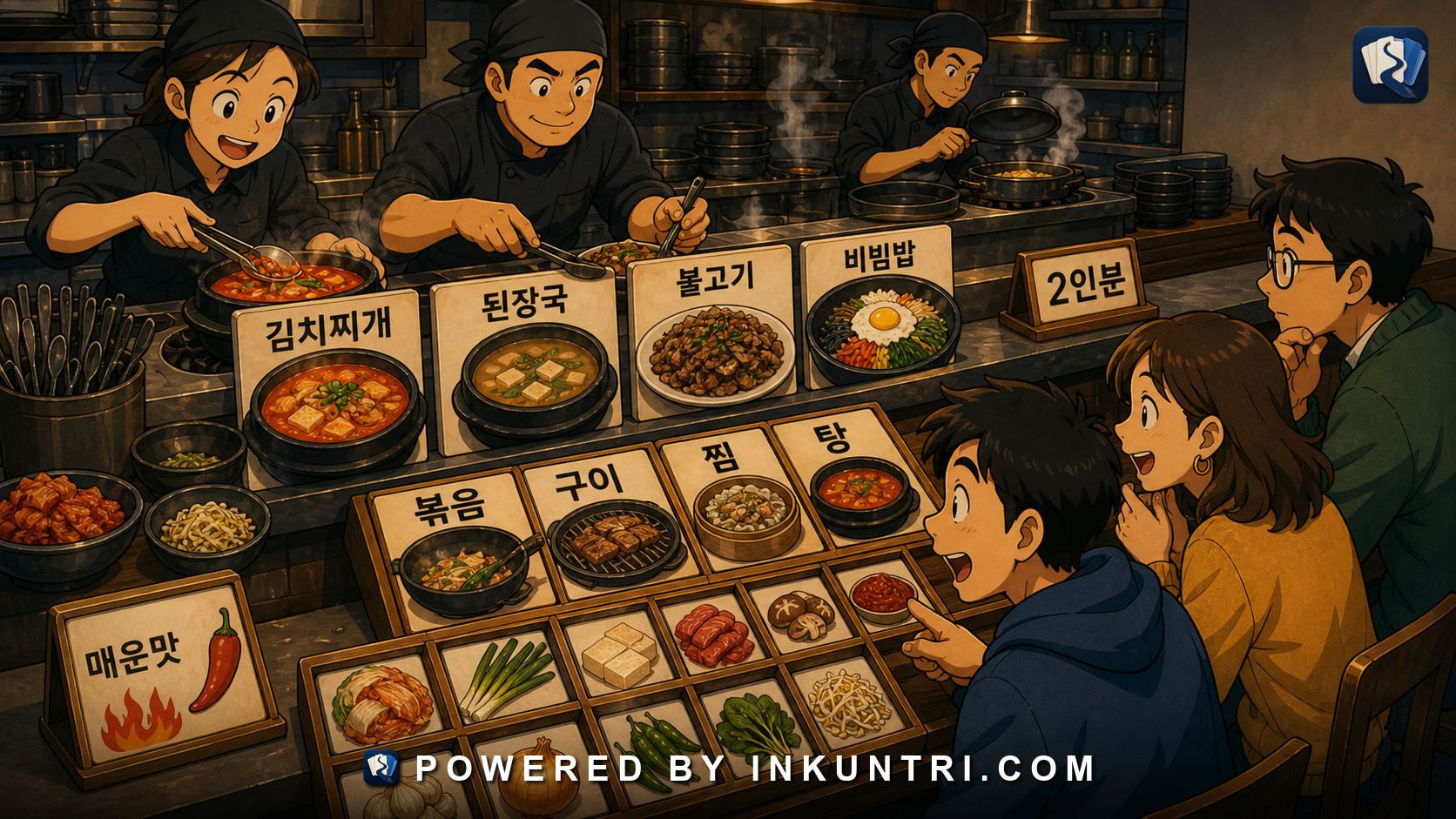
Core examples: 김치찌개; 된장국; 불고기; 비빔밥; 볶음; 구이; 찜; 탕; 매운맛; 2인분.
A menu is a grammar of food
Korean menus are not just lists of dish names. They encode ingredient, cooking method, dish category, serving size, spice level, set structure, regional identity, and price. A learner who looks up every item as a separate vocabulary word misses the system.
Consider 김치찌개, 된장국, 불고기, 비빔밥, 제육볶음, 생선구이, 갈비찜, 삼계탕. These names are not random. Many are built from a main ingredient plus a cooking method or dish category.
To read Korean menus well, parse the dish before translating it.
Ask: what is the main ingredient? How is it cooked? Is it soup, stew, rice, grilled food, stir-fry, steamed dish, noodles, or set menu? How many people is it for? Is the place name part of the dish identity?
Dish endings are high-value vocabulary
Several endings appear again and again:
| Ending | Rough category | Examples |
|---|---|---|
| 국 | soup | 된장국, 미역국 |
| 찌개 | stew, usually served bubbling and shared or individual | 김치찌개, 된장찌개 |
| 탕 | soup/stew, often hearty or specialized | 삼계탕, 감자탕 |
| 볶음 | stir-fried dish | 제육볶음, 오징어볶음 |
| 구이 | grilled/roasted dish | 생선구이, 갈비구이 |
| 찜 | steamed/braised dish | 갈비찜, 아귀찜 |
| 무침 | seasoned/mixed side dish | 오이무침, 나물무침 |
| 비빔 | mixed | 비빔밥, 비빔국수 |
Once you know these endings, a menu becomes less intimidating. You may not know the ingredient yet, but you know the dish family.
Ingredients often come first
Korean dish names frequently put the main ingredient before the method or category:
- 김치 + 찌개 → 김치찌개
- 된장 + 국 → 된장국
- 오징어 + 볶음 → 오징어볶음
- 생선 + 구이 → 생선구이
- 갈비 + 찜 → 갈비찜
This pattern is not universal, but it is common enough to guide reading. If the final element is a cooking category, the preceding material often tells you what is being cooked.
Some dishes are lexicalized and should be learned whole: 불고기, 비빔밥, 냉면, 떡볶이. But even there, components help. 비빔밥 is a mixed rice dish; 냉면 is cold noodles; 떡볶이 contains 떡 and 볶이 historically related to stir-frying/cooking, though the modern dish is its own category.
Menus compress grammar
Menus omit a lot. A menu may list:
- 김치찌개 9,000
- 제육볶음 2인분 이상
- 공기밥 별도
- 매운맛 / 순한맛
- 포장 가능
- 주문 마감 20:30
These are not full sentences. They are compressed labels and instructions. You must supply the implied grammar:
- 김치찌개 costs 9,000 won.
- 제육볶음 is available for at least two servings.
- Rice is separate.
- Choose spicy or mild.
- Takeout is available.
- Orders close at 20:30.
This makes menus good practice for real-world reading because they force you to infer the sentence behind the label.
Portion markers matter
Korean menus often include serving information:
- 1인분, 2인분
- 소, 중, 대
- 곱빼기
- 세트
- 추가
- 별도
- 무한리필
2인분 means two servings or for two people. It may be a minimum order for some shared dishes. 소/중/대 are small, medium, large. 곱빼기 is an extra-large portion, often with noodles or rice. 추가 means add-on; 별도 means separate or not included.
A learner who knows food names but misses portion markers may order incorrectly.
Spice and preference vocabulary
Spice level is often marked with words such as 매운맛, 순한맛, 덜 맵게, 아주 맵게, 보통맛. But “spicy” is not the only preference language. Menus and order screens may include:
- 포장 / 매장 식사
- 고수 빼 주세요
- 양념 따로
- 국물 많이
- 면 추가
- 밥 추가
These are not always printed on a traditional menu, but delivery apps and kiosk menus make them common.
Regional clues
Place names can signal regional style or origin: 전주비빔밥, 춘천닭갈비, 부산어묵, 안동찜닭, 제주흑돼지. The place name is not merely decoration. It may indicate a known dish family, ingredient style, or marketing identity.
Do not translate the place name away. Keep it as part of the dish identity until you know whether it is a literal origin, a recognized style, or branding.
Dish names do not list every ingredient
Menu literacy is useful, but it has limits. 김치찌개 tells you the dish family, not every broth ingredient. 된장국 may contain anchovy stock. 불고기 sauce may contain soy sauce, pear, garlic, sesame, or other ingredients. A menu name is not an allergen statement or a dietary guarantee.
If you have allergies, religious dietary constraints, vegetarian/vegan requirements, or medical restrictions, treat the menu name as only the first clue. Ask staff, check ingredient notes, or use a more reliable source. The language skill here is parsing; the safety decision may require confirmation.
A menu parser workflow
Use this routine:
- Identify the final dish category: 국, 찌개, 탕, 볶음, 구이, 찜, 밥, 면, 세트.
- Identify the main ingredient before it.
- Look for portion markers: 1인분, 2인분, 소/중/대.
- Look for spice or option markers: 매운맛, 순한맛, 추가, 별도.
- Look for service markers: 포장, 매장, 주문 가능, 품절.
- Treat regional names as clues, not as throwaway words.
- Only then translate.
Mini practice: parse before translating
| Menu item | Main clue | Likely reading strategy |
|---|---|---|
| 김치찌개 | 김치 + stew category | ingredient plus dish family |
| 된장국 | 된장 + soup | soup category; often side or simple soup |
| 제육볶음 | pork + stir-fry | cooking method is 볶음 |
| 생선구이 | fish + grilled | broad category; may need fish type |
| 갈비찜 | ribs + braised/steamed | shared dish possible |
| 매운맛 | spice level | option, not dish |
| 2인분 | serving count | ordering constraint |
| 공기밥 별도 | rice separate | price/serving warning |
Suggested functions:
- Ingredient chips: 김치, 된장, 생선, 갈비, 오징어, 닭.
- Method/category chips: 국, 찌개, 탕, 볶음, 구이, 찜, 비빔.
- Serving parser: 1인분, 2인분, 소/중/대, 추가, 별도.
- Regional tag layer: 전주, 춘천, 부산, 안동, 제주.
- Order simulator: users choose options and see the Korean sentence behind the menu label.
Final rule
Do not read a Korean menu as a list of mysterious names.
Read each item as a compact formula: ingredient + method + dish category + serving rule + option. The more formulas you know, the faster the menu opens up.
Related reading
When CJK Comparison Helps Korean Learners and When It Becomes Noise
The reader can decide when Chinese/Japanese comparison accelerates Korean learning and when it creates false friends, grammar transfer, register mistakes, or institutional confusion.
Sino-Korean Character Families Without Requiring Full Hanja Literacy
The reader can build Sino-Korean word families from recurring syllables without requiring full Hanja literacy.
Hanja Beneath Hangul: The Hidden Sino-Korean Layer
The reader can recognize the Sino-Korean layer behind Hangul words without needing to become a full Hanja reader on day one.
How Classical Chinese Shaped Korean Elite Literacy
The reader can recognize how Classical Chinese shaped Korean elite literacy, Sino-Korean vocabulary, education, moral terminology, historical documents, and modern academic abstraction without confusing Hanja...
Building a Korean Topical Reading Ladder From A1 to Advanced
The reader can build a long-term Korean reading ladder that moves from beginner-safe texts to serious domain reading without skipping the bridge stages.
Developer Documentation Korean: API, SDK, 매개변수, 반환값
The reader can approach Korean developer documentation by identifying APIs, SDKs, parameters, return values, endpoints, authentication keys, requests, responses, and error codes.