
Jamo, Syllable Blocks, and Why Korean Looks Square
The reader can see syllable blocks as structured combinations of jamo rather than as memorized square symbols.
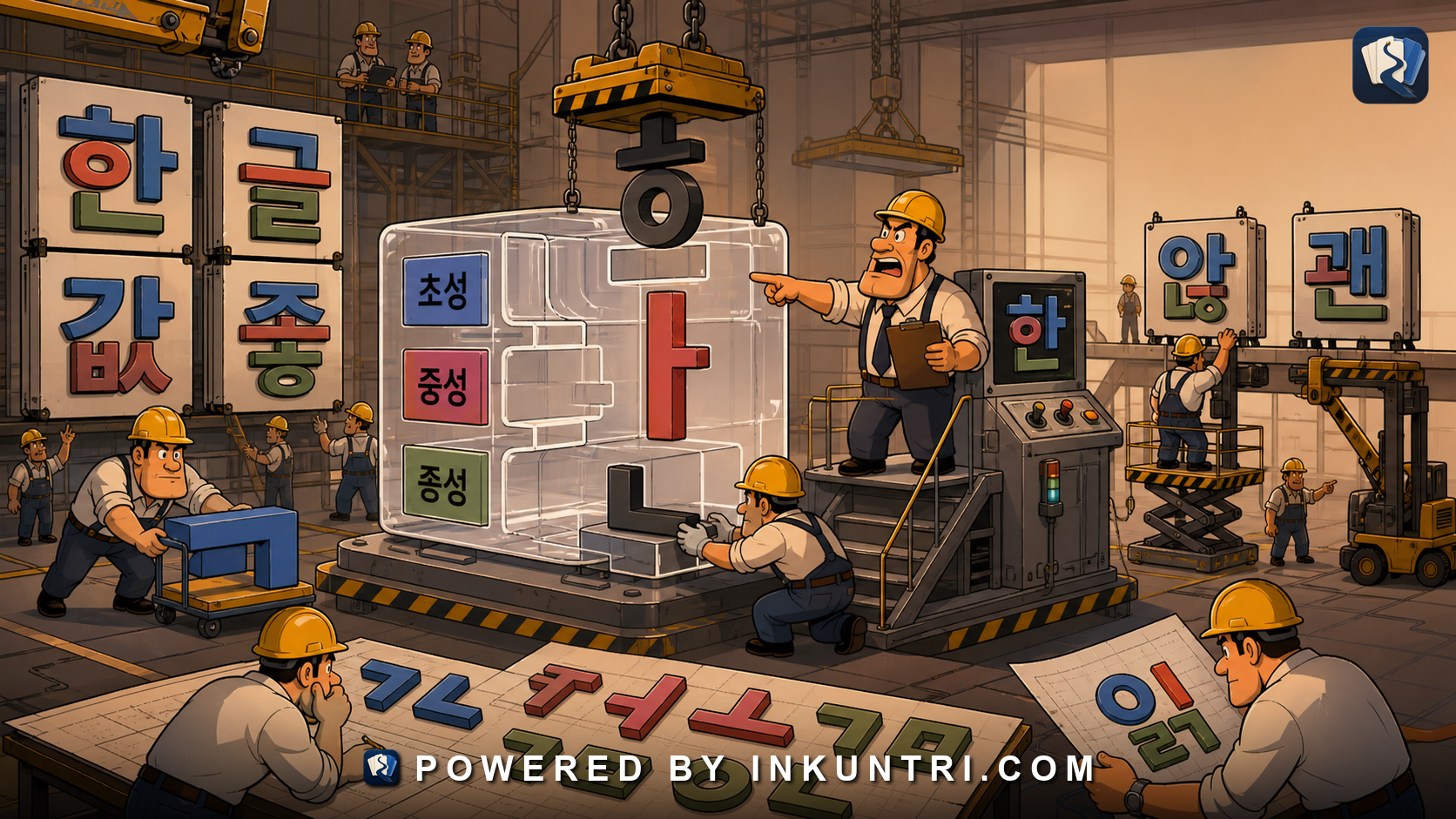
Core examples: 한, 글, 밥, 읽, 값, 좋, 앉, 괜.
The square shape is not the basic unit
Korean looks square because Hangul letters are packed into syllable blocks. That visual fact creates one of the most common beginner mistakes: treating each block as if it were a separate character to memorize.
A beginner may see 한국, 밥, 읽, and 값 as four kinds of square drawings. But the blocks are not indivisible pictures. They are combinations of smaller letters called jamo.
The word 한국 contains two syllable blocks:
- 한 = ㅎ + ㅏ + ㄴ
- 국 = ㄱ + ㅜ + ㄱ
The word 밥 is one block:
- 밥 = ㅂ + ㅏ + ㅂ
The block 읽 is more complex:
- 읽 = ㅇ + ㅣ + ㄺ
The block 값 is also more complex:
- 값 = ㄱ + ㅏ + ㅄ
If you learn blocks as pictures, Korean becomes artificially hard. If you learn blocks as structured combinations, the writing system becomes much more predictable.
The three positions: 초성, 중성, 종성
A standard Hangul syllable block can be described with three positions:
| Korean term | Meaning | Example in 한 |
|---|---|---|
| 초성 | initial consonant | ㅎ |
| 중성 | medial vowel | ㅏ |
| 종성 | final consonant, also called batchim in learner contexts | ㄴ |
Not every block has a final consonant. 가 has ㄱ as initial and ㅏ as vowel, but no final consonant. 한 has all three positions. Some blocks contain complex final clusters, such as 값 and 읽.
One important point: the written block is visual, but the reading order is phonological. You do not read 한 by scanning top-left, then bottom, then right in a purely visual way. You read the initial, then the vowel, then the final: ㅎ + ㅏ + ㄴ.
The silent-looking ㅇ is not optional decoration
A Korean syllable block must have an initial position. When a syllable begins with a vowel sound, Korean writes ㅇ in the initial slot.
Examples:
- 아 = ㅇ + ㅏ
- 이 = ㅇ + ㅣ
- 우 = ㅇ + ㅜ
- 안 = ㅇ + ㅏ + ㄴ
At the beginning of a syllable, ㅇ does not represent a pronounced consonant in standard Korean. It fills the initial position so the block can be formed. But in final position, ㅇ is pronounced [ŋ], as in 강, 방, and 사랑.
This dual role causes beginner confusion. ㅇ is not always “silent.” It is silent-like in initial position and nasal in final position.
Vowel layout determines block shape
Korean blocks look different depending on the vowel.
Vertical vowels such as ㅏ, ㅓ, ㅣ, ㅐ, and ㅔ sit to the right of the initial consonant:
- 가, 너, 미, 새, 게
Horizontal vowels such as ㅗ, ㅜ, ㅡ, ㅛ, and ㅠ sit below the initial consonant:
- 고, 무, 그, 교, 유
Compound vowels can create wider or more complex layouts:
- 과 = ㄱ + ㅘ
- 권 = ㄱ + ㅝ + ㄴ
- 괜 = ㄱ + ㅙ + ㄴ
- 의 = ㅇ + ㅢ
This is why Korean looks square even though it is alphabetic. The letters are arranged inside a visual box according to the shape of the vowel and the presence or absence of a final consonant.
Letter order and keyboard order are sound order
When you type Korean on a standard 2-set keyboard, you type jamo in sound order. The software assembles them into blocks.
To type 한, you type:
ㅎ → ㅏ → ㄴ
The input system then displays 한.
To type 글, you type:
ㄱ → ㅡ → ㄹ
The input system displays 글.
This matters because keyboard input reinforces the correct mental model. You are not searching for a key labeled 한. You are producing the block from letters.
Backspacing also reveals the structure. Depending on the system, deleting from a block may remove the final consonant first, then the vowel, then the initial. Digital behavior is a good reminder that the square block is assembled from parts.
Double finals are spelling information
Blocks such as 읽, 값, 앉, and 많 contain final clusters. These clusters are important for spelling, grammar, and dictionary lookup.
Examples:
| Block | Decomposition | Word example | Basic note |
|---|---|---|---|
| 읽 | ㅇ + ㅣ + ㄺ | 읽다 | final ㄺ cluster |
| 값 | ㄱ + ㅏ + ㅄ | 값 | final ㅄ cluster |
| 앉 | ㅇ + ㅏ + ㄵ | 앉다 | final ㄵ cluster |
| 많 | ㅁ + ㅏ + ㄶ | 많다 | final ㄶ cluster |
In isolation or before another consonant, final clusters often simplify in pronunciation. But before a vowel, one of the consonants may move forward or become audible through sound rules. That is why the written cluster must not be ignored.
The spelling is not trying to make pronunciation difficult. It is preserving the identity of the word stem.
Unicode also treats blocks as systematic combinations
Modern Korean text is encoded digitally in ways that reflect both precomposed syllable blocks and jamo structure. Most ordinary Korean text uses precomposed Hangul syllables such as 한, 글, 밥, and 값. But these syllables correspond to systematic combinations of initial, medial, and final elements.
You do not need to memorize Unicode formulas to read Korean. But it is useful to know that computers are not treating Hangul as a chaotic pile of square pictures. Digital systems can sort, search, compose, and decompose Korean because the block structure is regular.
This is why Korean input methods work so smoothly. The user types jamo; the software composes blocks.
Handwriting makes the same point
Printed Hangul can look very geometric. Handwritten Hangul reveals the same structure with more variation.
A fast handwritten 글 may look compressed. A handwritten 밥 may make the final ㅂ smaller. A handwritten 괜 may squeeze the compound vowel. But the positions remain meaningful. Initial, vowel, and final still organize the block.
Learners who only read clean fonts may struggle with forms, notes, restaurant signs, and casual handwriting. The solution is not to memorize every handwriting style. It is to strengthen block awareness so you can recognize the same jamo in different proportions.
Real learner errors come from bad block models
Many mistakes are not pronunciation mistakes at first. They are structural mistakes.
A learner may confuse:
- 무 and 모 because the horizontal vowels ㅜ and ㅗ are visually close.
- 라 and 마 because handwritten ㄹ and ㅁ can be misread.
- 밥 and 밤 because final ㅂ and ㅁ are both block-bottom consonants.
- 괜 and 관 because compound vowels are not decomposed correctly.
These errors improve when learners practice decomposition, not just copying.
A block-decomposition routine
Use this routine on every unfamiliar block:
- Find the initial consonant. What is in the 초성 position?
- Find the vowel. Is it vertical, horizontal, or compound?
- Check for final consonant. Is there a batchim? Is it single or double?
- Read in sound order. Initial → vowel → final.
- Reassemble. Confirm that the block shape makes sense.
Try it with 괜:
- initial: ㄱ
- vowel: ㅙ
- final: ㄴ
- reading: 괜
Try it with 좋:
- initial: ㅈ
- vowel: ㅗ
- final: ㅎ
- reading/spelling: 좋, with special pronunciation behavior in forms such as 좋아 and 좋다.
Mini practice: decompose before you memorize
Try decomposing these blocks without looking at romanization:
| Block | 초성 | 중성 | 종성 | Learner warning |
|---|---|---|---|---|
| 한 | ㅎ | ㅏ | ㄴ | straightforward block |
| 괜 | ㄱ | ㅙ | ㄴ | compound vowel must be recognized as one medial slot |
| 앉 | ㅇ | ㅏ | ㄵ | final cluster, not two separate syllables |
| 읽 | ㅇ | ㅣ | ㄺ | spelling and pronunciation diverge by context |
| 값 | ㄱ | ㅏ | ㅄ | root spelling matters for grammar |
A strong reader does not need to consciously decompose every syllable forever. The point is diagnostic. When a block looks confusing, return to 초성, 중성, 종성. If the block has no written initial sound, check whether ㅇ is filling the initial slot. If the bottom looks crowded, ask whether the final is a cluster.
A useful tool for this article would let users build blocks by dragging jamo into position.
Suggested functions:
- Drag-and-drop jamo: Build 가, 한, 글, 밥, 값, 읽, 괜.
- Position labels: Show 초성, 중성, 종성 as the user assembles the block.
- Keyboard preview: Display the exact key sequence on a 2-set keyboard.
- Pronunciation output: Show basic reading and warn when sound rules may change the surface pronunciation.
- Error mode: Present malformed blocks and ask the learner to fix them.
- Handwriting mode: Compare printed and handwritten versions of the same block.
Final rule
Korean looks square because Hangul letters are arranged into syllable blocks. The square shape is a layout system, not the deepest unit of writing.
Learn the jamo. Learn the positions. Learn how vowels shape the block. Learn how final consonants preserve spelling information. Once you see that 한국, 밥, 읽, and 값 are built from parts, Hangul stops being a wall of little boxes and becomes a readable alphabetic system.
Related reading
When CJK Comparison Helps Korean Learners and When It Becomes Noise
The reader can decide when Chinese/Japanese comparison accelerates Korean learning and when it creates false friends, grammar transfer, register mistakes, or institutional confusion.
Confucian Vocabulary in Korean Public Language
The reader can recognize Confucian-derived terms in modern Korean public language without treating them as timeless cultural essence.
Language Policy, Standardization, and Spacing Rules in Korea
The reader can understand Korean correctness debates as interactions among official norms, dictionaries, school practice, actual usage, and genre.
Sino-Korean Character Families Without Requiring Full Hanja Literacy
The reader can build Sino-Korean word families from recurring syllables without requiring full Hanja literacy.
Color Words in Korean: Tradition, Marketing, and Politics
The reader can classify Korean color words as literal description, traditional symbolism, political label, marketing style, or fixed expression.
Hanja Beneath Hangul: The Hidden Sino-Korean Layer
The reader can recognize the Sino-Korean layer behind Hangul words without needing to become a full Hanja reader on day one.