
How Korean Subtitles Compress Fast Speech
The reader can see how Korean subtitles compress fast speech while preserving enough grammar and discourse for viewers.
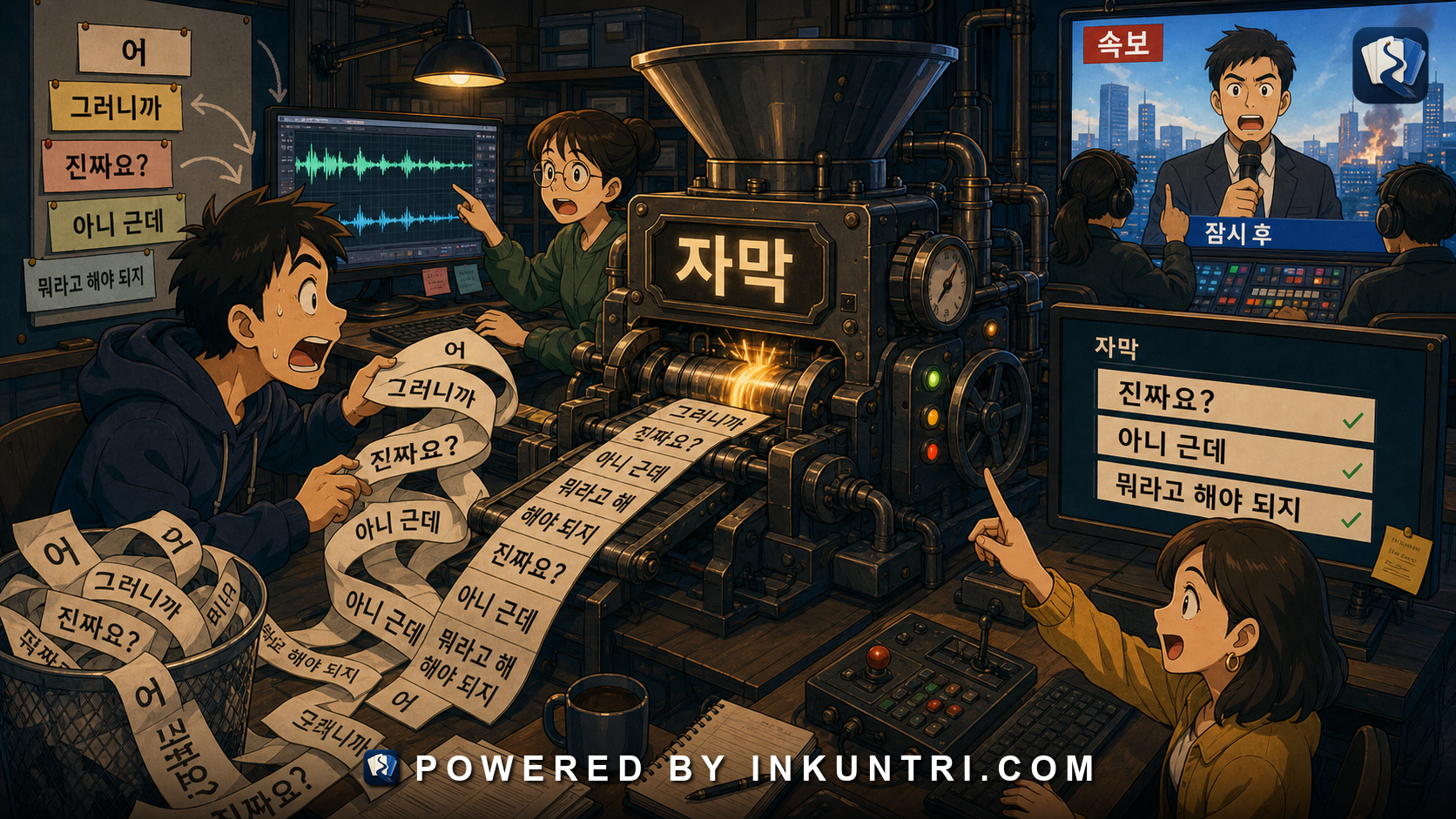
Core examples: 어, 그러니까; 진짜요?; 아니 근데; 뭐라고 해야 되지; 자막; 속보; 잠시 후.
Subtitles are not always transcripts
Learners often compare Korean audio with Korean subtitles and panic. The speaker says 어, 아니 근데, 그러니까, 뭐라고 해야 되지, and the subtitle shows a cleaner sentence. Or the subtitle includes a summary that does not match every syllable of the audio. The learner assumes the subtitle is wrong.
Sometimes it is wrong. More often, it is doing a different job.
Subtitles must fit time, space, readability, and viewer attention. They may preserve meaning while reducing hesitation, repetition, fillers, dialect features, false starts, or background talk. Variety-show captions may add editorial jokes. News captions may standardize wording. Drama subtitles may prioritize timing over exact transcription.
A subtitle can be a transcript, a condensation, a caption, or an editorial layer. Do not assume it is one thing.
The constraints are physical
A viewer cannot read unlimited text while watching moving images. Korean subtitles must fit on screen, stay long enough to read, and disappear at the right time. This forces compression.
Fast speech contains material that is communicatively useful but subtitle-expensive:
- fillers: 어, 음, 그러니까;
- repairs: 아니, 그게 아니라;
- hesitation: 뭐라고 해야 되지;
- repeated subjects or particles;
- incomplete clauses;
- overlapping speech;
- dialect or slang that may be standardized.
A full transcript may be valuable for learners, but a subtitle is made for viewers.
Particle omission is not always a subtitle error
Korean speech itself often drops particles when context is clear. Subtitles may drop even more when space is tight. For learners, this creates a double problem: spoken Korean may be elliptical, and the written caption may be compressed too.
A subtitle like 내일 회의 취소 may correspond to a fuller sentence such as 내일 회의가 취소됐어요. The caption is noun-heavy and compressed. This is normal in headlines, on-screen captions, and information graphics.
The learner should restore grammar as an exercise, not accuse the subtitle of being ungrammatical.
Variety-show captions are especially editorial
Korean variety shows often use captions not only to transcribe speech but to create humor, emphasize reactions, identify emotions, foreshadow jokes, or add commentary. These captions may include slang, sound effects, exaggerated punctuation, and playful spellings.
That means a variety-show caption may not be the best source for careful grammar study. It is a great source for discourse, timing, tone, and media literacy.
Ask: is this caption representing speech, explaining the scene, or making a joke?
News subtitles are cleaner but not neutral
News captions and on-screen text usually use more standard wording. 속보, 단독, 잠시 후, 현장 연결, and quoted summaries are common. These forms are compressed and institutional. They are not everyday conversation.
A news caption may turn a longer spoken explanation into a short noun phrase. It may also display names, titles, locations, dates, and organization names that are not spoken in exactly the same way.
For learners, news captions are useful for formal vocabulary and information structure, but they should not be treated as casual speech models.
Learner subtitles and auto-captions add another layer
YouTube auto-captions and learner-made subtitles can contain recognition errors, segmentation errors, or translation-influenced phrasing. Automatic captions may fail with background noise, dialect, overlapping speech, song lyrics, or specialized vocabulary.
This does not make them useless. It means you should compare sources. When possible, use clips with official subtitles, fan subtitles, transcript, and audio together. Differences are not only mistakes; they reveal the choices involved in representing speech.
A subtitle audit routine
Use this routine with a short clip:
- Listen once without subtitles and write the gist.
- Turn on subtitles and mark what is displayed.
- Listen again and mark fillers, repetitions, false starts, and omitted particles.
- Decide whether the subtitle is transcript, condensation, summary, or editorial caption.
- Restore a full sentence if the subtitle is compressed.
- Shadow the audio, not only the subtitle.
- Save one example of each compression type.
This routine turns mismatch into data.
Mini practice: restore the full sentence
| Caption-like Korean | Possible fuller form | What was compressed |
|---|---|---|
| 내일 회의 취소 | 내일 회의가 취소됐어요 | particle and predicate ending |
| 잠시 후 공개 | 잠시 후에 공개됩니다 | time particle and formal passive-like ending |
| 아니 근데 그게 | 아니, 그런데 그게 말이죠 | hesitation and discourse management |
| 진짜요? | 정말이에요? / 진짜예요? | register choice depends on speaker |
| 속보 | 속보입니다 | institutional headline compression |
| 뭐라고 해야 되지 | 뭐라고 해야 될지 모르겠어요 | hesitation expanded into full predicate |
The goal is not to force one “correct” expansion. It is to see how subtitle language compresses speech.
Suggested functions:
- Audio layer: original speech.
- Subtitle layer: displayed caption.
- Transcript layer: fuller transcription where available.
- Omission tags: filler, particle, repeated phrase, repair, dialect, overlap.
- Caption type label: transcript, condensation, summary, editorial joke, news headline.
- Shadowing mode: practice the spoken line after reading the compressed caption.
Final rule
A subtitle is not a promise to show every spoken syllable.
Treat subtitle mismatch as a reading skill: identify what was omitted, why it was omitted, and whether you should learn the caption, the spoken line, or both.
Related reading
When CJK Comparison Helps Korean Learners and When It Becomes Noise
The reader can decide when Chinese/Japanese comparison accelerates Korean learning and when it creates false friends, grammar transfer, register mistakes, or institutional confusion.
Hanja Beneath Hangul: The Hidden Sino-Korean Layer
The reader can recognize the Sino-Korean layer behind Hangul words without needing to become a full Hanja reader on day one.
Building a Korean Topical Reading Ladder From A1 to Advanced
The reader can build a long-term Korean reading ladder that moves from beginner-safe texts to serious domain reading without skipping the bridge stages.
How Sino-Korean Vocabulary Creates Formal and Technical Korean
The reader can use Sino-Korean roots to decode formal and technical Korean while avoiding false confidence.
Near-Synonym Field Guide: 고치다, 치료하다, 수정하다, 개선하다
The reader can choose the Korean repair verb based on whether the target is a machine, habit, illness, document, error, system, policy, or condition.
Why Knowing Chinese Helps Korean—and Where It Misleads You
The reader can use Chinese knowledge as a Korean vocabulary advantage while protecting against false friends, collocation errors, and Hangul-only ambiguity.