
How Korean Input Methods Shape Typing and Spelling
The reader can understand how Korean typing systems influence spelling, errors, autocorrect, and digital fluency.
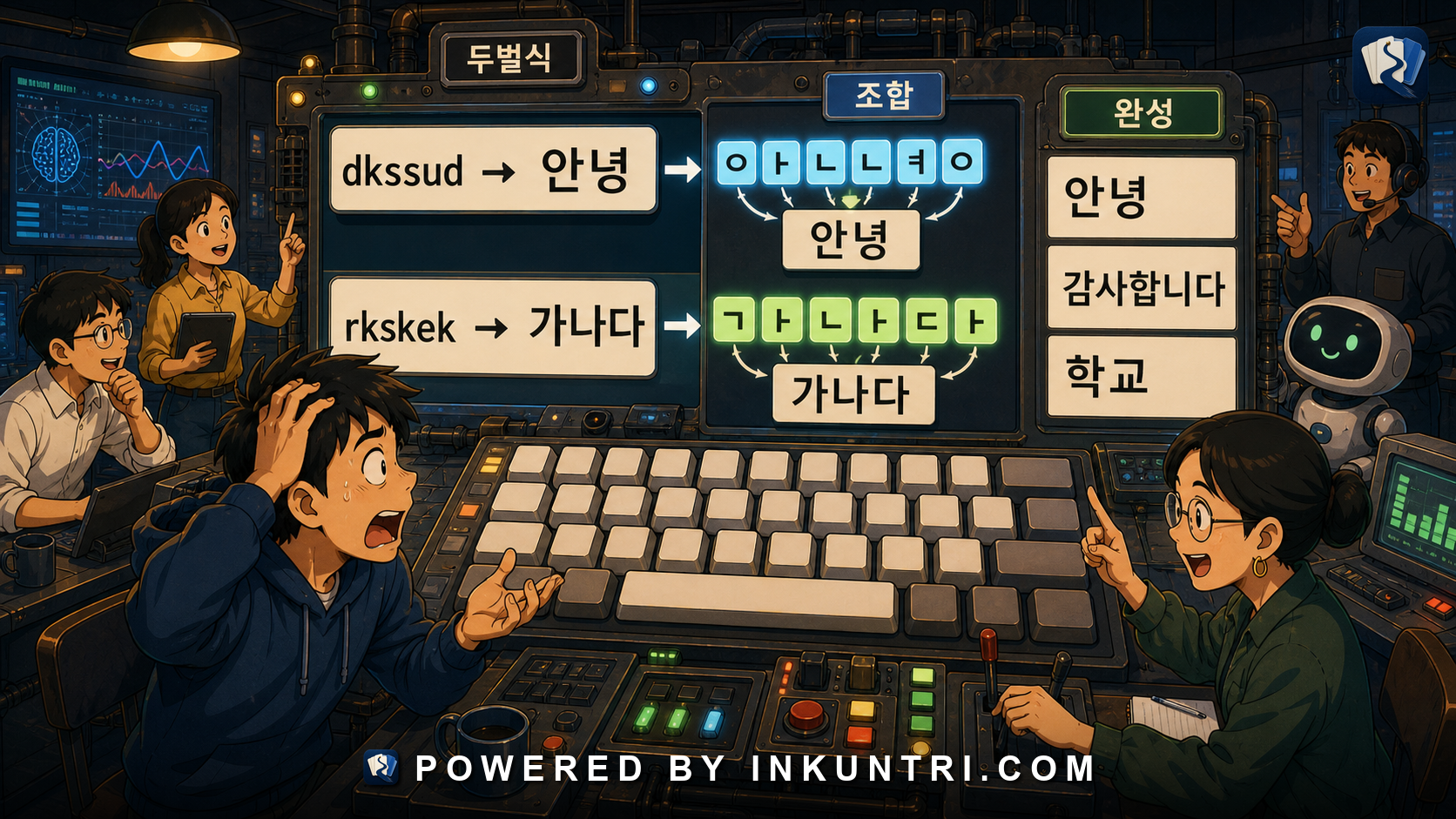
Core examples: 안녕; 감사합니다; 학교; dkssud→안녕; rkskek→가나다; ㅂㅈㄷㄱ/ㅛㅕㅑㅐ.
Typing Hangul teaches how Hangul works
A learner can recognize Hangul on paper and still freeze at a keyboard. That is not a minor inconvenience. Digital Korean is real Korean. Messaging, search, dictionaries, forms, subtitles, notes, and language apps all require typing.
Korean input methods also reveal the structure of Hangul. When you type 안녕, you are not choosing a whole square block from a menu. You type jamo in order, and the software assembles syllable blocks.
Typing therefore trains the right mental model:
Hangul blocks are composed, not selected as pictures.
The standard 2-set keyboard
The most common Korean keyboard layout is the 2-set keyboard, often called 두벌식. It places consonants mostly on the left side and vowels mostly on the right side.
The exact keyboard depends on device and settings, but a common mapping includes:
| QWERTY key | Korean jamo |
|---|---|
| r | ㄱ |
| s | ㄴ |
| e | ㄷ |
| f | ㄹ |
| a | ㅁ |
| q | ㅂ |
| t | ㅅ |
| d | ㅇ |
| w | ㅈ |
| c | ㅊ |
| z | ㅋ |
| x | ㅌ |
| v | ㅍ |
| g | ㅎ |
Vowels are on the right side:
| QWERTY key | Korean jamo |
|---|---|
| k | ㅏ |
| o | ㅐ |
| i | ㅑ |
| j | ㅓ |
| p | ㅔ |
| u | ㅕ |
| h | ㅗ |
| y | ㅛ |
| n | ㅜ |
| b | ㅠ |
| m | ㅡ |
| l | ㅣ |
This is why Korean keyboard learners often memorize strings such as:
- dkssud → 안녕
- rkskek → 가나다
Those roman-letter strings are not romanization. They are QWERTY key positions.
Typing order is pronunciation order
To type 한, you type ㅎ + ㅏ + ㄴ:
g + k + s → 한
To type 글, you type ㄱ + ㅡ + ㄹ:
r + m + f → 글
To type 안녕:
ㅇ + ㅏ + ㄴ + ㄴ + ㅕ + ㅇ d + k + s + s + u + d 안녕
The input method decides when to close one syllable and start the next. This is usually automatic, but it can create mistakes when the user types a wrong jamo or when the software interprets a final consonant as belonging to the previous block.
Backspacing reveals block structure
When you delete Korean text, many systems remove parts of the current syllable step by step. For example, deleting 한 may move through:
한 → 하 → ㅎ → empty
This behavior reminds you that 한 contains ㅎ, ㅏ, and ㄴ. The block is visually square but digitally compositional.
Different apps and operating systems may behave slightly differently, but the principle remains: Korean input methods are based on jamo composition.
Common typo patterns come from key position
Korean typos often reflect keyboard neighbors. If a learner knows the layout, typos become easier to diagnose.
For example, mistyping ㅓ and ㅏ can change a word because j and k are adjacent. Confusing ㅗ and ㅜ may happen because h and n are both on the vowel side but in different rows. Consonant mistakes may occur among nearby left-hand keys.
A Korean typo is not always a spelling misunderstanding. It may be a finger error.
This matters when reading chat, comments, search queries, and learner writing. Some errors are linguistic; others are mechanical.
Mobile keyboards add another layer
Mobile Korean input can use several layouts:
- full 2-set keyboard,
- 천지인-style layouts,
- swipe or flick systems,
- handwriting input,
- voice input,
- romanization-based input in some learner tools.
Native speakers may type very quickly on mobile systems that are not obvious to learners. Autocomplete and predictive text can correct or introduce errors. Spacing may become loose in chat. Repetition such as ㅋㅋㅋㅋ or ㅠㅠ is easy and socially meaningful.
For learners, the safest approach is to master one reliable input method first, usually a 2-set layout, then understand others as needed.
Romanization input is a crutch, not a destination
Some tools let users type Korean by romanization. For example, typing “annyeong” may produce 안녕. This can help at the very beginning, but it creates bad dependencies.
Romanization is inconsistent across systems, poor at representing Korean sound distinctions, and disconnected from native spelling habits. It also prevents your fingers from learning jamo directly.
For serious Korean study, type Hangul with a Korean keyboard. Your spelling, pronunciation awareness, dictionary lookup, and reading fluency will improve together.
Input methods affect search
Search engines and dictionaries often tolerate spacing and spelling variation, but not always.
If you type a word with the wrong jamo, the search result may fail or lead you somewhere else. If you type romanization, you may find learner pages instead of Korean sources. If you omit spacing, the result may still work, but you may miss exact matches.
Knowing how to type Korean lets you search Korean as Korean:
- dictionary headwords,
- government forms,
- menu items,
- names,
- addresses,
- grammar examples,
- news headlines,
- subtitles.
Digital literacy is part of language literacy.
Autocorrect can hide spelling weaknesses
Autocorrect and predictive input are useful, but they can hide mistakes. If your phone fixes 학교 after you mistype it, you may not notice which jamo you confused. If an app suggests 감사합니다 after a few letters, you may never practice the whole word.
Use autocomplete for real communication. Turn it off or ignore it during deliberate typing practice.
A learner who can type slowly but accurately will eventually type quickly. A learner who relies on prediction too early may never build reliable spelling instincts.
A typing practice routine
Use this routine:
- Learn the consonant side. Practice ㄱ ㄴ ㄷ ㄹ ㅁ ㅂ ㅅ ㅇ ㅈ ㅊ ㅋ ㅌ ㅍ ㅎ.
- Learn the vowel side. Practice ㅏ ㅓ ㅗ ㅜ ㅡ ㅣ and common compounds.
- Type by sound order. Initial → vowel → final.
- Practice real words. 안녕, 학교, 사람, 감사합니다, 괜찮아요.
- Diagnose typos. Ask whether the error is a key neighbor, a jamo confusion, or a spelling issue.
- Use Korean search. Look up real words in Korean dictionaries and websites.
Mini practice: diagnose the typo by keyboard position
Typing errors often reveal the keyboard, not the learner’s Korean knowledge.
| Intended | Common keyboard clue | What happened |
|---|---|---|
| 안녕 | dkssud | QWERTY positions were typed while keyboard layout was English |
| 가나다 | rkskek | key positions, not romanization |
| 학교 | gkrry | ㅎ+ㅏ+ㄱ+ㄱ+ㅛ typed in sound order |
| ㅐ/ㅔ errors | o/p keys are near each other | right-hand vowel-zone confusion |
| ㄱ/ㄷ/ㅅ errors | r/e/t keys are nearby | left-hand consonant-zone slip |
When a Korean search fails, try thinking like the input method. Was the keyboard in English mode? Did a vowel combine with the previous block? Did backspace remove a whole syllable or only the last jamo? These mechanical questions solve many “mystery” typos.
A strong tool for this article would show typing and block composition simultaneously.
Suggested functions:
- Keyboard map: Display Korean jamo on QWERTY keys.
- Live block builder: Show how typed jamo become syllables.
- Backspace animation: Demonstrate deletion through final, vowel, initial.
- Typo heat map: Highlight common adjacent-key errors.
- Practice mode: Type 안녕, 가나다, 학교, 감사합니다, 괜찮아요.
- Romanization warning: Compare romanization input with native keyboard input.
Final rule
Typing Korean is not an afterthought. It is Hangul practice in digital form.
Use a Korean keyboard, type jamo in sound order, watch syllable blocks assemble, and treat typos as evidence. The faster you stop depending on romanization input, the faster Korean becomes a working written language rather than a textbook object.
Related reading
When CJK Comparison Helps Korean Learners and When It Becomes Noise
The reader can decide when Chinese/Japanese comparison accelerates Korean learning and when it creates false friends, grammar transfer, register mistakes, or institutional confusion.
Using Speech Recognition Carefully for Korean Pronunciation
The reader can use speech recognition as a Korean pronunciation aid without treating it as an objective pronunciation judge.
Sino-Korean Character Families Without Requiring Full Hanja Literacy
The reader can build Sino-Korean word families from recurring syllables without requiring full Hanja literacy.
Hanja Beneath Hangul: The Hidden Sino-Korean Layer
The reader can recognize the Sino-Korean layer behind Hangul words without needing to become a full Hanja reader on day one.
Sentence Rhythm in Korean: Eojeol, Particles, and Breath Groups
The reader can understand Korean sentence rhythm through eojeol grouping, particles, verb endings, and breath units.
Korean Romanization Systems and Why They Frustrate Everyone
The reader can navigate Korean romanization without confusing it with Korean spelling or pronunciation itself.