
How Korean Children Learn Hangul and Then Academic Vocabulary
The reader can understand why Korean literacy does not stop at Hangul decoding and why academic vocabulary becomes the real bottleneck.
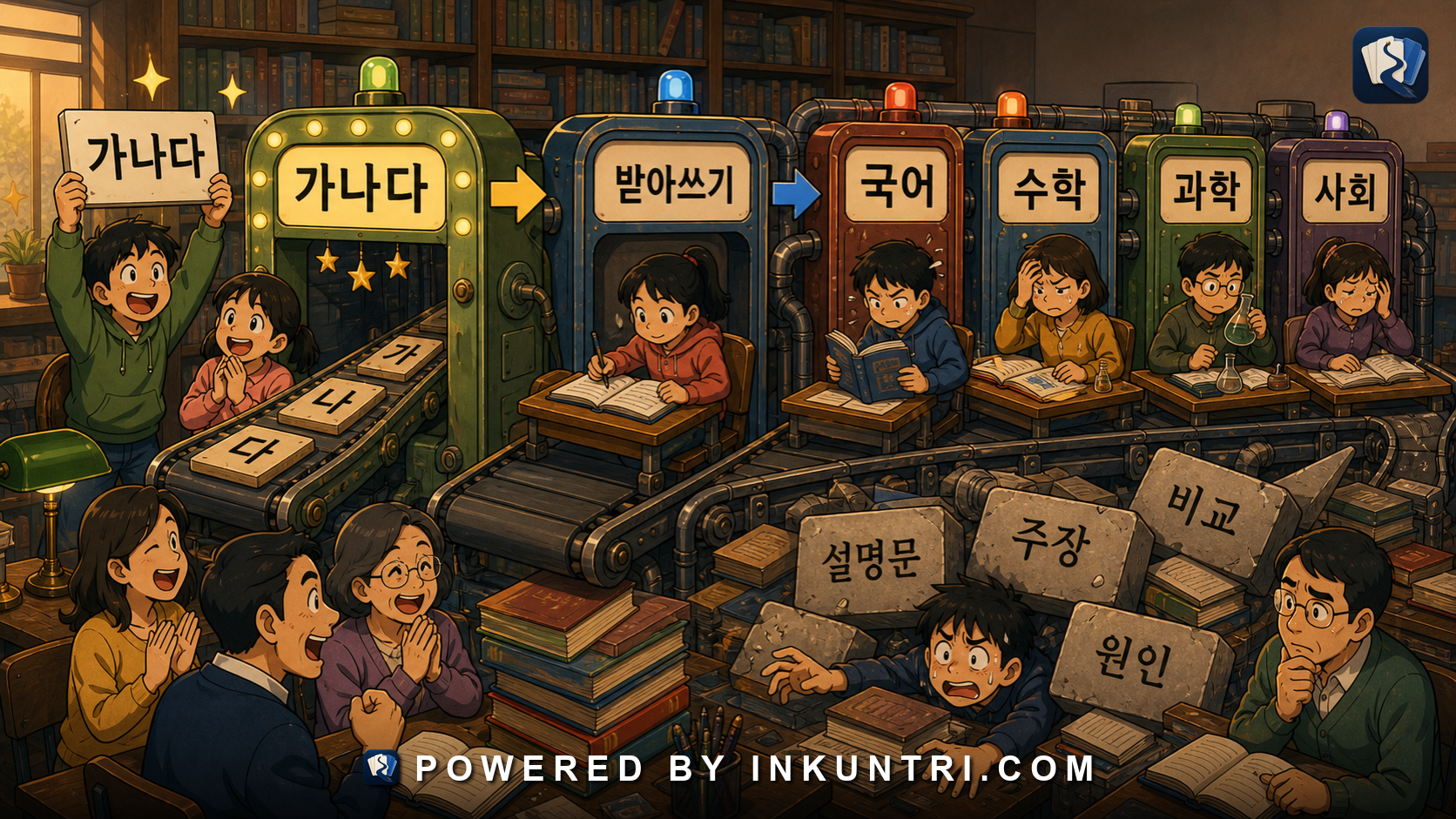
Core examples: 가나다; 받아쓰기; 국어; 수학; 과학; 사회; 설명문; 주장; 비교; 원인.
Decoding is the beginning, not the finish
Hangul is learnable quickly. That fact leads to a common misunderstanding: once a child or adult learner can read Hangul aloud, Korean reading should be easy.
But Korean literacy has layers. A child may decode 가나다 and still struggle with school vocabulary. An adult learner may sound out a paragraph and still miss the meaning because the text is full of Sino-Korean academic words, abstract nouns, and expository structures.
The real literacy question is not “Can you pronounce the syllables?” It is “Can you understand the genre, vocabulary, and reasoning carried by those syllables?”
Early Hangul learning focuses on mapping sound and block
Children and beginners learn jamo, syllable blocks, sound values, and simple words. They practice reading and writing syllables, distinguishing similar shapes, and connecting spoken words to written forms. 받아쓰기, dictation, trains the link between sound, spelling, and memory.
This stage is important. Without reliable decoding, later reading is slow and fragile. But decoding alone does not create comprehension.
A learner who can read 과학 aloud has not necessarily understood the word “science” in a school-textbook sense. A learner who can read 원인 and 결과 has not necessarily learned how Korean expository writing uses cause and effect.
Academic vocabulary becomes the bottleneck
Korean school and formal texts contain dense Sino-Korean vocabulary:
- 국어
- 수학
- 과학
- 사회
- 역사
- 설명문
- 주장
- 비교
- 원인
- 결과
- 과정
- 분석
- 개념
- 자료
These words are written in Hangul, but many are built from Hanja roots. The script is phonetic; the vocabulary layer is historical and conceptual.
This is why the slogan “Korean has an easy alphabet” can mislead adult learners. The alphabet may be accessible, but academic Korean requires vocabulary networks.
School genres teach ways of thinking
Children do not only learn words. They learn genres: explanation, argument, comparison, summary, report, story, poem, problem-solving, and evidence-based answer.
Words such as 설명문, 주장, 비교, 원인, 근거, 예시, 결론, and 요약 are genre tools. They tell the reader what kind of thinking the text expects.
Adult learners should borrow this insight. Reading Korean news, essays, manuals, and academic articles is easier when you recognize genre signals, not just sentence grammar.
Fluency is a separate layer
A child may know a word but read too slowly to hold the sentence in memory. Adult learners face the same issue. If every syllable requires effort, comprehension suffers.
Fluency means recognizing common syllable blocks, endings, particles, and word families quickly enough that attention is available for meaning. It comes from repeated exposure, not from alphabet memorization alone.
This is why graded reading, repeated reading, and topic-based vocabulary help. They reduce decoding load and build automatic recognition.
Background knowledge matters
A passage about photosynthesis, elections, economics, or climate does not become easy simply because the Hangul is familiar. The reader needs background knowledge and domain vocabulary.
For Korean learners, this is especially important because many intermediate textbooks underprepare readers for real informational prose. A learner may know daily conversation but not know terms like 증가, 감소, 비율, 원인, 분석, 정책, or 기준.
Reading growth requires domain expansion.
A literacy-growth plan
Separate five layers:
- Decoding: Can you read the Hangul accurately?
- Fluency: Can you read it quickly enough to hold meaning?
- Vocabulary: Do you know the words and word families?
- Genre: Do you know what kind of text it is?
- Background knowledge: Do you understand the topic world?
When reading fails, diagnose the layer. Do not blame all problems on grammar.
Mini practice: classify the barrier
| Item | Surface skill | Deeper literacy demand |
|---|---|---|
| 가나다 | jamo and syllable decoding | early alphabet fluency |
| 받아쓰기 | sound-spelling mapping | accurate orthographic memory |
| 국어 | school subject word | academic domain vocabulary |
| 과학 | school subject word | concept-heavy reading |
| 사회 | subject and abstract noun | context resolves meaning |
| 설명문 | genre term | expository structure |
| 주장 | argument vocabulary | stance and evidence |
| 비교 | academic operation | contrastive reading |
| 원인 | cause term | logical relation in text |
Suggested functions:
- Layer map: decoding, fluency, vocabulary, genre, background knowledge.
- Word-family builder: groups academic Sino-Korean terms by recurring syllables.
- Genre cards: 설명문, 주장문, 보고서, 기사, 안내문.
- Dictation mode: connects 받아쓰기 to spelling and listening.
- Reading diagnosis: users mark where comprehension broke down.
Final rule
Hangul literacy begins with decoding but matures through vocabulary, genre, fluency, and knowledge.
Do not stop at “I can sound it out.” Ask whether you can understand what kind of text it is, what domain it belongs to, and what argument or explanation it is building.
Related reading
When CJK Comparison Helps Korean Learners and When It Becomes Noise
The reader can decide when Chinese/Japanese comparison accelerates Korean learning and when it creates false friends, grammar transfer, register mistakes, or institutional confusion.
Confucian Vocabulary in Korean Public Language
The reader can recognize Confucian-derived terms in modern Korean public language without treating them as timeless cultural essence.
Language Policy, Standardization, and Spacing Rules in Korea
The reader can understand Korean correctness debates as interactions among official norms, dictionaries, school practice, actual usage, and genre.
Sino-Korean Character Families Without Requiring Full Hanja Literacy
The reader can build Sino-Korean word families from recurring syllables without requiring full Hanja literacy.
Color Words in Korean: Tradition, Marketing, and Politics
The reader can classify Korean color words as literal description, traditional symbolism, political label, marketing style, or fixed expression.
Hanja Beneath Hangul: The Hidden Sino-Korean Layer
The reader can recognize the Sino-Korean layer behind Hangul words without needing to become a full Hanja reader on day one.