
Hangul as a Scientific Script: What That Claim Gets Right and Wrong
The reader can separate the real design strengths of Hangul from simplistic claims about perfection or total transparency.
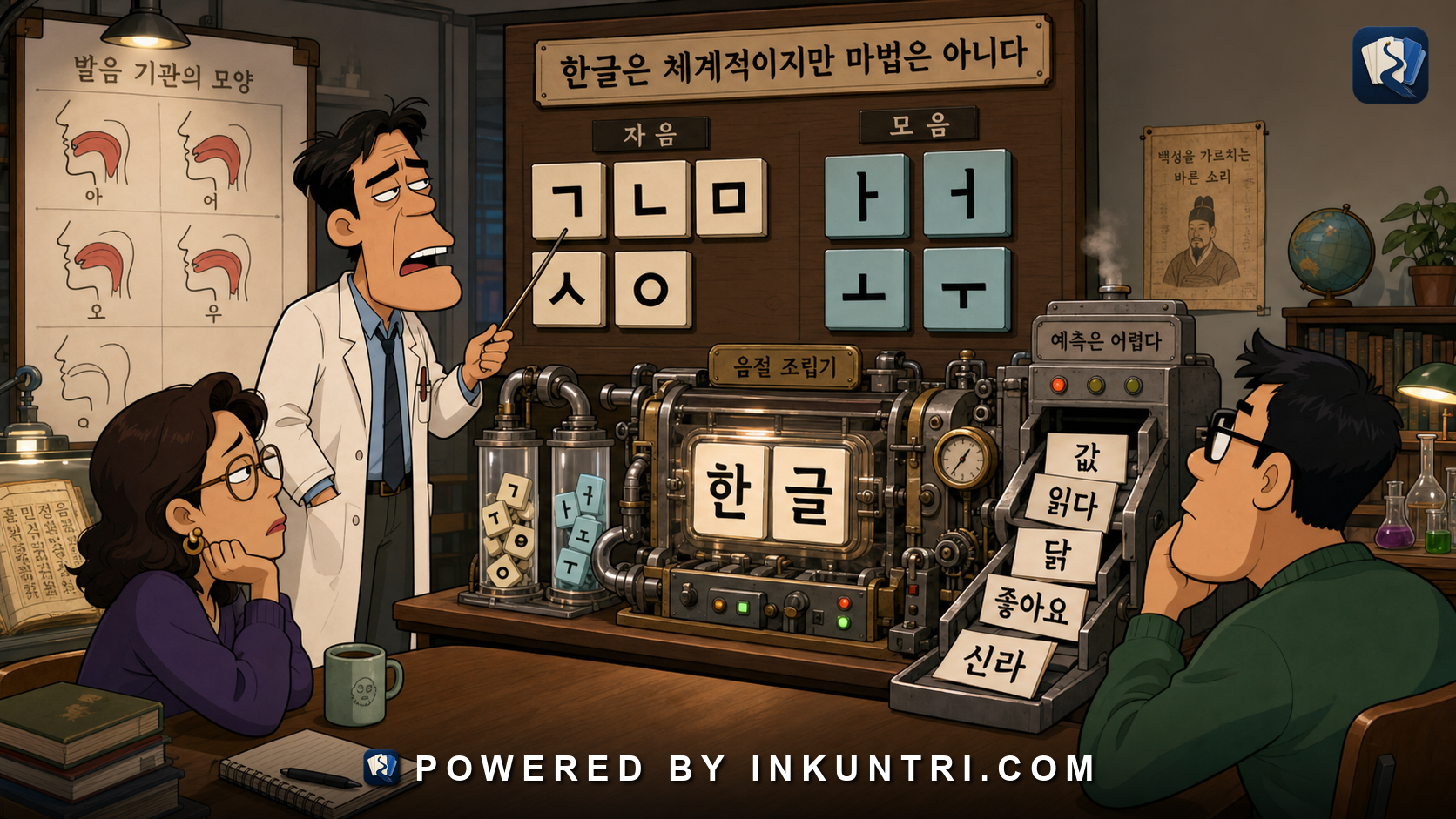
Core examples: ㄱ, ㄴ, ㅁ, ㅅ, ㅇ; ㅏ, ㅓ, ㅗ, ㅜ; 한글; 훈민정음; 사람; 값.
The slogan is useful, but dangerous
Hangul is often introduced with a flattering shortcut: “Korean has a scientific alphabet.”
That statement is not empty praise. Hangul really was designed with unusual explicitness. Its consonant letters were organized around articulatory ideas. Its vowel letters were built from a small set of visual elements. Its syllable blocks gave Korean a compact writing system that could represent native Korean grammar more directly than Chinese characters could. The historical document associated with the script, Hunminjeongeum, even explains the logic behind the letters rather than presenting them as arbitrary marks.
But the slogan becomes dangerous when it makes learners think Hangul is perfectly phonetic, effortless, or self-explanatory. Modern Korean spelling is not a simple sound recorder. It preserves roots, grammatical endings, historical distinctions, and standard conventions. A learner can memorize the alphabet quickly and still misread 같이, 값, 읽다, 닭, 좋아요, or 신라. The script is brilliantly designed, but it is still a living orthography attached to a real language.
A better first rule is this:
Hangul is systematic, not magical.
Systematic writing helps you learn faster. It does not remove the need to study pronunciation, spelling, morphology, spacing, register, names, typography, or real-world usage.
What “scientific” gets right
The strongest case for calling Hangul scientific is the relationship between letter shapes and speech organs.
The basic consonant letters are traditionally explained through the shape or position of the articulators:
| Letter | Rough articulatory idea | Example |
|---|---|---|
| ㄱ | back of tongue near soft palate | 가, 국 |
| ㄴ | tongue touching upper gums | 나, 눈 |
| ㅁ | closed lips | 마음, 몸 |
| ㅅ | tooth-like shape | 사람, 옷 |
| ㅇ | throat/open circle in initial position; final nasal sound in modern Korean | 아이, 강 |
This does not mean the letters are anatomical diagrams in a modern phonetics textbook. It means the system was designed with a visible internal logic. Related consonants were then built by adding strokes or modifying the base shapes. Learners can use this to see ㄱ, ㅋ, and ㄲ as members of a family, not as random symbols.
The vowels also have internal design logic. The traditional explanation uses three basic visual elements: a dot or short stroke associated with heaven, a horizontal line associated with earth, and a vertical line associated with human beings. In modern printed Hangul, the original dot is represented as a short stroke in letters such as ㅏ, ㅓ, ㅗ, and ㅜ.
Again, the practical learner lesson is not mysticism. It is pattern recognition. The vowels are not random curves. They form a small visual system that combines into ㅏ, ㅓ, ㅗ, ㅜ, ㅑ, ㅕ, ㅛ, ㅠ, ㅐ, ㅔ, ㅘ, ㅝ, ㅢ, and so on.
Syllable blocks are another design strength
Hangul letters, called jamo, do not usually appear in a straight alphabetic line. They are arranged into syllable blocks:
- ㅎ + ㅏ + ㄴ → 한
- ㄱ + ㅡ + ㄹ → 글
- ㅅ + ㅏ + ㄹ + ㅏ + ㅁ → 사람, written as two blocks: 사 + 람
A block normally has an initial consonant, a vowel, and sometimes a final consonant. This gives written Korean a distinctive square appearance. The word 한글 is alphabetic at the letter level, but visually block-based at the syllable level.
This design gives readers fast access to syllable structure. It also lets Korean mix well with Chinese characters historically and with compact vertical or horizontal layouts. But syllable blocks can mislead beginners. 한 is not one indivisible character like a Chinese character. It is a block made from ㅎ, ㅏ, and ㄴ. If you treat every block as a memorized picture, you throw away the alphabetic advantage.
What the slogan hides
The first hidden problem is sound change.
The word 같이 is written with ㅌ, but the standard pronunciation is [가치]. The word 국물 is written with ㄱ followed by ㅁ, but it is pronounced [궁물]. The word 신라 is written ㄴ + ㄹ across a syllable boundary, but pronounced [실라]. These are not exceptions caused by sloppy speech. They are normal Korean sound patterns.
The second hidden problem is morphophonemic spelling. Korean often preserves the written form of a root even when its surface pronunciation changes. This helps readers see related forms, but it means spelling is not always pronunciation.
Take 값. As a standalone form, it is pronounced [갑]. But when a vowel follows, as in 값이, the hidden ㅅ can reappear in pronunciation: [갑씨] in the standard analysis after the relevant sound changes. The spelling keeps information that the final sound alone does not show.
The third hidden problem is literacy beyond decoding. Knowing Hangul does not mean you understand Korean vocabulary. A Korean child can learn to sound out Hangul before being able to read academic words such as 경제, 사회, 법률, 정책, or 민주주의. Adult learners face the same wall. Hangul decoding is only the doorway.
Hangul is easy to begin, not easy to finish
It is fair to say that Hangul is easier to learn at the beginning than many writing systems. A motivated learner can understand the basic letter inventory and block structure quickly. This is a real gift. Korean does not require a beginner to memorize thousands of characters before reading basic words.
But beginner-friendly is not the same as shallow.
To read Korean well, you need to know:
- how syllable blocks are assembled,
- how batchim works,
- which sound changes are likely,
- when spelling preserves a root,
- how spacing marks grammar,
- how Sino-Korean vocabulary works,
- how names and Hanja interact,
- how formal documents compress information,
- how typography and punctuation affect real reading.
The alphabet gets you moving. The language still has depth.
Why Hangul matters for dictionary lookup
Hangul’s design helps lookup, but only if you decompose correctly.
Suppose you see 값. A beginner may copy the whole block into a dictionary. That works digitally, but it does not teach the structure. The block is ㄱ + ㅏ + ㅄ. The final cluster matters because it connects 값 to forms such as 값이 and 값은.
Suppose you see 읽다. The block 읽 contains ㅇ + ㅣ + ㄺ. The written cluster ㄺ is part of the spelling. Pronunciation may simplify depending on the environment, but the dictionary form preserves the written stem.
A serious learner should train both digital convenience and structural awareness. Copy-paste will save you. Decomposition will teach you.
Cross-CJK comparison helps only if used carefully
Hangul is often compared with Chinese characters and Japanese kana. Those comparisons can be useful, but they can also distort the picture.
Unlike Chinese characters, Hangul is alphabetic at the letter level. Unlike Japanese kana, Hangul letters are assembled into syllable blocks rather than written as one symbol per mora. Unlike romanization, Hangul is the native standard writing system, not a pronunciation aid.
Korean also has a major Sino-Korean vocabulary layer historically connected to Chinese characters. That means Hangul-only writing can hide Hanja roots. The word 학교 is easy to read aloud in Hangul, but its relationship to 학생, 학습, 학문, and 대학 becomes clearer when you know the Hanja root 學.
So Hangul solved one problem: representing Korean sound and grammar with a native script. It did not erase the historical vocabulary layer.
A learner workflow: jamo, block, sound, spelling
Use this routine when you meet a new Korean word:
- Identify the jamo. Break each block into letters.
- Assemble the block. Notice initial, vowel, and final position.
- Predict the basic pronunciation. Read the letters in sound order, not visual order.
- Check for sound rules. Look for batchim, following vowels, nasals, ㄹ, ㅎ, and palatalization environments.
- Check the dictionary form. Ask whether spelling preserves a root or grammatical pattern.
- Learn the word in context. Hangul gives pronunciation clues; usage gives meaning.
For 사람, the routine is simple: 사 + 람, read [사람]. For 값, it is not simple: ㄱ + ㅏ + ㅄ, final sound [갑] in isolation, but different behavior before vowels and endings.
Mini practice: separate design from pronunciation
Use three columns when a new Hangul word looks deceptively simple:
| Word | What the spelling shows | What must still be checked |
|---|---|---|
| 사람 | transparent jamo and block structure | vocabulary meaning and usage |
| 같이 | spelling preserves ㅌ in the written form | palatalized pronunciation [가치] |
| 값 | final cluster ㅄ preserves root information | isolation [갑], forms such as 값이 [갑씨] |
| 신라 | clear written ㄴ + ㄹ boundary | lateralized pronunciation [실라] |
The exercise is not to prove Hangul is difficult. It is to stop treating the script slogan as a substitute for analysis. For every new item, ask whether the script is giving you letter logic, syllable-block logic, root spelling, pronunciation, or historical vocabulary information. Sometimes it gives several of those at once; sometimes one layer hides another.
A strong tool for this article would let readers move from design to real usage.
Suggested functions:
- Jamo anatomy view: Show the basic consonants and traditional articulatory explanations.
- Vowel construction view: Build ㅏ, ㅓ, ㅗ, ㅜ and their iotized or compound forms.
- Block assembler: Combine jamo into syllable blocks such as 한, 글, 값, 읽.
- Pronunciation overlay: Add standard pronunciation when spelling and sound diverge.
- Historical note layer: Show brief notes on Hunminjeongeum without turning the article into a history lecture.
- Reality check mode: Present words where Hangul is transparent and words where sound rules intervene.
Final rule
Celebrate Hangul’s design, but do not flatten it into a slogan.
Hangul is scientific in the sense that it was deliberately designed, internally patterned, and unusually transparent at the letter level. It is not scientific in the sense of being a perfect one-symbol-one-sound machine for modern Korean.
The serious learner’s advantage is not believing that Hangul is easy. It is learning exactly where Hangul is systematic, where spelling protects grammar, and where modern pronunciation must be studied on its own terms.
Related reading
When CJK Comparison Helps Korean Learners and When It Becomes Noise
The reader can decide when Chinese/Japanese comparison accelerates Korean learning and when it creates false friends, grammar transfer, register mistakes, or institutional confusion.
Hanja Beneath Hangul: The Hidden Sino-Korean Layer
The reader can recognize the Sino-Korean layer behind Hangul words without needing to become a full Hanja reader on day one.
Near-Synonym Field Guide: 고치다, 치료하다, 수정하다, 개선하다
The reader can choose the Korean repair verb based on whether the target is a machine, habit, illness, document, error, system, policy, or condition.
Why Knowing Chinese Helps Korean—and Where It Misleads You
The reader can use Chinese knowledge as a Korean vocabulary advantage while protecting against false friends, collocation errors, and Hangul-only ambiguity.
A Serious Learner’s Guide to Korean Dictionaries
The reader can choose the right dictionary type for meaning, usage, Hanja layer, pronunciation, collocation, example sentences, and domain terminology.
Building a Korean Reader Workflow From News, Essays, Dramas, and Forms
The reader can build a balanced Korean reading workflow that combines polished prose, spoken dialogue, domain documents, and repeatable annotation habits.