
Reading Japanese Addresses: Prefecture, Ward, Chōme, Banchi, and Building Names
The reader can parse Japanese addresses from large administrative units down to block and building information.
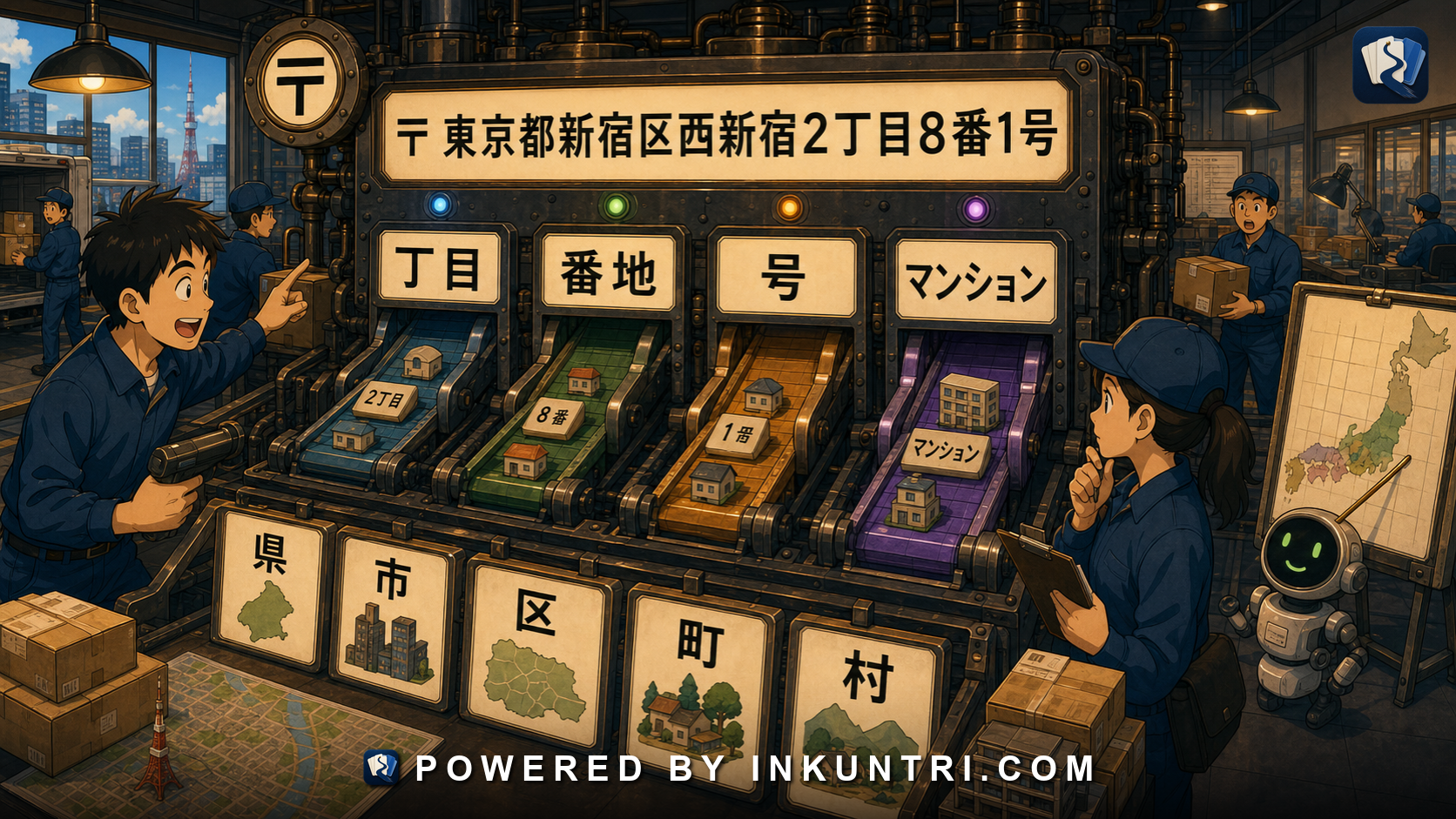
Core examples: 〒, 東京都新宿区西新宿2丁目8番1号, 丁目, 番地, 号, マンション, 県/市/区/町/村.
The address that looks backward until it doesn’t
A learner sees a Japanese address:
〒160-0023 東京都新宿区西新宿2丁目8番1号
At first, it can feel backward. Where is the street? Which number is the building? Why does the address begin with Tokyo instead of ending with it? What does 丁目 mean? Is 番 the same as street number? Why does the building name sometimes come after everything else? Why do some addresses have 番地 and others have 番 and 号?
The difficulty is not vocabulary alone. It is architecture.
Japanese addresses often move from large unit to small unit:
prefecture/metropolis → city/ward/town/village → district → chōme → block/lot/building number → building name → room number
This is different from many Western-style street-address systems, where the street number and street name lead the address.
The key principle is:
A Japanese address is usually a hierarchy of areas and numbered subdivisions, not primarily a street-name sentence.
Once you read the hierarchy, the address stops being a puzzle.
Start with 〒: the postal mark
The symbol 〒 marks postal code information. It is often followed by a seven-digit postal code:
〒160-0023
Japanese postal codes are usually written as three digits, hyphen, four digits. The postal code can help narrow the region and is important for forms, shipping, navigation, and delivery.
On a Japanese form, you may see:
郵便番号 〒 住所
Learner action: when filling forms, enter the postal code exactly as requested. Some forms want half-width digits, some accept hyphens, and some auto-fill part of the address after you enter the code.
Administrative units: 県, 都, 府, 道
At the largest ordinary address level, Japan is divided into prefectural-level units.
Common labels:
- 都 — metropolis, as in 東京都
- 道 — circuit/prefecture, as in 北海道
- 府 — urban prefecture, as in 大阪府, 京都府
- 県 — prefecture, as in 神奈川県, 福岡県, 長野県
Examples:
東京都 Tokyo Metropolis
大阪府 Osaka Prefecture
北海道 Hokkaidō
神奈川県 Kanagawa Prefecture
These are not decorative endings. They tell you the administrative level.
A learner should not translate every unit too literally while reading. Recognize the suffix as a level marker.
Municipalities: 市, 区, 町, 村
Below the prefectural level, addresses include municipalities and local administrative units.
Common labels:
- 市 — city
- 区 — ward
- 町 — town or district, depending on context
- 村 — village
Examples:
横浜市 Yokohama City
新宿区 Shinjuku Ward
箱根町 Hakone Town
山中湖村 Yamanakako Village
In Tokyo’s 23 special wards, 区 functions as a major municipal unit. In other cities, 区 may be a ward within a city, such as 大阪市北区.
This means 区 does not always occupy exactly the same administrative role everywhere. The address hierarchy tells you how it is functioning.
District and neighborhood names
After city or ward, you often get a district or neighborhood name:
西新宿 銀座 渋谷 浅草 中央 丸の内
These names are not always street names. They may be area names, neighborhood names, or administrative district labels.
Example:
東京都新宿区西新宿
This means:
- 東京都 — Tokyo Metropolis
- 新宿区 — Shinjuku Ward
- 西新宿 — Nishi-Shinjuku area
The address then continues into numbered subdivisions.
丁目: chōme as district subdivision
丁目 is a numbered subdivision within a district or neighborhood. It is often written with Arabic digits:
2丁目
or kanji numerals:
二丁目
Example:
西新宿2丁目
This means the second chōme of Nishi-Shinjuku.
Learners sometimes mistake 丁目 for a street number. It is not a street number in the ordinary English sense. It is an area subdivision.
A practical reading:
西新宿2丁目 Nishi-Shinjuku, 2-chōme
In spoken Japanese, 2丁目 is often read:
にちょうめ
番, 番地, and 号
After 丁目, addresses often use numbers with 番, 番地, and 号.
Common patterns:
2丁目8番1号 2-chōme, block 8, building/lot 1
2丁目8番地1 2-chōme, banchi 8-1
2-8-1 compact form representing the same general structure in many contexts
The relationship among 番, 番地, and 号 can vary by local addressing system and style. The learner does not need to become a land registry expert to read everyday addresses, but they should understand the function:
- 丁目: district subdivision
- 番 / 番地: block or lot-related number
- 号: building or final number in the address sequence
In practical navigation, these numbers narrow the location within the area.
Compact address notation: 2-8-1
Japanese addresses are often written compactly:
東京都新宿区西新宿2-8-1
This usually corresponds to a fuller form:
東京都新宿区西新宿2丁目8番1号
This compact style is common in maps, websites, business addresses, delivery forms, and navigation apps.
Learner action: when you see hyphenated numbers after a district name, mentally expand them as chōme-block-building/lot sequence.
But be cautious: not every area uses the same pattern, and rural addresses or older systems may behave differently. Use map tools when precision matters.
Building names and room numbers
Japanese addresses often include building names, apartment names, floor numbers, or room numbers after the main land address.
Examples:
〇〇ビル3階 〇〇 Building, 3rd floor
さくらマンション101号室 Sakura Mansion, Room 101
ABCタワー12F ABC Tower, 12th floor
山田アパート202 Yamada Apartment, Room 202
Common terms:
- ビル — building
- マンション — apartment/condominium building, often more substantial than English “mansion”
- アパート — apartment building, often smaller/older
- 号室 — room number
- 階 — floor
- F — floor, from English-style notation
- 棟 — building/block within a complex
The building name may be essential for delivery even if the land address gets you close.
Address order on forms
Japanese forms often ask for address in parts:
郵便番号 都道府県 市区町村 町名・番地 建物名・部屋番号
These labels correspond to the hierarchy.
A learner filling a form should not paste the whole address into the wrong field if the form expects separated parts.
Typical field meanings:
- 郵便番号 — postal code
- 都道府県 — prefecture/metropolis level
- 市区町村 — city/ward/town/village
- 町名 — town/neighborhood name
- 番地 — address number
- 建物名 — building name
- 部屋番号 — room number
Some forms auto-fill 都道府県 and 市区町村 from the postal code. Others require manual entry.
Addresses in translation
When translating a Japanese address into English, you may reverse the order for readability:
Japanese order:
〒160-0023 東京都新宿区西新宿2丁目8番1号
English-style order:
2-8-1 Nishi-Shinjuku, Shinjuku-ku, Tokyo 160-0023, Japan
But for mailing to Japan, preserving Japanese order is often safest, especially if the address will be handled domestically. Many international forms have their own field structure.
The practical rule:
For Japanese domestic delivery, preserve the Japanese address as accurately as possible. For English explanation, you may reverse or gloss the hierarchy.
Do not over-translate building names or district names unless needed.
Place names and readings
Address kanji can have difficult readings. Place names are not always predictable from ordinary kanji readings.
Examples:
- 日本橋 can be にほんばし or にっぽんばし depending on location.
- 上野 is うえの.
- 神戸 is こうべ.
- 難波 is なんば.
- 札幌 is さっぽろ.
Furigana may not be provided in addresses. Map apps, official websites, and station signs often help.
Learner action: treat place names like names. Confirm readings instead of deriving them mechanically.
Rural and exceptional addresses
Not all Japanese addresses fit the neat urban pattern. Rural areas, land-lot systems, Kyoto-style addresses, islands, historical districts, and special institutional addresses may behave differently.
Kyoto addresses, for example, can include street-based descriptions and directional terms that differ from the standard chōme-banchi pattern. Rural addresses may use 大字 and 字. Some places rely heavily on local knowledge.
Common terms you may encounter:
- 大字 — larger traditional section
- 字 — smaller section
- 丁 — alternative subdivision marker in some contexts
- 番外地 — unnumbered/special land designation
- 無番地 — no lot number
The ordinary learner does not need to master every exception at once. But they should know that exceptions exist.
Example bank walkthrough
〒
Marks postal code. Often appears before seven digits.
Learner action: recognize it immediately on forms and labels.
東京都新宿区西新宿2丁目8番1号
A model address showing large-to-small hierarchy.
Learner action: parse it as Tokyo → Shinjuku Ward → Nishi-Shinjuku → 2-chōme → 8-ban → 1-gō.
丁目
District subdivision. Often appears after neighborhood name.
Learner action: do not treat it as a street number.
番地
Lot/block-related address marker.
Learner action: read it as a narrowing address number within the area.
号
Final number marker, often building/lot number depending on address structure.
Learner action: keep it attached to the preceding number.
マンション
Apartment/condominium building, not an English mansion.
Learner action: in addresses, treat it as building type/name context.
県 / 市 / 区 / 町 / 村
Administrative suffixes.
Learner action: use them to identify address hierarchy.
Address parser workflow
When reading a Japanese address, use this sequence:
- Postal code: Find 〒 and postal digits.
- Prefecture level: Identify 都, 道, 府, or 県.
- Municipality: Find 市, 区, 町, or 村.
- District/neighborhood: Identify the area name after the municipality.
- Chōme: Look for 丁目 or the first hyphenated number.
- Block/lot numbers: Parse 番, 番地, 号, or hyphen sequence.
- Building: Identify ビル, マンション, アパート, タワー, etc.
- Room/floor: Look for 号室, 階, F, or room number.
- Confirm on map: Especially when delivery or travel matters.
A strong tool for this article would let users paste a Japanese address and see its layers.
Suggested functions:
- Segment highlighter: Color postal code, prefecture, municipality, district, chōme, banchi, gō, building, room.
- Hierarchy diagram: Large-to-small administrative tree.
- Compact expansion: Convert 2-8-1 into 2丁目8番1号.
- Form-fill mode: Place each segment into Japanese web-form fields.
- Reading support: Add furigana for common place names when available.
- Map caution: Flag ambiguous rural or special-format addresses.
- Translation mode: Show Japanese-order and English-order versions.
Final rule
Japanese addresses are not backward. They are hierarchical.
Start large, move small. Read suffixes as administrative markers. Treat 丁目, 番地, and 号 as address architecture. Preserve building names and room numbers. Use postal codes and maps as confirmation.
Once you understand the hierarchy, Japanese addresses become a system instead of a string of mysterious numbers.
Related reading
National Language Policy and the Idea of Kokugo
The reader can understand kokugo as a national-language idea with educational, political, and cultural consequences.
Why Japanese Mixed Script Is a Reading System, Not a Historical Accident
The reader can read Japanese mixed-script text as a designed system of roles rather than as a messy accumulation of scripts.
Tracking Japanese Listening Progress With Real Audio
The reader can track Japanese listening progress using real audio, transcripts, comprehension targets, error categories, and repeated measurement.
Katakana Loans vs Chinese Transliterations of the Same Global Terms
The reader can compare how Japanese katakana loans and Chinese transliterations or semantic translations handle the same global terms.
Designing Japanese Anki Cards for Kanji, Vocabulary, Pitch, and Context
The reader can design Japanese Anki cards that train recognition, production, kanji, vocabulary, pitch accent, and context without creating bloated review debt.
Engineering Japanese: 仕様, 公差, 図面, 検査
The reader can read engineering Japanese by connecting specifications, drawings, tolerances, inspection, and requirements.