
Why Japanese Mixed Script Is a Reading System, Not a Historical Accident
The reader can read Japanese mixed-script text as a designed system of roles rather than as a messy accumulation of scripts.
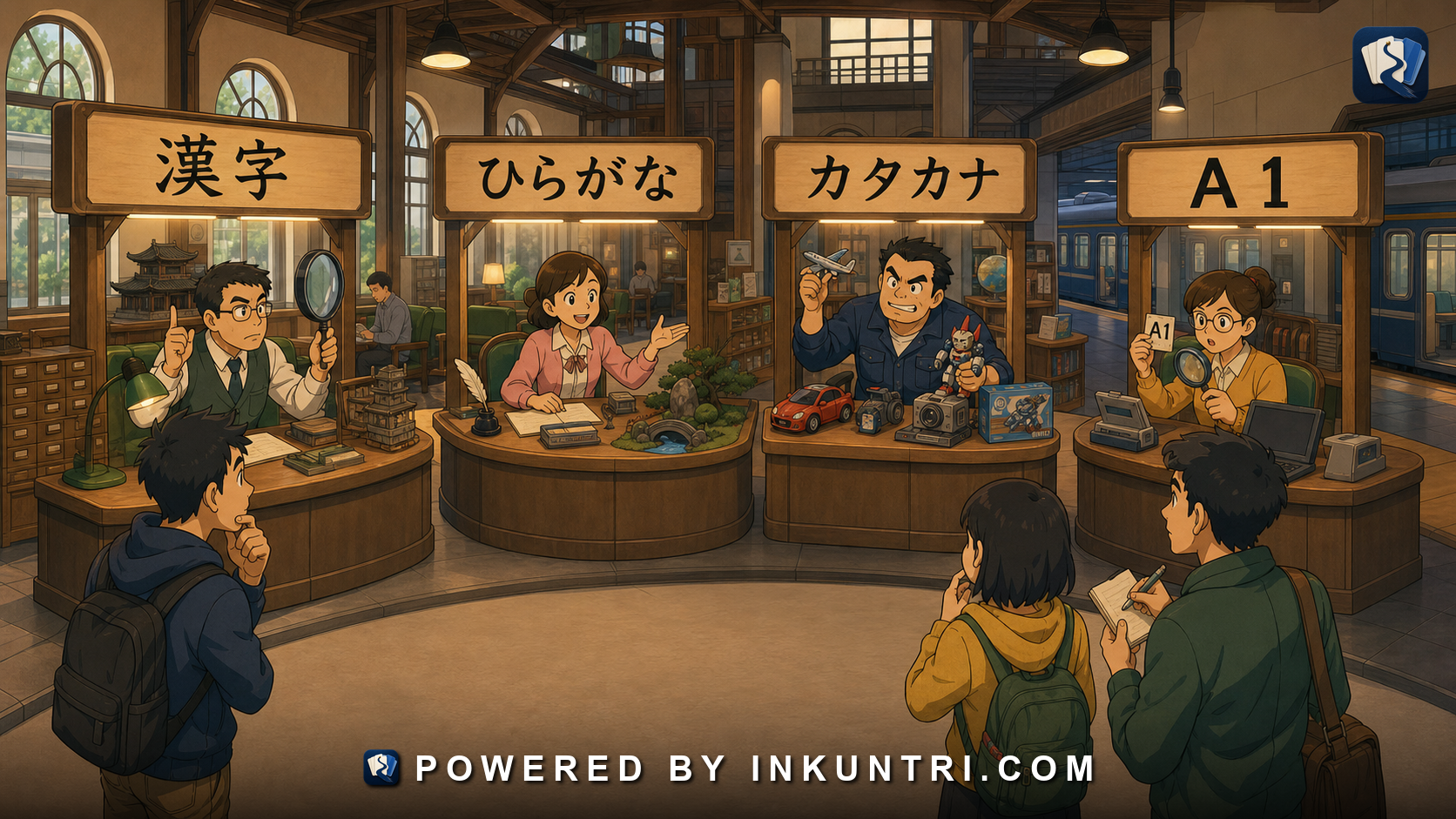
Core examples: 今日はコンビニでAIニュースを読んだ, お茶, サッカー, 受付, Tokyo 2026, すごい, 食べる, 申し込み, ゴミ, JR, 3番線.
The beginner reaction is understandable
Japanese looks chaotic before it looks elegant.
A beginner opens a Japanese menu, train sign, manga panel, app screen, or news article and sees several writing systems operating at once. Kanji appears beside hiragana. Katakana suddenly interrupts the line. Latin letters show up in a product name or company logo. Arabic numerals sit comfortably inside a sentence. Sometimes the same word can be written in kanji in one place, hiragana in another, and katakana somewhere else.
So the beginner reaches for the obvious explanation: Japanese mixed script must be historical clutter. Maybe the language simply accumulated too many writing systems and never cleaned itself up.
That explanation is emotionally satisfying. It is also wrong in the way that matters most for learners.
Japanese writing is historically layered, yes. Kanji came from Chinese. Hiragana and katakana developed from ways of using Chinese characters phonetically. Rōmaji entered through contact with alphabetic writing, printing, passports, signage, computing, branding, and language education. But the modern mixed-script system is not just a museum of historical leftovers.
It is a working reading technology.
Modern Japanese uses different scripts to signal different kinds of information. Kanji often carries lexical weight. Hiragana carries grammar, inflection, particles, native function words, and soft spelling choices. Katakana marks loanwords, foreign names, sound effects, emphasis, technical categories, species names, and stylized voice. Rōmaji supports branding, international signage, digital identity, acronyms, interface labels, and technical notation. Arabic numerals handle dates, prices, addresses, platform numbers, quantities, and modern data-heavy writing.
The system is not perfectly tidy. No real writing system is. But it is not random.
A better first rule is this:
In Japanese, script choice is part of the message.
That does not mean every script choice has a deep secret meaning. Sometimes a word is written in the conventional way because that is just how it is normally written. But when you read Japanese seriously, you should learn to ask not only “What does this word mean?” but also “Why is it written this way here?”
Start with one ordinary sentence
Consider this sentence:
今日はコンビニでAIニュースを読んだ。 Kyō wa konbini de AI nyūsu o yonda. Today I read AI news at a convenience store.
It is not literary. It is not old-fashioned. It is the kind of sentence that could appear in a learner example, a diary, a tweet, a reading app, or a classroom handout.
But it already uses the mixed-script system.
| Segment | Script | Job in the sentence |
|---|---|---|
| 今日 | kanji | Lexical content: “today” |
| は | hiragana | Topic particle |
| コンビニ | katakana | Loanword/naturalized foreign-origin vocabulary: convenience store |
| で | hiragana | Location/means particle |
| AI | Latin letters | Acronym/technical-global notation |
| ニュース | katakana | Loanword: news |
| を | hiragana | Object particle |
| 読 | kanji | Lexical verb root: read |
| んだ | hiragana | Inflectional ending: past plain form after sound change |
| 。 | punctuation | Sentence boundary |
This is the system in miniature.
Kanji gives the eye dense lexical anchors: 今日 and 読. Hiragana tells you how the sentence works: は, で, を, んだ. Katakana tells you that コンビニ and ニュース belong to a marked phonetic/loanword layer. AI is left as Latin-letter technical notation because spelling it as エーアイ would be possible but visually different, and often less natural in contemporary writing.
The sentence is not mixed because Japanese cannot make up its mind. It is mixed because Japanese readers use script contrast to parse information quickly.
Kanji carries lexical weight
Kanji are not simply “Chinese characters used in Japanese.” That is historically true, but it is not enough for reading.
In modern Japanese, kanji often serve as dense lexical anchors. They mark content-heavy words, roots, stems, Sino-Japanese compounds, names, technical terms, official vocabulary, and many everyday nouns and verbs.
Look at these pairs:
| Kanji form | Kana-only form | Why the kanji helps |
|---|---|---|
| 日本語 | にほんご | Makes the word visually compact and recognizable as “Japanese language” |
| 学校 | がっこう | Marks a common institutional noun immediately |
| 受付 | うけつけ | Signals “reception desk / acceptance / application handling” as a lexical unit |
| 読む | よむ | Shows the lexical root “read” before the kana ending |
| 食べる | たべる | Shows the lexical root “eat” plus inflectional kana |
| 申し込み | もうしこみ | Makes a formal/process word easier to scan in forms and notices |
Kana-only writing is possible for many of these, and it is common in materials for children, beginner texts, stylistic passages, or cases where the writer wants softness or accessibility. But in ordinary adult writing, kanji keeps many sentences from becoming visually flat.
Compare:
きょうはこんびにでえーあいにゅーすをよんだ。
This is technically pronounceable, but it is ugly, ambiguous, and childish-looking in most adult contexts. The reader has to work harder to segment the sentence. Where are the word boundaries? Which parts are grammar? Which parts are content? What is ordinary vocabulary, and what is a loanword?
Now compare:
今日はコンビニでAIニュースを読んだ。
The mixed-script version gives the reader landmarks. 今日, コンビニ, AIニュース, 読んだ. The grammar sits between those landmarks.
Kanji is not there only to preserve tradition. It supports fast visual parsing.
Hiragana is grammar infrastructure
Beginners often treat hiragana as “the easy script” and kanji as “the real Japanese.” That attitude is backwards for serious reading.
Hiragana is not just training wheels. It is the infrastructure of Japanese grammar.
Hiragana marks particles:
- は
- が
- を
- に
- で
- へ
- と
- から
- まで
It marks inflectional endings:
- 食べる
- 食べます
- 食べた
- 食べない
- 書く
- 書きます
- 書いた
- 書かない
It marks auxiliaries and grammatical patterns:
- 読んでいる
- 行きたい
- 書かれる
- 見せる
- 寒そうだ
- 行くかもしれない
- 分かったんです
It also writes native words that are usually or often left in kana:
- これ
- それ
- ここ
- そこ
- する
- ある
- いる
- すごい
- かわいい, though 可愛い is also common in some contexts
If you ignore hiragana because you are hunting for kanji, you miss the grammar. The kana tells you who did what to whom, whether a verb is past or non-past, whether a phrase is negative, whether a clause is explanatory, whether a request is polite, whether a noun is being modified, and where one chunk ends and another begins.
Take this phrase:
本を読んでいる人 the person who is reading a book / the person reading a book
The kanji are 本, 読, and 人. But the grammar is in を, んでいる, and the placement before 人. If you only know the kanji meanings “book,” “read,” and “person,” you do not yet have the phrase.
A serious learner should develop a kana-first pass when reading. Mark the particles. Mark the endings. Mark auxiliaries. Then use kanji to fill in lexical content.
Katakana is not just “foreign words”
The beginner explanation of katakana is also a useful half-truth: katakana is used for foreign words.
Yes, katakana writes many loanwords and foreign names:
- コーヒー
- サッカー
- コンビニ
- ニュース
- ホテル
- アメリカ
- ロンドン
- マリア
But katakana does much more than that.
It can mark sound effects and mimetic language:
- ドキドキ — heartbeat/nervous excitement
- キラキラ — sparkling
- ガタガタ — rattling/shivering
- ワンワン — dog barking
It can mark emphasis, somewhat like italics or visual highlighting:
- ココが大事です。 This part here is important.
It can mark species names or biological/technical categories:
- イヌ
- ネコ
- サクラ
- バラ
It can create a mechanical, foreign, robotic, childish, rough, comic, or stylized voice in manga, games, advertising, and character dialogue:
- ワタシハ ロボットデス。
- オレは行かない。
- カワイイ!
It can make an ordinary word feel brand-like or slogan-like:
- ゴミ
- ナゾ
- キレイ
- カンタン
This is why “katakana = foreign” will eventually fail you. A better rule is:
Katakana marks a word as visually special, phonetic, external, technical, emphatic, sound-symbolic, taxonomic, or stylized.
Loanwords are only one major case.
Rōmaji is not merely for foreigners
Rōmaji is often introduced as a support system for learners: Nihongo, Tokyo, sushi, arigatō. That is one use. But rōmaji also functions inside Japanese society.
You see Latin letters in:
- company names: JR, ANA, NHK, NTT
- brands: UNIQLO, MUJI, Toyota in global branding contexts
- technical terms: AI, IT, DX, URL, Wi-Fi
- station signs and travel infrastructure
- passports and official romanized names
- domain names and email addresses
- product labels and model numbers
- music, fashion, and youth branding
Consider:
JR新宿駅の3番線でWi-Fiを使った。 I used Wi-Fi on platform 3 at JR Shinjuku Station.
This sentence mixes Latin letters, kanji, Arabic numerals, katakana, and hiragana. It is not broken Japanese. It is ordinary modern text.
The Latin letters do not always need to be converted into kana. Writing AI as エーアイ is possible. Writing Wi-Fi as ワイファイ is possible. But in many contemporary settings, the Latin-letter form is more compact, more official, more brand-consistent, or more technically recognizable.
Rōmaji is not outside Japanese writing. In modern life, it is one of the layers Japanese writing can use.
Arabic numerals are also part of the reading system
Japanese has kanji numerals:
- 一
- 二
- 三
- 十
- 百
- 千
- 万
It also uses Arabic numerals constantly:
- 2026年
- 3番線
- 5分
- 10時30分
- 1,200円
- 03-1234-5678
- 2階
Arabic numerals are especially common in horizontal writing, digital interfaces, schedules, prices, addresses, forms, charts, data, and travel information.
Compare:
第三番線 3番線
Both are readable, but they do not feel identical. 3番線 is normal on signs, apps, and schedules. 第三番線 is more formal, more written-out, and less compact.
A Japanese literacy system for real life must include numbers, not just kanji and kana.
Mixed script helps word segmentation
Japanese does not normally put spaces between words. Mixed script helps compensate.
Consider this version:
きょうはこんびにでにゅーすをよんだ。
A beginner can sound it out. But the line gives little visual help. Everything has the same script texture.
Now the mixed version:
今日はコンビニでニュースを読んだ。
The script boundaries help you see the sentence structure:
- 今日 / は
- コンビニ / で
- ニュース / を
- 読 / んだ
This is one of the hidden strengths of Japanese mixed script. The alternation of kanji, hiragana, katakana, Latin letters, and numbers creates visual rhythm. It separates lexical chunks from grammatical glue. It helps readers scan.
This does not mean Japanese is easy to read. Long kanji compounds, names, ambiguous kana sequences, and dense institutional writing are hard. But the script mix is not the enemy. Often, it is the guide rope.
Mixed script supports tone and register
Script choice can change the feeling of a word.
Take kawaii:
| Form | Possible effect |
|---|---|
| かわいい | Soft, ordinary, approachable, often casual |
| 可愛い | More lexicalized with kanji; can feel slightly more written or compact depending on context |
| カワイイ | Pop, emphatic, commercial, stylized, slogan-like |
| Kawaii | Globalized, brand-like, internet/culture-export flavor |
These are not four separate words in the simple dictionary sense. They are four visual presentations with different effects.
Another example:
| Form | Possible effect |
|---|---|
| すごい | Ordinary hiragana spelling; casual and common |
| 凄い | Stronger kanji form; more visually intense or literary in some contexts |
| スゴイ | Emphatic, advertising-like, comic, or stylized |
This is why script choice matters for writing as well as reading. If you write everything in kanji that can be written in kanji, your Japanese may look stiff, old-fashioned, overly dense, or simply unnatural. If you write everything in hiragana, it may look childish or hard to scan. If you overuse katakana, it may look comic, promotional, or strange.
Good Japanese writing is not “maximum kanji.” It is appropriate script choice.
Mixed script and names
Names are a special challenge.
Japanese names may use kanji, hiragana, katakana, rōmaji, old character forms, variant forms, or combinations depending on person, institution, brand, nationality, and context.
Examples:
- 山田太郎 — ordinary kanji personal name
- さくら — given name in hiragana
- サクラ — katakana form, perhaps stylized or for a foreign/brand/species context
- SAKURA — romanized brand, stage name, username, or international presentation
- 髙橋 / 高橋 — variant character issue
- 斎藤 / 齋藤 / 齊藤 / さいとう — variant and reading issue
A learner should not treat names as ordinary vocabulary. Kanji readings in names can be unpredictable. Furigana, official spellings, business cards, passports, and self-presentation matter.
The script system gives clues, but identity overrides neat rules.
Mixed script and cross-CJK confusion
Learners who know Chinese often expect kanji to behave like hanzi. Learners who know Japanese sometimes overestimate how far kanji knowledge transfers to Chinese. Both directions require caution.
Japanese kanji may resemble traditional Chinese forms, simplified Chinese forms, or specifically Japanese shinjitai forms:
| Japanese | Traditional Chinese | Simplified Chinese | Note |
|---|---|---|---|
| 学 | 學 | 学 | Japanese matches simplified here |
| 国 | 國 | 国 | Japanese matches simplified here |
| 駅 | 驛 | 驿 | Japanese has its own form |
| 体 | 體 | 体 | Japanese matches simplified in common modern form |
| 読 | 讀 | 读 | Japanese differs from both in full system context |
Even when the character shape is shared, the word may not be. 手紙 means “letter” in Japanese but “toilet paper” in modern Mandarin usage. 勉強 means “study” in Japanese but is not used the same way in modern Chinese.
Mixed script also changes the reading environment. Japanese uses kanji plus kana. Chinese does not use kana. The kana around a kanji tells you Japanese grammar, verb endings, and readings. A Chinese-literate learner who ignores the kana will misunderstand Japanese.
How to read mixed script as a learner
Use a script-role annotation routine.
Take a sentence:
明日は新宿で友だちとランチを食べる予定です。 Tomorrow I plan to eat lunch with a friend in Shinjuku.
Do not translate immediately. First mark the script roles.
| Segment | Role |
|---|---|
| 明日 | time word / kanji lexical anchor |
| は | topic particle |
| 新宿 | place name / kanji proper noun |
| で | location particle |
| 友だち | mixed spelling; common noun with soft kana portion |
| と | companion particle |
| ランチ | katakana loanword / meal term |
| を | object particle |
| 食べる | kanji stem + hiragana ending / verb |
| 予定 | kanji noun / plan, schedule |
| です | polite copula |
Now translate.
The annotation step feels slow at first. That is fine. You are training your eyes to see Japanese the way the system presents itself: grammar in kana, lexical anchors in kanji, marked vocabulary in katakana, names and modern technical material in flexible script layers.
What not to do
Do not assume kanji is always more formal. Many common words are naturally written in kana. Some kanji spellings are rare, stiff, literary, or inappropriate in ordinary contexts.
Do not assume hiragana means “easy.” Hiragana often carries the hardest grammar in the sentence.
Do not assume katakana means English. Katakana words may come from English, Portuguese, Dutch, German, French, or other sources; some are wasei-eigo; some are sound effects; some are emphasis; some are biological names; some are branding.
Do not assume rōmaji is only for foreigners. Latin letters are embedded in Japanese modernity: companies, acronyms, computing, product names, URLs, transit, sports, music, and advertising.
Do not assume script conversion is neutral. Writing かわいい, 可愛い, カワイイ, and Kawaii creates different visual effects.
A useful tool for this article would let readers paste a Japanese sentence and highlight what each script is doing.
Suggested functions:
- Script detection: Kanji, hiragana, katakana, Latin letters, Arabic numerals, punctuation.
- Role tags: lexical anchor, grammar particle, inflection, loanword, emphasis, name, brand, number, acronym, technical notation.
- Difficulty layer: beginner-visible, grammar-heavy, name-risk, dictionary-needed, cross-CJK trap.
- Rewrite mode: show what happens if the same sentence is written mostly in kana, more kanji-heavy, or with katakana emphasis.
- Reader workflow export: generate a short annotated explanation for study notes.
Example input:
今日はコンビニでAIニュースを読んだ。
Possible output:
- 今日: kanji lexical time word
- は: topic particle
- コンビニ: katakana loanword
- で: location particle
- AI: Latin-letter acronym
- ニュース: katakana loanword
- を: object particle
- 読んだ: kanji verb root + kana inflection
Final rule
Japanese mixed script is not a failure to simplify. It is a reading system.
Kanji gives dense lexical shape. Hiragana carries grammar and inflection. Katakana marks phonetic, external, emphatic, technical, and stylized material. Rōmaji and numerals handle modern names, data, technology, branding, and global notation.
The system is historically layered, but it is not merely historical debris. It helps readers scan, segment, infer tone, identify grammar, and interpret modern life.
When you read Japanese, do not treat the scripts as separate alphabets to be mastered and forgotten. Treat them as signals. Ask what each script is doing. The sentence will start giving you more information before you even translate it.
Related reading
Tracking Japanese Listening Progress With Real Audio
The reader can track Japanese listening progress using real audio, transcripts, comprehension targets, error categories, and repeated measurement.
Katakana Loans vs Chinese Transliterations of the Same Global Terms
The reader can compare how Japanese katakana loans and Chinese transliterations or semantic translations handle the same global terms.
Designing Japanese Anki Cards for Kanji, Vocabulary, Pitch, and Context
The reader can design Japanese Anki cards that train recognition, production, kanji, vocabulary, pitch accent, and context without creating bloated review debt.
The Sound of Japanese Newsreading vs Conversation
The reader can compare Japanese newsreading and conversation as different speech styles with different pacing, pronunciation, and information structure.
Polite Speech Prosody: Why 丁寧語 Has a Sound
The reader can notice that polite Japanese has prosodic conventions in addition to polite vocabulary and grammar.
How Kango Creates Formal, Technical, and Institutional Japanese
The reader can see kango as the backbone of formal, technical, legal, bureaucratic, and institutional Japanese.