
Japanese Headline Writing: Compression, Omission, and Kanji Density
The reader can decode Japanese headlines by expanding omissions, compressed nouns, and headline-specific grammar into ordinary sentences.
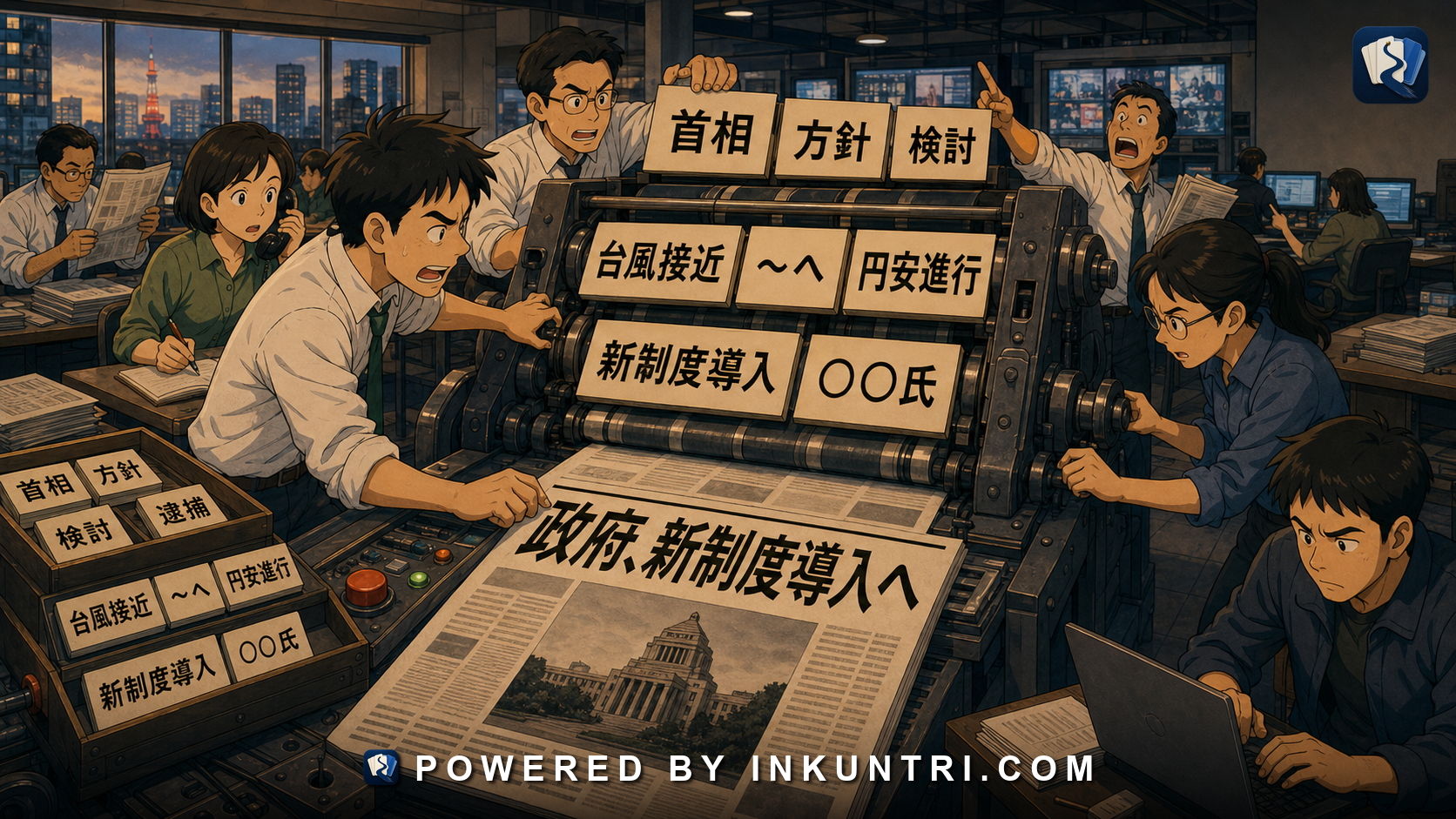
Core examples: 首相, 方針, 検討, 逮捕, 台風接近, 〜へ, 円安進行, 新制度導入, 〇〇氏.
Headlines are not ordinary sentences
A learner reads a Japanese headline:
政府、新制度導入へ
The words are familiar. The grammar is not. Where is the verb? Why is there a comma after 政府? What does へ mean here? Is the government physically going somewhere? Is this a complete sentence?
A Japanese headline often compresses a full event into a compact phrase. It may omit particles, omit the copula, use nouns instead of verbs, rely on kanji compounds, and use へ to mean “toward” a decision, policy, or expected development.
The expanded version might be:
政府は新しい制度を導入する方針です。 The government is moving toward introducing a new system.
The headline is not ungrammatical. It is headline grammar.
The key principle:
Japanese headlines are compressed event maps, not ordinary prose sentences.
To read them well, you need to restore the missing structure.
Why Japanese headlines compress so hard
Headlines must do several things at once:
- fit limited space,
- identify actor and event,
- signal novelty,
- attract attention,
- remain readable at a glance,
- use compact kanji compounds,
- avoid full sentence length,
- sometimes preserve ambiguity until the article lead.
Japanese writing is well suited to this because kanji compounds can carry dense information.
Examples:
台風接近 Typhoon approaching
円安進行 Yen depreciation continues/progresses
新制度導入 Introduction of new system
首相、訪米へ Prime minister to visit U.S. / set to visit U.S.
These are not full sentences, but readers understand the event.
The headline comma: actor marker
Japanese headlines often use a comma-like mark after an actor or topic:
首相、来月訪米へ
This can be expanded:
首相は来月、アメリカを訪問する予定です。
The headline comma works like a topic separator. It often marks the main actor before the event phrase.
Other examples:
政府、追加対策を検討 Government considers additional measures
〇〇社、新サービス発表 Company X announces new service
警察、男を逮捕 Police arrest man
Learner action: when a headline begins with a noun plus comma, treat that noun as the actor/topic.
へ: movement toward decision or event
In headlines, へ is extremely important. It often means “toward,” “set to,” “moving toward,” “expected to,” or “will likely,” depending on context.
Examples:
首相、訪米へ Prime minister set to visit the U.S.
新制度導入へ Toward introduction of a new system / set to introduce new system
来月にも開始へ Expected to begin as early as next month
料金値上げへ Moving toward price increases
This へ is not ordinary physical direction only. It points toward a planned, expected, or developing outcome.
Do not translate it mechanically as “to” every time. Ask what development the headline points toward.
Noun + する verbs lose する
Japanese has many する-verbs:
- 発表する — announce
- 検討する — consider
- 逮捕する — arrest
- 導入する — introduce
- 開催する — hold an event
- 開始する — start
- 中止する — cancel/suspend
- 決定する — decide
Headlines often omit する:
新サービス発表 New service announced / company announces new service
男を逮捕 Man arrested / police arrest man
対策を検討 Measures under consideration / considers measures
The noun carries the event. The article lead supplies full grammar.
Learner action: when you see an event noun, test whether it is a hidden する-verb.
Passive meanings without passive grammar
Headlines often omit agents or use compact forms that translate naturally as passive in English.
男逮捕 Man arrested
Expanded Japanese may be:
警察は男を逮捕しました。 Police arrested a man.
The headline focuses on the event and result. English may prefer a passive translation even when Japanese does not show passive morphology.
Similarly:
新制度導入 New system introduced / introduction of new system
This might correspond to:
政府が新制度を導入する。 The government introduces a new system.
or:
新制度が導入される。 A new system is introduced.
Context matters.
Titles, names, and 氏
Headlines often use 氏 after personal names:
田中氏、出馬表明
氏 is a formal suffix used in news and public writing, roughly “Mr./Ms.” or “the person named,” but it is not used exactly like English titles.
It signals that a person is being referred to in public-reporting style.
Examples:
〇〇氏 Mr./Ms. X
田中氏が会見 Tanaka holds press conference
山田氏、辞任へ Yamada set to resign
Learners should recognize 氏 as a news-style person marker, not as part of the name.
Common headline event words
Japanese headlines use a high-frequency set of event nouns. Learning them gives huge leverage.
方針
Policy/direction/intention.
政府、支援拡大の方針 Government policy/direction to expand support
検討
Consideration/examination.
追加対策を検討 Considering additional measures
Important: 検討 does not mean decided. It means under consideration.
逮捕
Arrest.
男を逮捕 Man arrested / police arrest man
接近
Approach.
台風接近 Typhoon approaching
進行
Progression/ongoing development.
円安進行 Yen depreciation continues
導入
Introduction/implementation.
新制度導入へ Moving toward introduction of new system
発表
Announcement.
新商品発表 New product announced
中止
Cancellation/suspension.
イベント中止 Event canceled
再開
Resumption.
運転再開 Service resumes
Headline names for institutions
Headlines often use compact institution names:
- 政府 — government
- 首相 — prime minister
- 警察 — police
- 気象庁 — Japan Meteorological Agency
- 厚労省 — Ministry of Health, Labour and Welfare, abbreviated
- 文科省 — Ministry of Education, Culture, Sports, Science and Technology, abbreviated
- 日銀 — Bank of Japan
- JR — Japan Railways group/company depending on context
Abbreviations are common. Learners should build an institution glossary.
A headline may be impossible to understand not because of grammar, but because the institution abbreviation is unknown.
Numbers and timelines in headlines
Headlines often include compressed time references:
来月にも開始へ expected to begin as early as next month
2026年度から導入 introduction from fiscal 2026
3人けが three injured
10万人避難 100,000 evacuated / 100,000 people evacuate
Words like にも can signal “as early as” or “possibly by,” depending on context. 年度 means fiscal/academic year, not always calendar year.
Learner action: take numbers and time expressions seriously. They often carry the update.
Weather and disaster headlines
Weather headlines are a compact subgenre.
Examples:
台風接近 Typhoon approaching
大雨のおそれ Risk of heavy rain
各地で猛暑日 Extremely hot day in many areas
交通機関に影響 Impact on transportation
避難指示 Evacuation order/instruction
Disaster headlines compress risk, location, time, and expected action. They often omit verbs because the urgency is in the nouns.
Learner action: memorize disaster headline vocabulary for safety.
Economy headlines
Economic headlines also rely on compact nouns.
Examples:
円安進行 Yen depreciation continues
株価下落 Stock prices fall
物価高続く High prices continue
賃上げ要求 Wage-increase demand
景気回復に遅れ Delay in economic recovery
Economic headlines often use compact verbal nouns and trend words: 上昇, 下落, 進行, 続く, 回復, 悪化, 改善.
Learner action: learn trend vocabulary as motion metaphors.
The headline expansion workflow
When a headline feels compressed, expand it.
Example:
政府、新制度導入へ
Step 1: Identify actor.
政府
Step 2: Identify event noun.
新制度導入
Step 3: Interpret へ.
moving toward / expected to
Step 4: Restore particles and verb.
政府は新制度を導入する方針です。
Step 5: Translate.
The government is moving toward introducing a new system.
Another example:
台風接近、交通機関に影響も
Step 1: Event.
台風が接近している。
Step 2: Possible effect.
交通機関に影響が出る可能性がある。
Step 3: も adds “also/possibly/even.”
Expanded:
台風が接近しており、交通機関にも影響が出る可能性があります。
Example bank walkthrough
首相
Prime minister. Often headline actor.
Learner action: expect visit, statement, policy, resignation, meeting, or election-related verbs.
方針
Policy/direction. Often signals institutional intention.
Learner action: distinguish from final decision if context requires.
検討
Considering. Not yet decided.
Learner action: do not overstate it as “will do.”
逮捕
Arrest. Often used with police actor omitted or compressed.
Learner action: identify suspect, charge, and agency in the article lead.
台風接近
Typhoon approaching. Weather headline compression.
Learner action: look for region, time, risk, and action.
〜へ
Toward / set to / moving toward. Common headline marker.
Learner action: treat it as development direction, not just physical “to.”
円安進行
Yen depreciation progresses/continues.
Learner action: parse trend word 進行.
新制度導入
Introduction of new system.
Learner action: expand to 新しい制度を導入する.
〇〇氏
News-style person reference.
Learner action: recognize 氏 as suffix, not name component.
A strong tool for this article would let users paste a headline and expand it into ordinary Japanese.
Suggested functions:
- Actor detector: Identify noun + comma topic.
- Event noun parser: Detect する-verbs with omitted する.
- へ interpreter: Explain development direction.
- Particle restoration: Suggest は, が, を, に, で.
- Plain Japanese expansion: Convert headline into full sentence.
- Translation caution: Mark uncertain or context-dependent expansions.
- Headline vocabulary deck: 方針, 検討, 逮捕, 導入, 発表, 中止, 再開.
- Genre mode: Politics, weather, economy, crime, transport, sports.
Final rule
Japanese headlines are compressed, not broken.
Do not panic when particles vanish and verbs shrink into nouns. Find the actor, identify the event noun, interpret へ, restore the missing grammar, and check the article lead.
Once you learn headline compression, Japanese news becomes much less intimidating. The headline is no longer a wall of kanji. It is a compressed map waiting to be expanded.
These drafts are written as publication-ready educational articles rather than academic papers. Useful technical/reference anchors for future source-linking include:
- Japanese postal and municipal address conventions for 郵便番号, 都道府県, 市区町村, 丁目, 番地, 号, building names, and room numbers.
- Japanese public-sign and facility-language conventions found in stations, museums, hospitals, parks, hotels, public notices, and disaster-prevention signs.
- Japanese newspaper and headline style conventions involving compressed noun phrases, omitted particles, へ as development marker, 氏, institutional abbreviations, and event-noun headlines.
- Japanese dictionary and learner-reference materials on public vocabulary, administrative suffixes, and kanji compound parsing.
Related reading
National Language Policy and the Idea of Kokugo
The reader can understand kokugo as a national-language idea with educational, political, and cultural consequences.
Why Japanese Mixed Script Is a Reading System, Not a Historical Accident
The reader can read Japanese mixed-script text as a designed system of roles rather than as a messy accumulation of scripts.
Tracking Japanese Listening Progress With Real Audio
The reader can track Japanese listening progress using real audio, transcripts, comprehension targets, error categories, and repeated measurement.
Katakana Loans vs Chinese Transliterations of the Same Global Terms
The reader can compare how Japanese katakana loans and Chinese transliterations or semantic translations handle the same global terms.
Designing Japanese Anki Cards for Kanji, Vocabulary, Pitch, and Context
The reader can design Japanese Anki cards that train recognition, production, kanji, vocabulary, pitch accent, and context without creating bloated review debt.
Engineering Japanese: 仕様, 公差, 図面, 検査
The reader can read engineering Japanese by connecting specifications, drawings, tolerances, inspection, and requirements.