
Variant Characters, 异体字, and What Learners Meet in Names and Archives
The reader recognizes variant characters as a real literacy issue in names, historical materials, typography, and cross-region reading.
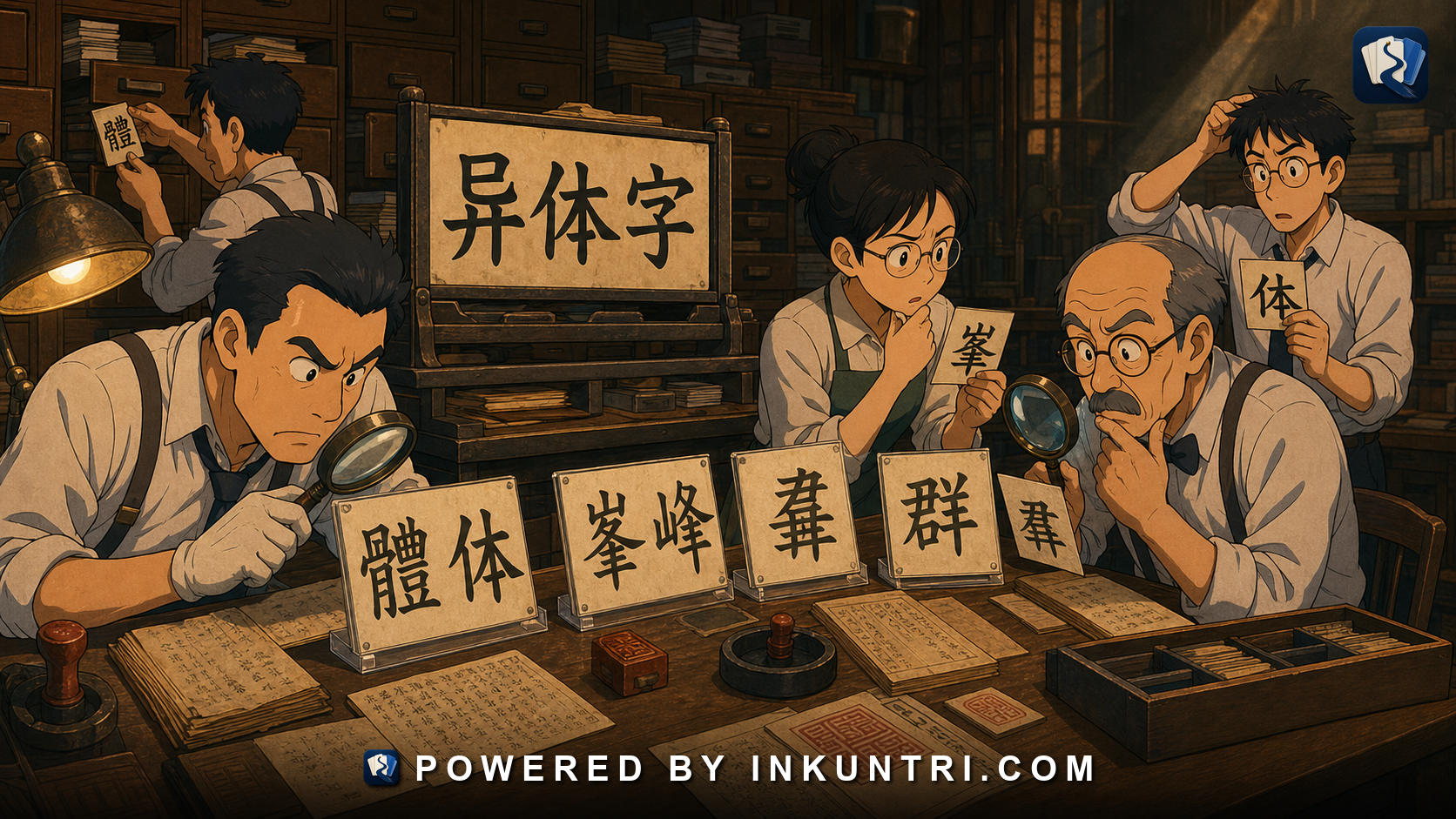
Core examples: 峯/峰, 体/體/躰, 够/夠, 羣/群, 祕/秘, 牀/床, 刘/劉 and variant forms in names.
Not every unfamiliar character is “traditional”
A simplified-only learner sees 體 and thinks, “traditional.” That is fair: 體 is the traditional counterpart of simplified 体 in ordinary modern conversion.
The same learner sees 峯 and may think, “traditional form of 峰.” That is less precise. 峯 and 峰 are variant forms of the same character, and 峰 is also used in traditional Chinese contexts. The issue is not simply simplified versus traditional.
The learner sees 羣 and 群. Again, this is not the usual simplified/traditional split. It is a variant-character issue.
The learner sees 牀 and 床. Which one is “correct”? Historically, some sources treat 牀 as the older or more orthodox form. Modern standards often use 床 as the standard form. So “older” and “standard” are not the same thing.
This is why serious Chinese literacy needs a third category after simplified and traditional: 异体字 / 異體字, variant characters.
Variant characters are not a decorative side topic. They appear in personal names, shop signs, old books, calligraphy, seals, genealogies, local signage, typography, OCR output, font differences, and archive search. If you read only clean textbook Mandarin, you can ignore many of them for a while. If you read the real world, you cannot ignore them forever.
What is a variant character?
In the strictest sense, variant characters are different written forms that represent the same word with the same pronunciation and meaning. They differ in shape, not in lexical function.
A simple pair is 峯/峰. Both represent fēng, “peak; summit,” and the difference lies in component arrangement and historical form. Another is 羣/群, qún, “group; crowd; herd.”
But real usage is messy. People use “variant” broadly for several related phenomena:
- older and newer forms;
- orthodox and popular forms;
- standard and nonstandard forms;
- regional preferred forms;
- handwriting forms;
- calligraphic forms;
- name-specific forms;
- digital glyph differences;
- simplified/traditional forms that also have variant histories.
For learners, the practical definition is:
A variant-character problem happens when two or more written forms may represent the same character or word in some contexts, but standards, regions, fonts, or documents do not treat them identically.
That definition is not as elegant as the strict dictionary definition, but it matches the problems you will actually meet.
Variants are different from simplified/traditional pairs
Simplified/traditional conversion is one axis:
| Simplified | Traditional | Example |
|---|---|---|
| 体 | 體 | 身体 / 身體 |
| 刘 | 劉 | 刘先生 / 劉先生 |
| 饭 | 飯 | 吃饭 / 吃飯 |
| 语 | 語 | 汉语 / 漢語 |
Variant forms are another axis:
| Standard/common form | Variant form | Pinyin | Meaning |
|---|---|---|---|
| 峰 | 峯 | fēng | peak; summit |
| 群 | 羣 | qún | group; crowd |
| 床 | 牀 | chuáng | bed; bed-like support |
| 夠 | 够 | gòu | enough, in traditional-standard view |
| 祕 | 秘 | mì / bì | secret; related readings, depending on standard/context |
The axes can overlap. 体 is the standard simplified form of 體, but 体 also has a history as a variant form. 刘 is the standard simplified form of 劉, but also appears in variant dictionaries as a form related to 劉. This is why a flat table can mislead learners. A form can be simplified in one standard, variant in another discussion, and name-bearing in another context.
The correct question is not only “simplified or traditional?” Ask:
- Is this a simplified/traditional pair?
- Is one form a regional standard?
- Is one form an older variant?
- Is the form used in a personal or place name?
- Does Unicode encode the difference as separate characters or only as a font/glyph difference?
- Does the document’s context require preserving the exact form?
Where learners actually meet variant characters
Variant characters show up in predictable places.
Personal names
Names preserve identity. A character that looks like a variant to you may be the exact legal form of someone’s name. Do not “correct” it casually.
Modern Chinese name databases and identity systems may include characters that are rare in ordinary prose. Family names, given names, generational names, and revived historical forms all create variant-character problems.
For example, a person named with 峯 may not want it silently normalized to 峰. A name using 喆 is not simply “哲 with extra decoration.” It may be the registered form. A Liu family record may use 劉, 刘, or older/rarer related forms depending on period, region, script, and document type.
For names, exact form matters.
Shop signs and branding
Restaurants, tea shops, temples, craft stores, hotels, and cultural brands often choose older, traditional, calligraphic, or variant-looking forms to project heritage. A sign may use 牀, 齋, 舖, 館, or other forms that feel more classical than the everyday standard.
This does not necessarily mean the business uses fully traditional Chinese everywhere. Signs are visual branding. They can mix standards, aesthetics, and local habits.
Old books and archives
Historical documents contain forms that modern standards no longer prefer. Genealogies, land deeds, imperial records, local gazetteers, religious texts, stele inscriptions, handwritten letters, and early printed books can contain variant forms that OCR struggles with.
Searching only the modern standard form may miss relevant records.
Calligraphy and seals
Calligraphy is not merely standard printed text written beautifully. It has its own scripts, abbreviations, historical references, and visual conventions. Seal script and carved seals may use forms that are hard to recognize even when the underlying character is familiar.
A learner who expects textbook regular script will be lost quickly.
Typography and fonts
Some differences are not different Unicode characters. They are different glyph shapes chosen by fonts for Mainland China, Taiwan, Hong Kong, Japan, or Korea. A character may have one code point but look different depending on language tag and font.
This is why the same text can look subtly wrong when displayed in the wrong CJK font. It may not be a typo. It may be a regional glyph selection problem.
OCR and search
OCR systems can confuse variants, traditional forms, simplified forms, and similar-looking glyphs. Search engines may or may not treat variants as equivalent. Databases may normalize names in one field but preserve exact forms in another. Archive search often requires multiple queries.
Variant literacy is therefore not just visual. It is digital.
Why variants matter socially
A learner may ask, “If the meaning is the same, why does it matter?”
It matters because writing is not only meaning. It is identity, legality, region, history, and aesthetics.
If someone’s official name uses a rare form, replacing it with a common form can create administrative problems. Bank accounts, immigration documents, academic records, property records, diplomas, and family registries may depend on exact character identity.
If a historical archive uses variants, a researcher who searches only modern standard forms may miss evidence. If a digitization project normalizes all variants without recording originals, it may erase useful information about the source.
If a font displays a character in a Japanese form in a Chinese text, the content may be readable but typographically inappropriate. Readers may notice even if learners do not.
If a shop sign uses an older form, the choice may signal tradition or prestige. Calling it “wrong” misses the social function.
So the correct attitude is neither panic nor pedantry. Preserve exact forms when identity or source fidelity matters. Normalize only when the purpose allows it.
Standardization: why “correct” depends on context
Modern Chinese has standards. Mainland China, Taiwan, Hong Kong, Japan, and Korea have different institutions, histories, and character norms. Even within “traditional Chinese,” Taiwan and Hong Kong may prefer different glyph shapes or standards in education and publishing.
In Mainland China, the 2013 《通用规范汉字表》 lists 8,105 characters and organizes them into levels for general use, printing, information processing, names, place names, technical terms, and other needs. It also includes appendices relating standard forms to traditional and variant forms. That does not mean every historical variant disappears from life. It means general public writing has a norm.
Taiwan has its own standard forms and a major Ministry of Education variant-character dictionary. Hong Kong has educational and typographic norms of its own. Japanese kanji has its own postwar simplifications and standard forms. Korean hanja is another context again.
The result is not chaos. It is layered standardization.
When you ask whether a form is “correct,” you must add:
- correct for which region?
- correct for handwriting, printing, education, legal name, archive transcription, or web display?
- correct as a standard form, variant form, or preserved source form?
Without context, “correct” is often the wrong question.
Example bank walkthrough
峯 / 峰
峰 and 峯 both represent fēng, peak or summit. The difference is structural: the components are arranged differently. 峯 places 山 above 夆; 峰 places 山 to the left.
Modern usage generally favors 峰 in ordinary printed text. 峯 appears in older writing, names, calligraphy, and variant-character references.
Useful words:
- 山峰 — mountain peak
- 高峰 — peak; high point
- 顶峰 — summit; peak
Learner action: recognize 峯 as 峰, but preserve it in names and source transcription.
羣 / 群
群 is the common modern standard form. 羣 is a variant with a different component arrangement. Both are qún and refer to a group, crowd, herd, or cluster.
Useful words:
- 人群 — crowd
- 群体 — group; community
- 群山 — mountain range
- 一群人 — a group of people
Learner action: treat 羣 as readable through 群, but do not automatically replace it in archival or name contexts.
体 / 體 / 躰
This family shows why categories overlap.
In Mainland simplified Chinese, 体 is the standard form corresponding to traditional 體. In traditional Chinese contexts, 體 is the usual standard form for “body; form; system; style.” 躰 is an older or variant form encountered in historical, Japanese, or archival contexts.
Useful words:
- 身体 / 身體 — body; health
- 体会 / 體會 — to experience; to understand from experience
- 体育 / 體育 — physical education; sports
- 体系 / 體系 — system
Learner action: do not treat every unfamiliar member of the family as the same type of problem. 体/體 is a simplified/traditional pair in modern conversion. 躰 is a variant/archival issue.
够 / 夠
够 and 夠 are visually striking because the components are reversed. Mainland simplified Chinese uses 够 as the standard form. Traditional Chinese commonly uses 夠. Variant dictionaries may describe 够 as a variant of 夠.
Useful words:
- 够了 / 夠了 — enough
- 不够 / 不夠 — not enough
- 能够 / 能夠 — to be able to
- 足够 / 足夠 — sufficient
Learner action: recognize the pair as both standardization and variant history. Do not assume “more strokes equals traditional” because this pair is about component order more than stroke count.
祕 / 秘
祕 and 秘 are a useful warning against oversimplified script charts. Both forms are used in Chinese traditions, and standards differ by region and context. 秘 is common in Mainland simplified writing. 祕 is often seen in traditional contexts and in variant-character discussions. Some standards treat one as primary and the other as a variant or dual-use form depending on reading and context.
Useful words:
- 秘密 / 祕密 — secret
- 神秘 / 神祕 — mysterious
- 秘书 / 祕書 — secretary
- 秘鲁 / 祕魯 — Peru, in traditional form
Learner action: learn the common words and expect regional preference. Do not reduce the pair to a simple “one is wrong” answer.
牀 / 床
床 is the common modern standard form in ordinary writing. 牀 is an older or variant form with strong historical support. Some older sources treated 牀 as the more orthodox form, while modern standards may select 床 as standard.
Useful words:
- 床 / 牀 — bed
- 起床 — to get up
- 床上 — on the bed
- 河床 — riverbed
Learner action: recognize 牀 in old books, calligraphy, signs, and variant contexts. Use 床 for ordinary modern writing unless your target standard or source demands otherwise.
刘 / 劉 and name variants
刘 is the standard simplified form. 劉 is the traditional form. The surname is common, but the history of the character includes older and variant forms that may appear in inscriptions, genealogies, dictionaries, or archival records.
Useful contexts:
- 刘先生 / 劉先生 — Mr. Liu
- 刘家 / 劉家 — the Liu family
- family genealogies and clan records
- historical inscriptions
Learner action: in ordinary modern text, handle 刘/劉 through script conversion. In archives and names, search broadly and preserve exact source forms.
Digital variant problems
Digital Chinese text creates a new kind of literacy problem: the difference between character, glyph, code point, font, and input method.
A character is the abstract written unit. A glyph is the visual shape used to display it. A code point is the Unicode number used to encode it. A font supplies the glyph. A language tag or regional font choice can affect which glyph appears.
Some variant forms have separate Unicode code points. Others are treated as glyph variants of the same encoded character. Some can be represented through ideographic variation sequences, but ordinary users rarely handle those directly. Some forms appear only if the right font is installed.
This explains several real-world annoyances:
- A Chinese character may display in a Japanese-looking form because the font fallback is Japanese.
- A database may reject a rare name character because the system lacks support.
- A search for 峰 may not find 峯 unless the search engine expands variants.
- OCR may read 羣 as 群, or fail entirely.
- A copied character may look different when pasted into another app.
- A website may display traditional text with regionally inappropriate glyphs.
A learner does not need to become a Unicode engineer. But you should know that “I typed the same character” and “I see the same shape” are not always the same claim.
A practical lookup strategy for unusual forms
When you meet a strange character form, use a method rather than guessing.
1. Preserve the exact form first
Before converting, correcting, or retyping, save a screenshot or copy the character. Exact evidence matters, especially for names and archives.
2. Identify the likely category
Ask what kind of problem it might be:
- simplified/traditional pair;
- variant character;
- regional glyph difference;
- calligraphic form;
- OCR error;
- rare name character;
- old printed form;
- Japanese kanji or Korean hanja form;
- typo or nonstandard form.
You do not need to know immediately. You need to keep the possibilities open.
3. Search by exact character
Paste the exact form into a dictionary, search engine, or variant-character database. If that fails, try screenshot-based OCR or handwriting input.
4. Search by likely standard form
If you suspect 峯 is 峰, search both. If you suspect 羣 is 群, search both. If you suspect 牀 is 床, search both.
For archives, this step is essential. One query is not enough.
5. Use component and stroke lookup
If you cannot type the character, identify components and stroke count. Many dictionaries allow radical/stroke or component search. Even imperfect component recognition can narrow the field.
6. Check regional sources
For Taiwan forms, check Taiwan Ministry of Education resources. For Mainland standard forms, check Mainland standard character lists. For Japanese contexts, check kanji dictionaries. For Hong Kong, use Hong Kong-specific references.
Do not force one region’s standard onto another region’s document.
7. Treat names conservatively
If the character is in a person’s name, do not normalize silently. Record both exact form and normalized/search form if your database allows it.
A good data model might have:
- display name as written;
- standard searchable equivalent;
- simplified equivalent;
- traditional equivalent;
- variant notes;
- source image.
That may sound excessive for casual learning, but it is exactly the kind of discipline needed for genealogy, legal records, academic databases, and archival work.
Why learners should not overcorrect variants
Learners love certainty. They want to know which form is “right.” Variant characters punish that desire.
If you see 牀 on a sign, it is not helpful to announce that 床 is the modern standard. The sign may be intentionally using an older form. If you see 峯 in a name, replacing it with 峰 may be disrespectful or legally wrong. If you see 祕 in a Taiwan text, calling it a typo because you learned 秘 is not serious literacy.
Standard forms are real. They matter in school, publishing, official writing, and input systems. But variants are also real. They matter in names, historical documents, typography, and identity.
The mature position is:
- Use standard forms when writing ordinary modern text.
- Recognize common variants when reading.
- Preserve exact forms in names and source documents.
- Normalize only when the purpose is search, teaching, or broad readability.
- Keep the original alongside any normalized form.
A strong tool for this article would make variant literacy practical rather than abstract.
Suggested functions:
- Canonical/variant comparison: Display 峰/峯, 群/羣, 床/牀, 夠/够, 祕/秘, 體/体/躰, 劉/刘.
- Context labels: Mark likely contexts: ordinary modern writing, traditional text, simplified text, name, archive, calligraphy, shop sign, Japanese context, OCR risk.
- Regional standard toggle: Show Mainland, Taiwan, Hong Kong, and Japanese expectations where relevant.
- Unicode layer: Indicate whether forms are separate code points, common glyph variants, or require font/language support.
- Search expansion: Let users enter 峯 and return suggested searches: 峯, 峰, 山峰, 高峰, name-specific queries.
- Preservation warning: If the input appears in a name field, warn against silent normalization.
- Stroke-order replay: Show how variant forms are written, not only how they look in print.
- Archive mode: Demonstrate how OCR may normalize or misread variants and how to query both original and standard forms.
Final rule
Variant characters teach humility.
Chinese writing is not only simplified and traditional. It is also standard and nonstandard, old and new, regional and local, printed and handwritten, encoded and font-rendered, ordinary and name-specific.
When you meet an unfamiliar form, do not rush to call it wrong. Ask what kind of variation you are seeing. Preserve the evidence. Look up the form. Check the regional context. Search likely equivalents. Then decide whether to read, normalize, or preserve.
For ordinary learners, variant literacy means recognizing common forms without panicking. For teachers, editors, researchers, and tool builders, it means designing systems that respect exact forms while helping users find equivalents.
That is the practical heart of 异体字: different shapes can carry the same word, but the difference in shape can still matter.
These drafts are written as publication-ready educational articles rather than academic papers. The following references were consulted for technical sanity checks and example validation:
- Shu, H., Chen, X., Anderson, R. C., Wu, N., & Xuan, Y. (2003), “Properties of School Chinese: Implications for Learning to Read,” Child Development, for character-property research involving visual complexity, phonetic regularity, and semantic transparency in school-taught Chinese characters.
- Scientific Reports / Nature Portfolio article “Semantic activation of phonetic radicals as revealed by the Stroop effect,” for the general reading-research framing that Chinese compound characters commonly include semantic radicals and phonetic radicals.
- Hacking Chinese, “Phonetic components, part 1: The key to 80% of all Chinese characters,” for learner-facing articulation of phonetic-component study and the warning against focusing only on pictographs.
- 《通用规范汉字表》, especially the 2013 standard’s explanations of character levels, names/place-name needs, traditional/variant appendices, and its adjustment of some formerly variant forms into standard use.
- 教育部《異體字字典》, especially entries for 峯/峰, 羣/群, 夠/够, 祕/秘, 牀/床, and 劉/刘.
- Unicode Standard Annex #38, “Unicode Han Database (Unihan),” especially variant fields such as
kTraditionalVariant,kSimplifiedVariant, and related variant data categories. - Typotheque, “Understanding CJK regional character variants,” for a typography-focused explanation of CJK regional glyph preferences, font selection, and the practical effects of Unicode unification.
- CJK and dictionary resources were used conservatively for example validation; the articles avoid relying on exact historical phonological reconstruction where a learner-facing modern explanation is sufficient.
Related reading
Chinese Characters Abroad: Hanzi, Kanji, Hanja, and the Shared Scriptworld
The reader understands the shared character tradition across China, Japan, and Korea while respecting each language’s independent grammar, pronunciation, and history.
Designing Chinese Anki Cards for Words, Characters, and Collocations
The reader can design Chinese flashcards that train recognition, pronunciation, meaning, collocation, character form, and contextual use without turning review into trivia.
A Serious Learner’s Guide to Chinese Dictionaries
The reader can use Chinese dictionaries more deeply by reading definitions, parts of speech, usage notes, examples, synonyms, variants, and register labels.
Chinese Pronunciation Self-Diagnosis With Recording and Native Models
The reader can diagnose Mandarin pronunciation problems through recording, comparison, targeted drills, and structured feedback rather than vague “tone practice.”
Korean Hangul-Only Writing and the Invisible Hanja Layer
The reader sees why Korean text can look alphabetic while still containing a deep Sino-Korean vocabulary layer that matters for Chinese learners comparing the languages.
Emoji, Homophones, and Character Play in Chinese Digital Writing
The reader can interpret common mechanisms of online character play without reducing Chinese internet language to memes.