
The Logic of Traditional–Simplified Conversion: Where One-to-One Rules Break
The reader can predict why automated conversion sometimes fails and why “traditional vs simplified” is not a reversible spelling swap.
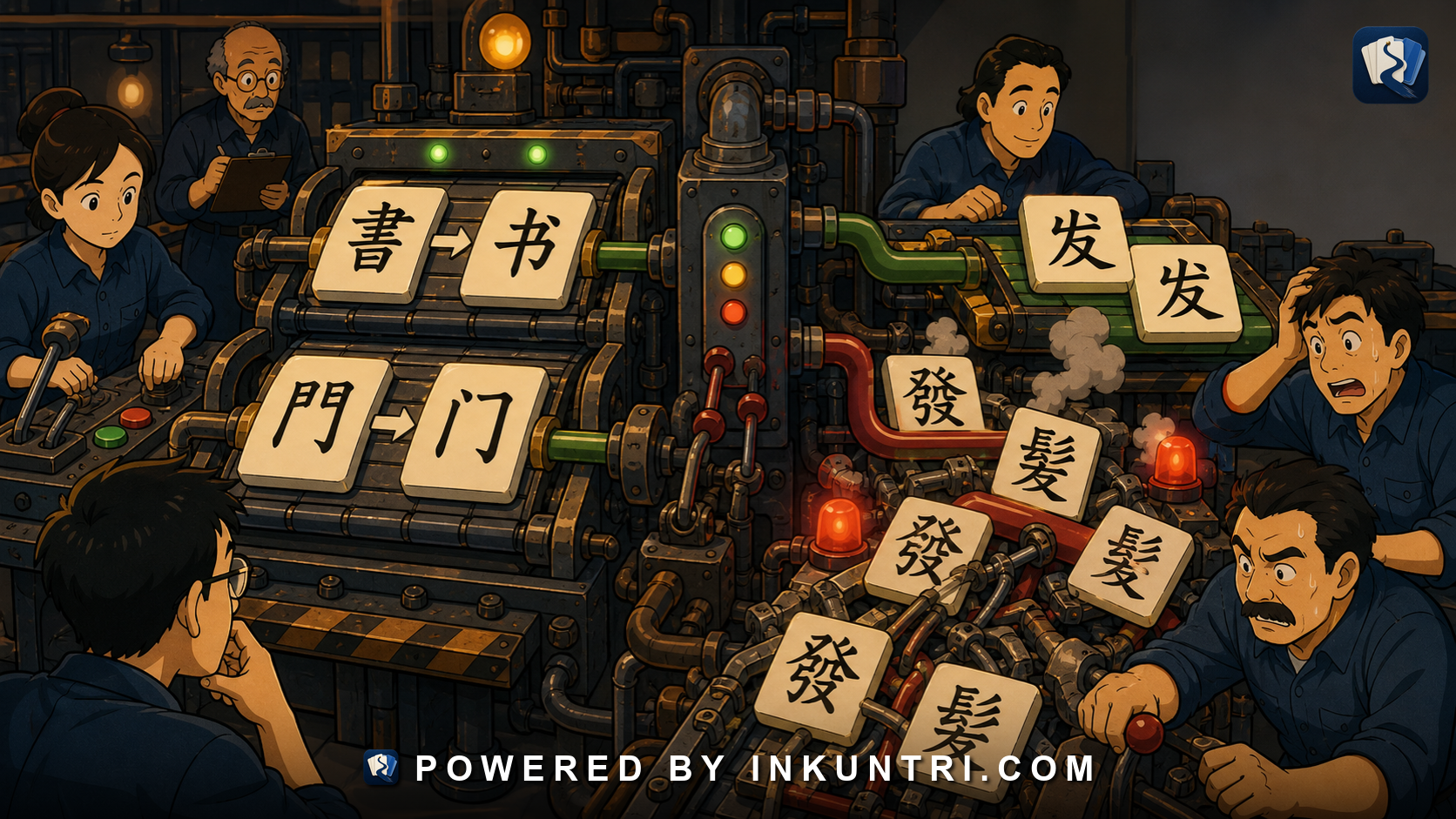
Core examples: 发/發/髮, 后/後/后, 里/裏/里, 干/幹/乾/干, 台/臺/檯/颱/台, 面/麵/面.
Conversion is not translation
Traditional–simplified conversion looks simple because many examples fit into a clean two-column chart:
| Traditional | Simplified |
|---|---|
| 語 | 语 |
| 門 | 门 |
| 書 | 书 |
| 馬 | 马 |
| 國 | 国 |
A beginner sees enough pairs like these and forms a reasonable assumption: conversion is a spelling swap. Replace every traditional character with its simplified equivalent, or replace every simplified character with its traditional equivalent, and the job is done.
That assumption breaks quickly.
Character conversion is not the same as translation, but it is also not always a simple character-by-character substitution. It sits somewhere between typography, orthography, dictionary lookup, and word-level interpretation.
A conversion tool may not need to translate 中国 into “China.” It only needs to know whether 中国 should become 中國. But when it sees 头发, it must know that 发 corresponds to 髮, not 發. When it sees 发展, it must choose 發, not 髮. That is no longer a pure character operation. It is word recognition.
This distinction matters for anyone who reads across regions, prepares subtitles, works with historical texts, builds language-learning tools, edits menus, searches archives, or handles Chinese names. Traditional and simplified Chinese are related writing standards, not two independent languages. But conversion between them is not perfectly reversible.
Conversion, localization, and translation are different jobs
Before looking at mappings, separate three tasks that are often confused.
Character conversion changes one character standard into another. For example:
- 简体 → 簡體
- 学习 → 學習
- 说话 → 說話
The words remain Chinese. The grammar remains Chinese. The sentence may still be associated with the same region or source.
Localization adapts text for a region or audience. It may involve vocabulary, punctuation, measurement conventions, terminology, tone, interface wording, and cultural expectations. A Mainland Chinese software interface converted into traditional characters may still sound Mainland if vocabulary and phrasing are not localized for Taiwan or Hong Kong.
Translation changes language. Chinese to English, English to Chinese, Japanese to Chinese, and so on.
Many bad text workflows fail because they treat all three as the same job. A converter can turn 计算机 into 計算機, but a Taiwan-localized text may prefer 電腦 in many ordinary contexts. A converter can change 后天 to 後天, but it cannot know whether an institutional title, place name, idiom, or technical term should be rewritten for a local readership unless it has more than a character table.
For learners, the important lesson is this: a traditional-looking text is not automatically Taiwan-style Chinese, and a simplified-looking text is not automatically Mainland-style Chinese. Script is only one layer.
One-to-one mappings: the easy cases
Many conversions are straightforward. One traditional character maps to one simplified character, and the same pair works in both directions.
Examples:
| Traditional | Simplified | Example word |
|---|---|---|
| 語 | 语 | 語言 / 语言 |
| 話 | 话 | 說話 / 说话 |
| 門 | 门 | 門口 / 门口 |
| 書 | 书 | 書店 / 书店 |
| 馬 | 马 | 馬上 / 马上 |
| 國 | 国 | 中國 / 中国 |
| 學 | 学 | 學校 / 学校 |
These cases are the reason conversion software can seem magical. A simple mapping table handles a large amount of text well, especially common modern prose.
But even these easy cases require caution. The characters may map neatly, while vocabulary, idiom, names, or punctuation still differ by region. For example, a sentence written in Mainland Chinese can be converted into traditional characters and still contain Mainland-preferred wording. The script has changed; the style may not have.
Many-to-one mappings: the source of non-reversibility
The real problem begins when multiple traditional characters share one simplified form.
The direction traditional → simplified is often easy:
- 發 → 发
- 髮 → 发
But the reverse direction is not automatic:
- 发 → 發 or 髮?
The simplified form has lost the original graphic distinction. To restore it, you need the word.
This is why simplified → traditional conversion is often harder than traditional → simplified conversion. Traditional text may contain distinctions that simplified text has merged. Once those distinctions are collapsed, a converter must infer them from context.
Think of it as a compression problem. If two files are compressed into the same filename, you cannot recover the original filename without extra information. Simplified characters often preserve enough information for reading but not always enough for automatic reverse mapping.
The 发 problem: 發 or 髮?
The most famous example is 发.
| Simplified word | Traditional form | Meaning |
|---|---|---|
| 发展 | 發展 | to develop |
| 发生 | 發生 | to happen |
| 发表 | 發表 | to publish; to issue |
| 出发 | 出發 | to set out |
| 发现 | 發現 | to discover |
| 头发 | 頭髮 | hair |
| 理发 | 理髮 | haircut; to cut hair |
| 长发 | 長髮 | long hair |
A character-level converter that turns every 发 into 發 will produce 頭發 instead of 頭髮. A converter that turns every 发 into 髮 will produce 髮展 instead of 發展. Both are wrong.
The correct conversion depends on the word. 发 in 发展 belongs to the 發 family. 发 in 头发 belongs to the 髮 family.
For learners, this example teaches a major principle: script conversion must often happen at the word level, not the character level.
The 后 problem: 後 or 后?
Simplified 后 represents at least two historically distinct traditional characters in common modern usage.
| Simplified word | Traditional form | Meaning |
|---|---|---|
| 后天 | 後天 | the day after tomorrow; acquired/later |
| 后来 | 後來 | later; afterward |
| 后面 | 後面 | behind; the back |
| 最后 | 最後 | final; last |
| 皇后 | 皇后 | empress |
| 王后 | 王后 | queen |
In simplified Chinese, 后天 and 皇后 share 后. In traditional Chinese, they do not. 後 handles “after/behind/later,” while 后 remains in queen/empress contexts and in names or special uses.
This is not hard for readers because words are familiar. But it is hard for naive conversion because the same simplified character requires two traditional outputs.
A good converter uses a dictionary and context. A careful human editor checks high-risk words.
The 里 problem: 裏/裡 or 里?
Simplified 里 is another useful case.
| Simplified word | Traditional form | Meaning |
|---|---|---|
| 里面 | 裡面 / 裏面 | inside |
| 这里 | 這裡 / 這裏 | here |
| 哪里 | 哪裡 / 哪裏 | where |
| 公里 | 公里 | kilometer |
| 里程 | 里程 | mileage; distance |
| 邻里 | 鄰里 | neighborhood; local community |
Traditional Chinese has 裡 and 裏 as forms associated with “inside,” with regional and stylistic preferences. But 里 also exists as a character in its own right, including in measurement and place-related words.
So 里 is not always “really” 裡/裏. Sometimes it stays 里.
Learner lesson: do not convert by emotional familiarity. Convert by word identity.
The 面 problem: 麵 or 面?
In simplified Chinese, 面 covers several meaning areas. In traditional writing, food-related “noodles/flour” is often 麵, while “face/surface/side/aspect” is 面.
| Simplified word | Traditional form | Meaning |
|---|---|---|
| 面条 | 麵條 | noodles |
| 面粉 | 麵粉 | flour |
| 拉面 | 拉麵 | pulled noodles / ramen-style noodles |
| 方面 | 方面 | aspect; side |
| 面对 | 面對 | to face |
| 面子 | 面子 | face; reputation |
| 表面 | 表面 | surface |
If you convert a menu, this matters. 牛肉面 should become 牛肉麵 in many traditional contexts, not 牛肉面. But 面对 should become 面對, not 麵對.
This is one reason menus are a dangerous test case for conversion. They contain regional dish names, brand names, shorthand, ingredients, and food-specific characters. A converter may know 麵條, but it may mishandle creative names or mixed regional usage.
The 干 problem: 幹, 乾, or 干?
干 is not one problem; it is a cluster of problems.
In simplified writing, 干 appears in words that correspond to several traditional characters:
| Simplified word | Traditional form | Meaning |
|---|---|---|
| 干净 | 乾淨 | clean; dry-clean in origin/association |
| 干燥 | 乾燥 | dry |
| 干杯 | 乾杯 | cheers; drink a toast |
| 干部 | 幹部 | cadre; official |
| 干事 | 幹事 | officer; functionary; to do work in some contexts |
| 树干 | 樹幹 | tree trunk |
| 干涉 | 干涉 | to interfere |
| 干戈 | 干戈 | weapons; war |
Then there are cases where 乾 remains as 乾 in standard simplified writing, especially for the qián reading in classical, cosmological, and proper-name contexts: 乾坤, 乾隆.
This means 干 cannot be solved with one arrow. It requires word knowledge, pronunciation knowledge, and sometimes domain knowledge.
The learner’s safest method is to treat common words as units:
- 干净 → 乾淨
- 干燥 → 乾燥
- 干部 → 幹部
- 树干 → 樹幹
- 干涉 → 干涉
- 乾隆 → 乾隆
The 台 problem: 臺, 檯, 颱, or 台?
台 is a good example because it shows both mapping complexity and regional preference.
In simplified writing, 台 can correspond to several traditional forms:
| Simplified word | Common traditional form | Meaning |
|---|---|---|
| 台湾 | 臺灣 / 台灣 | Taiwan |
| 台风 | 颱風 | typhoon |
| 讲台 | 講臺 / 講台 | platform; lectern |
| 柜台 | 櫃檯 | counter |
| 台灯 | 檯燈 / 台燈 | desk lamp |
| 舞台 | 舞臺 / 舞台 | stage |
But real usage is not only a dictionary question. 台 is also widely seen in traditional-character environments, especially in proper names, informal contexts, and certain regional style choices. Taiwan itself uses both 臺 and 台 in different contexts, with 臺 common in formal government names and 台 common in ordinary writing and typography.
So even when a converter knows that 台 can become 臺, 檯, or 颱, the best output may depend on region, register, and the specific name.
Regional standards complicate the picture
The phrase “traditional Chinese” can hide important differences.
Taiwan, Hong Kong, and Macau all use traditional characters, but they do not always use the same vocabulary, fonts, punctuation habits, Cantonese/Mandarin relationship, or institutional terminology. A traditional-character text intended for Hong Kong may not read like a Taiwan text. A Taiwan text may use Mandarin vocabulary and Zhuyin-based educational assumptions that do not apply elsewhere.
Mainland China and Singapore use simplified characters, but they also have local vocabulary and institutional terms. Singapore Mandarin, for example, has local words shaped by multilingual contact and local institutions.
Japanese adds another layer. Japanese kanji include forms that overlap with traditional Chinese, forms that resemble simplified Chinese, and forms that are specifically Japanese shinjitai. For example, 学 matches simplified 学, but Japanese writing is not “simplified Chinese.” The language, readings, vocabulary, grammar, and character standards are different.
For practical conversion, this means you should ask two questions:
- What character set do I need? Simplified, Taiwan traditional, Hong Kong traditional, Japanese kanji, or something else?
- What language variety or local style do I need? Mainland Mandarin, Taiwan Mandarin, Hong Kong written Chinese, Cantonese-influenced writing, Singapore Mandarin, historical Chinese, Japanese, or a mixed digital context?
A converter may answer the first question. It may not answer the second.
Mixed digital text is normal
Online Chinese is often mixed. You may see simplified characters in a traditional-character environment because someone copied a Mainland source. You may see traditional characters in Mainland social media for aesthetic, religious, historical, fandom, or branding reasons. You may see Japanese kanji in Chinese discussions of Japanese products. You may see names preserved in their chosen forms even when the surrounding text is converted.
Fonts also create confusion. A glyph may look slightly different depending on whether the font follows Mainland, Taiwan, Hong Kong, or Japanese conventions, even when the underlying Unicode character is the same. Learners often assume they are seeing a different character when they are seeing a regional glyph shape.
The internet is not a clean textbook. It is a pile of writing standards, fonts, copy-paste habits, OCR artifacts, and platform defaults.
Practical advice for names
Names are high-risk.
A person’s name may use a traditional form, a simplified form, a rare variant, a Japanese form, a family-preferred form, or a form preserved for legal reasons. Converting names automatically can be disrespectful or simply wrong.
For example, a public figure from Taiwan may have a name conventionally written in traditional characters. A Mainland publication may convert that name into simplified for its own style, but that does not mean the simplified form is the person’s preferred written name. Conversely, converting a Mainland person’s name into traditional may be acceptable in some publications but inappropriate in identity-sensitive contexts.
For names, use this rule:
Preserve the form used by the person, institution, or official source whenever identity matters.
If you must convert for publication style, keep a record of the original.
Practical advice for archives
Archive search requires multiple forms.
If you are searching for historical materials, family records, old newspapers, immigration documents, temple inscriptions, or local gazetteers, do not search only one script. A name or place may appear in traditional form, simplified form, variant form, romanization, or a scan with OCR errors.
Search strategies:
- Try both simplified and traditional forms.
- Search high-risk characters in multiple variants: 里/裡/裏, 台/臺, 峰/峯, 体/體.
- Search by associated words, not only names.
- Use date and place filters when possible.
- Expect OCR to fail on old print, calligraphy, seals, and damaged scans.
Conversion tools are useful, but archive work still rewards character awareness.
Practical advice for subtitles
Subtitles are often converted fast and edited lightly. This creates predictable errors.
A simplified subtitle file may be converted to traditional for a Taiwan or Hong Kong audience, but ambiguous characters may be mishandled. Hair, noodles, “after,” “inside,” “dry,” and “stage/counter/typhoon” words are common sources of mistakes.
Subtitles also contain slang, names, sound effects, song lyrics, dialect lines, and compressed speech. Those are not ideal conditions for blind conversion.
If you prepare subtitles professionally, run a second pass for ambiguous mappings. If you are a learner, do not panic when a subtitle looks slightly “wrong.” It may be a conversion artifact, not a grammar point.
Practical advice for menus
Menus are especially messy because they combine ingredients, cooking methods, regional dish names, brand names, and poetic names.
Watch these pairs:
- 面 / 麵: noodles and flour versus face/surface/aspect.
- 干 / 乾: dry-style dishes, dried ingredients, and “dry pot” terms.
- 台 / 臺 / 檯 / 颱: less common in menus, but relevant for place or brand names.
- 后 / 後: usually not common in dish names, but possible in names or slogans.
A menu converter may change words mechanically but miss culinary convention. In traditional-character menus, 牛肉麵 is expected in many contexts; 牛肉面 may look simplified or non-local depending on region.
Practical advice for web pages
When reading web pages, first identify the source region if possible. The domain, vocabulary, punctuation, currency, address format, contact number, and institutional names may tell you more than the script alone.
A traditional page using Mainland vocabulary may be a converted Mainland text. A simplified page discussing Taiwan topics may preserve some Taiwan names in traditional form. A Hong Kong page may use traditional characters with Cantonese expressions. A Japanese page may include kanji that look familiar but function in Japanese words.
Do not let script recognition create false confidence. Use vocabulary and context.
A conversion checklist
When converting traditional ↔ simplified, ask:
- Is this a one-to-one character pair? If yes, conversion is probably safe.
- Is this a known merger character? If yes, convert by word, not by character.
- Is this a name? Preserve the official or preferred form unless style rules require otherwise.
- Is this a regional text? Character conversion may not localize vocabulary.
- Is this a menu, subtitle, archive, legal document, or literary text? Use human review.
- Does the output contain suspicious words? Check 发, 后, 干, 里, 面, 台, and other common ambiguous characters.
Mini practice: choose the traditional form
Try converting the simplified character in context.
| Simplified word | Correct traditional form | Why |
|---|---|---|
| 头发 | 頭髮 | Hair uses 髮. |
| 发表 | 發表 | Publishing/issuing uses 發. |
| 后天 | 後天 | “Later/day after tomorrow” uses 後. |
| 皇后 | 皇后 | Empress/queen remains 后. |
| 面条 | 麵條 | Noodles use 麵. |
| 面对 | 面對 | Facing uses 面. |
| 里面 | 裡面 / 裏面 | Inside uses 裡/裏 depending on standard/style. |
| 公里 | 公里 | Kilometer uses 里. |
| 干部 | 幹部 | Cadre/official uses 幹. |
| 干涉 | 干涉 | Interfere remains 干. |
| 台风 | 颱風 | Typhoon uses 颱 in traditional. |
| 柜台 | 櫃檯 | Counter uses 檯. |
A useful tool for this article would let readers paste simplified text and see which characters are safe and which require context.
Suggested functions:
- Input box: User enters simplified or traditional text.
- Highlight modes: One-to-one pairs in neutral color; ambiguous mappings in warning color.
- Family chart: Click 发 to show 發/髮 with example words.
- Regional toggle: Taiwan traditional, Hong Kong traditional, general traditional, Mainland simplified.
- Practice sheet export: Generate drills from high-risk characters.
- Explanation layer: For each conversion, show “character rule,” “word rule,” or “requires human review.”
Final rule
Traditional–simplified conversion is easy until it is not. The easy cases create overconfidence; the hard cases reveal the real logic.
Use character tables for one-to-one mappings. Use word knowledge for mergers. Use regional judgment for localization. Use caution with names. Use human review for archives, subtitles, menus, and published materials.
The most important habit is simple: when a simplified character can represent several traditional characters, stop thinking in single characters. Read the word.
Related reading
Building a Mandarin Reader Workflow From News, Documents, and Literature
The reader can build a sustainable Mandarin reading workflow that combines current news, practical documents, essays, and literature without drowning in vocabulary.
Software UI Chinese: Buttons, Empty States, Errors, and Confirmation
The reader can interpret Chinese software interface text, including action buttons, empty states, error messages, confirmations, and status labels.
CJK Numerals, Counters, and Measure Words: Similar Surface, Different Grammar
The reader can compare Chinese measure words with Japanese counters and Korean counters without flattening the three systems into one.
The Vocabulary of Chinese Food Culture: 烹, 炒, 炖, 蒸, 煮
The reader can read menus and food writing through cooking verbs, ingredient categories, regional terms, and texture vocabulary.
Designing Chinese Anki Cards for Words, Characters, and Collocations
The reader can design Chinese flashcards that train recognition, pronunciation, meaning, collocation, character form, and contextual use without turning review into trivia.
From Flashcards to Literacy: When Chinese Study Must Leave the Card
The reader can recognize when flashcards are helping and when they are delaying real Chinese literacy, then shift toward connected reading and listening.