
Names of Places in Characters: County, District, Road, and Lane Literacy
The reader can decode Chinese place-name suffixes and administrative labels on maps, addresses, signs, and documents.
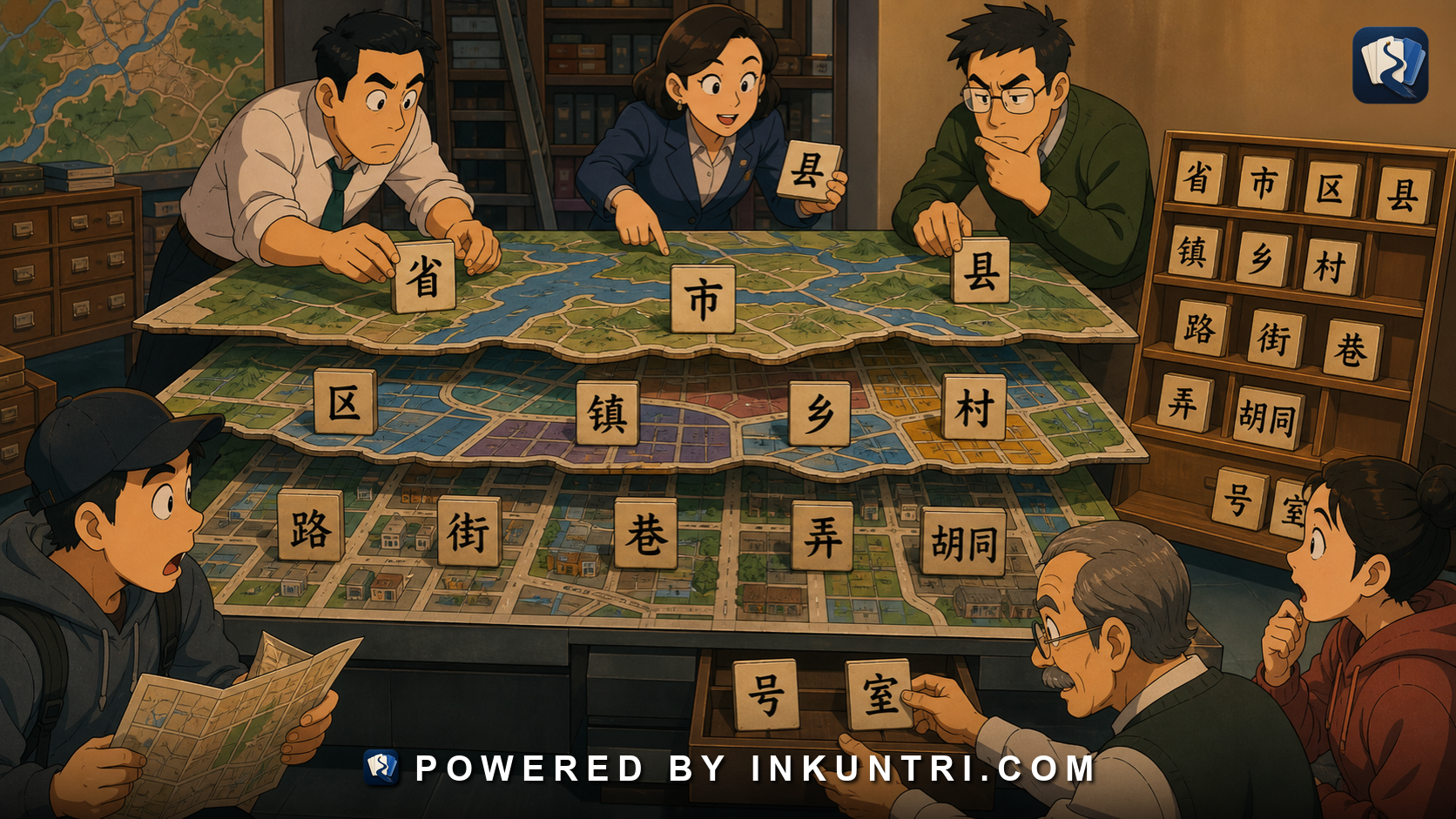
Recommended feature module: Map-label reader overlay: users click units such as 省, 市, 区, 县, 镇, 乡, 村, 路, 街, 巷, 弄, 胡同, 号, 室 and see hierarchy, pronunciation, and practical meaning. Related internal articles: 009, 015, 016, 017, 021, 034, 035.
Summary for readers
Chinese place names are not just names. They are often names plus labels. A map label such as 广东省深圳市南山区 contains three geographic layers. A street name such as 南京东路 may have nothing to do with being in Nanjing. A term like 区 can mean an official district in one context and a general “area” in another. A term like 市 may refer to a municipality, a prefecture-level city, a county-level city, or simply be part of an official place label.
For learners, the key is to stop treating every place name as a single block. Read the suffixes. They tell you what kind of place you are looking at.
1. Chinese place names often have a core plus a label
A Chinese administrative or geographic name often has two parts:
core name + place-type label
Examples:
- 广东 + 省 = 广东省 — Guangdong Province
- 深圳 + 市 = 深圳市 — Shenzhen City
- 南山 + 区 = 南山区 — Nanshan District
- 朝阳 + 区 = 朝阳区 — Chaoyang District
- 中山 + 路 = 中山路 — Zhongshan Road
- 北京 + 站 = 北京站 — Beijing Railway Station
The label is not decoration. It tells you what kind of unit the name belongs to.
Compare:
| Full label | Core name | Suffix | Meaning |
|---|---|---|---|
| 广东省 | 广东 | 省 | province |
| 深圳市 | 深圳 | 市 | city / municipality-type administrative label |
| 南山区 | 南山 | 区 | district |
| 中山路 | 中山 | 路 | road |
| 建国门 | 建国 | 门 | gate / gate-area name |
| 西湖区 | 西湖 | 区 | district |
When you see a long map string, look for these suffixes first. They are the grammar of the map.
2. Administrative geography: the high-value labels
Mainland Chinese administrative geography is layered. The exact legal hierarchy is more complex than a beginner needs at first, but the following labels are essential for literacy.
| Label | Pinyin | Basic meaning | What learners should know |
|---|---|---|---|
| 省 | shěng | province | A top-level provincial unit, as in 广东省, 四川省. |
| 自治区 | zìzhìqū | autonomous region | Province-level unit, as in 广西壮族自治区, 内蒙古自治区. Do not confuse with ordinary 区. |
| 直辖市 | zhíxiáshì | municipality directly under central government | 北京, 上海, 天津, 重庆 are province-level municipalities. |
| 特别行政区 | tèbié xíngzhèngqū | special administrative region | 香港特别行政区, 澳门特别行政区. |
| 市 | shì | city / municipality | Can appear at several levels; context matters. |
| 区 | qū | district / area | Often an urban district, but also a general “area/zone” word. |
| 县 | xiàn | county | Common county-level unit. |
| 县级市 | xiànjí shì | county-level city | A city at county-level rank. |
| 自治县 | zìzhìxiàn | autonomous county | County-level unit with ethnic-autonomy status. |
| 旗 | qí | banner | Used in Inner Mongolia administrative geography. |
| 镇 | zhèn | town | Township-level unit; larger/more urban than 乡 in many contexts. |
| 乡 | xiāng | township | Township-level rural unit. |
| 街道 | jiēdào | subdistrict | Urban township-level administrative unit, not just “street.” |
| 村 | cūn | village | Rural settlement or village-level label. |
| 社区 | shèqū | community | Urban community/residential administrative unit. |
This table gives reading value, not a full course in administrative law. Still, it prevents common mistakes.
A learner who sees 上海市浦东新区 should not read 市 as “market” or 区 as merely “zone.” The string is a place hierarchy: Shanghai Municipality + Pudong New Area / district-level unit. A learner who sees 内蒙古自治区鄂尔多斯市伊金霍洛旗 must know that 旗 is a place-type label used in Inner Mongolia, not a flag in the ordinary sense.
3. 市 is useful but slippery
The character 市 is one of the most common and most dangerous place labels for learners.
It can mean:
- a municipality or city in an address: 北京市, 深圳市, 成都市
- a prefecture-level city: 杭州市, 苏州市, 成都市
- a county-level city: 昆山市, 义乌市
- the ordinary word “market” in other contexts: 市场, 夜市, 超市
In a place name, 市 usually marks an administrative city-type unit. In a shopping word, it may be part of a market word.
Compare:
| Word | Meaning |
|---|---|
| 深圳市 | Shenzhen City |
| 成都市 | Chengdu City |
| 夜市 | night market |
| 超市 | supermarket |
| 市中心 | city center |
| 市政府 | municipal government |
The reading strategy is context. On a map or address, 市 after a place name is likely an administrative label. In a commercial phrase, it may refer to market or city life.
4. 区 is not always the same kind of “district”
The character 区 is also flexible.
In addresses and maps, it often means district:
- 北京市朝阳区 — Chaoyang District, Beijing
- 上海市黄浦区 — Huangpu District, Shanghai
- 深圳市南山区 — Nanshan District, Shenzhen
But 区 can also appear in broader words:
- 地区 — region / area
- 景区 — scenic area
- 开发区 — development zone
- 校区 — campus
- 小区 — residential compound or community
- 自治区 — autonomous region, a province-level unit
The learner trap is treating every 区 as the same administrative unit. It is better to ask: What word is 区 part of?
| Word | Pinyin | Meaning | Administrative? |
|---|---|---|---|
| 朝阳区 | Cháoyáng Qū | Chaoyang District | Yes, in Beijing context. |
| 景区 | jǐngqū | scenic area | Usually not the same as an urban district. |
| 开发区 | kāifāqū | development zone | May be administrative-like, economic, or management area. |
| 校区 | xiàoqū | campus | Institutional area, not a city district. |
| 小区 | xiǎoqū | residential compound/community | Crucial in addresses; not a district. |
| 自治区 | zìzhìqū | autonomous region | Province-level administrative unit. |
The same character contributes to many place words. The full compound matters.
5. Road, street, lane, alley: the urban suffixes
Once you move from administrative geography to urban navigation, another set of suffixes takes over.
| Label | Pinyin | Common translation | Notes |
|---|---|---|---|
| 路 | lù | road | Very common in modern addresses. |
| 街 | jiē | street | Can be a road, commercial street, or named street. |
| 大街 | dàjiē | avenue / main street | Often major or historically important. |
| 大道 | dàdào | avenue / boulevard | Often broad or planned road. |
| 巷 | xiàng | lane / alley | Smaller passage; common in older urban fabric. |
| 弄 | lòng | lane / alley | Especially associated with Shanghai and Jiangnan address usage. |
| 胡同 | hútòng | alley / lane | Strongly associated with Beijing and northern urban culture. |
| 里 | lǐ | lane/block/neighborhood suffix | Appears in older neighborhoods and compound names. |
| 号 | hào | number | Building or street number marker. |
| 室 | shì | room / office / apartment unit | Common final component in addresses. |
| 单元 | dānyuán | unit / entrance section | Common in apartment buildings. |
| 栋 / 幢 | dòng / zhuàng | building block | Common in residential compounds. |
| 楼 | lóu | building or floor | Position determines meaning. |
These terms are not fully interchangeable. 路 and 街 are both navigable roads, but a city may name and regulate them differently. 巷, 弄, and 胡同 carry strong local flavor and may reflect older urban patterns. 号, 栋, 单元, and 室 are not place names in the poetic sense; they are precision markers for getting to the correct door.
6. Direction words in place names
Chinese place names frequently use direction characters:
- 东 — east
- 南 — south
- 西 — west
- 北 — north
- 中 — central / middle
- 上 — upper / above / historically upstream or higher
- 下 — lower / below
- 前 — front
- 后 — back / rear
- 内 — inner
- 外 — outer
Examples:
- 南京东路 — Nanjing East Road
- 北京西站 — Beijing West Railway Station
- 朝阳北路 — Chaoyang North Road
- 中山南路 — Zhongshan South Road
- 内环路 — Inner Ring Road
- 外滩 — The Bund; literally “outer bank/beach” historically, but used as a proper place name
A major learner trap: a direction word inside a road name does not necessarily mean “go east” from where you are. It may identify a segment of a named road. 南京东路 in Shanghai is not “the eastern road to Nanjing.” It is the east section of Nanjing Road.
Treat the whole string as a name first. Use the direction character as a clue, not as turn-by-turn navigation.
7. Geography characters inside place names
Many place names preserve geographic information. These characters are worth recognizing even when the modern place is urbanized.
| Character | Pinyin | Meaning | Examples / notes |
|---|---|---|---|
| 山 | shān | mountain | 黄山, 南山, 香山 |
| 河 | hé | river | 漯河, 河东, 河西 |
| 江 | jiāng | river | 浙江, 江苏, 江北 |
| 湖 | hú | lake | 西湖, 湖南, 湖北 |
| 海 | hǎi | sea | 上海, 海南, 海淀 historically not always transparent to modern learners |
| 港 | gǎng | harbor / port | 香港, 蛇口港 |
| 湾 | wān | bay | 大亚湾, 后海湾 |
| 岛 | dǎo | island | 崇明岛, 鼓浪屿 uses 屿 “islet” |
| 洲 | zhōu | islet / continent / sandbar | 橘子洲, 亚洲 as non-place-name continent term |
| 坡 | pō | slope | 黄土坡, 山坡-related names |
| 岭 | lǐng | ridge | 大兴安岭, 南岭 |
| 沟 | gōu | ditch / valley | 九寨沟, various village names |
| 坝 | bà | dam / flatland / embankment | 沙坪坝, many southwestern names |
Do not overread these. A modern district name may preserve an old geography label even when the landscape has changed. But recognizing these characters makes place names less opaque.
8. History, politics, and culture in street names
Road names are not neutral vocabulary lists. They often preserve memory, politics, aspiration, commemoration, and planning history.
Common street-name elements include:
| Element | Meaning / association | Examples |
|---|---|---|
| 中山 | Sun Yat-sen / Zhongshan commemoration | 中山路 is extremely common. |
| 人民 | people / civic-political naming | 人民路, 人民广场 |
| 解放 | liberation | 解放路, 解放碑 |
| 建设 | construction / development | 建设路 |
| 文化 | culture | 文化路 |
| 和平 | peace | 和平路 |
| 胜利 | victory | 胜利街 |
| 友谊 | friendship | 友谊路 |
| 民族 | nationality / ethnic peoples | 民族大道 |
| 新华 | New China / Xinhua | 新华路 |
Because these names are widespread, they are poor identifiers by themselves. Saying “I’m on Zhongshan Road” is rarely enough. You need the city and district too.
9. Ethnic and regional labels
Chinese place names may mark ethnic autonomy, transliteration, or local-language history.
Examples:
- 广西壮族自治区 — Guangxi Zhuang Autonomous Region
- 新疆维吾尔自治区 — Xinjiang Uyghur Autonomous Region
- 内蒙古自治区 — Inner Mongolia Autonomous Region
- 延边朝鲜族自治州 — Yanbian Korean Autonomous Prefecture
- 西双版纳傣族自治州 — Xishuangbanna Dai Autonomous Prefecture
- 伊金霍洛旗 — Ejin Horo Banner
For learners, two points matter.
First, these names often contain ethnic labels such as 壮族, 维吾尔, 蒙古, 朝鲜族, 傣族. These are not adjectives to casually omit if you are reading formal names.
Second, some names are transliterations from non-Mandarin or non-Sinitic languages. Their characters may be chosen for sound, history, or convention, not transparent Mandarin meaning. Do not force a literal meaning onto every syllable.
10. Reading a map tile: examples
Example 1: 广东省深圳市南山区
Parse:
- 广东省 — Guangdong Province
- 深圳市 — Shenzhen City
- 南山区 — Nanshan District
Reading:
Nanshan District, Shenzhen City, Guangdong Province.
The Chinese order is large to small. English often reverses it.
Example 2: 北京市朝阳区建国路88号
Parse:
- 北京市 — Beijing Municipality
- 朝阳区 — Chaoyang District
- 建国路 — Jianguo Road
- 88号 — No. 88
Reading:
No. 88 Jianguo Road, Chaoyang District, Beijing.
Because Beijing is a province-level municipality, there is no separate province above it in normal addresses.
Example 3: 上海市黄浦区南京东路
Parse:
- 上海市 — Shanghai Municipality
- 黄浦区 — Huangpu District
- 南京东路 — East Nanjing Road
Warning:
南京东路 is a road name in Shanghai. It is not an address in Nanjing.
Example 4: 内蒙古自治区鄂尔多斯市伊金霍洛旗
Parse:
- 内蒙古自治区 — Inner Mongolia Autonomous Region
- 鄂尔多斯市 — Ordos City
- 伊金霍洛旗 — Ejin Horo Banner
Warning:
旗 here is an administrative label used in Inner Mongolia, not the ordinary object “flag.”
Example 5: 上海市静安区愚园路某弄
Parse:
- 上海市 — Shanghai Municipality
- 静安区 — Jing’an District
- 愚园路 — Yuyuan Road
- 弄 — lane number/entrance lane marker
Warning:
弄 is a crucial Shanghai-style address term. It may be the difference between finding the compound and wandering along the road.
11. Common learner mistakes
Mistake 1: Translating every suffix too literally
A learner sees 科技园 and translates “science and technology garden.” In an address, 科技园 is often better understood as “technology park” or simply left as a proper place name, depending on context.
Mistake 2: Ignoring repeated place names
There are many 朝阳, 中山, 和平, 人民, 建设, 解放, and 新华 place names. Always keep the larger location with the smaller one.
Bad:
Meet me on Zhongshan Road.
Better:
Meet me at the north entrance of the bookstore on Zhongshan Road in X District, Y City.
Mistake 3: Treating 路, 街, 巷, 弄, and 胡同 as interchangeable
They may all be navigable urban paths, but they are not culturally or practically identical. The suffix may tell you whether you are looking for a broad road, a commercial street, a lane, a Shanghai-style lane, or a Beijing-style alley.
Mistake 4: Assuming map abbreviations are “wrong”
Maps and apps often shorten names. A formal address may say 广东省深圳市南山区粤海街道科技园社区. A map label may show only 科技园. The shorter label is not necessarily wrong; it is a display choice.
Mistake 5: Forgetting that names change
Districts merge, roads are renamed, development zones change status, subway station names are updated, and neighborhoods are redeveloped. For current navigation, check a current map. For archives, preserve the historical name.
12. A place-name decoding checklist
When you meet an unfamiliar Chinese place name, do this:
- Find the suffixes. Look for 省, 市, 区, 县, 镇, 乡, 村, 路, 街, 巷, 弄, 胡同, 号.
- Separate core name from label. 广东省 = 广东 + 省.
- Build the hierarchy. Largest unit first, then smaller units.
- Notice local terms. 胡同 suggests Beijing/northern alley contexts; 弄 suggests Shanghai/Jiangnan lane contexts; 旗 suggests Inner Mongolia.
- Do not overtranslate. Proper names often stay as names.
- Keep enough context. 朝阳区 alone may be ambiguous; 北京市朝阳区 is clearer.
- Use the suffix to decide the kind of place. Is it a province, city, district, road, lane, station, gate, compound, or room?
This habit turns Chinese map reading from memorization into structured literacy.
Module goal: Help users understand Chinese map labels and address fragments as layered structures.
Input: A map label or address fragment.
Examples:
- 广东省深圳市南山区
- 北京市朝阳区建国路88号
- 上海市黄浦区南京东路
- 内蒙古自治区鄂尔多斯市伊金霍洛旗
- 上海市静安区愚园路某弄
User actions:
- Click suffixes.
- Choose the label type: province, city, district, county, town, road, lane, building number, room.
- Drag components into hierarchy.
- Toggle Chinese order and English-style order.
- Mark local or special labels such as 弄, 胡同, 旗, 自治州, 自治县.
Feedback:
- Explain whether the suffix is administrative, urban-navigation, residential, or generic.
- Warn about ambiguous names.
- Show a natural English rendering and a Pinyin rendering.
Editorial notes for Article 020
- Keep the article focused on literacy, not administrative-law completeness.
- Mainland China is the default frame for examples. Add a sidebar later for Taiwan, Hong Kong, Macau, Singapore, and diaspora address differences if the site expands cross-region coverage.
- Do not imply that every place-name character has a transparent modern meaning. Many names preserve older geography, transliteration, local languages, or historical layers.
- Good visual aid: a hierarchy ladder with color-coded suffixes.
Related reading
Chinese Characters Abroad: Hanzi, Kanji, Hanja, and the Shared Scriptworld
The reader understands the shared character tradition across China, Japan, and Korea while respecting each language’s independent grammar, pronunciation, and history.
How to Build a Personal Mandarin Shadowing Corpus
The reader can build a focused, repeatable set of audio materials for pronunciation, rhythm, vocabulary, and register practice.
Designing Chinese Anki Cards for Words, Characters, and Collocations
The reader can design Chinese flashcards that train recognition, pronunciation, meaning, collocation, character form, and contextual use without turning review into trivia.
How Punctuation Changed Modern Written Chinese
The reader understands modern Chinese punctuation as a historical layer that reshaped reading rhythm, sentence structure, and translation.
Political Slogans and Four-Character Style Across East Asia
The reader understands how four-character rhythm and classical-style compression shape political and public language across Chinese, Japanese, and Korean contexts.
From Flashcards to Literacy: When Chinese Study Must Leave the Card
The reader can recognize when flashcards are helping and when they are delaying real Chinese literacy, then shift toward connected reading and listening.