
Why Korean Spacing Is a Linguistic Problem, Not Just Punctuation
The reader can understand Korean spacing as a grammatical and editorial decision, not merely a matter of punctuation.
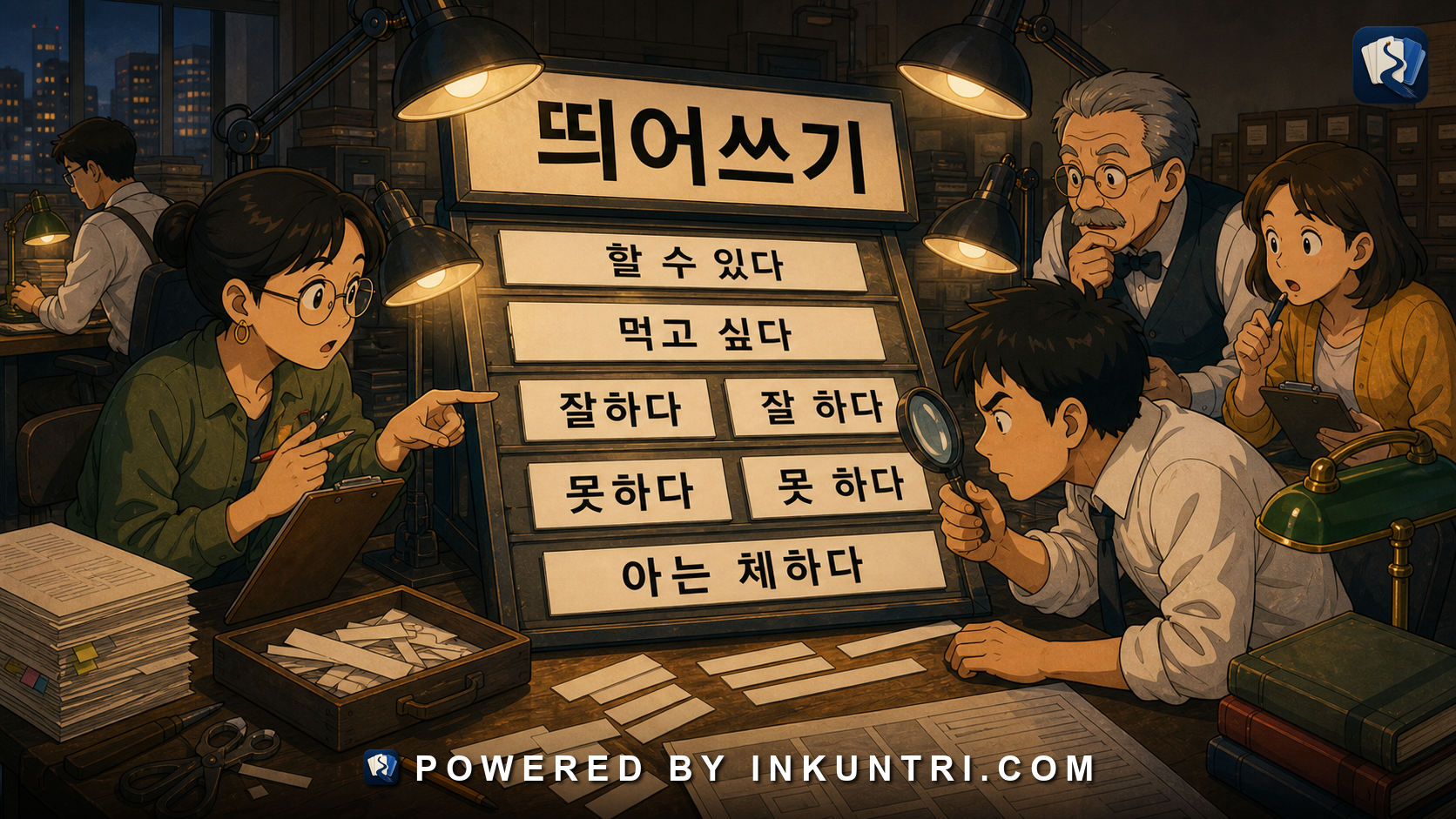
Core examples: 할 수 있다; 먹고 싶다; 서울역에서; 잘하다/잘 하다; 못하다/못 하다; 아는 체하다.
Spacing is where grammar becomes visible
Korean spacing can look like a minor formatting issue. It is not.
In Korean, particles attach to nouns. Verb endings attach to stems. Bound nouns often require spacing. Auxiliary constructions have spacing conventions. Compound verbs and ordinary adverb-plus-verb combinations can be distinguished by spacing. Public signs, news headlines, chat messages, legal clauses, and school grammar examples all use spacing to guide parsing.
A learner who reads Korean “word by word” in an English sense will get confused quickly. Korean spacing does not simply mark dictionary words. It marks units called 어절, roughly spacing units built around content words plus attached particles or endings.
That is why 서울역에서 is one written unit even though it contains 서울역 plus the particle 에서. It is also why 할 수 있다 is spaced into three parts even though the meaning functions as one modal expression: “can do.”
Spacing is not decoration. It is grammar on the page.
The basic unit: 어절
An 어절 is a spacing unit in Korean writing. It often consists of a lexical word plus attached grammatical material.
Examples:
| Written unit | Internal structure | Basic meaning |
|---|---|---|
| 서울역에서 | 서울역 + 에서 | at/from Seoul Station |
| 학생이 | 학생 + 이 | student + subject marker |
| 밥을 | 밥 + 을 | rice/meal + object marker |
| 갔습니다 | 가- + 았 + 습니다 | went |
Particles are not written as separate words. This is one of the first spacing rules learners must internalize.
English says “at Seoul Station.” Korean writes 서울역에서, not 서울역 에서 in standard spacing.
The particle belongs to the preceding noun phrase orthographically. That does not make it part of the noun’s meaning. It means Korean spacing follows its own grammatical logic.
Particles attach, but bound nouns often separate
Korean has many bound nouns: forms that behave like nouns but depend on a preceding modifier. Common examples include 수, 것, 데, 줄, 바, 체, 뿐, and 만 in certain uses.
In standard spacing, many bound nouns are written separately:
- 할 수 있다
- 먹을 것
- 가는 데 시간이 걸리다
- 아는 줄 알았다
- 한 바 있다
- 아는 체하다
The space before 수 in 할 수 있다 is not optional decoration in careful writing. 수 is a bound noun meaning something like “way/possibility” in this construction. The expression functions as “can,” but the spelling preserves its structure.
This is why Korean spacing is not always intuitive from translation. English “can do” is two words; Korean 할 수 있다 is three spacing units. English “pretend to know” is three words; Korean 아는 체하다 has a bound noun 체 plus 하다.
Auxiliary verbs create spacing decisions
Korean verb complexes often involve a main verb plus an auxiliary verb. Examples include:
- 먹고 싶다 — want to eat
- 해 보다 — try doing
- 가고 있다 — be going
- 해 주다 — do for someone
- 읽어 버리다 — end up reading / read completely, depending on context
Spacing can reflect the auxiliary relationship. In many cases, careful writing separates the auxiliary. In actual digital writing, people may compress some frequent expressions, especially in informal contexts or where lexicalization is strong.
The important learner point is not to panic over every variation. The point is to recognize the construction.
먹고 싶다 is not three unrelated words: eat + and + want. The ending 고 links the main verb to 싶다. The phrase means “want to eat.” The spacing helps you see the parts, but the grammar gives the meaning.
잘하다 and 잘 하다 are not always the same
Spacing can mark a meaning difference.
잘하다 as one word often means “to be good at” or “to do well” as a lexicalized verb:
- 한국어를 잘해요. I am good at Korean.
잘 하다 with a space can emphasize doing a particular action well:
- 이번 일은 정말 잘 했어요. You did this task really well.
In casual writing, people may not always preserve the distinction cleanly. But for serious reading, spacing can signal whether the writer treats the expression as a lexical verb or as an adverb modifying a verb.
A similar issue appears with 못하다 and 못 하다.
못하다 as one word can mean “to be poor at” or “inferior,” depending on context:
- 노래를 못해요. I cannot sing / I am bad at singing.
못 하다 with a space can emphasize inability to perform a specific action:
- 시간이 없어서 못 했어요. I could not do it because I had no time.
This is not always clean in real life, but the distinction is worth learning.
Official rules and real digital practice diverge
Korean has official spacing rules, school norms, proofreading conventions, and dictionary guidance. Real-world writing does not always follow them.
Text messages compress. Headlines omit. Public signs use line breaks for visual balance. App interfaces shorten. Search queries ignore spacing. Subtitles reduce. Legal and academic writing follows stricter patterns but can be dense.
A learner should not treat every online spacing pattern as a model to imitate. At the same time, it is unhelpful to treat every deviation as ignorance. Digital writing has its own pressures: speed, screen width, searchability, tone, and platform habits.
Good Korean literacy means recognizing both the rule and the genre.
Spacing can create ambiguity
Spacing sometimes changes parsing.
Consider:
- 잘하다 — to do well / be good at
- 잘 하다 — to do something well
Or:
- 못하다 — be unable, be bad at, be inferior, depending on context
- 못 하다 — cannot do a specific action
Another example:
- 아는 체하다 — pretend to know
- 아는체하다 — often seen but less careful in standard spacing
Spacing can also clarify whether a phrase contains a bound noun, an auxiliary, or a compound.
For learners, ambiguity is not a defect. It is evidence that Korean spacing is tied to grammar and meaning.
Spacing in signs and headlines
Public signs often use compressed noun phrases:
- 출입 금지 — entry prohibited
- 촬영 금지 — photography prohibited
- 사용 중지 — use suspended
- 관계자 외 출입 금지 — no entry except authorized personnel
These signs may not look like full sentences. Spacing helps identify the components: action noun, prohibition word, qualifier, authority phrase.
Headlines compress even further:
- 정부, 대책 발표
- 물가 상승세 둔화
- 회의 취소
Particles are often dropped, verbs are nominalized, and spacing marks the remaining noun chunks.
A spacing audit for learners
When a Korean sentence feels hard to parse, audit the spacing:
- Mark particles. Find 이/가, 은/는, 을/를, 에, 에서, 로, 와/과, 도, 만.
- Identify bound nouns. Look for 수, 것, 데, 줄, 바, 체, 뿐.
- Isolate verb complexes. Find constructions like 고 싶다, 아/어 보다, 고 있다, 아/어 주다.
- Check compound verbs. Ask whether 잘하다, 못하다, 좋아하다, 필요하다, 공부하다 function as lexical verbs.
- Consider genre. Is this a sign, chat message, law, headline, subtitle, or textbook sentence?
- Test a rewrite. Add missing particles or expand the sentence to confirm the structure.
Mini practice: spacing as parsing
Compare the grammar job in each phrase before deciding whether the spacing is arbitrary.
| Form | What to notice |
|---|---|
| 할 수 있다 | 수 is a bound noun; the phrase means ability or possibility |
| 먹고 싶다 | 싶다 works with the preceding connective phrase; spacing helps show the construction |
| 잘하다 | often lexicalized as “do well/be good at” |
| 잘 하다 | can emphasize doing an action carefully/well in context |
| 못하다 | can mean inability or poor performance, depending on construction |
| 못 하다 | can emphasize failure/not being able to perform a particular action |
| 아는 체하다 | 체 is a bound noun; the phrase means to pretend to know |
The useful habit is not “always trust spaces” or “ignore spaces.” It is to mark particles, bound nouns, auxiliaries, and lexicalized compounds, then ask whether the spacing changes the parse.
A strong tool for this article would let users toggle spacing and see parsing consequences.
Suggested functions:
- Input sentence: User enters a Korean sentence or phrase.
- Particle highlighter: Attached particles are marked inside each spacing unit.
- Bound noun detector: 수, 것, 데, 줄, 바, 체 are labeled.
- Auxiliary verb layer: 먹고 싶다, 해 보다, 가고 있다, 해 주다 are identified.
- Variant comparison: Show 잘하다 vs 잘 하다, 못하다 vs 못 하다.
- Genre mode: Compare textbook, headline, chat, and formal writing versions.
Final rule
Korean spacing is not merely punctuation. It is a grammar-facing writing convention.
Particles attach. Many bound nouns separate. Auxiliary constructions reveal structure. Compound verbs can change meaning depending on spacing. Real-world genres bend the rules for speed, space, and style.
Do not ask only “where are the spaces?” Ask what the spaces are telling you about Korean grammar.
Related reading
When CJK Comparison Helps Korean Learners and When It Becomes Noise
The reader can decide when Chinese/Japanese comparison accelerates Korean learning and when it creates false friends, grammar transfer, register mistakes, or institutional confusion.
Housing Policy Korean: 공공주택, 청약, 전세사기, 임대차
The reader can approach Korean housing-policy articles by identifying public housing, subscription/application systems, jeonse fraud, lease law, homeless/no-home status, point systems, guarantee insurance, landlords...
Korean AI Vocabulary: 생성형 AI, 추론, 학습데이터, 컴퓨팅 자원
The reader can read Korean AI policy, product, and technical prose by separating model terms, process terms, data terms, compute terms, privacy/safety terms, and English acronym layers.
Language Policy, Standardization, and Spacing Rules in Korea
The reader can understand Korean correctness debates as interactions among official norms, dictionaries, school practice, actual usage, and genre.
Sino-Korean Character Families Without Requiring Full Hanja Literacy
The reader can build Sino-Korean word families from recurring syllables without requiring full Hanja literacy.
Color Words in Korean: Tradition, Marketing, and Politics
The reader can classify Korean color words as literal description, traditional symbolism, political label, marketing style, or fixed expression.