
When Hanja Still Appears in Korean Names, Law, News, and Academia
The reader can know where Hanja still matters in modern Korean reading: names, law, news, official documents, scholarship, and archives.
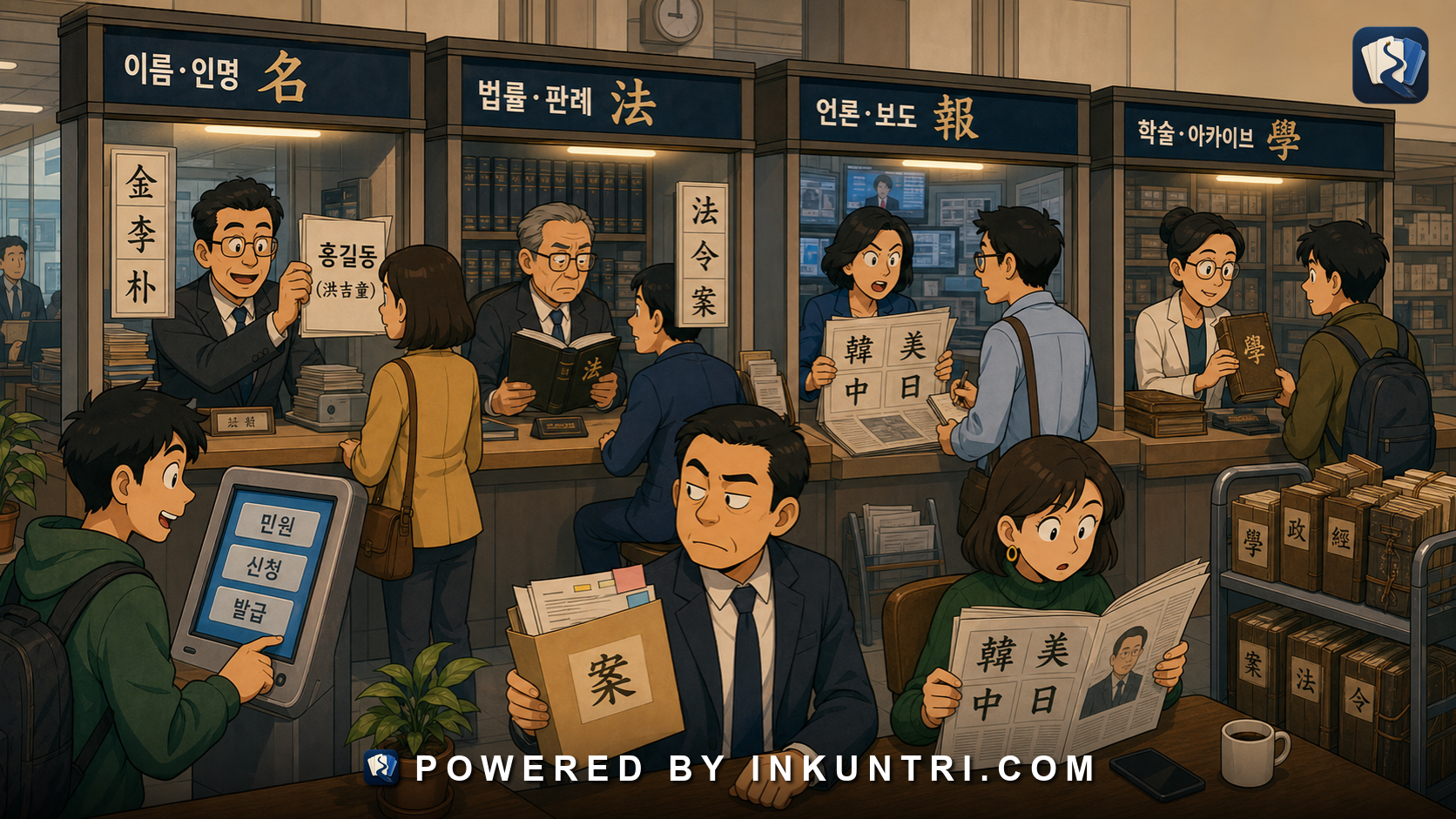
Core examples: 金, 李, 朴; 法, 令, 案; 韓, 美, 中, 日; 學, 政, 經; 홍길동(洪吉童).
Hanja did not disappear; it changed jobs
A common learner shortcut is: “Korean uses Hangul now, so I do not need Hanja.”
There is a useful truth there. Modern Korean is overwhelmingly written in Hangul in everyday life. You can read messages, signs, subtitles, menus, websites, and most books without being able to write Chinese characters. Hangul is the core script of modern Korean literacy.
But “not the core script” does not mean “irrelevant.” Hanja still appears in specific domains where it solves particular problems: name disambiguation, legal precision, headline compression, scholarly terminology, archival materials, and learned register.
The question is not whether every Korean learner should become a full Hanja reader immediately. The question is where Hanja still appears and what it is doing when it appears.
Names are the most personal reason Hanja still matters
Many Korean given names have associated Hanja, though not all do. A Hangul name such as 민지, 서준, 지훈, or 수빈 can correspond to many possible Hanja choices. The sound alone does not determine the written character meaning.
For example, a name pronounced 지훈 might be written with different characters depending on family choice and legal registration. Without evidence, you cannot safely guess the Hanja.
Family names also have common Hanja forms:
| Hangul | Common Hanja | Romanized examples |
|---|---|---|
| 김 | 金 | Kim, Gim |
| 이 | 李 | Lee, Yi, I |
| 박 | 朴 | Park, Bak |
| 최 | 崔 | Choi, Choe |
| 정 | 鄭 / 丁 / 程 and others | Jeong, Chung, Jung |
Even common surnames can have multiple Hanja origins. 정 is especially important because several surnames share the same Hangul spelling but differ in Hanja.
This is why official forms, family registers, genealogies, and news profiles may include Hanja in parentheses after a name:
홍길동(洪吉童)
The Hanja is not decorative. It identifies the name more precisely.
Legal and official language uses Hanja for precision
Korean law and public administration rely heavily on Sino-Korean vocabulary. Most legal text is written in Hangul today, but Hanja may appear in definitions, abbreviations, parenthetical clarifications, headings, older documents, and technical contexts.
Common legal and administrative characters include:
| Hanja | Korean reading | Meaning field |
|---|---|---|
| 法 | 법 | law |
| 令 | 령/영 | decree, order |
| 案 | 안 | bill, proposal, plan |
| 條 | 조 | article, clause |
| 項 | 항 | paragraph, item |
| 罪 | 죄 | crime, offense |
| 刑 | 형 | punishment, criminal law |
| 稅 | 세 | tax |
You may see 제1조, 제2항, 법률, 시행령, 개정안, 형법, 민법, 소득세, and similar terms. Many are written in Hangul, but Hanja knowledge helps decode their structure and distinguish homophones.
For learners, the practical skill is not reading classical legal Chinese. It is recognizing that 법, 조, 항, 령, 안, 세, 형, and 죄 are part of a formal Sino-Korean legal register.
Newspapers use Hanja for compression
Korean newspapers, especially headlines, sometimes use isolated Hanja characters for countries, institutions, political camps, or recurring terms.
Common headline shorthand includes:
| Hanja | Reading | Common headline meaning |
|---|---|---|
| 韓 | 한 | Korea |
| 美 | 미 | United States |
| 中 | 중 | China |
| 日 | 일 | Japan |
| 北 | 북 | North Korea |
| 與 | 여 | ruling party / government side in political reporting |
| 野 | 야 | opposition side |
| 檢 | 검 | prosecution |
| 軍 | 군 | military |
| 政 | 정 | politics/government |
| 經 | 경 | economy |
A headline with 韓, 美, 中, or 日 is not suddenly written in Classical Chinese. It is using compact abbreviations that Korean readers in that genre recognize.
The learner’s job is to expand the character into the Korean word or domain label. 韓 may represent 한국 or Korean-related matters. 美 usually points to 미국. 與野 means ruling and opposition parties together.
Academia uses Hanja as a definition tool
In academic Korean, Hanja may appear in parentheses to clarify a technical term or distinguish homophones. This is especially common in humanities, history, philosophy, law, linguistics, religious studies, and classical-text contexts.
A paper might introduce a term in Hangul and then give Hanja:
- 유교(儒敎)
- 민주주의(民主主義)
- 근대성(近代性)
- 법치주의(法治主義)
The Hanja helps define the conceptual lineage of the term. It may also help readers connect Korean terminology with Chinese, Japanese, or classical sources.
For learners, parenthetical Hanja is often a gift. It tells you, “This is the root family the author has in mind.” You do not have to know every character in advance. You can use the parentheses as a map.
Museums, archives, and older documents are different
Everyday Korean may be Hangul-dominant, but historical materials are not. Museum labels, old newspapers, royal documents, genealogies, land records, temple inscriptions, calligraphy, and family documents may contain Hanja heavily.
A tourist can enjoy Korea without reading these materials. A serious reader of Korean history cannot avoid them forever.
The key is to separate goals:
- Everyday communication: Hangul is enough for most tasks.
- Modern news and government reading: basic Hanja abbreviations help.
- Names and genealogy: name Hanja matters.
- Academic humanities and history: Hanja recognition becomes more important.
- Archival research: much deeper character literacy may be required.
Do not let the hardest domain intimidate you at the beginning. But do not pretend the domain does not exist.
Hanja can disambiguate homophones
Hangul is phonetic enough to represent Korean words clearly in context, but many Sino-Korean syllables sound alike. Hanja can disambiguate.
For example, 정 can represent many roots:
- 政 — politics/governance, as in 정치
- 情 — feeling, as in 감정
- 正 — correct/upright, as in 정답
- 定 — decide/fix, as in 결정
If a text gives Hanja, it is often preventing ambiguity. In names, this can be essential. In scholarship, it can be a definition.
A Hanja encounter routine
When you see Hanja in modern Korean, ask what job it is doing:
- Name clarification: Is it in parentheses after a person’s name?
- News compression: Is it in a headline or short label?
- Legal precision: Is it defining a statute, clause, or official term?
- Academic definition: Is it clarifying a concept?
- Historical source: Is the text older or archival?
- Aesthetic or branding use: Is it on a sign, restaurant name, seal, or logo?
Then decide how deeply you need to process it. Sometimes you only need to know that 美 means the United States. Sometimes you need the full character reading and meaning. Sometimes you should preserve the Hanja exactly because it is part of a name.
Mini practice: identify why Hanja appears
When you see Hanja in modern Korean, classify the job before trying to translate it.
| Example | Likely job | Reading strategy |
|---|---|---|
| 홍길동(洪吉童) | name clarification | do not guess meaning unless the person’s Hanja is given |
| 韓·美 정상회담 | headline compression | expand 韓 to 한국 and 美 to 미국 |
| 법률(法律) | learned-register gloss | use Hanja to confirm the term field |
| 與野 | political shorthand | read as 여야, ruling and opposition camps |
| 제1조(目的) | legal/academic definition | connect character gloss to the Hangul term |
This prevents two opposite errors: ignoring Hanja as irrelevant, or treating a modern Korean sentence as if it had switched into Classical Chinese.
A strong tool for this article would organize Hanja by usage context rather than by abstract character list.
Suggested functions:
- Name mode: Show 홍길동(洪吉童), 김(金), 이(李), 박(朴), and ambiguous surnames.
- News mode: Expand 韓, 美, 中, 日, 北, 與, 野, 檢.
- Law mode: Label 法, 令, 案, 條, 項, 稅.
- Academic mode: Show parenthetical Hanja in terms such as 민주주의(民主主義).
- Archive mode: Warn when deeper Hanja literacy is required.
- Learner priority list: Separate “recognize now” from “study later.”
Final rule
Hanja is no longer the everyday script of Korean, but it still has real jobs.
It clarifies names, compresses headlines, defines legal and academic terms, and opens the door to archives and historical materials. Learn Hangul first. Then build a practical recognition layer for the Hanja that still appears in the Korean you actually want to read.
Related reading
When CJK Comparison Helps Korean Learners and When It Becomes Noise
The reader can decide when Chinese/Japanese comparison accelerates Korean learning and when it creates false friends, grammar transfer, register mistakes, or institutional confusion.
Hanja Beneath Hangul: The Hidden Sino-Korean Layer
The reader can recognize the Sino-Korean layer behind Hangul words without needing to become a full Hanja reader on day one.
Nominalization With 기, 음, 것, and 데
The reader can distinguish nominalizers 기, 음, 것, and 데 by function, register, and sentence role.
Korean Internet Slang: Abbreviation, Hangul Play, and Persona
The reader can recognize Korean internet slang as a system of compression, emotional display, group identity, and online persona while avoiding unsafe or stale reuse.
Korean Newsreader Speech vs Everyday Conversation
The reader can distinguish Korean newsreader speech from everyday conversation and use both for different learning goals.
Busan and Gyeongsang Prosody Without Stereotypes
The reader can understand Busan and broader Gyeongsang prosody through pitch, rhythm, and pragmatic use rather than caricature.