
Stroke Order for Hangul: What Matters After the First Week
The reader can know which parts of Hangul stroke order matter for legibility, speed, and character recognition after basic literacy.
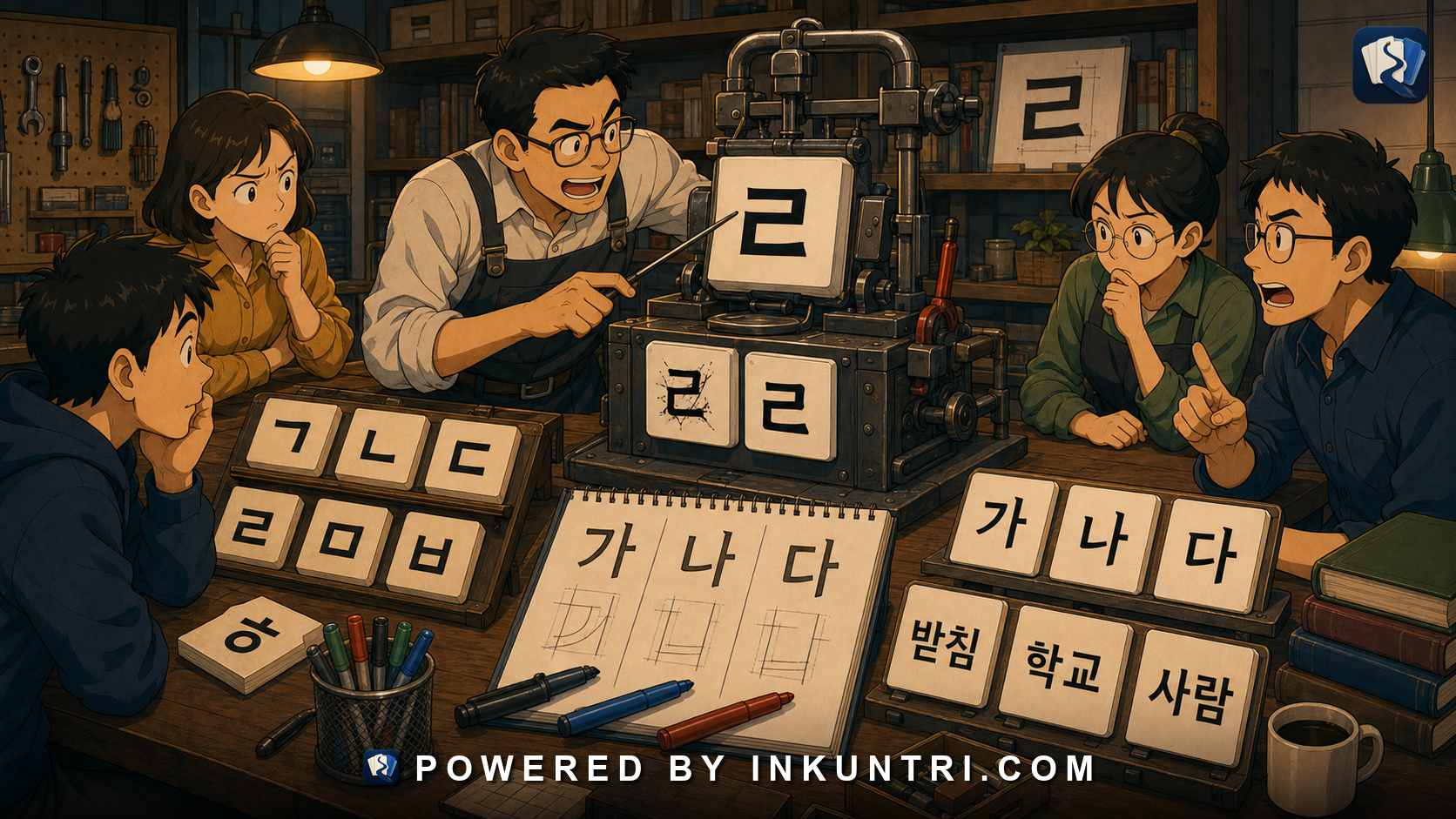
Core examples: ㄱ, ㄴ, ㄷ, ㄹ, ㅁ, ㅂ, ㅎ; 가, 나, 다; 받침; 학교; 사람.
Stroke order is neither sacred nor useless
Learners tend to fall into two bad positions about Hangul stroke order.
The first position treats stroke order like sacred calligraphy. Every slight deviation feels like a moral failure. This is too rigid for ordinary literacy. Koreans do not all write exactly the same way in casual notes, and real handwriting changes with speed, pen, surface, age, and personal habit.
The second position says stroke order does not matter at all because Hangul is alphabetic and the final shape is what counts. This is also wrong. Stroke direction and order affect speed, legibility, block balance, and recognition of fast native handwriting. They also affect digital handwriting input.
The useful middle position is simple:
Learn standard stroke habits well enough that your handwriting remains readable when it becomes fast.
After the first week, stroke order is not about reciting rules. It is about preventing your Korean from collapsing into ambiguous boxes.
The basic direction habits
Hangul stroke order generally follows broad writing habits that are easy to remember: top before bottom, left before right, and outside structure before internal completion where that applies. These are not magic formulas that solve every letter, but they explain the overall movement of the hand.
One important remediation point: stroke order is not a spelling rule in the same sense as writing 학교 rather than 하꾜. It is a practical convention for legibility, speed, and recognition. Ordinary handwriting varies, and calligraphy may stylize letters on purpose. The learner goal is not to police every pen movement; it is to build a path that still produces readable blocks under speed.
Letters such as ㄱ, ㄴ, ㄷ, and ㅁ are especially useful because they show how line direction creates recognizable corners. If you write these in a random path, the final printed-like result may still be readable when slow. But at speed the corners become distorted.
Vowels also have direction habits. A vertical vowel such as ㅏ or ㅓ should not float randomly away from the consonant. A horizontal vowel such as ㅗ or ㅜ changes the whole block layout. Compound vowels are built from simpler strokes, not memorized as decorative drawings.
Why ㄹ deserves special attention
ㄹ is one of the most important letters to practice because its printed form is visually complex but its handwritten form often becomes simplified. Learners who only know the font may fail to recognize fast handwritten ㄹ. Learners who invent their own ㄹ may produce a form that looks like a malformed ㅁ, ㄴ, or squiggle.
The goal is not to make ㄹ pretty. The goal is to preserve enough of its directional identity that the reader sees it as ㄹ even when it is quick.
Practice ㄹ in three environments:
- as an initial consonant: 라, 러, 로, 루;
- as a final consonant: 갈, 말, 길, 서울;
- inside dense blocks: 읽, 닭, 밝.
Initial ㄹ and final ㄹ do not feel the same on the page. Final ㄹ is squeezed into the bottom space, and that is where many learner forms become unclear.
ㅁ and ㅂ: closed boxes with different information
ㅁ and ㅂ cause trouble because both can look boxy. In printed fonts, ㅂ has internal structure and ㅁ is a simple closed square. In fast handwriting, the difference can weaken if the writer does not control the strokes.
This matters in pairs such as 마 and 바, 몸 and 봄, 마음 and 바음-like learner errors. The reader needs to know whether the block begins with ㅁ or ㅂ. If your ㅂ loses its internal clue, the word may still be guessed from context, but it no longer carries its own weight.
Practice ㅁ and ㅂ in real words rather than isolated letters:
- 마음, 몸, 말, 메뉴;
- 밥, 봄, 바다, 번호.
The word 번호 is especially useful because it contains ㅂ, ㄴ, and ㅎ in a form-like word that appears on documents and websites.
ㅎ and ㅇ: circles, breath, and visual weakness
The letters ㅎ and ㅇ are visually important because both involve rounded shapes, and both can shrink in handwriting. In pronunciation, initial ㅇ is silent, and ㅎ may weaken or interact with neighboring sounds. In spelling and handwriting, however, both must remain visible.
A learner who writes 좋아요 too quickly may accidentally make it look like 조아요. A learner who writes 학교 may let ㅎ and ㄱ crowd the block until the word loses its shape. A learner who writes 연락처 may make the ㅇ in 연 too small to notice.
This is a good example of why handwriting and pronunciation must be separated. You may hear 좋아요 as [조아요] in standard pronunciation, but the spelling still contains ㅎ. Handwriting practice helps preserve the written layer.
Stroke order and block layout are linked
A letter can be written correctly in isolation and still fail inside a block. That is the central lesson after the first week.
가 is easy because ㄱ and ㅏ create a simple left-right layout. 나 is also straightforward. 다 adds more horizontal structure. But 학교, 사람, 받침, and 연락처 require more planning because each syllable block has different internal pressure.
In 받침 itself, 받 has final ㄷ under ㅏ and ㅂ, while 침 has ㅊ, ㅣ, and ㅁ. If you over-enlarge the initial consonant, the batchim becomes cramped. If you over-enlarge the final consonant, the block becomes bottom-heavy.
Stroke order helps because it gives your hand a predictable route through the block. The result is less hesitation and better proportion.
Digital handwriting recognition cares more than you think
When you write Hangul on a phone or tablet, the system may evaluate the path of your strokes, not only the final image. This is especially true when several shapes could be visually similar. Standard-ish stroke order gives the system more evidence.
This does not mean you must write slowly like a worksheet forever. It means that early practice should build reliable motor habits before speed distorts them.
A practical stroke-order routine
Use this routine for two weeks, then keep only the parts that help.
- Practice a small set of letters: ㄱ, ㄴ, ㄷ, ㄹ, ㅁ, ㅂ, ㅎ.
- Write each letter inside real syllables, not only alone: 가, 나, 다, 라, 마, 바, 하.
- Add final consonants: 간, 말, 밥, 학교, 사람.
- Write slowly once, normally twice, and fast once.
- Compare the fast version with the slow version. Do not judge beauty; judge recognizability.
- Use digital handwriting input as a stress test, not as the only judge.
- Keep a list of your two worst letters and repair those first.
Mini practice: identify what stroke order protects
| Form | Main danger | Stroke-order benefit |
|---|---|---|
| ㄹ | becomes an unclear zigzag | preserves directional identity |
| ㅁ | opens or collapses | keeps the box closed and balanced |
| ㅂ | looks like ㅁ | preserves internal structure |
| ㅎ | disappears in dense blocks | keeps top strokes and circle visible |
| 받침 | bottom becomes crowded | teaches vertical space management |
| 학교 | ㅎ, ㄱ, and ㅛ compete visually | keeps each block readable |
Write each item once with deliberate standard order and once with your fastest natural writing. The difference will show what still needs work.
Suggested functions:
- Slow animation: shows a standard stroke path for each jamo.
- Normal-speed layer: shows how the same path looks in ordinary handwriting.
- Fast layer: shows realistic simplification without losing identity.
- Block mode: places letters inside syllable blocks.
- Error detector: flags ㅁ/ㅂ confusion, weak ㅎ, crowded batchim, and distorted ㄹ.
- Tablet test: users write a block and compare the recognized output.
Final rule
Stroke order matters when it protects legibility, speed, and recognition. It stops mattering when it becomes empty ritual.
Learn the standard path, then use it to write Korean that still reads like Korean when your hand speeds up.
Related reading
When CJK Comparison Helps Korean Learners and When It Becomes Noise
The reader can decide when Chinese/Japanese comparison accelerates Korean learning and when it creates false friends, grammar transfer, register mistakes, or institutional confusion.
Korean Numbers in Writing: Native, Sino-Korean, Arabic Digits, and Formal Use
The reader can choose between native Korean numbers, Sino-Korean numbers, Arabic digits, and formal written number conventions.
Housing Policy Korean: 공공주택, 청약, 전세사기, 임대차
The reader can approach Korean housing-policy articles by identifying public housing, subscription/application systems, jeonse fraud, lease law, homeless/no-home status, point systems, guarantee insurance, landlords...
Confucian Vocabulary in Korean Public Language
The reader can recognize Confucian-derived terms in modern Korean public language without treating them as timeless cultural essence.
Korean AI Vocabulary: 생성형 AI, 추론, 학습데이터, 컴퓨팅 자원
The reader can read Korean AI policy, product, and technical prose by separating model terms, process terms, data terms, compute terms, privacy/safety terms, and English acronym layers.
Language Policy, Standardization, and Spacing Rules in Korea
The reader can understand Korean correctness debates as interactions among official norms, dictionaries, school practice, actual usage, and genre.