
Korean Numbers in Writing: Native, Sino-Korean, Arabic Digits, and Formal Use
The reader can choose between native Korean numbers, Sino-Korean numbers, Arabic digits, and formal written number conventions.
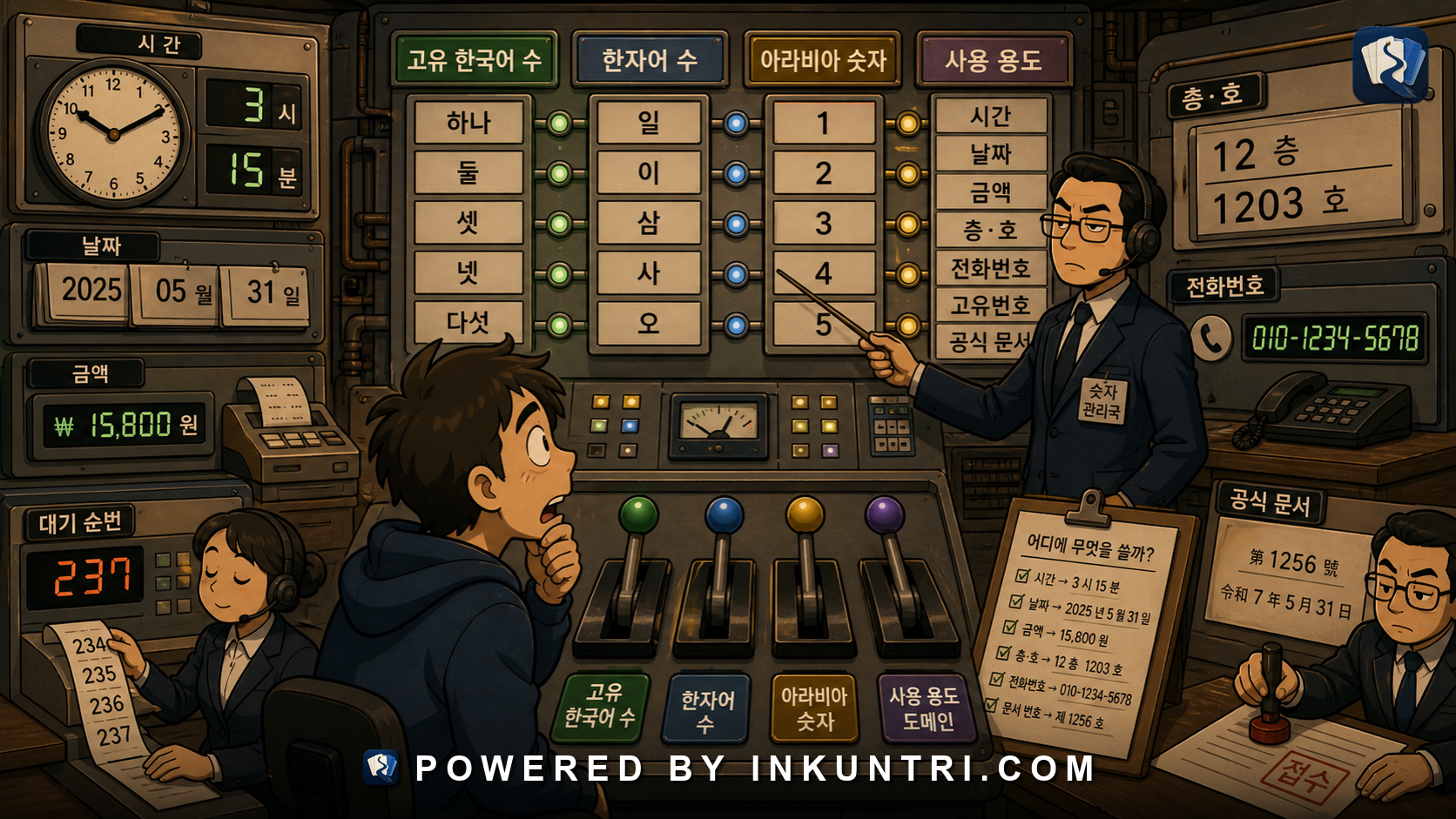
Core examples: 한 명; 두 개; 세 시; 삼 층; 5월 23일; 만 원; 010-1234-5678; 제1조.
Korean numbers are a domain system, not one list
Many learners memorize two number sets and then ask the wrong question: “Which Korean number system is correct?”
The better question is: “What domain am I counting in?”
Korean uses native Korean numbers, Sino-Korean numbers, Arabic digits, and formal written conventions in different contexts. Age, counters, hours, dates, prices, floors, phone numbers, laws, addresses, and documents do not all behave the same way.
A learner who knows 하나 and 일 still needs to know when to write 한 명, 세 시, 삼 층, 5월 23일, 만 원, and 제1조.
The two main number systems
Native Korean numbers include:
하나, 둘, 셋, 넷, 다섯, 여섯, 일곱, 여덟, 아홉, 열, 스물...
Sino-Korean numbers include:
일, 이, 삼, 사, 오, 육, 칠, 팔, 구, 십, 백, 천, 만...
Very roughly:
- Native Korean numbers are common with many counters and hours.
- Sino-Korean numbers are common with dates, minutes, money, floors, phone numbers, measurements, addresses, and formal numbering.
This rough rule is useful, but real usage is domain-specific.
Counters often use native Korean numbers
When counting people, objects, animals, books, bottles, and many everyday things, Korean often uses a native number plus a counter.
Examples:
| Phrase | Meaning |
|---|---|
| 한 명 | one person |
| 두 명 | two people |
| 세 개 | three items/things |
| 네 권 | four books/volumes |
| 다섯 병 | five bottles |
| 여섯 마리 | six animals |
Notice the special contracted forms before counters:
- 하나 → 한
- 둘 → 두
- 셋 → 세
- 넷 → 네
- 스물 → 스무 in many contexts such as 스무 살
You do not usually say 하나 명 or 셋 개 in standard counting. The number changes form before the counter.
Time splits the systems
Clock time commonly mixes systems:
- Hours use native Korean numbers.
- Minutes use Sino-Korean numbers.
Examples:
- 세 시 — three o’clock
- 세 시 십 분 — 3:10
- 일곱 시 삼십 분 — 7:30
- 열한 시 오 분 — 11:05
This mixed system is one of the most useful early patterns. 세 시 is native; 십 분 is Sino-Korean.
Dates use Sino-Korean numbers
Dates are usually Sino-Korean:
- 5월 23일 — May 23
- 2026년 5월 25일 — May 25, 2026
- 월요일 — Monday, not a number expression but often part of date reading
년, 월, and 일 combine with Sino-Korean numbers:
- 이천이십육년
- 오월
- 이십오일
In writing, Arabic digits are common: 2026년 5월 25일. In speech, those digits are read in Sino-Korean numbers.
Money uses Sino-Korean numbers and large units
Korean money commonly uses Sino-Korean numbers with 원:
- 천 원 — 1,000 won
- 만 원 — 10,000 won
- 오만 원 — 50,000 won
- 십만 원 — 100,000 won
- 백만 원 — 1,000,000 won
The large unit 만 is essential. English speakers often group large numbers by thousands; Korean groups many everyday large numbers around 만, 억, and 조.
Examples:
| Korean | Number | English-style grouping |
|---|---|---|
| 만 | 10,000 | ten thousand |
| 십만 | 100,000 | one hundred thousand |
| 백만 | 1,000,000 | one million |
| 천만 | 10,000,000 | ten million |
| 억 | 100,000,000 | one hundred million |
A price tag may write 10,000원, but people say 만 원.
Floors, dates, phone numbers, and addresses
Many numeric domains use Sino-Korean numbers:
- 삼 층 — third floor
- 제1조 — Article 1
- 2번 출구 — Exit 2
- 101동 1203호 — Building 101, Unit 1203
- 010-1234-5678 — phone number
Phone numbers are read digit by digit. 0 may be read as 공 or 영 depending on context and habit, with 공 especially common in phone numbers. Hyphens organize the number visually, but each digit matters.
Arabic digits are normal Korean writing
Korean writing frequently uses Arabic digits. This is not “less Korean.” It is normal.
You will see:
- 5월 23일
- 10명
- 3층
- 2인분
- 010-1234-5678
- 50% 할인
- 제1조
- 1+1 행사
The key is to know how the digits are read in context. 3 in 3층 is 삼. 3 in 3시 is 세. 2 in 2명 is 두 명 if read fully as a counting phrase, but 이 명 can appear in formal or statistical reading depending on context.
Digits do not remove the number-system decision. They hide it until speech.
Formal and legal numbering
Formal documents, laws, regulations, contracts, and forms use numbering conventions such as:
- 제1조 — Article 1
- 제2항 — Paragraph 2
- 제3호 — Subparagraph/item 3
- 1. 목적
- 가. 세부 사항
- (1) 조건
제 marks an ordinal or numbered item in many formal contexts. 조, 항, 호, 목 and similar terms organize legal or administrative documents.
A learner reading law or policy documents should treat numbers as structural markers, not just quantities.
A number-selection routine
Use this routine:
- Identify the domain. People, objects, time, date, money, floor, phone, legal article, address?
- Choose the number system. Native for many counters and hours; Sino-Korean for dates, minutes, money, floors, and formal numbering.
- Attach the right counter or unit. 명, 개, 권, 병, 시, 분, 원, 층, 조.
- Use contracted native forms. 한, 두, 세, 네, 스무.
- Decide digits or words. Menus, forms, prices, and schedules often use digits.
- Read digits by context. 3 can be 세 or 삼 depending on the domain.
Mini practice: read the same digit four ways
The written digit does not decide the Korean number system by itself.
| Written form | Likely reading | Domain |
|---|---|---|
| 3명 | 세 명 | people counter |
| 3시 | 세 시 | hour |
| 3분 | 삼 분 | minute |
| 3층 | 삼 층 | floor |
| 3월 | 삼 월 | month |
| 제3조 | 제삼조 / 제3조 read structurally as Article 3 | legal/formal numbering |
This is why number study should be organized by use case: counters, time, date, money, phone numbers, addresses, documents, and rankings.
A strong tool for this article would ask the user what they are counting.
Suggested functions:
- Domain cards: age, people, objects, time, date, price, floor, phone, law.
- Number-system output: Native or Sino-Korean with explanation.
- Counter chooser: 명, 개, 권, 병, 마리, 대, 잔, 인분.
- Digit reading mode: Convert 3층, 3시, 3명, 3분 into spoken Korean.
- Large-number trainer: 만, 억, 조 grouping.
- Formal document mode: 제1조, 제2항, 제3호.
Final rule
Korean numbers are chosen by context.
Do not memorize 하나 and 일 as competing translations of “one.” Learn the domains: 한 명, 세 시, 삼십 분, 5월 23일, 만 원, 삼 층, 010, 제1조. Once you attach numbers to real contexts, the system becomes practical instead of chaotic.
Related reading
When CJK Comparison Helps Korean Learners and When It Becomes Noise
The reader can decide when Chinese/Japanese comparison accelerates Korean learning and when it creates false friends, grammar transfer, register mistakes, or institutional confusion.
Confucian Vocabulary in Korean Public Language
The reader can recognize Confucian-derived terms in modern Korean public language without treating them as timeless cultural essence.
Language Policy, Standardization, and Spacing Rules in Korea
The reader can understand Korean correctness debates as interactions among official norms, dictionaries, school practice, actual usage, and genre.
Color Words in Korean: Tradition, Marketing, and Politics
The reader can classify Korean color words as literal description, traditional symbolism, political label, marketing style, or fixed expression.
Formal Korean Connectors: 따라서, 한편, 다만, 또한, 이에
The reader can read formal Korean connectors as paragraph-level logic signals rather than translating them one word at a time.
Hanja Beneath Hangul: The Hidden Sino-Korean Layer
The reader can recognize the Sino-Korean layer behind Hangul words without needing to become a full Hanja reader on day one.