
Reading Korean Addresses: Province, City, Gu, Dong, Road Name, and Building
The reader can parse Korean addresses from the largest administrative unit down to the building or room.
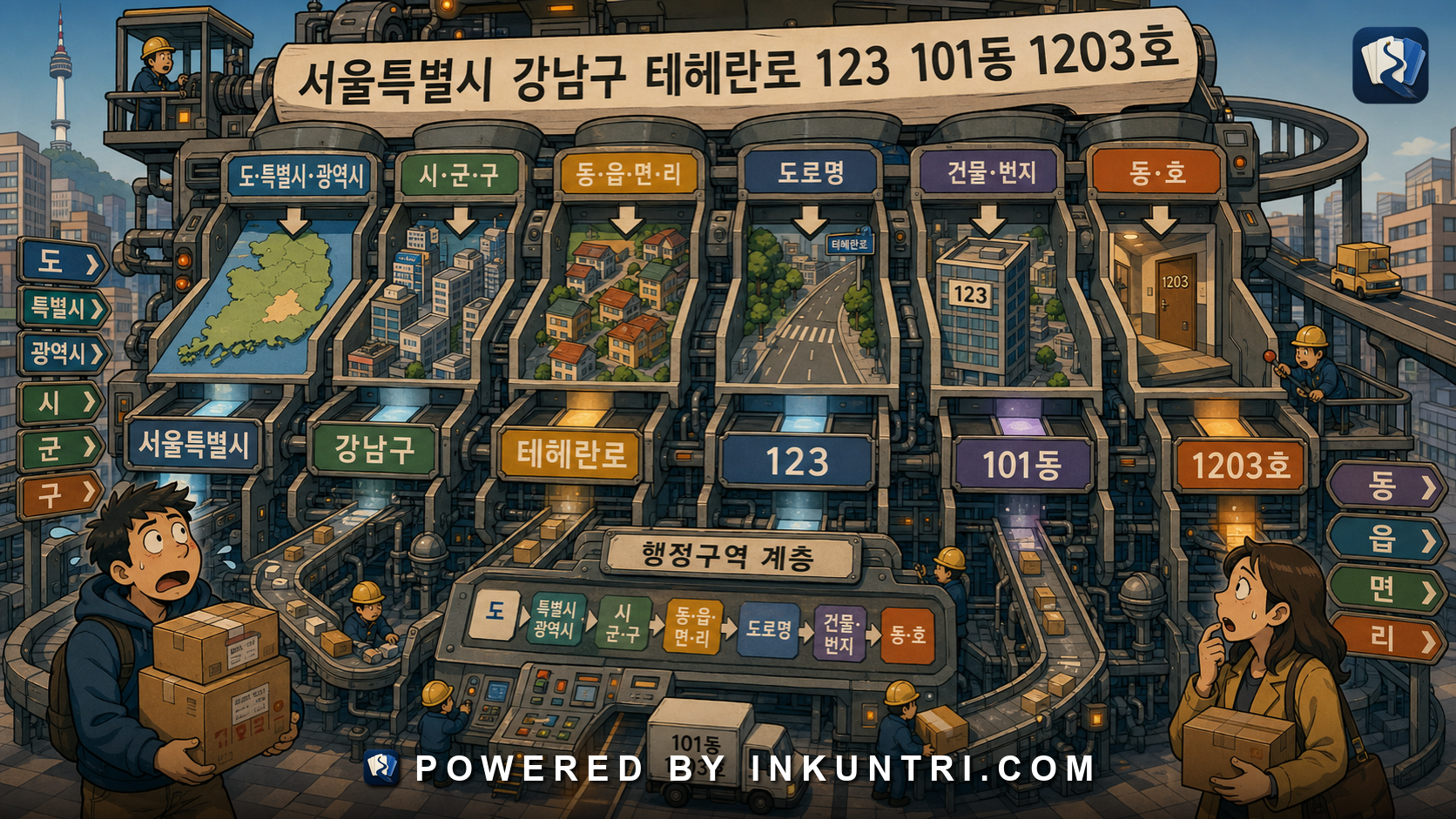
Core examples: 서울특별시 강남구 테헤란로; 부산광역시 해운대구; 경기도 수원시; 종로구 세종대로; 101동 1203호.
A Korean address is a hierarchy
A long Korean address can look like one intimidating string:
서울특별시 강남구 테헤란로 123, 101동 1203호
But it is not random. Korean addresses move through administrative and location units, usually from larger to smaller:
- province or metropolitan city,
- city or district,
- neighborhood or road,
- building number,
- building/tower/unit information.
Once you recognize the labels, the address becomes a map.
Large units: 도, 특별시, 광역시
Korean addresses often begin with a large administrative unit.
| Korean term | Rough role | Example |
|---|---|---|
| 도 | province | 경기도, 강원도 |
| 특별시 | special city | 서울특별시 |
| 광역시 | metropolitan city | 부산광역시, 대구광역시 |
| 특별자치시 / 특별자치도 | special self-governing city/province | 세종특별자치시, 제주특별자치도 |
In everyday speech, people often shorten 서울특별시 to 서울, 부산광역시 to 부산, and 경기도 to 경기. But official addresses may use the full form.
Middle units: 시, 군, 구
After the large unit, you may see:
| Term | Rough meaning | Example |
|---|---|---|
| 시 | city | 수원시, 고양시 |
| 군 | county | 가평군 |
| 구 | district/ward | 강남구, 해운대구, 종로구 |
A large city may contain 구 districts. A province may contain cities and counties. Some addresses include both city and district:
경기도 수원시 영통구 ...
This tells you: Gyeonggi Province → Suwon City → Yeongtong District.
Smaller neighborhood units: 동, 읍, 면, 리
Older or lot-based addresses and many local references use neighborhood-level units:
| Term | Rough meaning | Example use |
|---|---|---|
| 동 | neighborhood | 서교동, 역삼동 |
| 읍 | town | 조치원읍 |
| 면 | township | 애월읍 is 읍; many rural units use 면 |
| 리 | village-level unit | often in rural addresses |
Even with modern road-name addresses, 동 names remain important in conversation, real estate, delivery, local identity, and maps.
A learner should recognize both systems: road-name addresses and neighborhood/lot-based references.
Road-name addresses: 로, 길, 번길
Modern Korean addresses often use road names.
Common road terms:
| Term | Meaning | Example |
|---|---|---|
| 대로 | large avenue/boulevard | 세종대로 |
| 로 | road/street | 테헤란로 |
| 길 | street/path | 압구정로데오길 |
| 번길 | numbered side street | 테헤란로7길 |
A road-name address may look like:
서울특별시 강남구 테헤란로 123
Breakdown:
- 서울특별시 — Seoul Special City
- 강남구 — Gangnam District
- 테헤란로 — Teheran-ro/Road
- 123 — building number
The road name plus building number is central for navigation.
Building, apartment, and room units
Korean addresses often include building and unit information.
Common terms:
| Korean | Meaning |
|---|---|
| 동 | building/tower in apartment complexes; also neighborhood in other contexts |
| 호 | room/unit number |
| 층 | floor |
| 건물 | building |
| 지하 | basement |
| 1층 | first floor |
| 101동 1203호 | Building 101, Unit 1203 |
The word 동 can confuse learners because it can mean neighborhood in one context and apartment building/tower in another. In 101동 1203호, it refers to a building/tower number, not a neighborhood.
호 is very important for apartments, offices, hotel rooms, and form fields.
Postal codes and parentheses
Korean addresses may include a postal code, often in parentheses or before the address:
(06236) 서울특별시 강남구 테헤란로 123
Additional information may appear in parentheses:
- building name,
- neighborhood name,
- old lot address,
- company or department,
- floor and room.
Delivery addresses may also include recipient name and phone number, which are not part of the address itself but are essential for shipping.
Old lot-based addresses still appear
South Korea uses road-name addresses as the official address system, but older lot-based addresses and neighborhood references remain common in memory, older documents, local speech, real estate, and some maps.
You may see terms such as 번지, 지번, 동, 리, and 산 in older or land-related addresses. A road-name address and a lot-based address may refer to the same place through different systems.
For learners, the practical rule is: do not assume every Korean address follows one visible pattern. Identify the labels.
How to parse an address
Take:
부산광역시 해운대구 해운대로 570, 3층
Breakdown:
- 부산광역시 — Busan Metropolitan City
- 해운대구 — Haeundae District
- 해운대로 — Haeundae-daero/Road
- 570 — building number
- 3층 — third floor
Take:
경기도 수원시 영통구 광교중앙로 140, 101동 1203호
Breakdown:
- 경기도 — Gyeonggi Province
- 수원시 — Suwon City
- 영통구 — Yeongtong District
- 광교중앙로 — Gwanggyo Jungang-ro/Road
- 140 — building number
- 101동 — Building/Tower 101
- 1203호 — Unit 1203
An address parser workflow
Use this routine:
- Start large. Find 도, 특별시, 광역시, 특별자치시, 특별자치도.
- Find city/district. Look for 시, 군, 구.
- Find road or neighborhood. 로, 대로, 길, 번길, 동, 읍, 면, 리.
- Locate building number. Often a number after the road name.
- Separate unit information. 동, 호, 층, 건물명.
- Ignore non-address extras at first. Recipient name, phone number, delivery notes.
Mini practice: disassemble one address
Take this address:
서울특별시 종로구 세종대로 175, 3층
Break it into fields:
| Piece | Field |
|---|---|
| 서울특별시 | large administrative unit |
| 종로구 | district |
| 세종대로 | road name |
| 175 | building number |
| 3층 | floor |
Now compare:
서울특별시 종로구 세종대로 175 (세종로)
The parenthetical 세종로 may be a neighborhood or old/location reference depending on context. Do not mix it into the road-name core until you know what it is doing.
A strong tool for this article would color-code address parts.
Suggested functions:
- Input address: User pastes a Korean address.
- Color coding: Province/city/district/neighborhood/road/building/unit.
- Label glossary: 도, 시, 군, 구, 동, 로, 길, 호, 층.
- Road vs lot toggle: Show whether the address is road-name or lot-based.
- Delivery mode: Separate recipient, phone, postal code, and address.
- Map-readiness check: Identify the searchable core address.
Final rule
A Korean address is not one long noun. It is a hierarchy.
Read from macro to micro: province or city, district, road or neighborhood, building number, building/tower, unit or floor. Once you know the administrative nouns, Korean addresses become structured and searchable rather than intimidating.
Related reading
When CJK Comparison Helps Korean Learners and When It Becomes Noise
The reader can decide when Chinese/Japanese comparison accelerates Korean learning and when it creates false friends, grammar transfer, register mistakes, or institutional confusion.
Confucian Vocabulary in Korean Public Language
The reader can recognize Confucian-derived terms in modern Korean public language without treating them as timeless cultural essence.
Hanja Beneath Hangul: The Hidden Sino-Korean Layer
The reader can recognize the Sino-Korean layer behind Hangul words without needing to become a full Hanja reader on day one.
Nominalization With 기, 음, 것, and 데
The reader can distinguish nominalizers 기, 음, 것, and 데 by function, register, and sentence role.
Korean Internet Slang: Abbreviation, Hangul Play, and Persona
The reader can recognize Korean internet slang as a system of compression, emotional display, group identity, and online persona while avoiding unsafe or stale reuse.
Korean Newsreader Speech vs Everyday Conversation
The reader can distinguish Korean newsreader speech from everyday conversation and use both for different learning goals.