
Korean Punctuation: Modern Standards and Real Usage
The reader can read Korean punctuation according to modern convention while recognizing real-world variation.
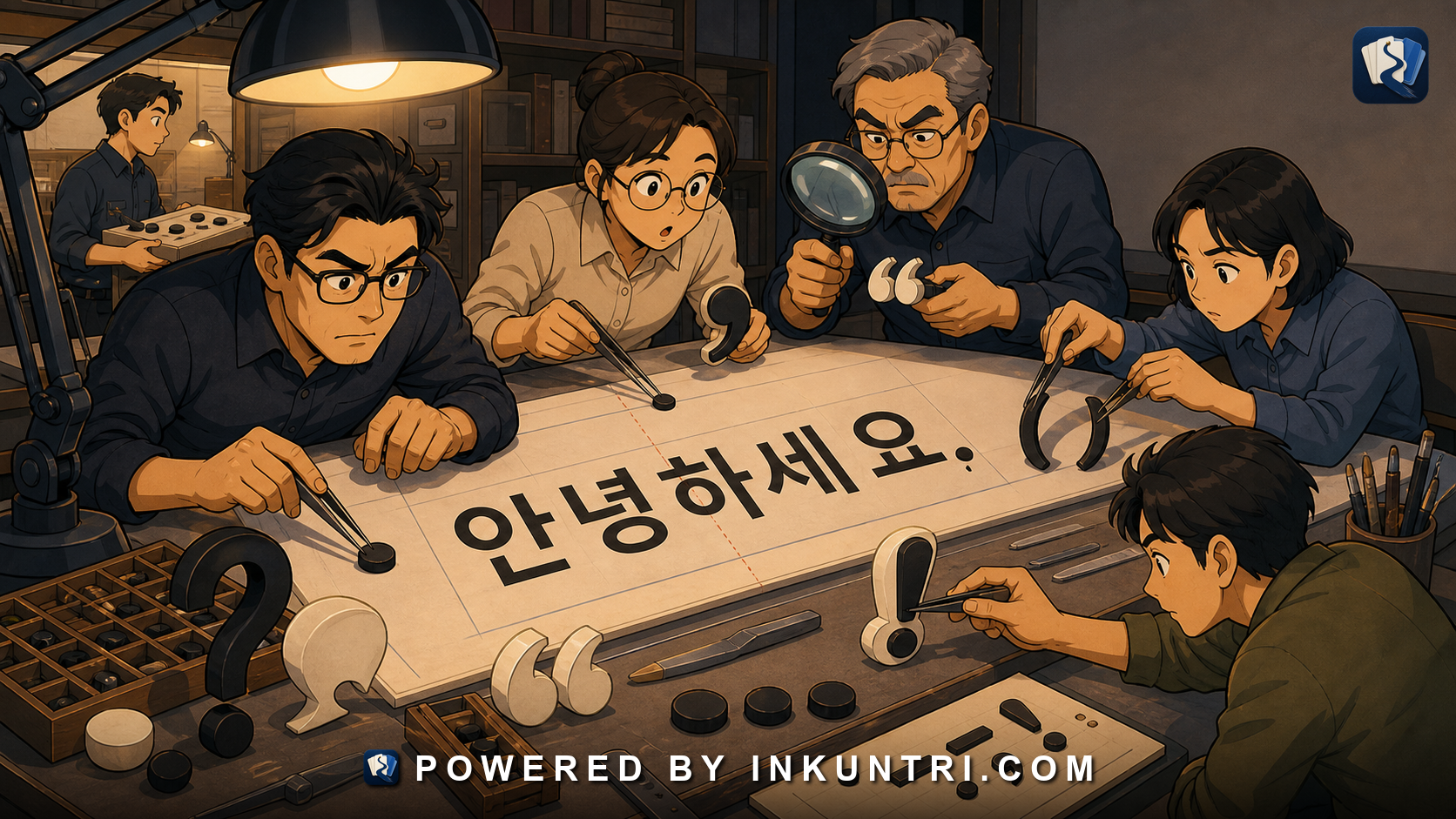
Core examples: 안녕하세요.; “네, 맞습니다.”; 「 」; ·; (한자); 10~20명; …; !?; ㅋㅋ.
Editorial note: the first example is treated below as the normal sentence-final form 안녕하세요.; the semicolon is not part of the standard greeting.
Korean punctuation is familiar until it is not
Modern Korean uses many punctuation marks that look familiar to readers of English: periods, commas, quotation marks, parentheses, question marks, exclamation marks, ellipses, and hyphens.
But familiar marks do not always behave identically. Korean punctuation interacts with spacing, quotation style, lists, Hanja glosses, ranges, digital tone, subtitles, academic writing, and chat language.
A learner who ignores punctuation may miss sentence boundaries, quoted speech, list structure, glosses, ranges, hesitation, sarcasm, or emotional tone.
Punctuation is not the main grammar of Korean, but it is part of real reading.
Periods and commas
Korean sentences commonly end with a period in formal writing:
안녕하세요. 오늘 회의는 오후 3시에 시작합니다.
In casual chat, periods may be omitted or may feel emotionally marked. A bare period can make a short message feel blunt, serious, cold, or final depending on relationship and context.
Commas organize clauses, lists, inserted phrases, and headline structures. Korean comma usage may not match English expectations exactly, especially in headlines:
정부, 대책 발표
Here the comma separates a headline topic or actor from the compressed event.
Quotation marks
Modern Korean uses quotation marks such as:
“네, 맞습니다.”
You may also see single quotes, corner brackets, or book-title-style marks depending on genre, publisher, older style, or influence from Japanese/Chinese typography:
- ‘ ’
- “ ”
- 「 」
- 『 』
In ordinary modern Korean web writing and publishing, Western-style quotation marks are common. Corner brackets may appear in titles, literary contexts, older materials, or stylistic uses.
Learners should recognize all of them as possible quotation or title markers depending on context.
Parentheses for glosses and clarification
Parentheses often provide explanations, Hanja, English terms, abbreviations, or clarifications.
Examples:
- 민주주의(民主主義)
- 인공지능(AI)
- 서울특별시(서울시)
- 참가자(총 20명)
In educational and academic texts, parentheses can be very important. They may tell you the Hanja root, the English technical term, or the abbreviation used later.
Do not skip parenthetical material automatically. It may be the key to the term.
The middle dot ·
The middle dot can appear in lists, paired names, organization names, titles, and compressed labels.
Examples:
- 정치·경제·사회
- 한·미 관계
- 서울·부산
- 연구·개발
It often functions like “and” or a separator between closely related terms. In headline and formal writing, it saves space.
A learner should read 정치·경제·사회 as politics, economy, and society, not as one strange word.
Tilde ~ for ranges and tone
The tilde has several uses.
In ranges:
- 10~20명 — 10 to 20 people
- 3~5일 — three to five days
- 오전 9시~오후 6시 — 9 a.m. to 6 p.m.
In casual digital writing, a tilde can soften tone, lengthen sound, or create a friendly feel:
- 안녕하세요~
- 감사합니다~
This is not appropriate in every context. A tilde in a business contract and a tilde in a friendly message do different jobs.
Ellipses and hesitation
Korean uses ellipses and repeated dots in formal and informal ways:
- …
- ...
- ……
They can signal omission, hesitation, trailing off, awkwardness, suspense, or emotional tone.
In chat, punctuation length can matter socially. A message ending with “...” may feel hesitant, disappointed, passive-aggressive, or simply unfinished depending on context.
Learners should avoid overusing ellipses until they understand the tone they create.
Question marks and exclamation marks
Korean uses ? and ! in familiar ways, but digital usage can amplify tone:
- 정말요?
- 괜찮아요?
- 감사합니다!
- 뭐라고요?!
- 진짜요??
Multiple punctuation marks can signal surprise, disbelief, excitement, irritation, or informality. They are common in chat, comments, comics, subtitles, and advertising, but less appropriate in formal writing.
Korean chat markers behave like punctuation
Forms such as ㅋㅋ, ㅎㅎ, ㅠㅠ, ㅜㅜ, and ^^ are not punctuation in the strict traditional sense, but they function like tone markers in digital Korean.
Examples:
- ㅋㅋ — laughter, amusement, sometimes sarcasm depending on context
- ㅎㅎ — softer laughter/smile
- ㅠㅠ / ㅜㅜ — crying/sadness/cuteness/pleading depending on context
- ^^ — smile, friendliness, sometimes older-style politeness
A sentence with ㅋㅋ is not the same as the same sentence without it. Digital tone markers can soften, mock, flirt, complain, or signal informality.
Punctuation in official documents
Official documents use punctuation to structure clauses, lists, definitions, and conditions. You may see:
- numbered items,
- parentheses,
- colons,
- semicolon-like list structures,
- quotation marks around defined terms,
- middle dots in headings,
- legal article numbering.
In dense formal Korean, punctuation may be your guide to structure. Do not ignore it.
A punctuation-reading routine
Use this checklist:
- Sentence boundary: Does the mark end a sentence or just a clause?
- Quotation: Is someone speaking, or is a term/title being marked?
- List structure: Does ·, comma, or numbering separate items?
- Gloss: Do parentheses give Hanja, English, abbreviation, or clarification?
- Range: Does ~ mean “from/to”?
- Tone: Do !, ?, …, ㅋㅋ, ㅠㅠ, or ~ mark emotion or register?
- Genre: Is this chat, news, law, academic writing, subtitle, menu, or sign?
Mini practice: read punctuation by genre
The same mark can do different work depending on the text type.
| Example | Genre tendency | What to read |
|---|---|---|
| 안녕하세요. | formal/default sentence ending | neutral completion |
| “네, 맞습니다.” | quoted speech | speaker’s exact words or represented speech |
| 정치·경제·사회 | headline/formal list | compact “and” relationship |
| 민주주의(民主主義) | academic/dictionary/formal gloss | Hanja clarification |
| 10~20명 | range | from 10 to 20 people |
| 감사합니다~ | casual digital tone | softened or friendly delivery |
| 뭐라고요?! | chat/comic/subtitle tone | surprise, challenge, or disbelief |
| ㅋㅋ | digital affect marker | laughter, lightness, or sarcasm by context |
Punctuation is not decoration. It can mark structure, definition, range, quotation, hesitation, or relationship tone.
A strong tool for this article would show punctuation by genre.
Suggested functions:
- Mark gallery: Period, comma, quotes, parentheses, middle dot, tilde, ellipsis.
- Genre filters: News, academic, official, chat, subtitle, advertisement.
- Tone simulator: Compare 감사합니다., 감사합니다!, 감사합니다~, 감사합니다ㅎㅎ.
- Gloss mode: Explain parentheses with Hanja and English terms.
- Range mode: Interpret 10~20명, 3~5일, 9시~6시.
- Chat mode: Label ㅋㅋ, ㅎㅎ, ㅠㅠ, ^^.
Final rule
Korean punctuation is both standard and alive.
Formal writing uses punctuation to mark sentences, quotations, lists, ranges, and explanations. Digital writing uses punctuation and chat symbols to manage tone. Read the mark, read the genre, and read the relationship. The same symbol can be neutral in one context and socially loaded in another.
These drafts are written as publication-ready educational articles rather than academic papers. The following references and source categories were consulted for technical sanity checks, terminology, and example validation during the remediation pass:
- 국립국어원 Korean language norms, especially 한글 맞춤법, 표준 발음법, 문장 부호, 외래어 표기법, and related explanatory materials.
- 국립국어원 dictionary resources, including 표준국어대사전, 우리말샘, and 한국어기초사전, for headwords, pronunciation brackets, Hanja fields, spacing-sensitive entries, and usage notes.
- Official road-name address resources from the South Korean address system, especially for 도로명주소 terminology, road/building-number parsing, and address-unit labels.
- Unicode Hangul composition references and common Korean input-method documentation for jamo order, syllable-block composition, precomposed syllables, and 두벌식 keyboard behavior.
- Korean-language learning references for beginner-facing explanations of jamo, batchim, sound change, number systems, public signs, and official-form literacy.
- Contemporary real-source Korean materials: news headlines, public signs, official forms, address examples, dictionaries, subtitles, menus, web interfaces, typography specimens, and messaging conventions.
Related reading
When CJK Comparison Helps Korean Learners and When It Becomes Noise
The reader can decide when Chinese/Japanese comparison accelerates Korean learning and when it creates false friends, grammar transfer, register mistakes, or institutional confusion.
Hanja Beneath Hangul: The Hidden Sino-Korean Layer
The reader can recognize the Sino-Korean layer behind Hangul words without needing to become a full Hanja reader on day one.
Nominalization With 기, 음, 것, and 데
The reader can distinguish nominalizers 기, 음, 것, and 데 by function, register, and sentence role.
Korean Internet Slang: Abbreviation, Hangul Play, and Persona
The reader can recognize Korean internet slang as a system of compression, emotional display, group identity, and online persona while avoiding unsafe or stale reuse.
Korean Newsreader Speech vs Everyday Conversation
The reader can distinguish Korean newsreader speech from everyday conversation and use both for different learning goals.
Busan and Gyeongsang Prosody Without Stereotypes
The reader can understand Busan and broader Gyeongsang prosody through pitch, rhythm, and pragmatic use rather than caricature.