
Public-Sign Korean: Prohibitions, Requests, Warnings, and Polite Authority
The reader can read Korean public signs as compressed systems of authority, politeness, safety, and institutional voice.
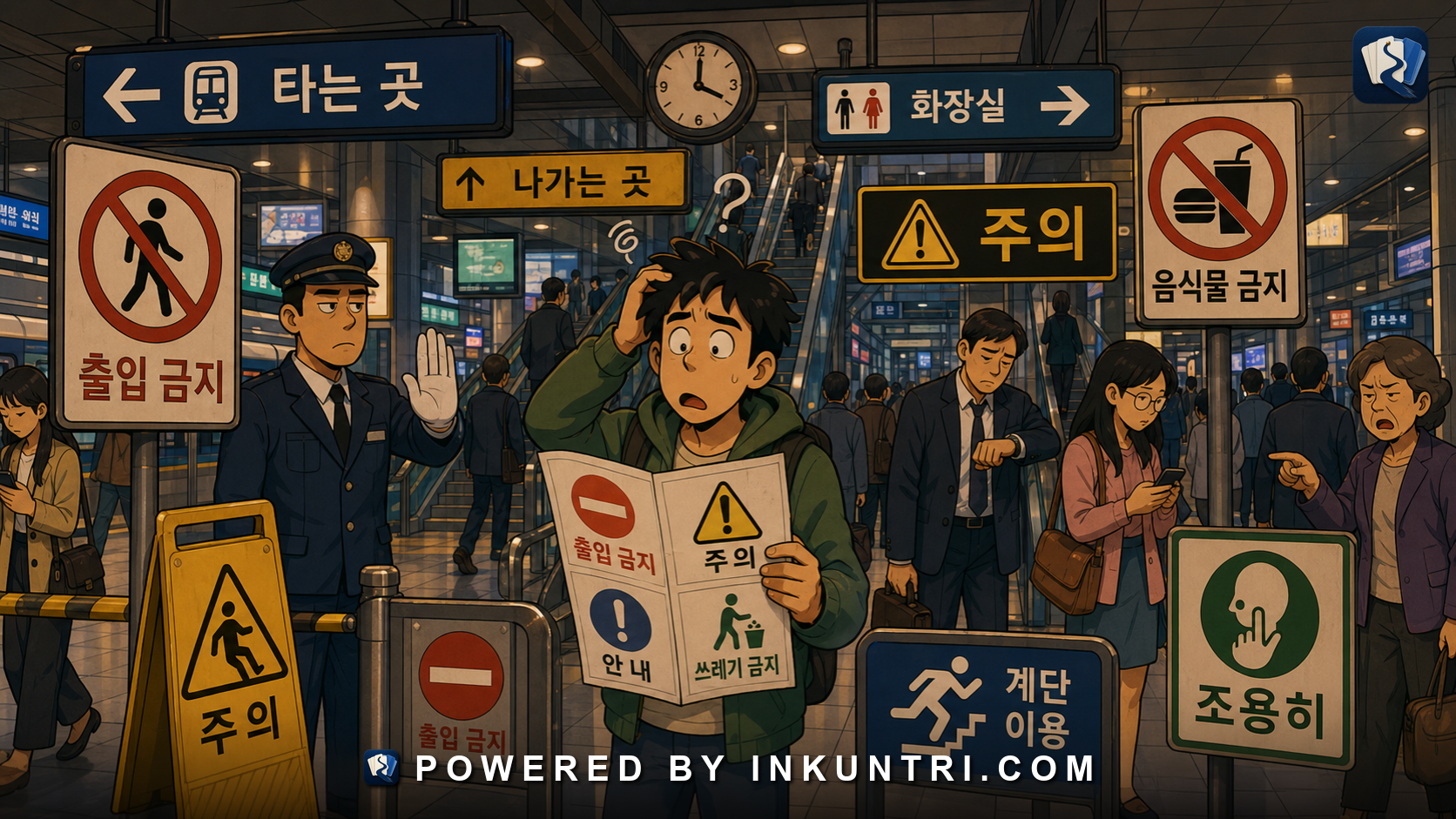
Core examples: 출입 금지; 촬영 금지; 미끄럼 주의; 사용 중지; 관계자 외 출입 금지; 안내; 협조 바랍니다.
Signs are not normal conversation
A learner who can hold a simple conversation may still struggle with public signs. The problem is not vocabulary alone. Signs use compressed grammar, institutional phrasing, safety terms, nominal endings, and polite authority.
A sign does not usually say, “Please do not enter this place because it is dangerous.” It says:
출입 금지
A sign may not say, “Be careful because the floor is slippery.” It says:
미끄럼 주의
Public-sign Korean is a genre. It is short, formulaic, and designed to be understood quickly by people moving through a space.
The main sign functions
Most public signs do one of a few things:
| Function | Common Korean pattern | Example |
|---|---|---|
| Prohibition | Noun + 금지 | 촬영 금지 |
| Warning | Hazard + 주의 | 미끄럼 주의 |
| Instruction | Action noun or imperative/request form | 손을 씻으세요 |
| Suspension/out of service | Use/action + 중지 | 사용 중지 |
| Information | 안내 / 알림 | 이용 안내 |
| Request for cooperation | 협조 바랍니다 / 양해 바랍니다 | 협조 바랍니다 |
Once you identify the function, the sign becomes easier to parse.
금지: prohibition as a noun phrase
금지 means prohibition. It commonly appears after an action noun:
- 출입 금지 — entry prohibited
- 촬영 금지 — photography prohibited
- 주차 금지 — parking prohibited
- 흡연 금지 — smoking prohibited
- 음식물 반입 금지 — bringing in food/drink prohibited
These are not full sentences, but they function as commands. The authority comes from the institution controlling the space: subway operator, museum, school, park, hospital, office, or construction site.
A learner should read 금지 as a strong prohibition, not as a gentle suggestion.
주의: warning and attention
주의 means caution, attention, or warning depending on context.
Examples:
- 미끄럼 주의 — caution: slippery
- 화재 주의 — fire caution
- 감전 주의 — electric shock hazard
- 낙상 주의 — fall risk
- 충돌 주의 — collision warning
주의 signs are often safety-related. They may not tell you exactly what to do, but they tell you what danger to watch for.
The grammar is compressed: hazard noun + 주의.
관계자 외 출입 금지
This is one of the most useful public-sign phrases:
관계자 외 출입 금지
A literal breakdown:
- 관계자 — relevant person, authorized personnel, staff/person concerned
- 외 — except, outside of
- 출입 — entering and exiting/access
- 금지 — prohibited
Natural meaning:
No entry except authorized personnel.
This sign is common in offices, construction areas, staff-only zones, equipment rooms, and restricted facilities. The phrase is formal and institutional. It is not conversational Korean, but it is very common.
사용 중지 and 이용 불가
Signs often tell you that something cannot be used:
- 사용 중지 — use suspended / out of service
- 이용 불가 — use unavailable
- 고장 — broken / out of order
- 점검 중 — under inspection/maintenance
- 수리 중 — under repair
The difference between 사용 and 이용 is subtle and context-dependent. 사용 often means use of an object or device. 이용 often means use of a service, facility, or system. In signs, both can appear.
A restroom stall, ticket machine, elevator, escalator, vending machine, or website page may use these phrases.
Polite authority: 바랍니다 and 부탁드립니다
Korean signs often use polite request endings even when the instruction is not optional.
Examples:
- 협조 바랍니다 — We ask for your cooperation.
- 양해 바랍니다 — Please understand / We ask for your understanding.
- 이용해 주시기 바랍니다 — Please use...
- 문의하시기 바랍니다 — Please inquire...
- 확인 부탁드립니다 — Please check / confirmation requested.
This is institutional politeness. It softens the surface but does not necessarily reduce authority. A museum sign saying 촬영을 삼가 주시기 바랍니다 is still telling you not to take photos.
Nominal style and impersonal phrasing
Public signs often avoid explicit subjects. Instead of “We prohibit entry,” they write 출입 금지. Instead of “The elevator is being inspected,” they write 점검 중.
This impersonal style makes the sign sound official and general. It also saves space.
Learners should not expect every sign to contain a subject, object marker, and full verb ending. Sign Korean is built for speed.
Visual hierarchy matters
A sign is not only text. Color, icons, font size, arrows, line breaks, and placement all carry meaning.
A sign may show:
- a large noun phrase such as 출입 금지,
- a smaller explanation below,
- an icon of a camera, cigarette, elevator, or hazard,
- red for prohibition,
- yellow for caution,
- blue or green for information.
Reading signs means combining language with visual design.
A sign-reading routine
Use this checklist:
- Identify the function. Prohibition, warning, request, instruction, information, out-of-service notice?
- Find the key noun. 출입, 촬영, 주차, 흡연, 사용, 점검, 안내.
- Find the authority marker. 금지, 주의, 중지, 불가, 바랍니다, 부탁드립니다.
- Check who is affected. Everyone, visitors, 관계자, customers, passengers?
- Use the icon and location. A subway sign and a hospital sign may use similar grammar but different stakes.
- Translate function first. Do not translate word by word before identifying the sign type.
Mini practice: classify the sign before translating it
Public signs are easier when you first name the authority function.
| Sign phrase | Function | Likely action expected |
|---|---|---|
| 출입 금지 | prohibition | do not enter |
| 촬영 금지 | prohibition | do not take photos/video |
| 미끄럼 주의 | warning | be careful; surface may be slippery |
| 사용 중지 | suspension | do not use this item/facility now |
| 안내 | information/guidance | read or follow the indicated guidance |
| 협조 바랍니다 | polite institutional request | comply with the requested behavior |
The grammar may be short, but the social meaning is not. A sign can sound polite while still carrying institutional authority.
A strong tool for this article would organize signs by communicative function.
Suggested functions:
- Category filters: Prohibition, warning, request, instruction, information.
- Template cards: Noun + 금지, hazard + 주의, action + 바랍니다.
- Annotated images: Realistic sign layouts with text, icon, color, and authority labels.
- Register note: Explain why polite forms can still be mandatory.
- Expansion mode: Turn 출입 금지 into a full sentence.
- Quiz mode: Identify whether a sign is warning, request, or prohibition.
Final rule
Public-sign Korean is compressed institutional language.
Read signs by function first. 금지 prohibits, 주의 warns, 중지 suspends, 안내 informs, 바랍니다 requests cooperation with authority. Once you see the templates, signs become less like isolated vocabulary and more like a compact public grammar.
Related reading
When CJK Comparison Helps Korean Learners and When It Becomes Noise
The reader can decide when Chinese/Japanese comparison accelerates Korean learning and when it creates false friends, grammar transfer, register mistakes, or institutional confusion.
Hanja Beneath Hangul: The Hidden Sino-Korean Layer
The reader can recognize the Sino-Korean layer behind Hangul words without needing to become a full Hanja reader on day one.
Korean Internet Slang: Abbreviation, Hangul Play, and Persona
The reader can recognize Korean internet slang as a system of compression, emotional display, group identity, and online persona while avoiding unsafe or stale reuse.
Korean Newsreader Speech vs Everyday Conversation
The reader can distinguish Korean newsreader speech from everyday conversation and use both for different learning goals.
Busan and Gyeongsang Prosody Without Stereotypes
The reader can understand Busan and broader Gyeongsang prosody through pitch, rhythm, and pragmatic use rather than caricature.
Fast Speech Reductions in Korean Conversation
The reader can recognize common reductions in fast Korean speech without treating them as separate vocabulary.