
Korean Packaging Literacy: Labels, Expiry Dates, Ingredients, and Warnings
The reader can extract practical information from Korean packaging: ingredients, dates, safety warnings, storage, and claims.
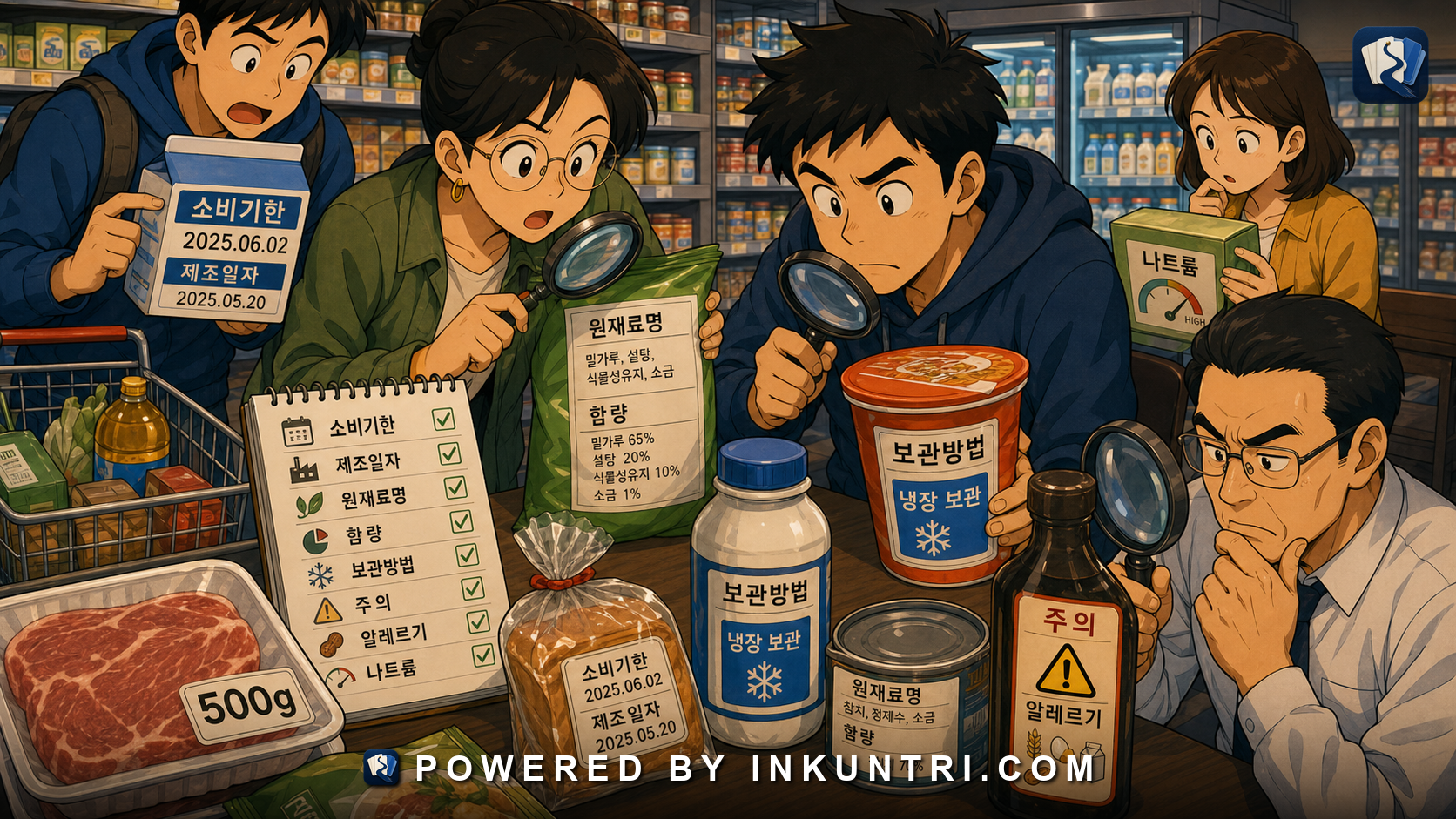
Core examples: 소비기한; 제조일자; 원재료명; 함량; 보관방법; 냉장 보관; 주의; 알레르기; 나트륨; 500g.
Packaging Korean is practical literacy
A learner may be able to read a brand name and still miss the information that matters: whether the item is past its date, whether it requires refrigeration, whether it contains an allergen, how much sodium it has, how to store it, or whether a warning applies.
Packaging is not prose. It is structured information. It uses labels, short nouns, legal terms, numbers, symbols, tables, icons, and caution phrases. That makes it excellent reading practice, but only if you know where to look.
On packaging, the question is not “Can I translate every word?” The question is “Can I find the decision-critical information?”
Date labels: 소비기한 and 제조일자
Two date labels are especially important.
제조일자 means manufacturing date. It tells you when the product was made.
소비기한 means use-by or consumption deadline in the practical consumer sense. Since the 2023 consumer-label shift, many Korean food labels use 소비기한 where older learner materials may still emphasize 유통기한. Learners should recognize both because older packaging, transition-period materials, old articles, and non-food contexts may still show varied date language.
Do not confuse date labels with event dates in advertising copy. A large printed date on the front may be a promotion. The required date information may be on the back, bottom, cap, or seal.
Ingredients and content
원재료명 means ingredient names. 함량 means content or amount, often used when a highlighted ingredient has a percentage. 내용량 means net quantity. You may see grams, milliliters, servings, or pieces: 500g, 1L, 10개입.
A package may say 딸기 20% or 국내산 쌀 100%. That does not mean every marketing claim is equally important. Learn to distinguish the required label area from the front-of-package advertising language.
Storage instructions
보관방법 means storage method. Common phrases include:
- 냉장 보관: refrigerate;
- 냉동 보관: keep frozen;
- 실온 보관: store at room temperature;
- 직사광선을 피하여 보관: keep away from direct sunlight;
- 개봉 후 냉장 보관: refrigerate after opening;
- 가급적 빨리 드십시오: consume as soon as possible.
These phrases are not decorative. They tell you what to do after purchase and after opening.
Allergy and caution language
알레르기 or 알레르기 유발물질 indicates allergy-related information. Packaging may list ingredients such as milk, egg, wheat, soy, peanuts, tree nuts, shellfish, fish, pork, beef, chicken, peach, tomato, sulfites, or other items depending on the category and labeling rules.
주의 means caution. Other common warning words include 경고, 보관상 주의, 섭취 시 주의, 어린이의 손이 닿지 않는 곳에 보관, and 개봉 시 주의.
This article is not medical advice. If you have serious allergies or health restrictions, do not rely on partial language knowledge. Use official translations, manufacturer information, or qualified help. But basic label literacy still reduces risk.
Nutrition labels are tables
Nutrition panels use compressed table language:
- 영양정보
- 총 내용량
- 1회 섭취참고량
- 1일 영양성분 기준치
- 열량
- 탄수화물
- 당류
- 단백질
- 지방
- 포화지방
- 트랜스지방
- 콜레스테롤
- 나트륨
Older materials and some consumer-facing explanations may still use familiar serving-size language such as 1회 제공량, so learners should recognize both. For current label reading, pay close attention to whether the nutrition values are given by total package, 100g/ml, unit package, or reference serving. A learner who reads 나트륨 but misses the basis of calculation may misunderstand the label.
Packaging claims and advertising language
Packages often contain claims such as 무가당, 저지방, 고단백, 국내산, 프리미엄, 신선한, 자연, 건강, 무첨가. Some claims are legally meaningful; others are marketing style. The learner’s first job is to identify whether a phrase is in the required information panel or in promotional copy.
A front label is designed to persuade. The back label is designed to inform and comply.
A package-reading checklist
Use this order:
- Identify product type and brand.
- Locate 소비기한 or other date information.
- Locate 제조일자 if relevant.
- Find 원재료명 and allergen-related wording.
- Check 보관방법.
- Check 내용량 and the nutrition basis: total package, 100g/ml, unit package, or 1회 섭취참고량.
- Read 주의 or 경고 statements.
- Review 영양정보 if it affects your decision.
- Separate required information from advertising claims.
Mini practice: find the function
| Label term | Function | What to ask |
|---|---|---|
| 소비기한 | use-by/consumption deadline | Is the product still within date? |
| 제조일자 | manufacturing date | When was it made? |
| 원재료명 | ingredients | What is it made from? |
| 함량 | content/percentage | How much of the named ingredient? |
| 보관방법 | storage method | Refrigerated, frozen, room temperature? |
| 냉장 보관 | refrigeration instruction | Does it need the fridge? |
| 알레르기 | allergy information | Is a relevant allergen present? |
| 나트륨 | sodium | What is the unit and serving basis? |
| 500g | net amount | How much product is there? |
Suggested functions:
- Date finder: highlights 소비기한, 제조일자, and related date formats.
- Ingredient pane: extracts 원재료명 and 함량.
- Storage flag: identifies 냉장, 냉동, 실온, 개봉 후.
- Allergy alert: highlights 알레르기-related terms without giving medical advice.
- Nutrition table reader: converts numeric rows into plain Korean sentences.
- Ad-copy filter: separates promotional phrases from required label fields.
Final rule
Read packaging by function, not by sentence order.
Find the date, ingredients, storage rule, warning, quantity, and nutrition basis first. Full translation can come later; safety and use information come first.
Related reading
When CJK Comparison Helps Korean Learners and When It Becomes Noise
The reader can decide when Chinese/Japanese comparison accelerates Korean learning and when it creates false friends, grammar transfer, register mistakes, or institutional confusion.
Korean Numbers in Writing: Native, Sino-Korean, Arabic Digits, and Formal Use
The reader can choose between native Korean numbers, Sino-Korean numbers, Arabic digits, and formal written number conventions.
Housing Policy Korean: 공공주택, 청약, 전세사기, 임대차
The reader can approach Korean housing-policy articles by identifying public housing, subscription/application systems, jeonse fraud, lease law, homeless/no-home status, point systems, guarantee insurance, landlords...
Confucian Vocabulary in Korean Public Language
The reader can recognize Confucian-derived terms in modern Korean public language without treating them as timeless cultural essence.
Korean AI Vocabulary: 생성형 AI, 추론, 학습데이터, 컴퓨팅 자원
The reader can read Korean AI policy, product, and technical prose by separating model terms, process terms, data terms, compute terms, privacy/safety terms, and English acronym layers.
Language Policy, Standardization, and Spacing Rules in Korea
The reader can understand Korean correctness debates as interactions among official norms, dictionaries, school practice, actual usage, and genre.