
Korean Official Forms: Names, Birthdates, IDs, and Contact Fields
The reader can complete and interpret common Korean official-form fields without confusing labels, formats, or register.
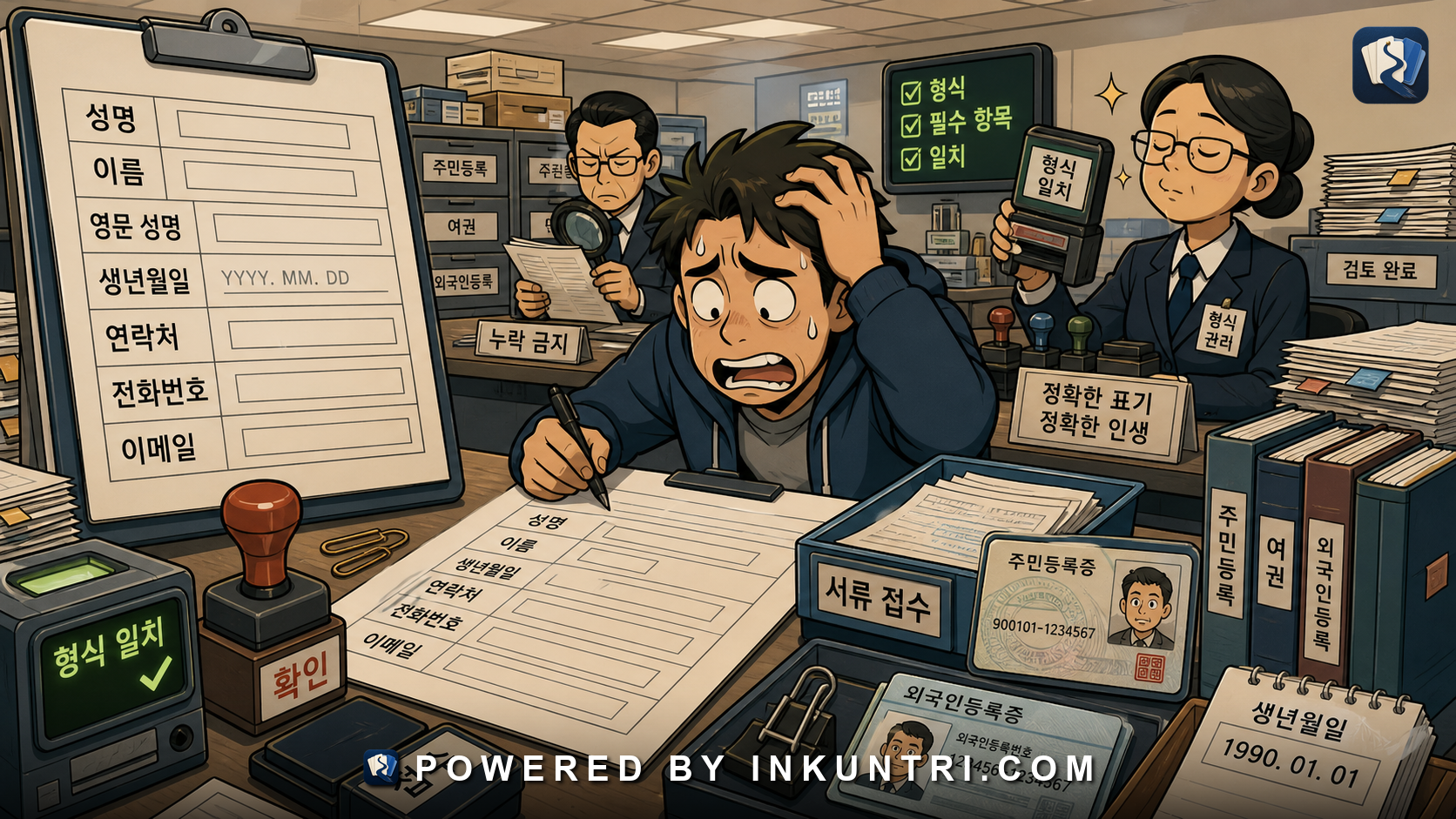
Core examples: 성명; 생년월일; 주소; 연락처; 이메일; 주민등록번호; 서명; 동의합니다; 필수/선택.
Forms use a different Korean from conversation
A learner who can order coffee may still freeze in front of a form. The words are short, formal, and compressed:
- 성명
- 생년월일
- 주소
- 연락처
- 이메일
- 서명
- 동의합니다
- 필수 / 선택
Official forms do not speak like people. They label fields, request personal information, state consent conditions, and distinguish required from optional items. To use Korean in real life, you need this form-literacy layer.
Name fields: 성명, 이름, 영문 성명
Common name labels include:
| Korean | Meaning | Note |
|---|---|---|
| 성명 | full name | Formal; common on official forms |
| 이름 | name | More general |
| 성 | family name | May appear in split-name forms |
| 영문 성명 | name in English/Latin letters | Often should match passport or official ID |
| 한글 성명 | name in Hangul | For Korean script entry |
| 한자 성명 | name in Hanja | Only if applicable/known |
If a form asks for 성명, provide the full name, usually in the requested script. If it asks for 영문 성명, do not casually invent a new romanization if the form is official. Use passport or legal spelling where relevant.
Birthdate and date order
생년월일 means date of birth:
- 생 — birth/life root
- 년 — year
- 월 — month
- 일 — day
Korean dates are commonly written in year-month-day order:
1995년 8월 12일
Or numerically:
1995.08.12 1995-08-12
A form may label fields separately:
- 년 — year
- 월 — month
- 일 — day
Do not reverse into month-day-year order unless the form specifically uses a foreign format.
Contact information: 연락처, 전화번호, 이메일
Common contact fields:
| Korean | Meaning |
|---|---|
| 연락처 | contact information, often phone number |
| 전화번호 | phone number |
| 휴대전화 / 휴대폰 | mobile phone |
| 이메일 | |
| 주소 | address |
| 우편번호 | postal code |
연락처 can be broader than “phone number,” but on many forms it effectively asks for a number where you can be reached.
Korean mobile numbers often appear with hyphens:
010-1234-5678
For a mock article example, use fictional numbers. Do not publish real personal information.
ID numbers and privacy caution
주민등록번호 is the resident registration number used for Korean citizens and certain official contexts. Foreign residents may encounter 외국인등록번호, alien registration number, in relevant settings.
These are sensitive identity numbers. Learners should recognize the labels but should not practice with real numbers, share them casually, or enter them into untrusted websites.
Other ID-related labels include:
- 신분증 — ID card
- 여권번호 — passport number
- 외국인등록번호 — foreign resident registration number
- 발급일 — issue date
- 만료일 — expiration date
Form literacy includes privacy judgment. Understanding the field does not mean you should always fill it out.
Required and optional: 필수 and 선택
Korean forms often mark fields as required or optional:
- 필수 — required
- 선택 — optional
- 필수 입력 — required input
- 선택 입력 — optional input
- 미입력 — not entered
- 입력하세요 — please enter
Asterisks may mark required fields:
성명 연락처
If a form fails to submit, look for 필수, 누락, 다시 입력, or 확인.
Agreement and consent language
Consent language is common in forms, especially online forms.
Key phrases:
| Korean | Meaning |
|---|---|
| 동의합니다 | I agree |
| 동의하지 않습니다 | I do not agree |
| 개인정보 | personal information |
| 수집 및 이용 | collection and use |
| 제3자 제공 | provision to third parties |
| 약관 | terms and conditions |
| 전체 동의 | agree to all |
| 필수 동의 | required consent |
| 선택 동의 | optional consent |
Do not click 전체 동의 automatically. Some consent boxes may be optional marketing consent. A careful user distinguishes required service consent from optional promotional consent.
Signature, seal, and confirmation
Common completion labels:
- 서명 — signature
- 날인 — affixing a seal/stamp
- 인감 — registered seal in formal contexts
- 확인 — confirmation/check
- 제출 — submission
- 신청 — application
- 접수 — receipt/acceptance of application
- 작성일 — date written
Korean paperwork may use signature or seal depending on context. Many modern forms accept signatures, but some formal procedures may still refer to stamps/seals.
Online forms and error messages
Online Korean forms often use short validation messages:
- 다시 입력해 주세요 — Please enter again.
- 형식이 올바르지 않습니다 — The format is not correct.
- 필수 항목입니다 — This is a required item.
- 중복 확인 — duplicate check / check availability
- 인증번호 — verification code
- 인증하기 — verify/authenticate
These messages are part of digital survival Korean. They are not conversational, but they are common.
A form workflow
Use this routine:
- Scan required fields. Look for 필수, *, 필수 입력.
- Identify personal information labels. 성명, 생년월일, 주소, 연락처.
- Preserve date order. Year-month-day unless otherwise specified.
- Use official romanization for names. Especially passport-related fields.
- Watch ID fields. 주민등록번호, 외국인등록번호, 여권번호 are sensitive.
- Read consent boxes. Separate required and optional agreement.
- Confirm before submission. 제출, 신청, 확인, 동의 all have consequences.
Mini practice: identify the field before entering data
Use this table as a safety check.
| Field label | What it asks for | Risk level |
|---|---|---|
| 성명 | full name | medium; use official spelling |
| 생년월일 | date of birth | medium; preserve year-month-day order |
| 연락처 | contact information, often phone | medium |
| 이메일 | email address | medium |
| 주소 | address | medium/high if public |
| 주민등록번호 | resident registration number | high; do not enter on untrusted sites |
| 외국인등록번호 | foreign resident registration number | high; do not enter on untrusted sites |
| 선택 동의 | optional consent | read carefully; often marketing or third-party use |
Form literacy is partly language and partly judgment. Understanding a field does not mean the request is safe or necessary.
A strong tool for this article would let users complete a safe fictional form.
Suggested functions:
- Hover glosses: Explain 성명, 생년월일, 연락처, 주소, 서명.
- Mock data mode: Use fictional names, numbers, and addresses.
- Date-format check: Year-month-day validation.
- Consent warning: Separate required and optional marketing consent.
- Error-message practice: Display common Korean validation messages.
- Privacy flags: Mark sensitive fields such as 주민등록번호 and 여권번호.
Final rule
Korean forms are compressed bureaucratic texts. Learn the labels before you need them.
성명 is full name. 생년월일 is birthdate. 연락처 is contact information. 필수 means required. 선택 means optional. 동의합니다 means you are agreeing to something. Recognize the field, respect the format, and treat identity numbers and consent language seriously.
Related reading
When CJK Comparison Helps Korean Learners and When It Becomes Noise
The reader can decide when Chinese/Japanese comparison accelerates Korean learning and when it creates false friends, grammar transfer, register mistakes, or institutional confusion.
Korean Numbers in Writing: Native, Sino-Korean, Arabic Digits, and Formal Use
The reader can choose between native Korean numbers, Sino-Korean numbers, Arabic digits, and formal written number conventions.
Confucian Vocabulary in Korean Public Language
The reader can recognize Confucian-derived terms in modern Korean public language without treating them as timeless cultural essence.
Language Policy, Standardization, and Spacing Rules in Korea
The reader can understand Korean correctness debates as interactions among official norms, dictionaries, school practice, actual usage, and genre.
Color Words in Korean: Tradition, Marketing, and Politics
The reader can classify Korean color words as literal description, traditional symbolism, political label, marketing style, or fixed expression.
Formal Korean Connectors: 따라서, 한편, 다만, 또한, 이에
The reader can read formal Korean connectors as paragraph-level logic signals rather than translating them one word at a time.