
Korean Internet Spelling: ㅋㅋ, ㅠㅠ, Abbreviations, and Persona
The reader can interpret Korean internet spelling as social signaling, affect, speed, and community style rather than as random mistakes.
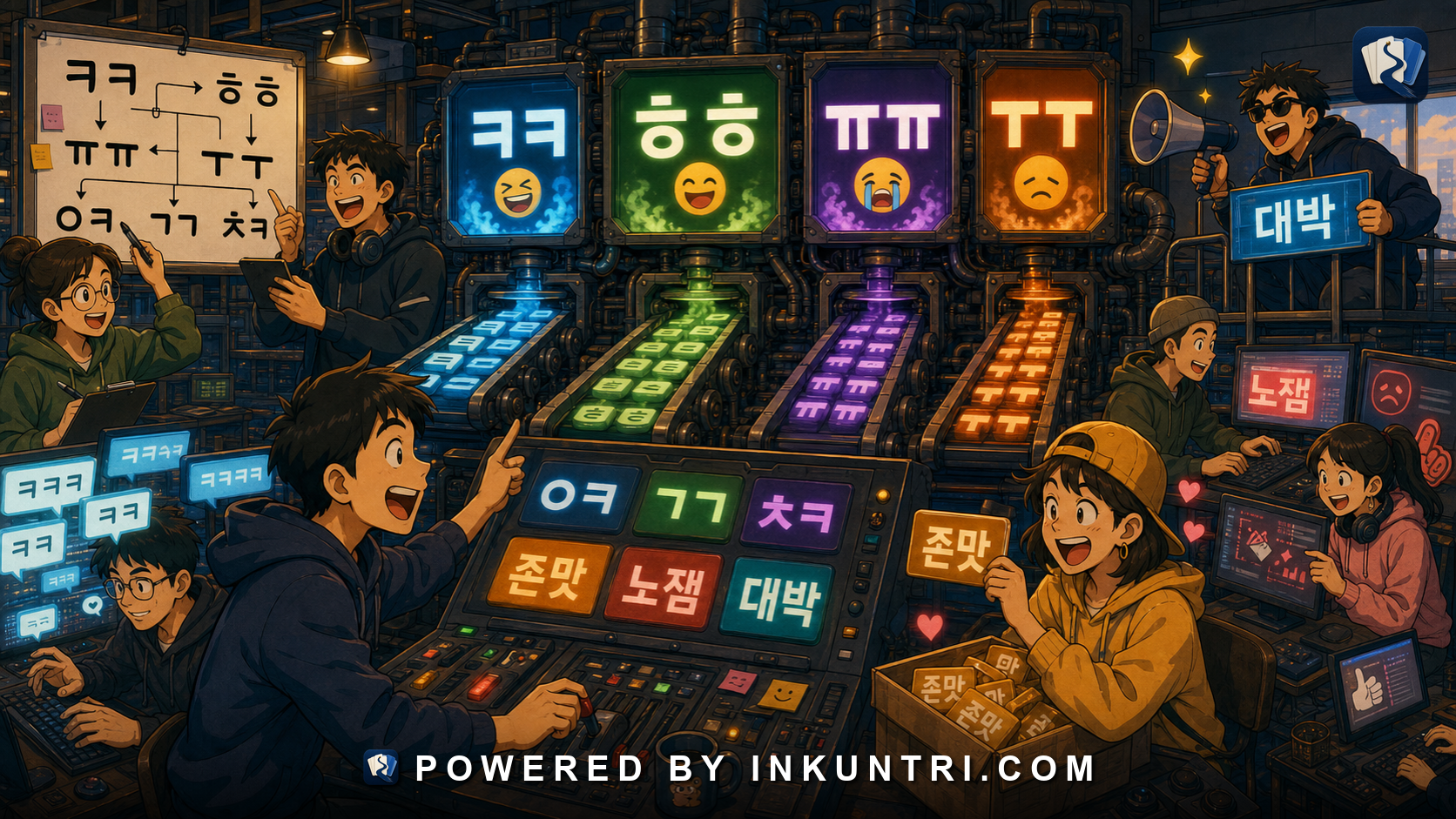
Core examples: ㅋㅋ; ㅎㅎ; ㅠㅠ; ㅜㅜ; ㅇㅋ; ㄱㄱ; ㅊㅋ; 존맛; 노잼; 대박.
Chat Korean is not broken Korean
A learner opens a Korean comment thread and sees ㅋㅋ, ㅠㅠ, ㅇㅋ, ㄱㄱ, ㅊㅋ, 존맛, 노잼, 대박, and stretched spellings. It can look like a collapse of normal spelling.
But internet spelling is not just laziness. It is a social register. It compresses emotion, speed, group identity, sarcasm, affection, embarrassment, and persona. The same person who writes formal Korean at work may write ㅋㅋ in chat. That does not mean they do not know standard spelling. It means they are using a different register.
The learner’s danger is twofold: ignoring tone, or copying forms into the wrong context.
Internet spelling is readable only when you ask who is speaking to whom, where, and with what persona.
ㅋㅋ and ㅎㅎ are not identical
Both ㅋㅋ and ㅎㅎ can signal laughter, but they do not always feel the same.
ㅋㅋ is often sharper, more casual, sometimes teasing, sometimes deadpan, sometimes genuinely amused. More ㅋ can intensify laughter or create a performative reaction: ㅋㅋㅋㅋㅋㅋ.
ㅎㅎ can feel softer, warmer, more modest, or more smile-like in many contexts. It can also be awkward, polite, or used to soften a message.
The exact interpretation depends on relationship and message. A single ㅋ can feel dismissive in one context and playful in another. A polite ㅎㅎ after a request can soften the tone. A long ㅋㅋ after someone’s mistake can feel friendly or mocking depending on relationship.
ㅠㅠ and ㅜㅜ are visual emotion
ㅠㅠ and ㅜㅜ use vowel shapes as crying eyes. They may indicate sadness, embarrassment, pleading, cuteness, exhaustion, or exaggerated frustration.
They do not always mean literal crying. In a message like 늦었어요ㅠㅠ, the marker can soften an apology. In 너무 귀여워ㅠㅠ, it can express overwhelmed affection. In 망했다ㅠㅠ, it can signal comic despair.
Again, do not translate mechanically. Label the social effect.
Consonant-only abbreviations are speed and in-group style
Korean internet writing often uses initial consonants from syllables:
- ㅇㅋ = 오케이
- ㄱㄱ = 고고 or 가자-like “go” energy
- ㅊㅋ = 축하
- ㅂㅂ = 바이바이 or bye-bye
- ㄴㄴ = no-no / no
These forms are fast, informal, and context-dependent. They are not safe in formal writing. They may be fine among friends, in game chat, livestream chat, or casual comments.
A learner should understand them before using them. Copying them too early can make your Korean sound performative or socially misplaced.
Slang words carry community and tone
Words such as 존맛, 노잼, 꿀잼, 대박, 헐, and 레전드 appear widely online, but they carry register and age/style associations.
존맛 means extremely tasty in casual slang, but it comes from a rough intensifying style and can be too crude for polite contexts. A safer food compliment is 맛있어요, 정말 맛있어요, or 너무 맛있어요. 노잼 means not fun or boring. 꿀잼 means very fun. 대박 can express surprise, success, or admiration, and it is more widely usable than many harsher slang forms, though still informal in many settings.
A serious learner should not avoid all slang. But slang should be learned with usage boundaries.
Repetition changes tone
Korean internet spelling often repeats letters or symbols:
- 네ㅋㅋ
- 네ㅋㅋㅋㅋ
- 네...?
- 아니ㅠㅠㅠ
- 진짜요????
- 대박!!!!
Repetition is not neutral. It changes volume, intensity, sincerity, irony, and emotional pacing. A single question mark may ask a question. Multiple question marks can show disbelief, excitement, or pressure. Long ㅠㅠㅠ may make the message more emotional or more playful.
Internet spelling can enter advertising and subtitles
These forms are no longer limited to private chat. Ads, youth-oriented brand copy, subtitles, variety-show captions, and social-media posts often use internet-style spelling to sound casual or current.
That does not make the forms universally appropriate. A brand can use ㅋㅋ in a campaign because it is performing a casual voice. A learner should not automatically use the same style in an email to a professor.
A chat-register routine
Use this routine before copying internet forms:
- Identify the form: laughter, crying, abbreviation, slang, repetition, or clipped word.
- Expand it into standard Korean if possible.
- Ask what emotion or persona it creates.
- Identify the relationship and platform.
- Decide whether you should understand it only, reuse it carefully, or avoid it.
- When uncertain, choose a safer full expression.
Understanding is lower-risk than production. You can read ㅋㅋ long before you should use it everywhere.
Mini practice: expand and label tone
| Form | Likely expansion/function | Tone warning |
|---|---|---|
| ㅋㅋ | laughter | can be friendly, teasing, or dismissive |
| ㅎㅎ | soft laughter/smile | often softer but still informal |
| ㅠㅠ | crying/pleading/emotion | not always literal sadness |
| ㅇㅋ | 오케이 | casual only |
| ㄱㄱ | go/go ahead/let’s go | game/chat energy |
| ㅊㅋ | 축하 | very casual congratulations |
| 존맛 | very delicious | rough/slangy intensity |
| 노잼 | not fun | casual negative judgment |
| 대박 | wow/great/surprising | broadly known but informal in many uses |
Suggested functions:
- Form expansion: turns ㅇㅋ into 오케이, ㅊㅋ into 축하.
- Tone label: friendly, teasing, sad, cute, sarcastic, informal, risky.
- Register warning: private chat, public comment, advertising, formal writing.
- Safe alternative: suggests a full-form sentence for cautious learners.
- Persona slider: shows how repetition changes the feel of ㅋㅋ, ㅠㅠ, ?, and !.
Final rule
Internet Korean is not random. It is social writing.
Before copying a form, ask what persona it creates. Reading slang is literacy. Using it well is relationship judgment.
Related reading
When CJK Comparison Helps Korean Learners and When It Becomes Noise
The reader can decide when Chinese/Japanese comparison accelerates Korean learning and when it creates false friends, grammar transfer, register mistakes, or institutional confusion.
Korean Internet Slang: Abbreviation, Hangul Play, and Persona
The reader can recognize Korean internet slang as a system of compression, emotional display, group identity, and online persona while avoiding unsafe or stale reuse.
Busan and Gyeongsang Prosody Without Stereotypes
The reader can understand Busan and broader Gyeongsang prosody through pitch, rhythm, and pragmatic use rather than caricature.
Near-Synonym Field Guide: 고치다, 치료하다, 수정하다, 개선하다
The reader can choose the Korean repair verb based on whether the target is a machine, habit, illness, document, error, system, policy, or condition.
Why Knowing Chinese Helps Korean—and Where It Misleads You
The reader can use Chinese knowledge as a Korean vocabulary advantage while protecting against false friends, collocation errors, and Hangul-only ambiguity.
Speech Rate and Pausing in Korean Presentations
The reader can control speech rate and pausing for Korean presentations and formal explanations.