
How Korean Newspapers Use Hanja for Compression and Clarity
The reader can interpret Hanja in Korean newspapers as a tool for compression, disambiguation, and headline economy.
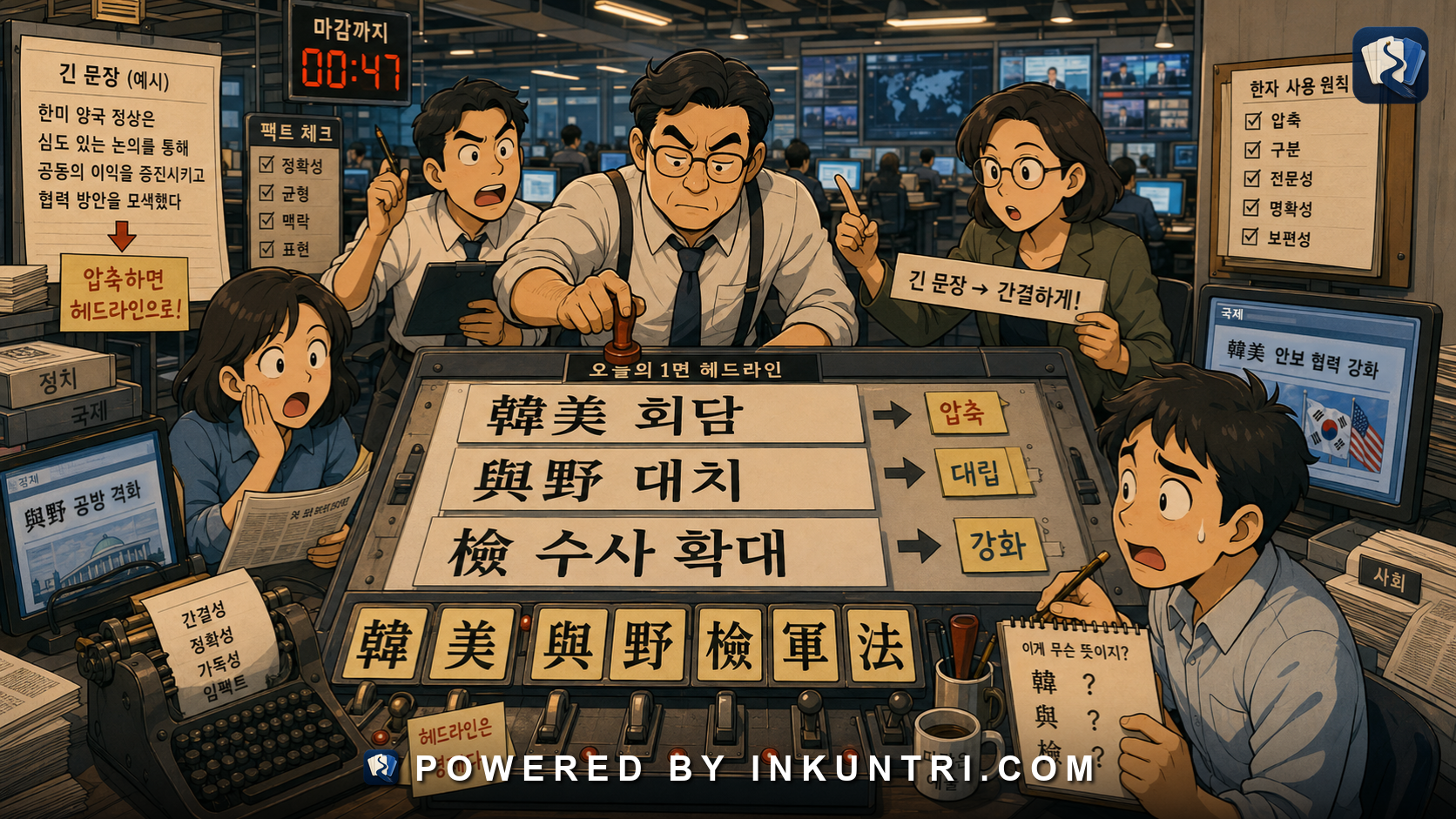
Core examples: 韓; 美; 中; 日; 北; 與野; 檢; 法; 政; 經; 금리; 국회.
A Hanja character in a headline is usually shorthand, not a script switch
Korean news headlines can surprise learners with isolated Chinese characters:
韓美 회담 與野 대치 檢 수사 확대
A beginner may think the article has switched into Chinese or old Korean. Usually it has not. The headline is using Hanja as compact Korean shorthand.
News Korean values brevity. Headlines must fit narrow spaces, mobile screens, tickers, and search listings. A single character such as 美 can replace 미국, and 與野 can replace a longer phrase about ruling and opposition parties.
The task is to expand the shorthand into Korean meaning.
Country shorthand
The most common newspaper Hanja abbreviations include country and region labels.
| Hanja | Korean reading | Common meaning in headlines |
|---|---|---|
| 韓 | 한 | Korea / South Korea, depending on context |
| 美 | 미 | United States |
| 中 | 중 | China |
| 日 | 일 | Japan |
| 北 | 북 | North Korea |
| 英 | 영 | Britain/UK in many contexts |
| 獨 | 독 | Germany |
| 佛 | 불 | France |
A headline such as 韓美 may be read as 한미, meaning Korea-U.S. A headline with 美中 may refer to U.S.-China relations. 北 usually points to North Korea in South Korean news style.
These are Korean readings of Hanja in Korean news, not Mandarin words inserted into the article.
Political shorthand: 與 and 野
Two important political characters are:
- 與 — 여, ruling party/government side in political reporting
- 野 — 야, opposition side
Together:
與野 — 여야, ruling and opposition parties
You may see headlines such as:
- 與野 합의 — ruling and opposition parties reach agreement
- 與 반발 — ruling party protests, depending on context
- 野 공세 — opposition offensive/criticism
These characters compress political roles into one syllable each.
The learner should not translate 與 as a standalone Chinese word every time. In Korean news, it is a genre-specific abbreviation.
Institutional shorthand: 檢, 軍, 法
Other common news abbreviations include institutions and domains:
| Hanja | Reading | Common headline meaning |
|---|---|---|
| 檢 | 검 | prosecution/prosecutors |
| 軍 | 군 | military |
| 法 | 법 | law/court/legal issue, depending on context |
| 警 | 경 | police |
| 政 | 정 | politics/government |
| 經 | 경 | economy/economic affairs |
A headline such as 檢 수사 확대 means the prosecution expands an investigation. 軍 발표 means a military announcement. 政 and 經 often appear in section names or compact labels.
Hanja can disambiguate homophones
Korean has many Sino-Korean homophones. Hanja in headlines can clarify the intended word family.
For example, 경 can represent many roots. In a news section label, 經 likely means economy. In another context, 警 points to police. A single Hangul syllable 경 would be ambiguous without domain context.
Hanja solves this by making the root visible. It also saves space.
Hanja appears with Hangul, numbers, and English letters
Modern Korean headlines often mix scripts:
- 韓美 정상회담
- AI 규제 논의
- 與野, 예산안 충돌
- 檢, 전면 재수사
- 금리 0.25%p 인상
This mixed style is normal. Hangul carries most grammar and vocabulary. Hanja compresses selected terms. English acronyms carry technical or institutional labels. Numbers and symbols carry data.
The headline is not messy if you read each script by function.
Hanja is more common in headlines than body text
A newspaper may use Hanja in the headline and then write the body mostly in Hangul. The body text may expand the abbreviation:
Headline:
美 금리 동결
Body:
미국 중앙은행이 기준금리를 동결했다...
The headline uses 美 for compression. The article body writes 미국 for clarity.
This means learners should not panic. Often you only need a small set of Hanja abbreviations to unlock many headlines.
Archive articles may use more Hanja
Older Korean newspapers may use much more Hanja than contemporary online articles. Historical archives can be significantly harder because they reflect older orthographic habits, fonts, vocabulary, and political terminology.
For modern learners, start with contemporary headline shorthand. Do not assume that reading one old newspaper scan is the baseline requirement for Korean news literacy.
A headline-Hanja routine
Use this checklist:
- Identify the character. Is it a country, institution, political camp, or domain?
- Read it in Korean. 美 = 미, not “měi” in Korean context.
- Expand the word. 美 → 미국, 檢 → 검찰, 與野 → 여야.
- Use the headline domain. Politics, economy, law, international news?
- Reread the headline as Korean. Restore particles and full nouns mentally.
- Check the body text. It often expands the abbreviation.
Example:
與野, 예산안 합의 불발
Expansion:
여야가 예산안에 대해 합의하지 못했다.
Mini practice: expand headline Hanja
Expand the shorthand before reading the whole headline.
| Headline element | Expansion | Domain |
|---|---|---|
| 韓 | 한국 | country/geopolitics |
| 美 | 미국 | country/geopolitics |
| 中 | 중국 | country/geopolitics |
| 日 | 일본 | country/geopolitics |
| 北 | 북한 | inter-Korean/geopolitics |
| 與野 | 여야 | domestic politics |
| 檢 | 검찰 | law/prosecution |
| 法 | 법원 or law-related term by context | legal/institutional |
Do not translate the character directly into English first. Expand it into the Korean word, then reread the Korean headline.
A strong tool for this article would help learners expand headline characters.
Suggested functions:
- Headline input: User enters a headline with Hanja.
- Character expansion: 韓→한국, 美→미국, 中→중국, 檢→검찰.
- Domain labels: International, politics, prosecution, military, economy.
- Full-sentence rewrite: Restore likely particles and verbs.
- Archive warning: Mark older or rare Hanja outside the core set.
- Flashcard export: Create headline-Hanja recognition cards.
Final rule
Hanja in Korean newspapers is usually a compression tool.
Do not treat every character as a detour into Classical Chinese. Expand it into its Korean reading, identify the domain, and restore the headline into ordinary Korean. A small set of headline Hanja—韓, 美, 中, 日, 北, 與, 野, 檢, 軍, 法, 政, 經—goes a long way.
Related reading
When CJK Comparison Helps Korean Learners and When It Becomes Noise
The reader can decide when Chinese/Japanese comparison accelerates Korean learning and when it creates false friends, grammar transfer, register mistakes, or institutional confusion.
Housing Policy Korean: 공공주택, 청약, 전세사기, 임대차
The reader can approach Korean housing-policy articles by identifying public housing, subscription/application systems, jeonse fraud, lease law, homeless/no-home status, point systems, guarantee insurance, landlords...
Korean AI Vocabulary: 생성형 AI, 추론, 학습데이터, 컴퓨팅 자원
The reader can read Korean AI policy, product, and technical prose by separating model terms, process terms, data terms, compute terms, privacy/safety terms, and English acronym layers.
Language Policy, Standardization, and Spacing Rules in Korea
The reader can understand Korean correctness debates as interactions among official norms, dictionaries, school practice, actual usage, and genre.
Sino-Korean Character Families Without Requiring Full Hanja Literacy
The reader can build Sino-Korean word families from recurring syllables without requiring full Hanja literacy.
Color Words in Korean: Tradition, Marketing, and Politics
The reader can classify Korean color words as literal description, traditional symbolism, political label, marketing style, or fixed expression.