
Korean Headline Writing: Particles Dropped, Verbs Compressed, Meaning Preserved
The reader can decode Korean headlines that omit particles, compress verbs, and front-load key actors or results.
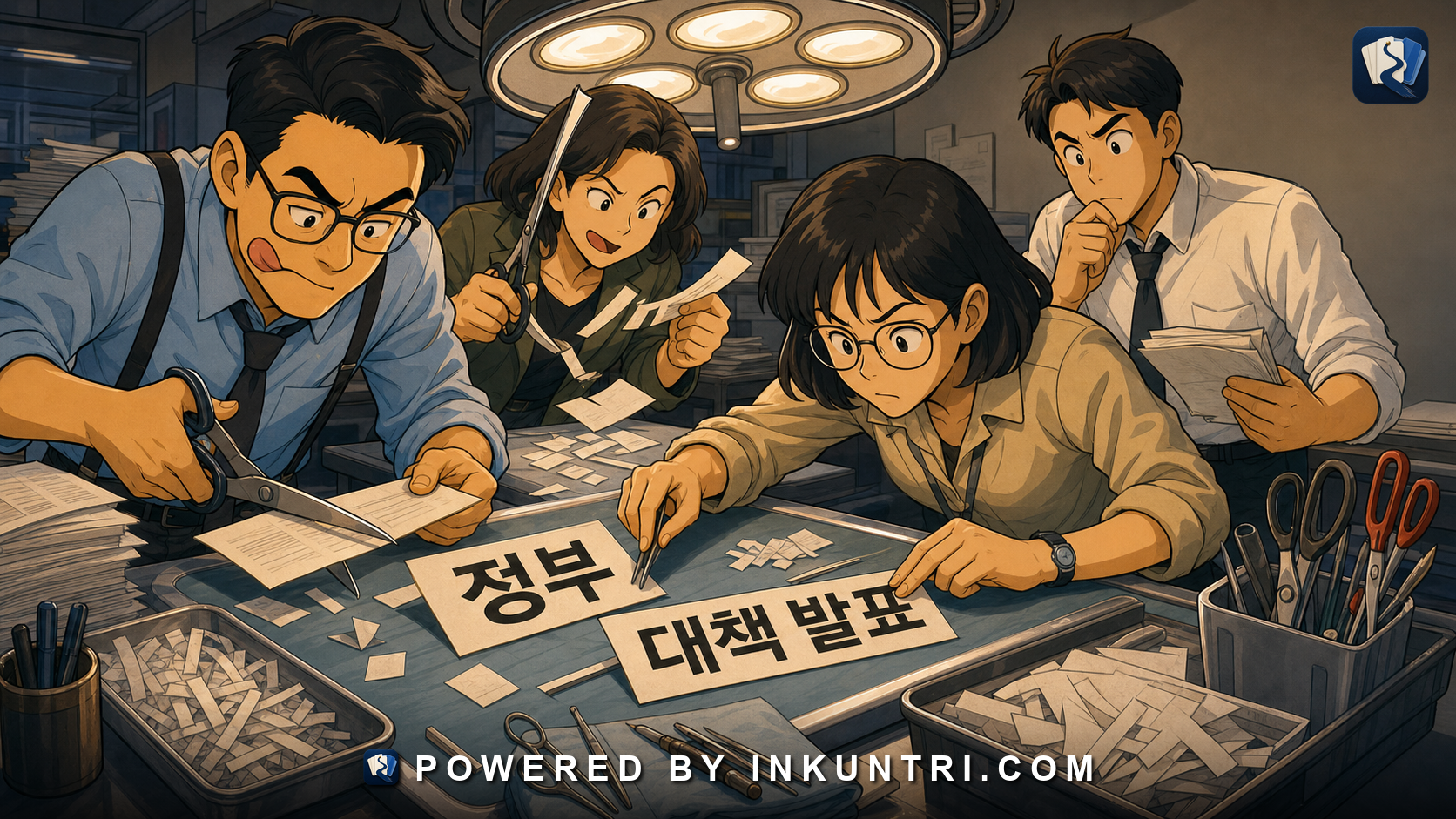
Core examples: 정부, 대책 발표; 물가 상승세 둔화; 비 내일까지 계속; 선수 이적 확정; 수출 증가; 회의 취소.
Headlines are not ordinary sentences
A Korean headline may look simple and still be hard to parse:
정부, 대책 발표
A textbook-trained learner may ask: Where is the subject particle? Where is the full verb ending? Is 발표 a noun or a verb? Why is there a comma after 정부?
The answer is that headlines are a compressed genre. They omit particles, use noun-heavy structures, drop full endings, front-load actors or results, and tolerate ambiguity for brevity.
The goal is not to read headlines as ordinary conversation. The goal is to expand them into ordinary Korean.
Particle omission is normal
Korean headlines often omit particles such as 이/가, 은/는, 을/를, 에서, and 로.
Headline:
정부, 대책 발표
Expanded:
정부가 대책을 발표했다.
Headline:
수출 증가
Expanded:
수출이 증가했다.
Headline:
회의 취소
Expanded:
회의가 취소되었다 / 회의가 취소됐다.
The particles are not missing because the writer does not know grammar. They are omitted because headline style compresses information.
Noun-heavy compression
Korean headlines often use Sino-Korean verbal nouns such as 발표, 증가, 감소, 둔화, 확정, 취소, 검토, 추진, 논의, 체결, and 공개.
These nouns can stand for full predicate meanings:
| Headline noun | Expanded predicate |
|---|---|
| 발표 | 발표했다 |
| 증가 | 증가했다 |
| 둔화 | 둔화됐다 |
| 확정 | 확정됐다 / 확정했다 |
| 취소 | 취소됐다 / 취소했다 |
| 추진 | 추진한다 / 추진하기로 했다 |
| 검토 | 검토한다 / 검토 중이다 |
The headline may not tell you whether the event is active, passive, completed, planned, or under discussion without more context. The body text clarifies.
Commas often separate topic or actor
A headline comma can mark a fronted actor, source, location, or topic.
Examples:
- 정부, 대책 발표
- 서울시, 새 정책 추진
- 경찰, 수사 확대
- 기업들, 투자 축소
This comma is not the same as ordinary English punctuation. It often signals “as for this actor/source, here is the event.”
Expanded:
서울시가 새 정책을 추진한다.
Tense is compressed
Headlines may not show tense clearly. A noun such as 확정 can mean “confirmed,” “to be confirmed,” or “confirmation” depending on article timing and context.
Examples:
- 선수 이적 확정 — player transfer confirmed
- 회의 내일 개최 — meeting to be held tomorrow
- 비 내일까지 계속 — rain continues until tomorrow
- 가격 인상 검토 — price increase under review
The date, body text, and publication context matter. Do not overread tense from the headline alone.
Quoted fragments and colon structures
Headlines often use quotes or colon-like structures:
- 장관 “대책 마련하겠다”
- 전문가 “추가 조치 필요”
- 시장: 안전 대책 강화
Quoted headlines compress speech. They may omit said, stated, argued, or emphasized. The quoted phrase may also be shortened from a longer statement.
A learner should identify whether the headline is reporting an event or quoting a claim.
Passive and impersonal style
Headlines often use passive or result-oriented nouns:
- 회의 취소
- 일정 연기
- 법안 통과
- 계획 공개
- 사업 중단
These phrases focus on the event or result rather than the agent. Who canceled the meeting? Who delayed the schedule? The headline may not say.
The body text is needed to assign responsibility.
Ambiguity is tolerated
A headline must attract attention and fit space. It does not always carry every grammatical detail.
For example:
가격 인상 검토
Possible expansions:
- A company is reviewing a price increase.
- The government is reviewing whether prices rose.
- A price increase is under review.
The surrounding section and body text resolve the intended meaning.
Learners should not demand complete certainty from the headline alone. Headlines are entry points, not full explanations.
Weather, sports, entertainment, and finance have substyles
Different news domains have their own compression habits.
Weather:
- 비 내일까지 계속
- 전국 폭염주의보
Sports:
- 선수 이적 확정
- 팀 3연승
Finance:
- 코스피 상승 마감
- 금리 동결
- 수출 증가세 둔화
Entertainment:
- 배우 새 작품 출연
- 앨범 공개
Each domain has recurring nouns and verbs. Build headline vocabulary by domain rather than memorizing isolated words.
A headline expansion routine
Use this checklist:
- Find the main event noun. 발표, 증가, 취소, 확정, 검토, 추진.
- Restore likely particles. Who did what? What happened to what?
- Identify actor/source. Is the first noun before a comma the subject or source?
- Choose active/passive carefully. 발표했다 vs 발표됐다; 취소했다 vs 취소됐다.
- Check time markers. 내일, 오늘, 올해, 지난달, until/until tomorrow.
- Read the body text. Confirm tense, agent, and responsibility.
Example:
Headline:
물가 상승세 둔화
Expansion:
물가 상승세가 둔화됐다.
Meaning:
The pace of price increases slowed.
Mini practice: restore the full sentence
Turn compressed headlines into ordinary Korean.
| Headline | Possible expanded sentence |
|---|---|
| 정부, 대책 발표 | 정부가 대책을 발표했다. |
| 물가 상승세 둔화 | 물가 상승세가 둔화되고 있다/둔화됐다. |
| 비 내일까지 계속 | 비가 내일까지 계속된다. |
| 선수 이적 확정 | 선수의 이적이 확정됐다. |
| 회의 취소 | 회의가 취소됐다. |
There may be more than one valid expansion. The point is to recover actors, particles, predicate, tense, and source of information before making a confident translation.
A strong tool for this article would let users turn headlines into full Korean sentences.
Suggested functions:
- Headline input: 정부, 대책 발표; 회의 취소; 수출 증가.
- Particle restoration: Suggest 이/가, 을/를, 은/는.
- Predicate expansion: 발표 → 발표했다, 취소 → 취소됐다.
- Quote mode: Identify quoted fragments and reporting verbs.
- Domain glossary: Weather, politics, sports, finance, entertainment.
- Ambiguity warning: Show when multiple expansions are possible.
Final rule
Korean headlines preserve meaning by compressing grammar.
Do not read them as ordinary sentences. Restore particles, expand verbal nouns, identify the main predicate, and check the article body for tense and agency. Once you learn the compression patterns, headlines become a powerful reading exercise instead of a source of frustration.
Related reading
When CJK Comparison Helps Korean Learners and When It Becomes Noise
The reader can decide when Chinese/Japanese comparison accelerates Korean learning and when it creates false friends, grammar transfer, register mistakes, or institutional confusion.
Language Policy, Standardization, and Spacing Rules in Korea
The reader can understand Korean correctness debates as interactions among official norms, dictionaries, school practice, actual usage, and genre.
Color Words in Korean: Tradition, Marketing, and Politics
The reader can classify Korean color words as literal description, traditional symbolism, political label, marketing style, or fixed expression.
Formal Korean Connectors: 따라서, 한편, 다만, 또한, 이에
The reader can read formal Korean connectors as paragraph-level logic signals rather than translating them one word at a time.
Hanja Beneath Hangul: The Hidden Sino-Korean Layer
The reader can recognize the Sino-Korean layer behind Hangul words without needing to become a full Hanja reader on day one.
How Classical Chinese Shaped Korean Elite Literacy
The reader can recognize how Classical Chinese shaped Korean elite literacy, Sino-Korean vocabulary, education, moral terminology, historical documents, and modern academic abstraction without confusing Hanja...