
Double Consonants in Hangul: Spelling, Sound, and Meaning
The reader can distinguish Korean double consonants as spelling units, tense consonants, and meaning-changing contrasts.
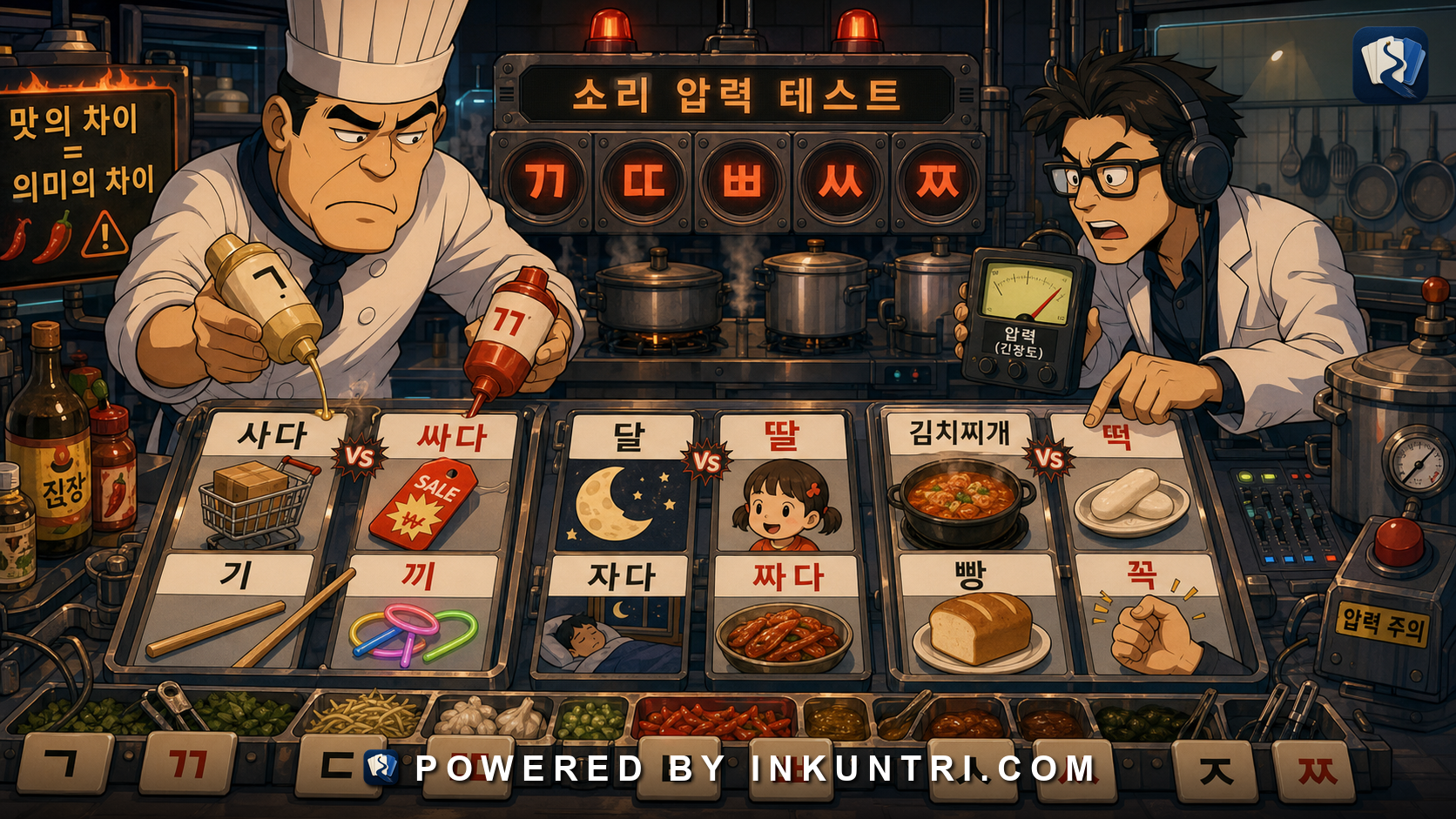
Core examples: 사다/싸다; 기/끼; 달/딸; 자다/짜다; 김치찌개; 떡; 빵; 꼭.
Double consonants are not just “stronger” letters
Korean double consonants look like doubled letters:
ㄲ ㄸ ㅃ ㅆ ㅉ
That visual doubling tempts learners to think they are simply louder, longer, or more emphatic versions of ㄱ, ㄷ, ㅂ, ㅅ, and ㅈ. That is not enough.
In Korean, these letters represent tense consonants. They contrast with plain and aspirated consonants. They can change word meaning. They appear in native words, expressive words, loanwords, tense-sound alternations, and spelling patterns.
If you pronounce ㄲ as just “extra k,” or ㅆ as just “two s sounds,” you will miss a core Korean contrast.
The three-way contrast
Korean stops and affricates often form three-way sets:
| Plain | Tense | Aspirated | Example contrast |
|---|---|---|---|
| ㄱ | ㄲ | ㅋ | 가 / 까 / 카 |
| ㄷ | ㄸ | ㅌ | 달 / 딸 / 탈 |
| ㅂ | ㅃ | ㅍ | 불 / 뿔 / 풀 |
| ㅈ | ㅉ | ㅊ | 자다 / 짜다 / 차다 |
ㅅ has a major plain-tense contrast:
| Plain | Tense |
|---|---|
| ㅅ | ㅆ |
| 사다 | 싸다 |
English does not have the same system. English speakers may hear these sounds through misleading categories such as voiced/unvoiced, hard/soft, or single/double. Korean cares about a different laryngeal contrast: plain, tense, and aspirated.
Meaning changes with the consonant
These are not pronunciation ornaments. They distinguish words.
| Pair | Rough meanings |
|---|---|
| 사다 / 싸다 | buy / be cheap; wrap, depending on context |
| 달 / 딸 | moon/month / daughter |
| 불 / 뿔 / 풀 | fire / horn / grass or glue, depending on word |
| 자다 / 짜다 | sleep / salty; squeeze; weave, depending on context |
| 기 / 끼 | energy/skill marker in some words / talent, meal, or끼 as a bound form depending on context |
If you say 사다 when you mean 싸다, the sentence can change completely. If you say 달 instead of 딸, you may be talking about the moon rather than someone’s daughter.
Tense consonants are spelling units
Double consonants are independent jamo in modern Hangul. ㄲ is not two separate ㄱs in spelling. ㄸ is not two ㄷs. They sort separately in Korean alphabetical order and occupy one initial consonant slot in a syllable block.
Examples:
- 까 = ㄲ + ㅏ
- 딸 = ㄸ + ㅏ + ㄹ
- 빵 = ㅃ + ㅏ + ㅇ
- 싸 = ㅆ + ㅏ
- 짜 = ㅉ + ㅏ
This matters for dictionary lookup, keyboard input, and block decomposition. On a 2-set keyboard, tense consonants are commonly typed with shift plus the corresponding consonant key.
They are not normally long consonants
The phrase “double consonant” is visually convenient but phonetically misleading. In many contexts, ㄲ, ㄸ, ㅃ, ㅆ, and ㅉ are not simply held twice as long as their plain counterparts. They involve tense articulation and different acoustic cues.
For learners, a practical description is:
- Aspirated consonants release more air.
- Tense consonants are tighter and less breathy.
- Plain consonants behave differently depending on position and speech style.
Do not try to create ㄲ by saying ㄱ twice. Train the contrast with audio.
Pitch can help perception
In contemporary Seoul Korean, the consonant type can affect the pitch of the following vowel. Tense and aspirated consonants often condition a higher pitch than plain consonants in certain positions. This is one reason learners may hear the contrast as partly tonal or pitch-like.
This does not mean Korean has tones like Mandarin. It means that pitch is one acoustic clue among several. Listening practice should include the vowel after the consonant, not only the consonant burst.
Double consonants in real words
Common words with tense consonants include:
- 떡 — rice cake
- 빵 — bread
- 꼭 — surely; tightly; exactly
- 짜다 — salty; squeeze; plan, depending on context
- 싸다 — cheap; wrap
- 깨끗하다 — clean
- 빠르다 — fast
- 똑똑하다 — smart; knock-knock-like sound in another use
- 김치찌개 — kimchi stew
Food vocabulary is a useful domain because tense consonants appear frequently: 떡, 빵, 찌개, 볶음, 뼈, 깻잎, 꼬치.
Tense consonants can arise through sound rules
Not every tense consonant is written as a double consonant in the source word. Korean has tensification processes where a following consonant becomes tense in pronunciation.
Examples:
- 먹고 → [먹꼬]
- 학교 → [학꾜]
- 국밥 → [국빱]
The spelling may show ㄱ, ㄱ, ㅂ, but the pronunciation can contain tense sounds due to the preceding final consonant or compound structure.
This is important: written tense consonants and pronounced tense consonants are related but not identical categories. Sometimes the tense sound is in the spelling. Sometimes it is produced by a sound rule.
Loanwords and expressive words
Korean uses tense consonants in some loanwords and expressive vocabulary. 빵 comes from a borrowed word for bread but is fully Koreanized in spelling and pronunciation. Words that sound mimetic, emphatic, or expressive may also use tense consonants to convey texture, force, or sharpness.
A learner should not reduce all tense consonants to “emotion.” Many are ordinary lexical distinctions. But expressive vocabulary is one domain where the sound symbolism of tense consonants may be noticeable.
A contrast-training routine
Use this routine:
- Train in sets. 가/카/까, 다/타/따, 바/파/빠, 자/차/짜.
- Listen before speaking. Identify the sound in blind audio.
- Record minimal pairs. 사다/싸다, 달/딸, 불/풀/뿔.
- Watch the following vowel. Listen for aspiration and pitch effects.
- Use real phrases. 떡 먹어요, 빵 주세요, 꼭 가요, 김치찌개.
- Separate spelling from sound rules. Written ㄲ is not the only source of [ㄲ]-like pronunciation.
Mini practice: do not train only one contrast
Use a three-way set whenever possible.
| Plain | Aspirated | Tense | Contrast to hear |
|---|---|---|---|
| 가 | 카 | 까 | aspiration and tenseness after the release |
| 달 | 탈 | 딸 | the consonant changes the word, not just the mood |
| 불 | 풀 | 뿔 | all three are meaningful words |
| 자다 | 차다 | 짜다 | affricate contrast |
| 사다 | — | 싸다 | ㅅ/ㅆ contrast without aspirated partner |
Recording yourself is useful only if you test perception too. Listen blind to a model, choose the word, then produce the pair or triplet in a short phrase. Korean listeners respond to the whole acoustic pattern: consonant release, following vowel, pitch, and rhythm.
A strong tool for this article would combine audio and visual feedback.
Suggested functions:
- Three-way audio: 가/카/까, 다/타/따, 바/파/빠.
- Waveform and aspiration view: Show release differences.
- Pitch trace: Display following-vowel pitch patterns.
- Minimal-pair quiz: 사다/싸다, 달/딸, 자다/짜다.
- Recording slot: Let learners compare their production to models.
- Tensification mode: Show 먹고 → [먹꼬] and 학교 → [학꾜].
Final rule
Double consonants are not decorative, not merely louder, and not simply two consonants in a row.
They are tense consonant letters with real meaning contrasts. Learn them as part of Korean’s plain-tense-aspirated system, train them through minimal pairs, and remember that tense sounds can also arise through pronunciation rules even when the spelling does not show a double consonant.
Related reading
When CJK Comparison Helps Korean Learners and When It Becomes Noise
The reader can decide when Chinese/Japanese comparison accelerates Korean learning and when it creates false friends, grammar transfer, register mistakes, or institutional confusion.
Vowel Combinations in Korean: ㅐ, ㅔ, ㅚ, ㅟ, ㅢ
The reader can recognize Korean vowel combinations and the modern pronunciation issues they create.
Using Speech Recognition Carefully for Korean Pronunciation
The reader can use speech recognition as a Korean pronunciation aid without treating it as an objective pronunciation judge.
Language Policy, Standardization, and Spacing Rules in Korea
The reader can understand Korean correctness debates as interactions among official norms, dictionaries, school practice, actual usage, and genre.
Sino-Korean Character Families Without Requiring Full Hanja Literacy
The reader can build Sino-Korean word families from recurring syllables without requiring full Hanja literacy.
Pronouncing Korean Loanwords: English Knowledge as a Liability
The reader can pronounce Korean loanwords by Korean phonology instead of by English spelling habits.