
The Korean Alphabetical Order: ㄱ to ㅎ and Dictionary Search
The reader can use Korean alphabetical order for dictionary lookup, search, indexes, and sorted lists.
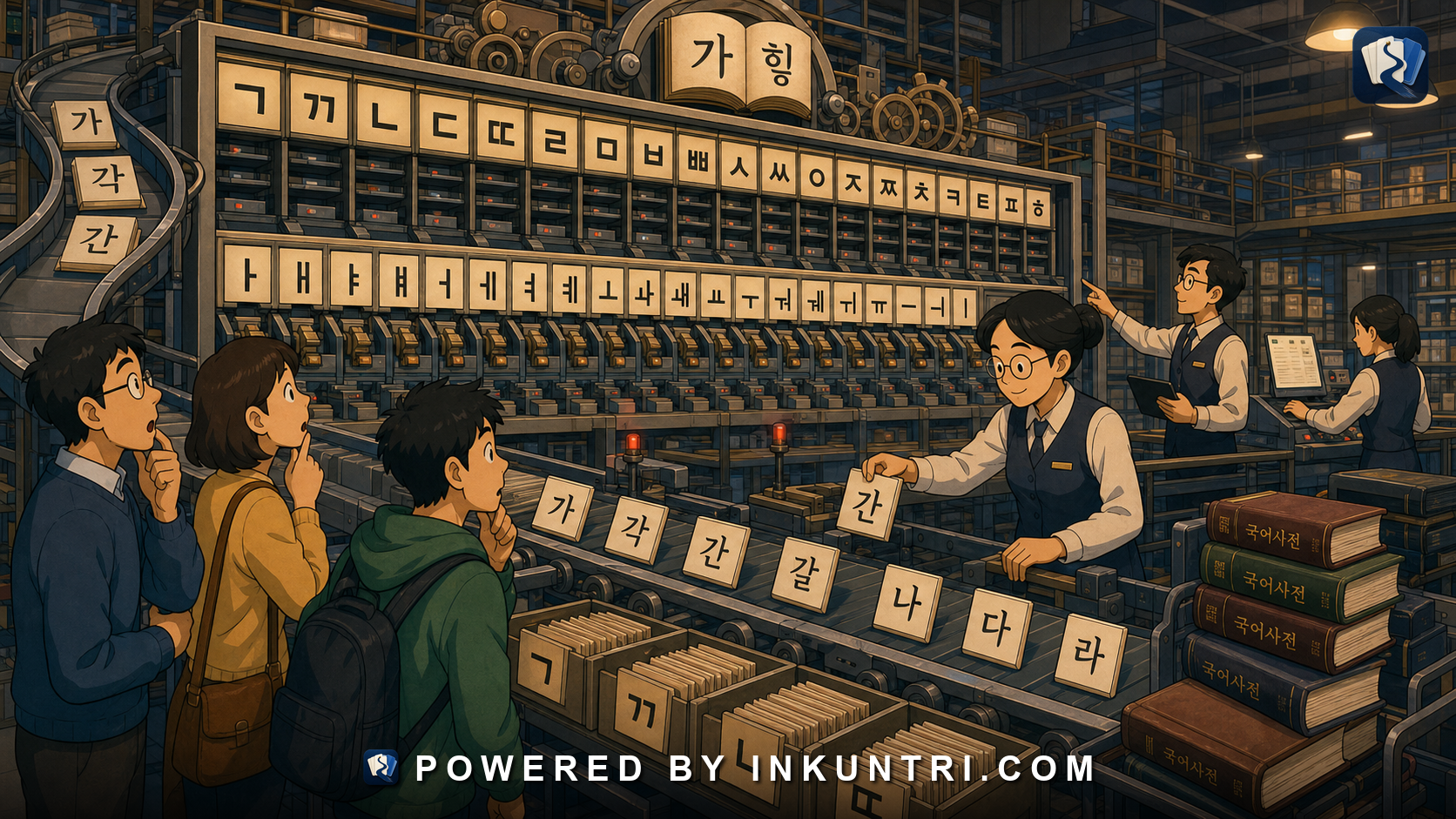
Core examples: ㄱ, ㄲ, ㄴ, ㄷ, ㄸ; ㅏ, ㅐ, ㅑ, ㅒ; 가, 각, 간, 갈; 나, 다, 라.
Being able to read Hangul is not the same as being able to sort it
Many learners can sound out Hangul before they know Korean alphabetical order. That works until they use a paper dictionary, scan a glossary, sort vocabulary cards, search a contact list, or interpret an index.
Korean alphabetical order is based on jamo order, not on romanization. ㄲ does not sort wherever English “kk” might sort. ㅐ does not sort by the letter “a” plus something. Syllable blocks are sorted by their internal jamo: initial consonant, vowel, then final consonant.
If you understand the order, 가, 각, 간, 갈, 감, 갑, 값, 갓, 강 stop feeling arbitrary. They become a predictable sequence.
Modern South Korean consonant order
A common modern South Korean order for initial consonants is:
ㄱ ㄲ ㄴ ㄷ ㄸ ㄹ ㅁ ㅂ ㅃ ㅅ ㅆ ㅇ ㅈ ㅉ ㅊ ㅋ ㅌ ㅍ ㅎ
This order matters for dictionary entries, sorted word lists, and educational materials.
A few points are worth noticing:
- ㄲ follows ㄱ.
- ㄸ follows ㄷ.
- ㅃ follows ㅂ.
- ㅆ follows ㅅ.
- ㅉ follows ㅈ.
- ㅇ appears after ㅆ in this order.
- Aspirated consonants ㅊ, ㅋ, ㅌ, ㅍ appear later.
Do not assume English alphabetic logic. Korean has its own order.
Modern South Korean vowel order
A common modern vowel order is:
ㅏ ㅐ ㅑ ㅒ ㅓ ㅔ ㅕ ㅖ ㅗ ㅘ ㅙ ㅚ ㅛ ㅜ ㅝ ㅞ ㅟ ㅠ ㅡ ㅢ ㅣ
This explains why syllables with ㅏ come before syllables with ㅓ, and why compound vowels have their own positions.
For example, syllables beginning with ㄱ and no final consonant sort roughly by vowel:
- 가
- 개
- 갸
- 걔
- 거
- 게
- 겨
- 계
- 고
- 과
- 괘
- 괴
- 교
- 구
- 궈
- 궤
- 귀
- 규
- 그
- 긔, rare in modern ordinary vocabulary
- 기
You do not need to recite rare syllables daily, but you should know that vowel order drives dictionary order after the initial consonant.
Initial, medial, final: the sorting logic
Hangul syllables sort by internal structure.
First, compare the initial consonant. If the initial is the same, compare the vowel. If both are the same, compare the final consonant.
Example sequence:
가 → 각 → 간 → 갇 → 갈 → 감 → 갑 → 값 → 갓 → 강
The exact order of final consonants follows the standard final jamo order. The important learner point is that 가 comes before 각 because no final consonant sorts before a final consonant, and then finals proceed by their order.
This is why dictionary lookup requires decomposition. If you see 값, you need to know it begins with ㄱ, has vowel ㅏ, and has final ㅄ. It belongs near other 가/각/간/갑 forms, not in a separate “square block” section.
Double consonants and tense consonants are sorted as letters
ㄲ, ㄸ, ㅃ, ㅆ, and ㅉ are separate jamo in Korean order. They are not treated as two ㄱs or two ㄷs for sorting purposes.
This matters for words such as:
- 가다 vs 까다
- 달 vs 딸
- 불 vs 뿔
- 사다 vs 싸다
- 자다 vs 짜다
In a dictionary, tense consonant entries appear in their own positions, not wherever a romanized spelling might suggest.
North/South and digital differences
Korean ordering conventions can differ in North Korean standards, historical materials, and specialized digital collation systems. Software may also sort differently depending on locale, normalization, database settings, or whether text contains compatibility jamo, precomposed syllables, mixed scripts, or punctuation.
For most learners using South Korean materials, the modern South Korean order is the practical base. But if a sorted list looks strange, do not immediately assume the Korean is wrong. The sorting environment may be different.
Dictionary search in the digital age still benefits from order knowledge
Digital dictionaries let you type, paste, draw, or speak words. This reduces the need for paper lookup skills. But alphabetic order still matters.
You need it for:
- printed glossaries,
- textbook vocabulary lists,
- grammar reference indexes,
- paper dictionaries,
- phone contacts,
- library catalogs,
- sorted name lists,
- flashcard organization,
- database cleanup,
- understanding autocomplete behavior.
Digital tools are strongest when you understand what they are doing.
Names and indexes
Name lists are often sorted by family name first:
- 김...
- 박...
- 이...
- 최...
Within each family name, given-name syllables may determine order. If you do not know jamo order, a class roster or participant list may feel arbitrary.
Romanized sorting is a separate problem. Kim, Gim, Lee, Yi, Park, Bak, Choi, Choe, Jung, Jeong, and Chung can disrupt clean matching. For Korean-language materials, sort by Hangul when possible.
A lookup workflow
Use this routine for a Korean word:
- Decompose the first syllable. Identify initial, vowel, and final.
- Find the initial section. ㄱ, ㄴ, ㄷ, etc.
- Use the vowel order. 가 before 거, 고 before 구, etc.
- Use the final consonant. 가 before 각 before 간.
- Continue syllable by syllable. If the first syllable is identical, compare the next block.
- Ignore romanization for sorting. Use Hangul structure.
Try sorting these:
- 가
- 간
- 각
- 나
- 까
- 다
Correct initial-level order begins with ㄱ forms, then ㄲ, then ㄴ, then ㄷ:
가, 각, 간, 까, 나, 다
Within 가/각/간, final order decides the sequence.
Mini practice: sort by jamo, not by romanization
Sort this set: 가, 나, 까, 각, 간, 다, 갈.
The correct order is:
가, 각, 간, 갈, 까, 나, 다
Why? First compare initial consonants. ㄱ comes before ㄲ, ㄴ, and ㄷ. Within ㄱ + ㅏ syllables, compare final consonants: no final comes before ㄱ, then ㄴ, then ㄹ in this subset. Only after the ㄱ group do you move to ㄲ, then ㄴ, then ㄷ.
Now try a vowel set: 가, 거, 고, 개, 기. The order begins with ㅏ, then ㅐ, then ㅓ, then ㅗ, and later ㅣ:
가, 개, 거, 고, 기
This is the kind of small skill that pays off in dictionaries, indexes, contacts, and vocabulary cleanup.
A strong tool for this article would train sorting through games.
Suggested functions:
- Jamo order strip: Always-visible consonant and vowel order.
- Syllable sorter: Drag 가, 각, 간, 갈, 감 into order.
- Double consonant drills: Place 까, 따, 빠, 싸, 짜 correctly.
- Dictionary lookup simulator: Find a word in a mock paper dictionary.
- Name-list mode: Sort Korean names by Hangul order.
- Digital collation note: Show when software sorting may differ.
Final rule
Korean alphabetical order is not romanization. It is jamo order inside syllable blocks.
To sort Korean, decompose the block: initial consonant first, vowel second, final consonant third. Once you know that logic, dictionaries, glossaries, contacts, and indexes become much less mysterious.
Related reading
When CJK Comparison Helps Korean Learners and When It Becomes Noise
The reader can decide when Chinese/Japanese comparison accelerates Korean learning and when it creates false friends, grammar transfer, register mistakes, or institutional confusion.
Vowel Combinations in Korean: ㅐ, ㅔ, ㅚ, ㅟ, ㅢ
The reader can recognize Korean vowel combinations and the modern pronunciation issues they create.
Confucian Vocabulary in Korean Public Language
The reader can recognize Confucian-derived terms in modern Korean public language without treating them as timeless cultural essence.
Using Speech Recognition Carefully for Korean Pronunciation
The reader can use speech recognition as a Korean pronunciation aid without treating it as an objective pronunciation judge.
Language Policy, Standardization, and Spacing Rules in Korea
The reader can understand Korean correctness debates as interactions among official norms, dictionaries, school practice, actual usage, and genre.
Sino-Korean Character Families Without Requiring Full Hanja Literacy
The reader can build Sino-Korean word families from recurring syllables without requiring full Hanja literacy.