
Why Japanese Learners Should Study Handwriting Even If They Type
The reader can see handwriting study as a tool for recognition, component awareness, stroke economy, and cultural literacy even in a typing-first world.
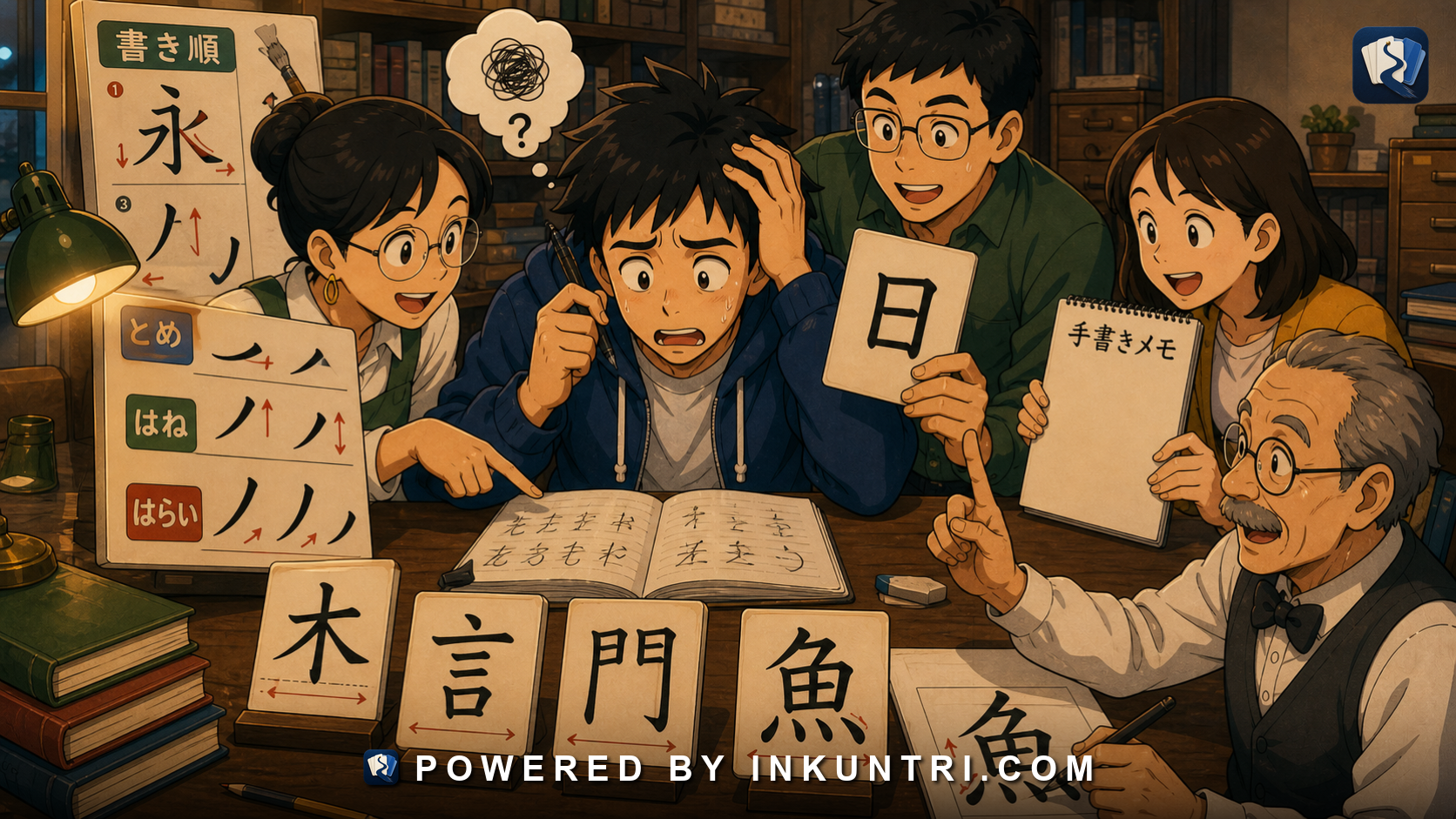
Core examples: とめ, はね, はらい, 書き順, 日, 木, 言, 門, 魚, 手書きメモ.
Typing did not make handwriting irrelevant
Most modern Japanese writing is typed. Phones, computers, IMEs, predictive input, OCR, and copy-paste have changed literacy. A learner can produce kanji without remembering every stroke. That is real.
So why study handwriting?
Not because every learner needs to handwrite thousands of kanji from memory. Not because typing is illegitimate. Not because old-fashioned study is morally superior.
The practical reason is better:
Handwriting study improves recognition, component awareness, dictionary lookup, memory, and the ability to read real-world handwritten Japanese.
Even a typing-first learner benefits from knowing how characters are built. Stroke order, stroke types, component placement, and handwritten variation make printed kanji less mysterious. They also help you catch wrong IME conversions, read notes, fill paper forms, recognize signs, and understand why similar characters differ.
Handwriting is not only output. It is visual training.
The false choice: handwriting everything or nothing
Learners often frame the issue badly:
- “Do I need to handwrite every kanji?”
- “Can I ignore handwriting completely?”
Both extremes are weak.
You probably do not need to handwrite every character you can read, especially if your goals are reading, travel, media, or digital communication. But ignoring handwriting completely leaves a gap in character awareness.
A better goal:
Learn handwriting principles deeply enough to recognize, remember, and write core forms when needed.
That means studying:
- stroke order,
- stroke types,
- radicals/components,
- balance,
- printed vs handwritten differences,
- common handwritten simplifications,
- high-frequency kanji,
- your own name/address/form needs,
- characters you repeatedly confuse.
Stroke order: 書き順 as logic
書き順 means stroke order. It is not arbitrary ritual. It supports balance, speed, legibility, and memory.
Common principles include:
- top to bottom,
- left to right,
- horizontal before vertical in many structures,
- outside before inside, then close,
- center before sides in some forms,
- major enclosing structures first,
- final closing stroke last.
These principles help you predict how unfamiliar characters are written.
Stroke order also matters for handwriting recognition. If you use a digital handwriting input tool, writing strokes in a plausible order improves recognition.
Learner action: learn stroke order for representative characters, not only isolated rules.
Stroke types: とめ, はね, はらい
Japanese handwriting includes basic stroke endings and movements.
Important terms:
とめ stop
はね hook
はらい sweep
These affect how characters look and feel. A printed font may show them clearly or subtly. Handwriting requires movement.
Examples:
- A stroke may stop firmly.
- A stroke may hook upward.
- A stroke may sweep away.
- A stroke may turn a corner.
- A stroke may connect visually in fast writing.
Understanding these makes handwriting less like drawing pictures and more like writing with controlled motion.
Components: the real memory payoff
Kanji are built from components. Handwriting forces you to notice them.
Examples:
日 sun/day component in many characters
木 tree/wood component
言 speech component
門 gate component
魚 fish component
When you handwrite, you learn not only the whole character but where components sit: left, right, top, bottom, enclosure, inner element.
This helps distinguish similar characters:
- 待 / 持 / 時
- 話 / 語 / 読
- 間 / 聞 / 問
- 休 / 体 / 本
- 魚 / 鮮 / 鯨
A learner who never writes may recognize characters as fuzzy wholes. A learner who writes a bit sees structure.
Printed forms and handwritten forms differ
Textbook fonts, Minchō fonts, Gothic fonts, handwriting, brush writing, and casual notes do not look identical. Some shapes change substantially.
Learners who only see clean digital fonts may struggle with:
- handwritten notes,
- whiteboard writing,
- restaurant menus,
- signs,
- teachers’ corrections,
- form labels,
- calligraphy,
- manga handwriting,
- personal letters.
Handwriting study gives you tolerance for variation. You learn what must stay stable and what can change.
Reading handwritten Japanese
Real handwritten Japanese appears in many places:
- classroom notes,
- office whiteboards,
- sticky notes,
- forms,
- envelopes,
- restaurant specials,
- personal cards,
- temple/shrine notices,
- manga lettering,
- teachers’ comments,
- delivery notes.
Even if you never write long essays by hand, you may need to read handwritten Japanese.
Handwriting recognition is a skill. It improves when you know stroke order and components because you can reconstruct messy forms.
Handwriting helps IME proofreading
IME conversion lets you type many kanji you cannot handwrite. That is useful, but it creates risk. You may choose a wrong homophone because the candidate looked vaguely familiar.
Handwriting study sharpens visual discrimination. It helps you notice the difference between similar characters and choose the right conversion.
Examples:
- 橋 / 箸 / 端
- 以外 / 意外
- 以上 / 異常
- 使用 / 仕様
- 保障 / 保証 / 補償
Not all of these are handwriting problems, but component awareness supports proofreading.
Memory: writing as active recall
Writing a character from memory is harder than recognizing it. That difficulty can be useful.
Recognition can be passive. Writing requires active recall of:
- components,
- order,
- placement,
- proportions,
- stroke count,
- orientation.
You do not need to write every character daily, but writing important characters strengthens memory.
A practical method:
- Look at character.
- Identify components.
- Watch stroke order.
- Write once slowly.
- Write from memory.
- Compare.
- Use in a word.
- Stop before practice becomes mindless copying.
Quality beats pages of mechanical repetition.
Which characters should learners handwrite?
Prioritize:
- kana,
- numbers,
- your name,
- address-related characters,
- form vocabulary,
- high-frequency kanji,
- confusing lookalikes,
- radicals/components,
- characters in your learning domain,
- characters you need for whiteboards or notes.
Do not start by trying to handwrite every rare kanji in a newspaper. Build structural literacy first.
Good early component families:
- 日: 明, 時, 映
- 木: 林, 森, 本, 校
- 言: 話, 語, 読
- 門: 間, 聞, 問
- 心: 思, 意, 感
- 手/扌: 持, 指, 探
- 水/氵: 海, 洗, 漢
Example bank walkthrough
とめ
A stopped stroke ending.
Learner action: notice where strokes end firmly.
はね
A hooked stroke ending.
Learner action: practice hooks because they affect handwritten identity.
はらい
A sweeping stroke.
Learner action: distinguish left/right sweeping motions.
書き順
Stroke order.
Learner action: learn principles, not just animations.
日
Simple component with high frequency.
Learner action: practice as character and component.
木
Important character and component.
Learner action: compare 木, 本, 林, 校.
言
Speech component.
Learner action: use it to organize 話, 語, 読.
門
Gate/enclosure component.
Learner action: compare 間, 聞, 問.
魚
Fish component.
Learner action: useful for food, animals, and component awareness.
手書きメモ
Handwritten note.
Learner action: practice reading messy real-world text gradually.
Handwriting practice plan
A sane typing-first handwriting plan:
Phase 1: Kana mastery
Write hiragana and katakana accurately. This is non-negotiable.
Phase 2: Stroke principles
Learn basic stroke order and stroke types with simple kanji.
Phase 3: Component families
Practice radicals/components that recur often.
Phase 4: High-frequency words
Write useful words, not isolated kanji only.
Phase 5: Recognition under messiness
Read handwritten samples, whiteboards, menus, and notes.
Phase 6: Personal practical writing
Learn to write your name, address, date, phone-related labels, and form vocabulary.
A strong tool for this article would connect printed forms, stroke order, and handwritten variation.
Suggested functions:
- Stroke animation: Show 書き順.
- Stroke type labels: とめ, はね, はらい.
- Component view: Highlight 日, 木, 言, 門, 魚.
- Printed vs handwritten comparison: Minchō, Gothic, handwritten.
- Messy recognition quiz: Identify handwritten variants.
- Lookalike drills: 持/待/時, 話/語/読.
- Practical form mode: Write name, address, date labels.
- IME proofreading link: Choose correct kanji candidate after handwriting analysis.
Final rule
You do not need to become a calligrapher. You do need enough handwriting literacy to understand how kanji are built.
Typing is efficient. Handwriting study builds structure. Learn stroke logic, components, and practical writing. It will make you a better reader, better typist, better proofreader, and more resilient user of Japanese in the real world.
Related reading
National Language Policy and the Idea of Kokugo
The reader can understand kokugo as a national-language idea with educational, political, and cultural consequences.
How to Build a Kanji Component Notebook That Respects Japanese Readings
The reader can build a kanji component notebook that uses radicals and components without pretending they determine Japanese meanings or readings mechanically.
Tracking Japanese Listening Progress With Real Audio
The reader can track Japanese listening progress using real audio, transcripts, comprehension targets, error categories, and repeated measurement.
Designing Japanese Anki Cards for Kanji, Vocabulary, Pitch, and Context
The reader can design Japanese Anki cards that train recognition, production, kanji, vocabulary, pitch accent, and context without creating bloated review debt.
Engineering Japanese: 仕様, 公差, 図面, 検査
The reader can read engineering Japanese by connecting specifications, drawings, tolerances, inspection, and requirements.
When Japanese Uses Spaces: Children’s Books, Teaching Materials, and UI
The reader can recognize the few contexts where Japanese uses spaces and understand what spacing reveals about audience, pedagogy, and interface design.