
Stroke Order for Kanji Learners Who Already Know Hanzi
The reader can transfer Hanzi knowledge to Japanese kanji without importing the wrong stroke order, form assumptions, or reading expectations.
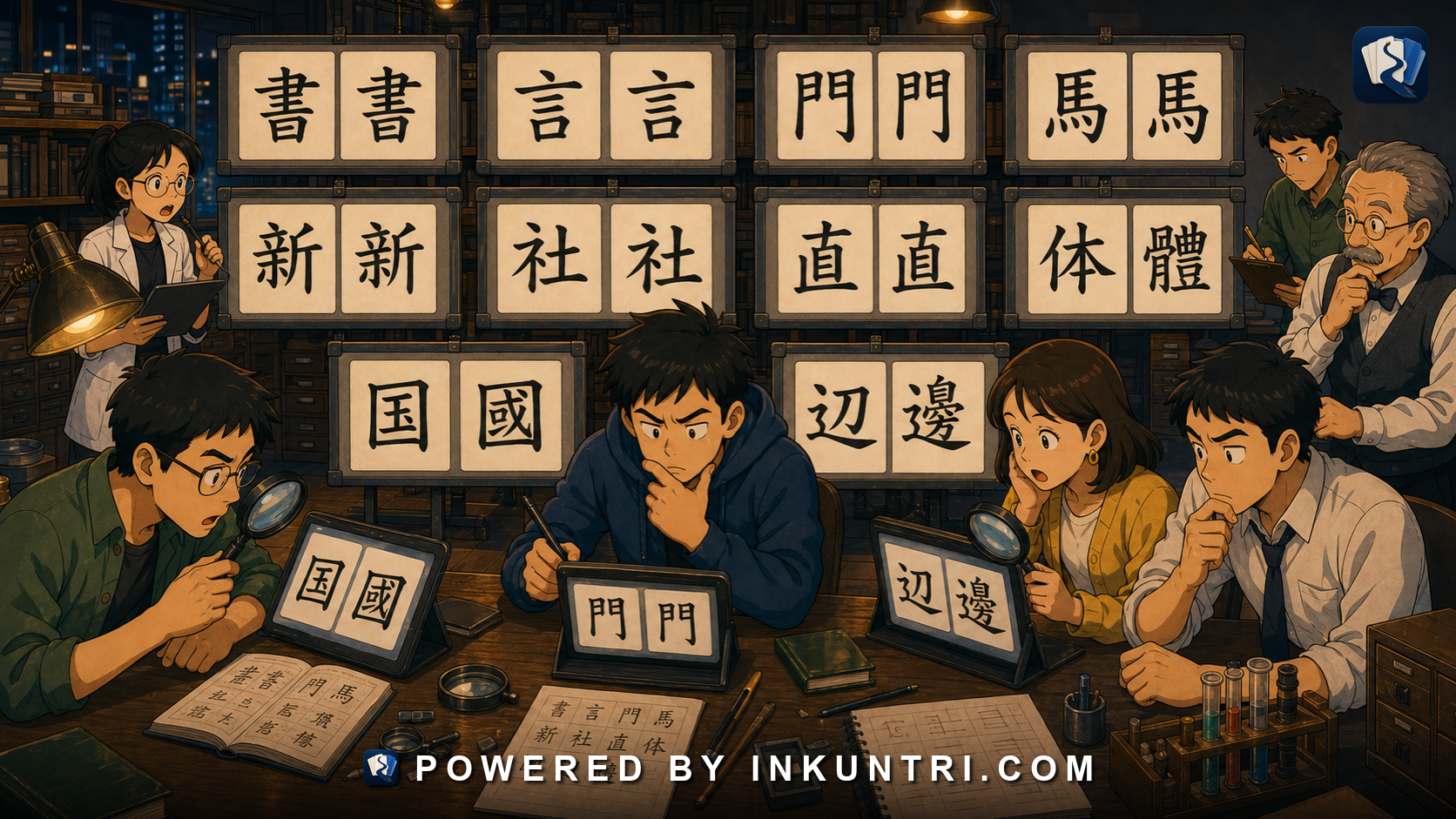
Core examples: 書, 言, 門, 馬, 新, 社, 直, 体/體, 国/國, 辺/邊.
Knowing Hanzi is a head start, not a free pass
Chinese-literate learners come to Japanese with a huge advantage. They can recognize many characters, understand component structure, guess meanings in compounds, tolerate character density, and learn kanji faster than learners from alphabetic backgrounds.
But the advantage creates traps.
Japanese kanji are not simply Chinese characters with Japanese pronunciation pasted on. Character forms differ. Stroke order can differ. Simplified, traditional, and Japanese shinjitai standards do not line up cleanly. Handwritten conventions may differ. Meanings may shift. Readings multiply. Okurigana changes how characters behave in words. Names become their own universe.
The key principle:
Hanzi knowledge transfers powerfully to Japanese, but it must be filtered through Japanese standards.
If you write Japanese kanji exactly as you would write simplified or traditional Chinese, the result may look non-Japanese, even when it is understandable.
Three character standards, not two
Many learners think only in terms of simplified and traditional Chinese. Japanese introduces another standard: shinjitai, the modern Japanese simplified character forms used for many common kanji.
Compare:
學 → 学 體 → 体 國 → 国 舊 → 旧 邊 → 辺
Some Japanese forms look like simplified Chinese. Some look like traditional Chinese. Some are specifically Japanese. Some share a Unicode code point but differ by font glyph. Some old forms still appear in names, temples, literature, and company names.
A Chinese-literate learner must ask:
What is the standard Japanese form?
Not “Do I recognize this from Chinese?”
Shinjitai is not simplified Chinese
Japanese character reform and Mainland Chinese simplification are different systems.
Examples:
國 → 国
Japanese 国 and simplified Chinese 国 match.
學 → 学
Japanese 学 and simplified Chinese 学 match.
But not all forms align.
Traditional Chinese:
邊
Simplified Chinese:
边
Japanese shinjitai:
辺
These are related, but not identical.
Traditional Chinese:
廣
Simplified Chinese:
广
Japanese:
広
Again, Japanese has its own form.
Learner action: build a three-column awareness: Japanese modern, simplified Chinese, traditional Chinese.
Stroke order may differ even when forms look familiar
Some characters have different stroke-order conventions across Japanese and Chinese standards. The visible result may be similar, but the motion can differ. In careful handwriting education, tests, calligraphy, or handwriting recognition, this matters.
Even when the official order is similar, proportions and handwritten style may differ.
A Chinese-literate learner may write quickly and confidently, but a Japanese teacher may notice:
- non-Japanese stroke order,
- Chinese-style component shape,
- simplified form instead of Japanese shinjitai,
- traditional form where modern Japanese expects simplified Japanese form,
- wrong okurigana usage,
- Chinese-like spacing or punctuation habits.
The issue is not intelligence. It is standard mismatch.
Japanese handwritten balance
Japanese kanji handwriting has its own school conventions. Characters should sit balanced in square space, with proportions matching Japanese models.
For example:
言
The exact shape, spacing, and stroke finishing may differ from a learner’s Chinese handwriting habit.
門
The enclosure shape and internal spacing must match Japanese expectations.
馬
The Japanese standard form may differ from simplified 马 and from handwriting habits tied to Chinese standards.
A learner should copy Japanese model forms, not only rely on memory.
Okurigana changes how kanji work
Chinese characters usually represent morphemes without kana endings. Japanese kanji often combine with okurigana:
書く 書きます 食べる 新しい 正しい 直す 直る
For Hanzi-literate learners, this is one of the biggest mental shifts. The kanji is not always the whole written word. The kana ending is grammatical evidence.
Example:
直す to fix
直る to be fixed / return to normal
A Chinese-literate learner may recognize 直, but the Japanese word depends on kana.
Stroke order study should therefore connect to word forms. Do not learn kanji as isolated Chinese-like blocks only. Learn them inside Japanese words.
On-readings, kun-readings, and false friends
Knowing Chinese pronunciation may help guess some Sino-Japanese on-readings historically, especially for learners with knowledge of Middle Chinese-related patterns, but modern Mandarin/Cantonese/etc. do not directly give Japanese readings.
A character may have:
- on-readings,
- kun-readings,
- name readings,
- special readings,
- multiple word-specific pronunciations.
Example:
生
Japanese readings vary wildly: せい, しょう, なま, い, う, は, and more in compounds and verbs.
A Chinese-literate learner must resist the urge to attach one sound to one character.
Japanese is word-reading heavy. Learn readings through vocabulary.
Meaning transfer: useful but dangerous
Many kanji meanings overlap with Chinese. This helps.
Examples:
山, 川, 人, 国, 学, 新, 社
But meanings can shift or narrow. Some words are false friends. Some compounds mean something different in Japanese from Chinese. Some characters are common in one language and rare in the other. Some Japanese words use kanji semantically but are native Japanese words with kun-readings.
For stroke order and form study, meaning transfer is useful. For vocabulary, verify.
Character examples
書
Traditional Chinese 書 and Japanese 書 look closely related. Simplified Chinese 书 is different. Japanese uses 書 in words like 書く, 書店, 図書館.
Learner action: learn Japanese form and okurigana behavior: 書く, 書きます.
言
Shared character, but Japanese usage includes 言う, 言葉, 発言, 言語.
Learner action: learn Japanese readings and handwriting proportions.
門
Traditional-looking form in Japanese. Simplified Chinese 门 differs.
Learner action: do not import simplified 门 into Japanese writing.
馬
Japanese 馬 differs from simplified 马. It appears in words and names.
Learner action: write Japanese standard form.
新
Widely recognizable. Appears in 新しい, 新聞, 新幹線.
Learner action: note kun-reading with okurigana in 新しい and on-reading in compounds.
社
Shared component/character. Appears in 会社, 社会, 神社.
Learner action: meanings differ by compound; learn Japanese words.
直
Appears in 直す, 直る, 直接, 正直.
Learner action: kana endings distinguish verb pairs.
体 / 體
Japanese modern 体 corresponds to old 體. Simplified Chinese also uses 体.
Learner action: know old form for names/history, but use 体 in standard modern Japanese.
国 / 國
Japanese modern 国 corresponds to old 國. Simplified Chinese also uses 国.
Learner action: use 国 in modern Japanese; recognize 國 in old-style names/signs.
辺 / 邊
Japanese 辺 differs from simplified Chinese 边 and traditional 邊.
Learner action: this is a perfect example of Japanese-specific form awareness.
The transfer checklist
When a Hanzi-literate learner meets a Japanese kanji, ask:
- Japanese form: What is the standard modern Japanese shape?
- Old form: Is there a kyūjitai or traditional form I recognize?
- Chinese forms: How do simplified/traditional forms differ?
- Stroke order: Does Japanese handwriting match my habit?
- Readings: What are the Japanese word readings?
- Okurigana: Does this character appear with kana endings?
- Meaning: Does the Japanese word match Chinese meaning?
- Names: Could this have special name readings or variants?
- Font: Am I seeing Japanese glyphs or Chinese font rendering?
Study strategy for Chinese-literate learners
Step 1: Separate recognition from production
You may recognize many kanji instantly. That does not mean you can write them in Japanese standard form.
Step 2: Build a shinjitai comparison deck
Make cards comparing:
- Japanese modern form,
- traditional Chinese form,
- simplified Chinese form,
- common Japanese words.
Step 3: Practice stroke order only where it differs or matters
Do not waste time relearning every obvious character. Focus on mismatch and high-frequency forms.
Step 4: Learn okurigana with verbs/adjectives
This is where Japanese diverges sharply from Chinese writing.
Step 5: Read real Japanese compounds
Do not assume Chinese compound meanings transfer. Verify in Japanese context.
Step 6: Respect names and variants
Do not normalize names according to Chinese habits.
A strong tool for this article would compare Japanese, simplified Chinese, and traditional Chinese forms.
Suggested functions:
- Three-form grid: Japanese shinjitai, simplified Chinese, traditional Chinese.
- Stroke animation: Japanese standard stroke order.
- Mismatch warning: Highlight forms like 辺/边/邊, 広/广/廣.
- Okurigana examples: 書く, 新しい, 直す/直る.
- Meaning comparison: Japanese word meaning vs Chinese cognate/false friend.
- Handwriting overlay: Japanese model vs common Chinese-style learner form.
- Name/old-form mode: 體, 國, 邊 in names, temples, old texts.
Final rule
If you know Hanzi, you are not starting from zero. You are starting with powerful assumptions.
Some assumptions will help. Some will betray you.
Transfer recognition, component knowledge, and character confidence. Then relearn Japanese forms, stroke order where needed, readings, okurigana, and name conventions. The goal is not to erase your Chinese literacy. The goal is to route it through Japanese standards.
That is how Hanzi knowledge becomes a kanji advantage instead of a source of stubborn errors.
These drafts are written as publication-ready educational articles rather than academic papers. Useful technical/reference anchors for future source-linking include:
- Japanese manga and publishing conventions for script choice, furigana, sound effects, and dialogue lettering.
- Japanese onomatopoeia/mimetic-word references covering 擬音語, 擬声語, 擬態語, repetition, voicing, and semantic categories.
- Japanese business-writing and email references for 宛名, お世話になっております, request formulas, closings, and signatures.
- Japanese administrative form conventions for 氏名, ふりがな/フリガナ, 生年月日, 住所, 印, 必須, 任意, and era-year dates.
- Japanese handwriting and school-kanji references covering 書き順, とめ, はね, はらい, radicals/components, and printed-vs-handwritten variation.
- Cross-CJK orthography references for shinjitai, kyūjitai, simplified Chinese, traditional Chinese, and Japanese-specific character forms.
Related reading
Why Japanese Mixed Script Is a Reading System, Not a Historical Accident
The reader can read Japanese mixed-script text as a designed system of roles rather than as a messy accumulation of scripts.
Japanese Wedding Language: ご祝儀, 披露宴, 招待状, 内祝い
The reader can understand Japanese wedding language around gift money, receptions, invitations, return gifts, speeches, and formal register.
How to Build a Kanji Component Notebook That Respects Japanese Readings
The reader can build a kanji component notebook that uses radicals and components without pretending they determine Japanese meanings or readings mechanically.
Tracking Japanese Listening Progress With Real Audio
The reader can track Japanese listening progress using real audio, transcripts, comprehension targets, error categories, and repeated measurement.
Chinese Classics in Japanese Education and Quotation
The reader can recognize Chinese-classics quotations and allusions in Japanese education, journalism, speeches, and public writing.
Japanese Bureaucratic Vocabulary: 実施, 対応, 検討, 周知, 徹底
The reader can unpack high-frequency bureaucratic Japanese and understand the institutional actions hidden behind neutral-sounding vocabulary.