
Sound Effects in Japanese: Visual Language Beyond Translation
The reader can treat Japanese sound effects as a visual-semantic system that often carries narrative information beyond sound alone.
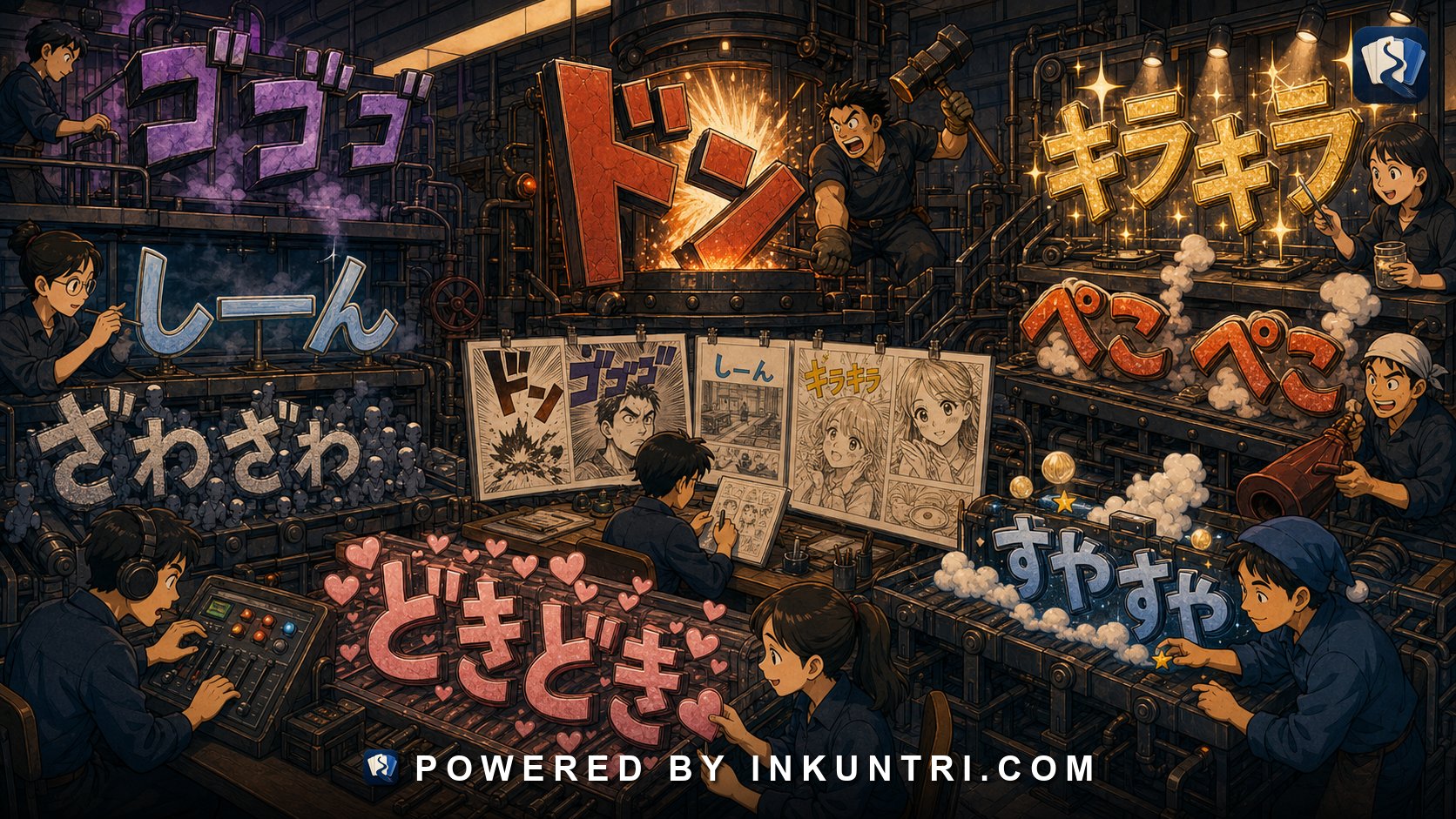
Core examples: ドン, ゴゴゴ, しーん, キラキラ, ざわざわ, どきどき, すやすや, ぺこぺこ.
The sound that is not only a sound
In Japanese manga, a huge ドン may crash across a panel. A quiet しーん may fill a room with silence. A nervous どきどき may tell you a character’s heart is pounding. キラキラ may make eyes, jewels, water, or an idol performance sparkle.
These are often called sound effects, but that label is too small.
Japanese uses a rich system of onomatopoeia and mimetic words that represent sounds, states, textures, motions, emotions, atmospheres, and bodily sensations. In manga, these words become visual objects. They are drawn into the panel, shaped by typography, size, angle, texture, and placement.
The key principle:
Japanese sound effects are visual language. They often tell the reader what the panel feels like, not only what it sounds like.
A learner who skips them misses action, mood, pacing, and comedy.
Giongo, gitaigo, and friends
Japanese mimetic vocabulary is often divided into categories.
- 擬音語: words imitating actual sounds.
- 擬声語: words imitating voices or animal sounds.
- 擬態語: words expressing states, manners, feelings, or conditions that may not make sound.
In practical learning, the boundary is less important than the function. Ask:
- Is it an actual sound?
- Is it a movement?
- Is it an emotional state?
- Is it a texture?
- Is it an atmosphere?
- Is it silence?
- Is it bodily sensation?
- Is it visual sparkle or intensity?
Examples:
ドン impact, thud, dramatic hit
ざわざわ crowd murmuring, uneasy atmosphere
どきどき heartbeat, nervous excitement
すやすや sleeping peacefully
ぺこぺこ hungry, bowing repeatedly, dented/flimsy depending on context
The same mimetic word may cover several related meanings. Context and image decide.
Typography changes meaning
In manga, sound effects are drawn. A word can be huge, tiny, jagged, round, shaky, dripping, metallic, fluffy, or nearly invisible.
A giant jagged ドン differs from a small round ぽん. A stretched しーーん differs from a small しん. A shaky ガタガタ may indicate rattling, fear, cold, or instability depending on panel context.
Typography can signal:
- volume,
- distance,
- texture,
- speed,
- emotional intensity,
- heaviness,
- cuteness,
- danger,
- silence,
- comedy.
This means the word itself is only part of the meaning. The lettering is also semantic.
Silence as sound: しーん
One of the best examples is:
しーん
It marks silence. That seems paradoxical: a sound effect for no sound.
In manga, しーん can make awkwardness visible. It can show an empty room, a failed joke, shock, isolation, or sudden quiet after chaos. It controls pacing.
In English translation, this may become “...” or be left out. But the Japanese reader sees the silence as a drawn element.
Learner lesson: not all “sound effects” are sounds. Some are atmosphere.
Repetition and rhythm
Many Japanese mimetic words use repetition:
キラキラ sparkle
ざわざわ murmuring/uneasy stir
どきどき heartbeat/nervous excitement
すやすや peaceful sleep
ぺこぺこ hungry/bowing/dented
The repetition often creates continuous or repeated action/state. It gives rhythm to the panel.
A single ドン may be a sudden impact. ゴゴゴ may create ongoing ominous pressure. キラキラ may suggest continuous sparkling. どきどき may indicate repeated heartbeat.
Learner action: pay attention to repeated forms and whether the scene is momentary, continuous, or rhythmic.
Voicing and weight
Japanese sound-symbolic patterns often use voiced consonants for heavier, rougher, louder, or more intense impressions.
Compare:
さらさら smooth, light, flowing
ざらざら rough, gritty
Compare:
ころころ rolling lightly
ごろごろ rumbling, rolling heavily, lazing around depending on context
Voicing is not a perfect formula, but it is a strong pattern. Manga uses this intuitively. A heavy object does not usually go ぽん if the scene wants impact; it may go ドン, ガン, ゴン, or ズドン.
Learner action: when a mimetic word feels rougher or heavier, check voiced sounds.
Script choice: katakana vs hiragana
Sound effects may be written in katakana or hiragana.
Katakana often feels sharper, louder, more mechanical, more impact-like, or more visually forceful. Hiragana often feels softer, quieter, more organic, more intimate, or more emotional. But this is a tendency, not a fixed rule.
Compare:
キラキラ きらきら
The katakana version may feel more visually bright or stylized. The hiragana version may feel softer or more prose-like.
Compare:
ドキドキ どきどき
Both represent heartbeat/excitement. Katakana may feel more manga-visual or emphatic; hiragana may feel more internal or descriptive.
Script choice works together with typography and panel context.
Placement in the panel
A sound effect’s position matters.
If the word is near a door, it may be knocking. If it surrounds a character, it may be emotional aura. If it fills the background, it may describe atmosphere. If it follows a movement line, it may track motion. If it sits outside a speech bubble, it belongs to the scene rather than dialogue.
Manga readers learn to read sound effects spatially.
A learner should ask:
- What object or person is the word attached to?
- Is it inside or outside a speech bubble?
- Is it background atmosphere?
- Does it indicate motion direction?
- Does it mark a reaction?
- Does it replace narration?
Translation difficulty
Japanese sound effects are notoriously hard to translate.
English has onomatopoeia, but it does not use mimetic vocabulary as extensively in ordinary prose. English comics may use “BAM,” “THUD,” “SPARKLE,” “MURMUR,” or “SILENCE,” but many Japanese forms do not map neatly.
For example:
ざわざわ
Depending on context, it may be “murmur,” “rustle,” “buzz,” “uneasy stir,” or just background crowd tension.
ぺこぺこ
Could be hungry, bowing repeatedly, or dented/flimsy depending on context.
しーん
Could be silence, awkward silence, or empty stillness.
A good translation often translates function, not literal sound.
Example bank walkthrough
ドン
Impact, thud, dramatic hit, sudden entrance, or emphatic beat.
Learner action: check size and placement. It may be physical or dramatic.
ゴゴゴ
Ominous rumbling, pressure, tension, or dramatic atmosphere.
Learner action: treat it as mood as much as sound.
しーん
Silence. Often awkward, empty, shocked, or tense.
Learner action: do not ignore it because “nothing happened.”
キラキラ
Sparkling visually or metaphorically.
Learner action: look for eyes, light, water, jewels, idol aura, or emotional shine.
ざわざわ
Murmuring, crowd unease, rustling, social disturbance.
Learner action: identify whether it is sound or atmosphere.
どきどき
Heartbeat, nervousness, excitement, romantic tension.
Learner action: treat it as internal state.
すやすや
Peaceful sleeping.
Learner action: recognize it as state, not external sound.
ぺこぺこ
Hungry, repeatedly bowing, or dented/flimsy depending on context.
Learner action: do not memorize only one English gloss.
Sound-effect reading routine
When you meet a manga sound effect:
- Read the kana: Identify the word and script.
- Classify function: Sound, state, motion, texture, emotion, atmosphere?
- Inspect typography: Big, small, jagged, round, shaky, stretched?
- Check placement: Attached to object, character, background, motion, or silence?
- Look at repetition: One-time impact or ongoing rhythm?
- Use context: What is happening visually?
- Translate function: What should the reader feel or notice?
A strong tool for this article would combine text, panel design, and meaning.
Suggested functions:
- Category filters: sound, motion, texture, emotion, atmosphere, body state.
- Typography samples: jagged, soft, heavy, tiny, stretched, shaky.
- Panel placement examples: background, object-attached, character aura, motion line.
- Script toggle: キラキラ vs きらきら, ドキドキ vs どきどき.
- Translation notes: literal sound vs functional translation.
- Context quiz: Same word in different panels with different meaning.
- Audio/visual mode: Where appropriate, pair actual sound with visual effect.
Final rule
Japanese manga sound effects are not optional decorations. They are part of the story.
They show sound, silence, motion, texture, emotion, atmosphere, and timing. Read their script, shape, size, and placement. Translate what they do, not only what they “sound like.”
A manga page is not complete until you read the words outside the speech bubbles.
Related reading
Why Japanese Mixed Script Is a Reading System, Not a Historical Accident
The reader can read Japanese mixed-script text as a designed system of roles rather than as a messy accumulation of scripts.
Tracking Japanese Listening Progress With Real Audio
The reader can track Japanese listening progress using real audio, transcripts, comprehension targets, error categories, and repeated measurement.
Katakana Loans vs Chinese Transliterations of the Same Global Terms
The reader can compare how Japanese katakana loans and Chinese transliterations or semantic translations handle the same global terms.
Designing Japanese Anki Cards for Kanji, Vocabulary, Pitch, and Context
The reader can design Japanese Anki cards that train recognition, production, kanji, vocabulary, pitch accent, and context without creating bloated review debt.
The Sound of Japanese Newsreading vs Conversation
The reader can compare Japanese newsreading and conversation as different speech styles with different pacing, pronunciation, and information structure.
Polite Speech Prosody: Why 丁寧語 Has a Sound
The reader can notice that polite Japanese has prosodic conventions in addition to polite vocabulary and grammar.