
Small Kana and Contracted Sounds: きゃ, ちゅ, ファ, ティ
The reader can interpret small kana as a precision system for contracted sounds, gemination, loanword adaptation, and modern phonetic flexibility.
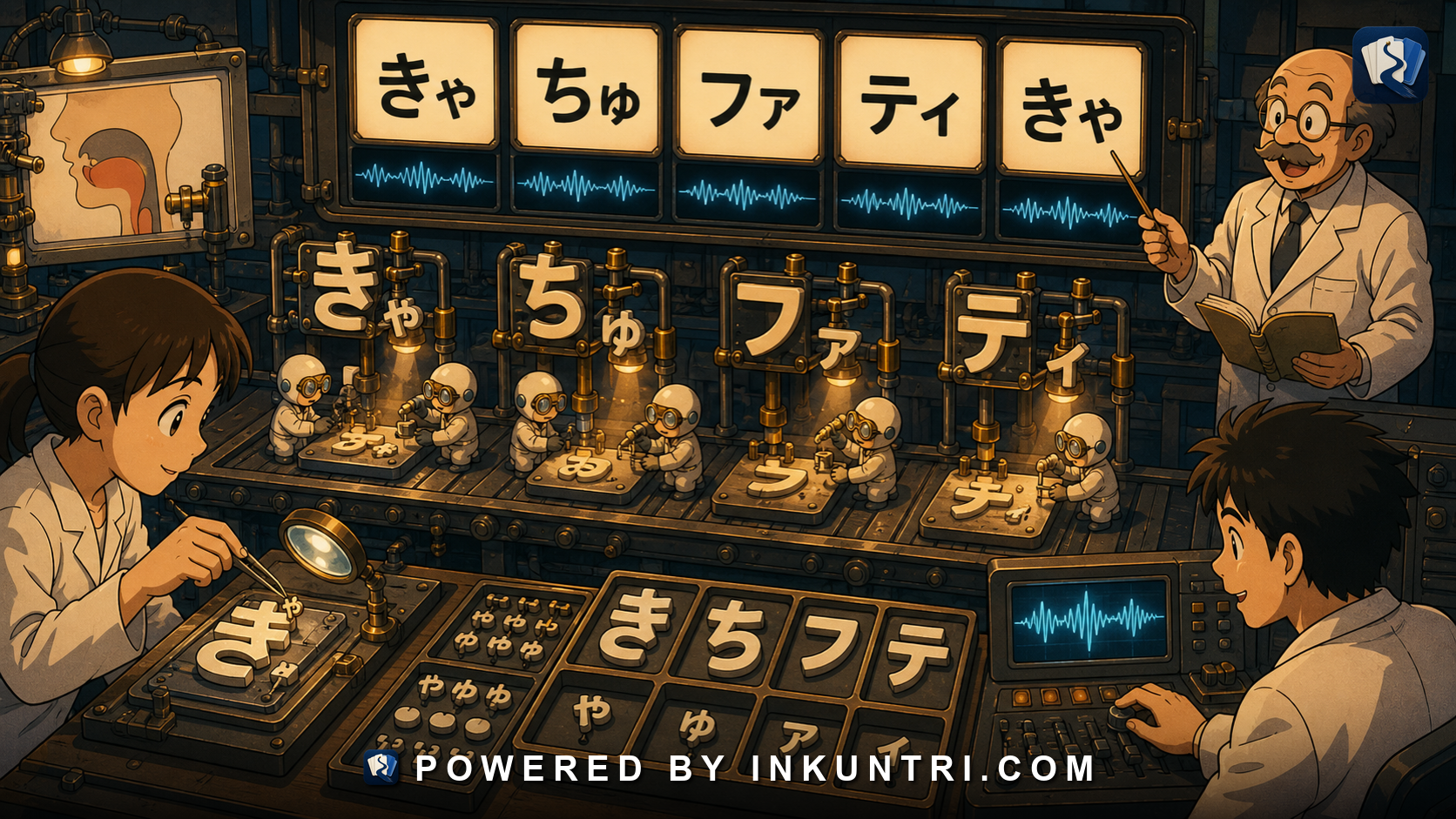
Core examples: きゃ, しゅ, ちょ, っ, ファ, ティ, デュ, ヴ, チェック, パーティー.
Small kana are small for a reason
Japanese kana come in normal-sized and small-sized forms. To a beginner, this can look like typography. It is not. A small kana can change the sound, the rhythm, and the word.
Compare:
きや ki-ya
きゃ kya
The second is not two full kana sounds. It is a contracted sound written with small ゃ.
Compare:
つて tsu-te
って geminate consonant before te
The small っ does not have its own ordinary vowel sound. It marks a pause or doubled consonant timing.
In katakana loanwords, small vowels allow Japanese to approximate sounds that older kana combinations did not represent neatly:
ファ ティ デュ チェ
The key principle:
Small kana are not decorative. They are sound-shape instructions.
A learner who ignores size will misread words.
Yōon: contracted sounds with small ゃ, ゅ, ょ
Yōon are contracted sounds written with an i-row kana plus small ゃ, ゅ, or ょ.
Examples:
きゃ kya
しゅ shu
ちょ cho
にゃ nya
りょ ryo
These are not pronounced as full sequences きや, しゆ, ちよ. They are contracted into one syllable-like unit, but in Japanese timing they count as one mora.
Compare:
きや き・や two morae
きゃ きゃ one mora
That timing difference matters in pronunciation, poetry, song lyrics, and listening.
Small っ: the sokuon
Small っ marks gemination, often called sokuon. It creates a brief closure or hold before the following consonant.
Examples:
きて come
きって stamp; cut, depending on context/kanji
さか slope
さっか writer
チェク? no チェック check
The small っ occupies a mora. It is not pronounced as “tsu” in these contexts. It is a timing hold before the next consonant.
Mora count:
きって き・っ・て three morae
A learner who ignores small っ will collapse words and sound unclear.
Full-size versus small-size changes meaning
Size matters.
Compare:
ちよ chi-yo
ちょ cho
Compare:
つや tsu-ya
っや unusual as a standard sequence, but small っ before consonants changes timing
Compare:
ファ fa
フア fu-a
In real typography, small kana may be subtle. On poor screens, low-resolution images, old fonts, or handwriting, the size difference can be hard to see. Learners must train the eye.
A good reading habit:
When a word looks strange, check whether a kana is small.
Katakana small vowels and foreign sounds
Katakana uses small vowels to represent sounds common in loanwords and foreign names.
Examples:
ファ fa
フィ fi
フェ fe
フォ fo
ティ ti
ディ di
デュ dyu/du-like adapted sound
チェ che
ジェ je
ウィ wi
ウェ we
These combinations help Japanese approximate foreign sounds while still fitting Japanese phonology. They are common in technology, fashion, food, names, music, sports, and brand language.
Examples:
ファイル file
パーティー party
チェック check
デュエット duet
フェリー ferry
A learner must pronounce these as Japanese words, not as English words. ファイル is not English “file” with English vowels and stress. It is a Japanese katakana word with mora timing.
ヴ and modern sound adaptation
The katakana ヴ is used to represent a v-like sound in some foreign words, although many speakers pronounce it close to バ行 depending on word, speaker, and context.
Examples:
ヴァイオリン violin
ヴィーナス Venus
ヴェネツィア Venezia/Venice
In many ordinary words, バ, ビ, ブ, ベ, ボ may be used instead, especially when the borrowing is older or conventional. The existence of ヴ does not mean every “v” from a foreign language will be represented that way.
Learner action: learn the conventional Japanese spelling of the loanword, not just the source-language spelling.
Small kana and typing
Typing small kana requires special input conventions.
With rōmaji input:
- kya → きゃ
- shu → しゅ
- cho → ちょ
- xtu or ltu → っ
- xya or lya → ゃ
- fa → ファ
- thi or ti depending on IME → ティ
- dhu or du depending on IME → デュ
Double consonants often produce small っ automatically:
kitte → きって chekku → チェック
Learners should learn both automatic and explicit small-kana input. If you cannot type small kana, you will avoid words or write them incorrectly.
Small kana and dictionary lookup
If you confuse small and full-size kana, dictionary lookup may fail or return the wrong word.
For example:
きゃく guest/customer
is not the same as:
きやく rare or different sequence depending on context
チェック check
is not:
チエック
Many digital dictionaries are forgiving, but not always. Paper dictionaries and exact search can be less forgiving.
When lookup fails, check:
- Did you type small ゃ/ゅ/ょ correctly?
- Did you include small っ?
- Did you confuse long mark ー with hyphen?
- Did you use full-width katakana?
- Did you enter the loanword with conventional Japanese spelling?
Small kana and mora count
Small kana combinations behave differently in mora timing.
Yōon like きゃ, しゅ, ちょ count as one mora.
Sokuon っ counts as one mora.
Long mark ー counts as one mora.
So:
きゃく きゃ・く two morae
チェック チェ・ッ・ク three morae
パーティー パ・ー・ティ・ー four morae
This is why small kana belongs in both writing and pronunciation study. It is not only visual.
Loanword adaptation: English knowledge can mislead
English speakers often see katakana and try to restore the English word. That helps with meaning sometimes, but it hurts pronunciation.
Example:
パーティー
The source is “party,” but the Japanese word has four morae:
パ・ー・ティ・ー
Do not pronounce it like English “party.” Pronounce the Japanese word.
Example:
チェック
The source is “check,” but the Japanese form is:
チェ・ッ・ク
The small ッ marks the held consonant timing.
Example:
ファイル
The source is “file,” but the Japanese form is:
ファ・イ・ル
The sound and rhythm are Japanese.
Example bank walkthrough
きゃ
Contracted sound from き + small ゃ. One mora.
Learner action: distinguish きゃ from きや.
しゅ
Contracted sound from し + small ゅ. Common in words like しゅくだい and loanwords.
Learner action: do not add an extra vowel between し and ゅ.
ちょ
Contracted sound from ち + small ょ. Appears in words like ちょっと.
Learner action: pronounce it as one timing unit.
っ
Small っ marks gemination or a held consonant. It counts as a mora.
Learner action: practice minimal pairs like きて/きって.
ファ
Katakana combination for fa-like sounds.
Learner action: recognize small ァ as modifying フ.
ティ
Katakana combination for ti-like sounds in loanwords.
Learner action: do not read it as テイ unless the word is actually written that way.
デュ
Katakana combination for dyu/du-like adapted sounds.
Learner action: learn conventional spellings by word.
ヴ
Used for v-like sounds in some loanwords and names, but not universally.
Learner action: expect variation between ヴ and バ行 conventions.
チェック
Loanword with small ェ and small ッ.
Learner action: count チェ・ッ・ク.
パーティー
Loanword with long marks and small ィ.
Learner action: count パ・ー・ティ・ー.
A small-kana reading routine
When you meet a kana word, especially in katakana, do this:
- Scan for small kana: ゃ, ゅ, ょ, っ, ァ, ィ, ゥ, ェ, ォ.
- Compare size: Is it full-size or small?
- Count morae: Contracted sounds count as one; っ and ー count as timing units.
- Check loanword conventions: Do not force English spelling.
- Listen to audio: Confirm rhythm and vowel length.
- Practice typing: Make sure you can input the form correctly.
- Look up exact spelling: Especially for names and technical terms.
A strong visual tool for this article would let users build kana clusters and hear them.
Suggested functions:
- Full vs small toggle: きや vs きゃ, フア vs ファ.
- Mora counter: Show timing blocks.
- Sokuon trainer: きて vs きって, さか vs さっか.
- Katakana loanword builder: ファ, フィ, ティ, デュ, チェ, ジェ.
- Typing mode: Show romaji inputs for small kana.
- Audio comparison: Slow and natural speed.
- Quiz mode: Identify whether a displayed kana is small or full-size.
Final rule
Small kana are small because they are doing work.
They contract sounds, mark consonant timing, adapt foreign sounds, shape loanwords, and control mora rhythm. Ignore them and you will misread, mistype, and mispronounce Japanese.
Train your eyes for size. Train your ears for timing. Train your hands to type them correctly.
Related reading
Why Japanese Mixed Script Is a Reading System, Not a Historical Accident
The reader can read Japanese mixed-script text as a designed system of roles rather than as a messy accumulation of scripts.
Kanji Component Analysis Without Fake Etymology
The reader can use kanji components for memory and lookup while avoiding made-up etymologies that teach false history.
Tracking Japanese Listening Progress With Real Audio
The reader can track Japanese listening progress using real audio, transcripts, comprehension targets, error categories, and repeated measurement.
Ainu Language in Japanese Cultural Memory and Policy
The reader can understand Ainu language as part of Japan’s linguistic landscape, cultural memory, and policy conversation.
Katakana Loans vs Chinese Transliterations of the Same Global Terms
The reader can compare how Japanese katakana loans and Chinese transliterations or semantic translations handle the same global terms.
Designing Japanese Anki Cards for Kanji, Vocabulary, Pitch, and Context
The reader can design Japanese Anki cards that train recognition, production, kanji, vocabulary, pitch accent, and context without creating bloated review debt.