
Shinjitai vs Kyūjitai: Japanese Character Reform in Practice
The reader can recognize shinjitai and kyūjitai pairs and understand Japanese character reform as its own system, not the same as Mainland simplification.
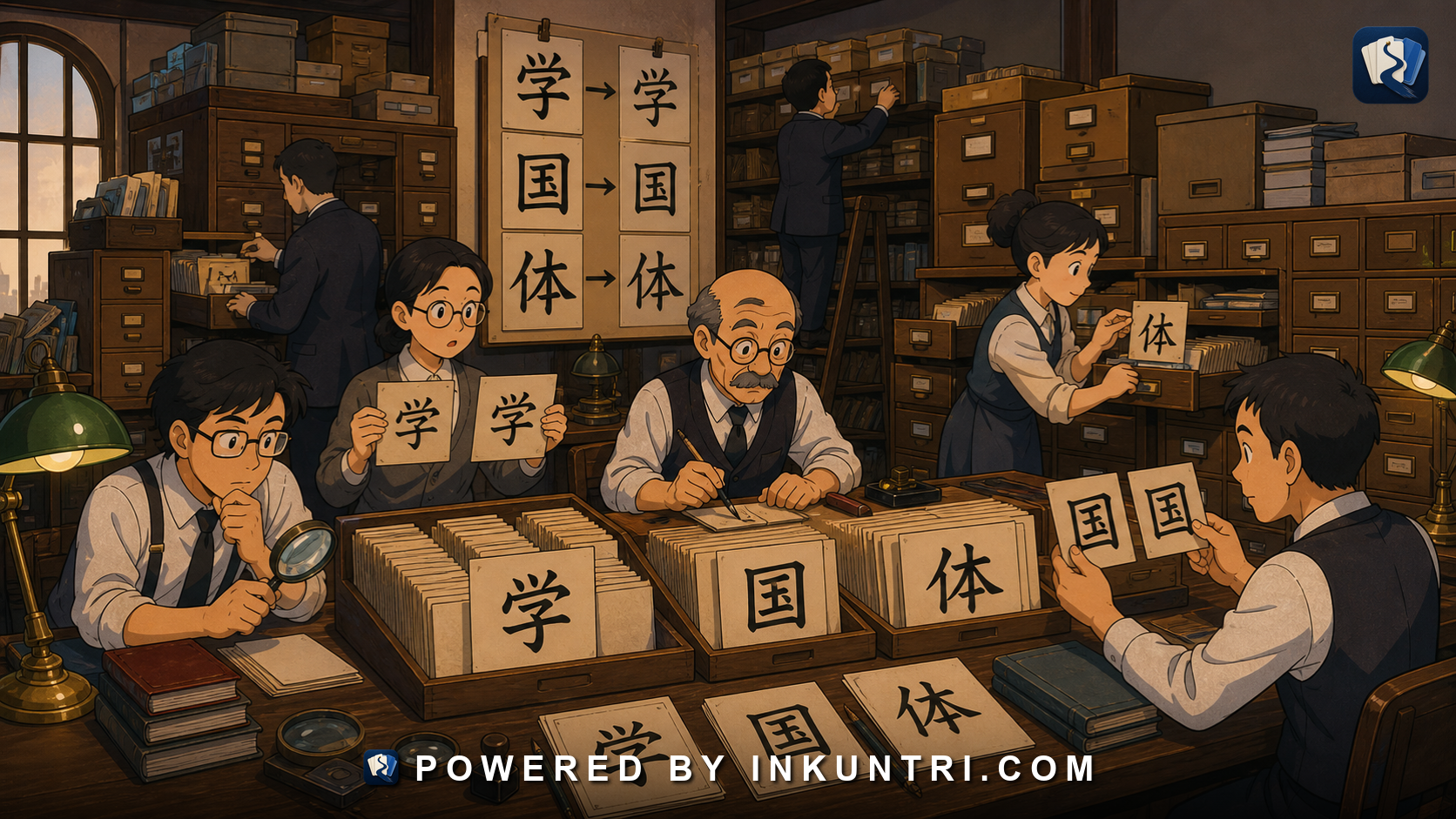
Core examples: 學→学, 體→体, 舊→旧, 國→国, 當→当, 龍/竜, 澤/沢, 齋藤/斎藤, 邊/辺, 廣/広.
Japanese simplification is not Chinese simplification
A learner who already knows Chinese often has a dangerous moment of confidence when looking at Japanese kanji.
Some forms look familiar. 学 looks like simplified Chinese 学. 国 looks like simplified Chinese 国. 体 looks like simplified Chinese 体. It is tempting to conclude that Japanese simply uses simplified Chinese characters, or that Japanese character reform is a smaller version of the same system.
That is wrong.
Japanese has its own postwar character reforms, its own common-use kanji standards, its own name-character rules, its own handwritten conventions, and its own mixture of reformed and unreformed forms. Some Japanese shinjitai forms overlap with simplified Chinese. Some do not. Some traditional-looking forms remain standard in Japanese. Some simplified Chinese forms are not Japanese standard forms. Some older forms survive in names, company names, temples, publications, legal records, and aesthetic contexts.
A better rule:
Shinjitai are modern Japanese character forms. Kyūjitai are older/traditional forms. Their relationship overlaps with Chinese simplification but is not governed by Chinese simplification.
If you read Japanese seriously, especially names, older books, signs, temples, family records, legal documents, and cross-CJK materials, you need to understand the difference.
What shinjitai and kyūjitai mean
Shinjitai means “new character forms.” In practice, it refers to the simplified or reformed kanji forms used in modern Japanese standards for many common characters.
Kyūjitai means “old character forms.” These are pre-reform or traditional-style forms associated with older printed Japanese, historical documents, and unreformed character shapes.
Examples:
| Kyūjitai | Shinjitai | Common reading / meaning |
|---|---|---|
| 學 | 学 | learning; school |
| 國 | 国 | country |
| 體 | 体 | body |
| 舊 | 旧 | old/former |
| 當 | 当 | hit; apply; this/that in compounds |
| 廣 | 広 | wide |
| 邊 | 辺 | area/edge |
| 澤 | 沢 | swamp; surname element |
| 龍 | 竜 | dragon, depending on word/name convention |
These are not just font variants. 學 and 学 are different character forms. In modern ordinary Japanese, 学 is the standard form for the common-use character. But 學 still appears in historical writing, proper names, institutions, old-style branding, and some aesthetic contexts.
Reform changed common-use writing, not the entire universe of kanji
One of the biggest beginner misconceptions is that character reform replaced every old form everywhere.
It did not.
Modern Japanese writing uses reformed forms for many common kanji, especially those included in official common-use standards. But Japanese still contains:
- old forms in names,
- variant forms in surnames,
- traditional forms in temples and shrines,
- old forms in prewar books and documents,
- company names that preserve older shapes,
- artistic and calligraphic forms,
- rare kanji outside common-use lists,
- characters whose forms were not simplified,
- characters whose printed and handwritten shapes differ subtly.
This means a modern reader may normally write 学校, but still encounter 學 in a university name, old book title, stone inscription, or historical document.
The reform changed the default for much ordinary modern writing. It did not erase the older forms from Japanese visual culture.
Shared forms with simplified Chinese
Some shinjitai forms are the same as simplified Chinese forms:
| Traditional / kyūjitai-like form | Japanese shinjitai | Simplified Chinese |
|---|---|---|
| 學 | 学 | 学 |
| 國 | 国 | 国 |
| 體 | 体 | 体 |
| 會 | 会 | 会 |
| 號 | 号 | 号 |
| 圖 | 図 | 图 is Simplified Chinese, not 図 |
The overlap is real. It is one reason Chinese-literate learners can sometimes transfer recognition into Japanese quickly.
But the last row already shows the danger. Japanese 図 corresponds to old 圖, while simplified Chinese uses 图. Japanese and Mainland Chinese did not apply the same reforms in the same way.
Another example:
| Meaning | Japanese | Simplified Chinese | Traditional Chinese |
|---|---|---|---|
| wide | 広 | 广 / 宽 depending on word | 廣 / 寬 |
| dragon | 竜 often, 龍 also used | 龙 | 龍 |
| area/edge | 辺 | 边 | 邊 |
| learning | 学 | 学 | 學 |
Knowing simplified Chinese helps, but it can also cause false recognition. The Japanese form may be neither the traditional Chinese form nor the simplified Chinese form you expect.
Forms that remain traditional-looking in Japanese
Japanese did not simplify every character that Mainland China simplified.
For example, many characters used in Japanese remain closer to traditional forms than to simplified Chinese forms.
| Meaning | Japanese standard form | Simplified Chinese | Traditional Chinese |
|---|---|---|---|
| electricity | 電 | 电 | 電 |
| car/vehicle | 車 | 车 | 車 |
| east | 東 | 东 | 東 |
| horse | 馬 | 马 | 馬 |
| bird | 鳥 | 鸟 | 鳥 |
| language/speech in compounds | 語 | 语 | 語 |
| buy | 買 | 买 | 買 |
This is why Japanese is not “written in simplified Chinese.” A sentence in Japanese may contain 学 and 国, which resemble simplified Chinese, but also 電車, 語, 馬, 鳥, and 買, which do not use Mainland simplified forms.
A Chinese-literate learner must learn Japanese forms as Japanese forms.
Japanese-specific simplification patterns
Some shinjitai forms have their own Japanese character.
Examples:
| Kyūjitai | Shinjitai | Note |
|---|---|---|
| 廣 | 広 | Japanese 広; simplified Chinese often uses 广 as a component/character in different contexts. |
| 邊 | 辺 | Japanese 辺 differs from simplified Chinese 边. |
| 澤 | 沢 | Japanese 沢 differs from simplified Chinese 泽. |
| 圖 | 図 | Japanese 図 differs from simplified Chinese 图. |
| 驛 | 駅 | Japanese 駅 differs from simplified Chinese 驿. |
| 櫻 | 桜 | Japanese 桜 differs from simplified Chinese 樱. |
These forms are essential for Japanese literacy. A learner coming from Chinese cannot simply apply a Chinese conversion table.
Kyūjitai in names
Names are the place where old and variant forms survive most visibly.
Surnames such as Saitō, Watanabe, Takasaki, and Sawada may appear with multiple character forms:
| Common modern form | Older/variant forms you may see |
|---|---|
| 斎藤 | 齋藤, 齊藤, 斉藤, 齋籐, and others |
| 渡辺 | 渡邊, 渡邉 |
| 高崎 | 髙崎, 高﨑, 髙﨑 |
| 沢田 | 澤田 |
| 広田 | 廣田 |
These are not just spelling trivia. They can be legal identity forms. A person whose name is written 齋藤 may not appreciate being casually rewritten as 斎藤 in a context where exact identity matters. On the other hand, many systems normalize or simplify forms due to input limitations, database restrictions, or style rules.
For learners and tool builders, the rule is clear:
Preserve the person’s chosen or official name form when identity matters.
A newspaper style guide, passport field, school roster, bank account, company registration, wedding invitation, and casual email may handle variants differently. Do not assume one normalized form is always acceptable.
Kyūjitai in institutions, temples, and branding
Old forms often survive because they look dignified, traditional, prestigious, or historically correct.
You may see kyūjitai or variant forms in:
- temple and shrine names,
- university mottos,
- old company names,
- ryokan and restaurant signs,
- calligraphy,
- certificates,
- family crests and genealogies,
- historical plaques,
- classical literature editions,
- product branding meant to feel traditional.
A shop that uses 醬油 instead of 醤油, or a sign that uses old forms in a name, is not necessarily making a literacy mistake. It may be preserving an older spelling, a brand identity, or an aesthetic register.
For readers, this means old forms are not confined to museums. They appear in the living visual environment.
Kyūjitai in older texts
If you read prewar Japanese materials, old novels, historical newspapers, imperial-era documents, family records, wartime materials, or old dictionaries, kyūjitai recognition becomes much more important.
A sentence that looks difficult may become easier once you map old forms to modern forms:
| Older form | Modern form |
|---|---|
| 學校 | 学校 |
| 國語 | 国語 |
| 舊制度 | 旧制度 |
| 體育 | 体育 |
| 廣告 | 広告 |
| 邊境 | 辺境 |
But older texts may also include historical kana usage, old vocabulary, different punctuation, vertical layout, and prewar grammar/register. Character form is only one layer of the problem.
Still, learning high-frequency kyūjitai pairs gives immediate leverage.
Character reform and okurigana are different issues
Do not confuse shinjitai/kyūjitai with okurigana.
Shinjitai vs kyūjitai concerns the form of the kanji itself:
學 → 学 國 → 国 體 → 体
Okurigana concerns kana endings attached to kanji stems:
書く 食べる 正しい 送り仮名
Both are orthographic issues, but they solve different problems. Character reform changes the shape of the kanji. Okurigana marks grammar and word identity.
A word can involve both issues in older writing. For example, an older document may use an older character form and an older or variant kana usage. Treat them separately when analyzing the text.
Shinjitai are standards, not casual abbreviations
Another misconception: shinjitai are informal shortcuts.
They are not. In modern ordinary Japanese, 学 is not a lazy version of 學. It is the standard form. 国 is not a careless 國. It is the standard modern Japanese form.
This matters for tone. If you write 學校 in an ordinary modern context, you are not being “more correct.” You are creating an old-style, formal, historical, or affected impression unless the context specifically calls for it.
Likewise, if you write 體 instead of 体 in ordinary modern prose, the reader may interpret it as archaic, stylized, Chinese-influenced, brand-like, or simply odd.
The old forms are not wrong. They are context-specific.
Cross-CJK comparison: a practical grid
For serious learners, one of the best tools is a four-column comparison:
| Meaning / word family | Japanese modern | Japanese old | Simplified Chinese | Traditional Chinese |
|---|---|---|---|---|
| learning | 学 | 學 | 学 | 學 |
| country | 国 | 國 | 国 | 國 |
| body | 体 | 體 | 体 | 體 |
| electricity | 電 | 電 | 电 | 電 |
| car | 車 | 車 | 车 | 車 |
| diagram | 図 | 圖 | 图 | 圖 |
| station | 駅 | 驛 | 驿 | 驛 |
| edge/area | 辺 | 邊 | 边 | 邊 |
| swamp/sawa | 沢 | 澤 | 泽 | 澤 |
| cherry blossom | 桜 | 櫻 | 樱 | 櫻 |
This table teaches humility. Sometimes Japanese aligns with simplified Chinese. Sometimes it aligns with traditional Chinese. Sometimes it uses a Japanese-specific form.
What learners should memorize first
Do not try to memorize every old form at once. That is a bad use of time unless your goal is historical texts, names, or specialist work.
Prioritize three groups.
1. High-frequency modern shinjitai
These are simply part of normal Japanese literacy:
学, 国, 体, 会, 当, 広, 辺, 図, 駅, 桜
Learn them as the default Japanese forms.
2. High-frequency old forms you will see in names and signs
These are worth recognition even if you do not write them actively:
學, 國, 體, 廣, 澤, 齋, 齊, 邊, 邉, 髙
Recognition is enough for many learners.
3. Cross-CJK traps
These matter if you know Chinese or compare Japanese with Chinese:
図 / 图 / 圖 駅 / 驿 / 驛 沢 / 泽 / 澤 桜 / 樱 / 櫻 広 / 广 / 廣
These prevent false assumptions.
Lookup workflow for old forms
When you encounter an unfamiliar old or variant form:
- Try OCR or handwriting input. Modern tools often recognize common kyūjitai and name variants.
- Search the whole word. Old forms usually appear in recognizable compounds.
- Compare components. 學 resembles 学 in structure; 澤 resembles 沢 by context and component relation.
- Check whether it is a name. If yes, preserve the form.
- Map to modern form only for understanding. Do not automatically rewrite the original.
- Record the pair if it recurs. High-frequency pairs are worth saving.
Example walkthroughs
學 → 学
學 is the old form. 学 is the modern Japanese standard form and also matches simplified Chinese. You may see 學 in old books, calligraphy, institution names, and historical contexts.
Learner action: write 学 in ordinary modern Japanese; recognize 學.
國 → 国
國 becomes 国 in modern Japanese, matching simplified Chinese. Traditional Chinese uses 國.
Learner action: remember 国 as standard Japanese; recognize 國 in old/traditional contexts.
體 → 体
體 becomes 体. Words like 体育 are written with 体 in modern Japanese.
Learner action: do not write 體育 unless intentionally using old style or quoting.
廣 → 広
廣 becomes 広 in Japanese. This is a Japanese form that does not simply equal simplified Chinese usage.
Learner action: recognize 廣 in surnames, signs, old forms, and formal names.
澤 → 沢
澤 becomes 沢. But 澤 remains common in names.
Learner action: treat 澤田 and 沢田 as different written name forms unless you know the person’s preferred/official spelling.
齋藤 / 斎藤 / 斉藤
Saitō is notorious because several forms circulate. Some are simplifications, some variants, some tied to system limitations, and some are official personal forms.
Learner action: never assume all Saitō spellings are interchangeable in identity-sensitive contexts.
If you are building a Japanese learning app, dictionary, OCR pipeline, flashcard importer, name database, or search tool, shinjitai/kyūjitai handling matters.
Bad behavior:
- silently normalizing all names,
- failing to search old forms,
- treating Japanese kanji as simplified Chinese,
- replacing Japanese forms with Chinese simplified forms,
- failing to display rare name variants,
- assuming every character maps one-to-one.
Better behavior:
- store original form,
- store normalized search form separately,
- allow variant-aware search,
- display warnings for names,
- distinguish Japanese shinjitai from simplified Chinese,
- preserve user-provided characters.
For Inkuntri-style tools, this is a major product-quality issue. Character literacy is not only pedagogy. It is data modeling.
A strong tool for this article would compare forms across Japanese and Chinese standards.
Suggested functions:
- Grid view: modern Japanese, kyūjitai, simplified Chinese, traditional Chinese.
- Name mode: show common surname variants such as 斎藤/齋藤/齊藤 and 渡辺/渡邊/渡邉.
- Context labels: modern prose, old text, name, temple/sign, brand, Chinese comparison.
- Search mode: enter an old form and find modern equivalents.
- Warning layer: “Do not automatically normalize this if it is a person’s name.”
- Flashcard export: high-frequency recognition pairs for learners.
Final rule
Shinjitai are not “Japanese simplified Chinese.” Kyūjitai are not “wrong old clutter.” They are part of the Japanese writing system’s history and present-day visual life.
For ordinary modern prose, learn and use shinjitai. For names, signs, old documents, temples, brands, and cross-CJK reading, learn to recognize kyūjitai and variants. And when identity matters, preserve the form you were given.
Japanese character reform is not just a table of old-to-new shapes. It is a practical literacy map.
These drafts are written as publication-ready educational articles rather than academic papers. The following references and standards were consulted for technical sanity checks and example validation:
- Japanese Agency for Cultural Affairs materials on national-language policy and Japanese orthographic standards, including the common-use kanji framework and okurigana guidance.
- Official and educational references around the Jōyō Kanji table and its relationship to modern Japanese character forms.
- Japanese text-layout and ruby/furigana conventions in modern print and digital typography.
- Japanese dictionary conventions for ateji, gikun, jukujikun, name readings, and variant character forms.
Related reading
National Language Policy and the Idea of Kokugo
The reader can understand kokugo as a national-language idea with educational, political, and cultural consequences.
Why Japanese Mixed Script Is a Reading System, Not a Historical Accident
The reader can read Japanese mixed-script text as a designed system of roles rather than as a messy accumulation of scripts.
Japanese Wedding Language: ご祝儀, 披露宴, 招待状, 内祝い
The reader can understand Japanese wedding language around gift money, receptions, invitations, return gifts, speeches, and formal register.
How Japanese Names Encode Era, Family, and Aesthetics
The reader can read Japanese names as historical, family, aesthetic, and generational signals rather than simple labels.
How to Build a Kanji Component Notebook That Respects Japanese Readings
The reader can build a kanji component notebook that uses radicals and components without pretending they determine Japanese meanings or readings mechanically.
Tracking Japanese Listening Progress With Real Audio
The reader can track Japanese listening progress using real audio, transcripts, comprehension targets, error categories, and repeated measurement.