
Kanji Compounds in Newspapers vs Everyday Writing
The reader can read Japanese news and institutional writing by recognizing why kanji compounds are denser there than in casual prose.
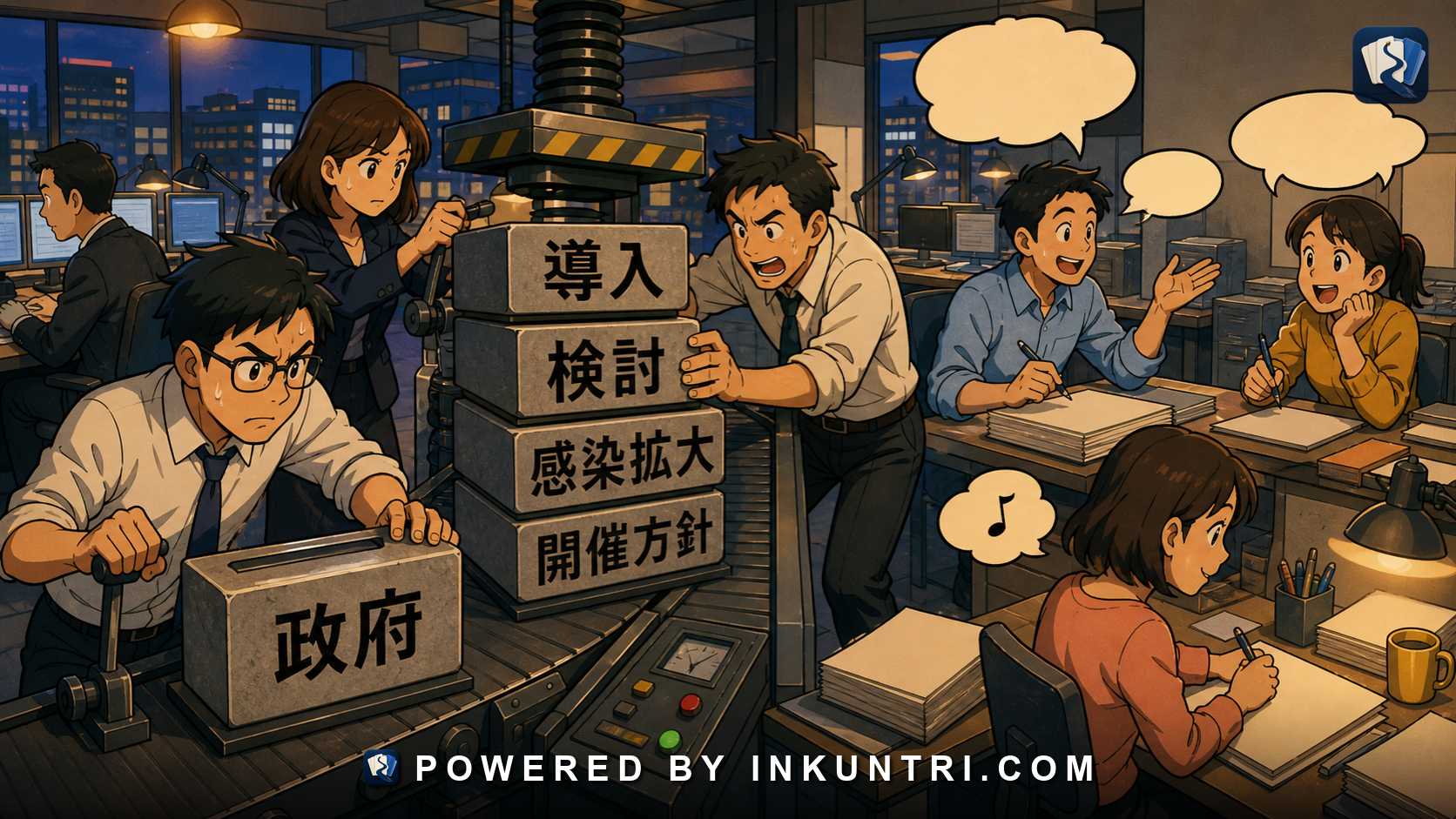
Core examples: 政府, 経済, 開催, 参加, 高齢化, 感染拡大, 方針, 検討, コンビニ.
Why news Japanese feels heavier than conversation
A learner who can handle textbook dialogues may open a Japanese news article and feel as if the language has turned into concrete.
The grammar is not always exotic. The sentences may even be shorter than literary prose. But the page is packed with kanji compounds:
政府は新制度の導入を検討している。 感染拡大を受け、イベントの開催方針を見直す。 高齢化に伴う地域経済への影響が懸念されている。
This is not how most people casually speak at lunch.
News Japanese is dense because it does specific work. It reports institutions, policies, events, numbers, decisions, trends, and causes quickly. Kanji compounds let writers compress information into compact noun phrases and institutional labels.
The beginner’s instinct is to translate each compound separately. That is necessary at first, but serious news reading requires a larger skill:
Learn to decompress kanji compounds into event structure.
A compound-heavy sentence is often not conceptually difficult. It is compressed.
Kango: Sino-Japanese compounds as information blocks
Many dense news terms are kango: Sino-Japanese vocabulary built from Chinese-derived readings and kanji compounds. Kango often feels formal, technical, institutional, or abstract compared with native Japanese equivalents.
Examples:
- 政府 — government
- 経済 — economy
- 方針 — policy/direction
- 検討 — consideration/examination
- 開催 — holding an event
- 参加 — participation
- 導入 — introduction/implementation
- 感染拡大 — spread of infection
- 高齢化 — aging of the population/society
- 影響 — impact/influence
- 懸念 — concern
These words are efficient. A headline can pack actor, event, and policy direction into a few characters.
But for learners, they create two problems:
- They look similar because many are two-character compounds.
- They often translate into English nouns while the Japanese sentence may be built around nominal style.
You need to learn not only what they mean but what they do in sentence structure.
Newspaper style loves nouns
Japanese news and official writing often use noun-heavy structures. Instead of saying everything through simple verbs, it builds phrases around nouns plus する, nouns plus を, nouns plus による, or nouns plus の.
Compare a casual paraphrase:
政府は新しい制度を入れるかどうか考えています。 The government is thinking about whether to introduce a new system.
News style:
政府は新制度の導入を検討している。 The government is considering the introduction of a new system.
The news version uses:
- 新制度 — new system/policy framework,
- 導入 — introduction/implementation,
- 検討 — consideration.
The information is the same basic event: the government is thinking about introducing a new system. But the news version compresses it into institutional nouns.
A learner should practice moving in both directions: news style to plain style, plain style to news style.
Headline compression is even stronger
Headlines push compression further. Particles may be omitted. Verbs may be reduced to nouns. Directional へ may signal movement toward a decision. Names and institutions are packed tightly.
Example-style headline:
政府、新制度導入へ
Expanded ordinary sentence:
政府は新しい制度を導入する方針です。 The government is moving toward introducing a new system.
The headline does not give every grammatical piece. It gives enough for a literate reader to infer the event.
This is why learners should not read headlines as if they were normal sentences. A headline is often a compressed index of the article’s event structure.
Compounds hide relationships
A dense compound may contain several relationships inside it.
Take:
感染拡大
This literally combines infection + expansion/spread. In English, it may become “spread of infection” or “rising infections.” The relationship between the two parts is not marked by a particle inside the compound. You infer it.
Take:
地域経済
Region + economy = regional economy/local economy.
Take:
高齢化対策
Aging + countermeasures = measures to address population aging.
Take:
観光客増加
Tourist + increase = increase in tourists.
Japanese compounds often leave you to infer whether the relationship is:
- X of Y,
- X for Y,
- X caused by Y,
- X concerning Y,
- X performed by Y,
- X affecting Y,
- X used for Y,
- X located in Y.
Fluent readers do this quickly. Learners must slow it down.
The decompression method
When a sentence feels too dense, use a four-step method.
Step 1: Identify the main predicate
Find the sentence engine: 検討している, 発表した, 開催する, 見直す, 増加した, 影響が出ている.
Step 2: Identify the institutional actor
Who is doing or reporting something? 政府, 市, 会社, 警察, 気象庁, 厚生労働省, 大学, コンビニ大手.
Step 3: Break compound nouns into event pieces
For 新制度導入, ask:
- What? 新制度 — new system.
- What action? 導入 — introduction/implementation.
- Who? 政府.
- What stance? 検討 — considering.
Step 4: Paraphrase in plain Japanese
政府は、新しい制度を入れるかどうか考えている。
Once you can paraphrase it plainly, the compound stops being a wall.
Everyday writing uses more verbs, kana, and context
Everyday conversation and casual writing often use simpler verbs, more hiragana, more context, and fewer institutional compounds.
News style:
イベントの開催方針を見直す。
Everyday style:
イベントをやるかどうか、もう一度考え直す。
News style:
感染拡大の影響で参加者が減少した。
Everyday style:
感染が広がった影響で、参加する人が減った。
News style:
地域経済への影響が懸念される。
Everyday style:
地元の経済に悪い影響が出るのではないかと心配されている。
The news version is not “better Japanese.” It is better for a particular job: compact formal reporting.
Why learners should not avoid kanji compounds
It is tempting to hate kanji compounds because they slow reading. That would be a mistake.
Kanji compounds are one of the main engines of adult Japanese literacy. They are essential for:
- news,
- politics,
- economics,
- public notices,
- academic writing,
- company documents,
- law,
- medicine,
- technology,
- bureaucratic forms,
- formal speeches.
If you avoid them, you remain trapped in conversational Japanese. Conversation matters, but serious reading requires compound literacy.
The key is to study compounds as families and event patterns, not as isolated two-character flashcards.
Compound families give leverage
Characters recur across news vocabulary.
政
- 政府 — government
- 政策 — policy
- 政治 — politics
- 行政 — administration
- 財政 — public finance
経
- 経済 — economy
- 経営 — management
- 経験 — experience
- 経路 — route
- 経由 — via
感
- 感染 — infection
- 感情 — emotion
- 感覚 — sensation
- 実感 — real feeling
- 共感 — empathy
化
- 高齢化 — aging
- 少子化 — declining birthrate
- 国際化 — internationalization
- デジタル化 — digitization
- 温暖化 — warming
The suffix 化 is especially important because it turns many nouns/adjectives into “-ization,” “becoming X,” or “making X.” Recognizing 化 helps you parse long news terms quickly.
コンビニ: katakana inside news density
News Japanese is not all kanji. Katakana words appear constantly, especially in business, technology, consumer life, foreign names, product categories, and modern institutions.
コンビニ is a good example. It is casual and everyday, but it appears in serious news:
コンビニ大手が新サービスを導入する。 A major convenience-store operator will introduce a new service.
Here, コンビニ is not informal just because it is katakana. It is the normal word. 大手 is a business-news term meaning major company/operator. 新サービス mixes kanji and katakana. 導入する is formal/business-style.
Modern news Japanese is a mixed-script compression system, not a pure kanji system.
Example bank walkthrough
政府
政府 is an institutional actor. In news, it often appears as the subject of 発表する, 検討する, 決定する, 方針を示す.
Learner action: when you see 政府, expect policy verbs and institutional statements.
経済
経済 is a domain noun. It appears in compounds such as 経済成長, 経済対策, 地域経済, 世界経済.
Learner action: learn common pairings, not just “economy.”
開催
開催 means holding an event. It often appears with event nouns: 会議を開催する, イベント開催, 開催予定.
Learner action: connect it to event structure: organizer, event, date, place.
参加
参加 means participation. It can be a noun or する-verb: 参加する, 参加者, 参加費, 参加予定.
Learner action: learn derivative forms around the core event.
高齢化
高齢化 means aging, especially demographic aging. It is a noun built with 化.
Learner action: treat 化 as a powerful suffix for social trends.
感染拡大
感染拡大 compresses “the spread of infection.” It often appears in public health and event-policy contexts.
Learner action: unpack it as an event: infections spread; policy responds.
方針
方針 means policy, direction, course of action. It often appears with 示す, 決める, 見直す.
Learner action: expect institutional stance.
検討
検討 means consideration/examination. In news, it can mean an institution is considering something, not that it has decided.
Learner action: do not over-translate it as action completed. It often signals pre-decision status.
コンビニ
コンビニ is katakana but completely ordinary. In news, it may be part of business reporting.
Learner action: do not assume katakana equals casual or foreign-only.
A news-reading workflow
When reading a news sentence, mark:
- Actor: government, company, police, agency, group.
- Event noun: introduction, increase, arrest, announcement, cancellation.
- Policy/status word: 方針, 検討, 決定, 発表, 見直し.
- Cause/context: 感染拡大, 円安, 台風, 高齢化.
- Affected domain: 経済, 交通, 教育, 医療, 観光.
- Plain paraphrase: rewrite it as if explaining to a friend.
This makes dense prose manageable.
A strong tool for this article would show the same event in three forms:
- Headline: 政府、新制度導入へ
- News lead: 政府は新制度の導入を検討している。
- Plain paraphrase: 政府は新しい制度を入れるかどうか考えている。
Suggested functions:
- highlight compounds,
- split compounds into morphemes,
- show event roles,
- provide plain Japanese paraphrase,
- compare translation choices,
- let learners rebuild a news sentence from a plain version.
Final rule
Kanji compounds in news are not there to torture learners. They are there because institutional writing needs compression.
Do not read every compound as a separate mountain. Find the actor, find the event, find the policy status, then decompress the sentence into plain Japanese.
News Japanese becomes readable when kanji density stops looking like decoration and starts looking like architecture.
Related reading
How Kango Creates Formal, Technical, and Institutional Japanese
The reader can see kango as the backbone of formal, technical, legal, bureaucratic, and institutional Japanese.
Bungo, Kōgo, and the Modernization of Japanese Prose
The reader can understand bungo and kōgo as competing prose norms whose modernization shaped the Japanese people read today.
Japanese Internet Slang: Abbreviation, Kana Play, and Persona
The reader can understand Japanese internet slang as abbreviation, kana play, persona performance, and platform-specific writing.
Kango in Japanese and Sino-Korean Vocabulary Compared
The reader can compare Japanese kango and Sino-Korean vocabulary as parallel systems built from Chinese-character roots but shaped by different languages.
Economic Japanese: 景気, 物価, 賃金, 投資, 消費
The reader can follow economic Japanese by separating macro indicators, household conditions, corporate activity, and policy language.
False Friends Between Japanese and Mandarin in Everyday Kanji Words
The reader can recognize false friends between Japanese and Mandarin in everyday character words before they cause practical misunderstandings.