
Jōyō Kanji as Policy, Not a Complete Map of Literacy
The reader can treat the Jōyō Kanji list as an educational and administrative standard, not as the boundary of real Japanese literacy.
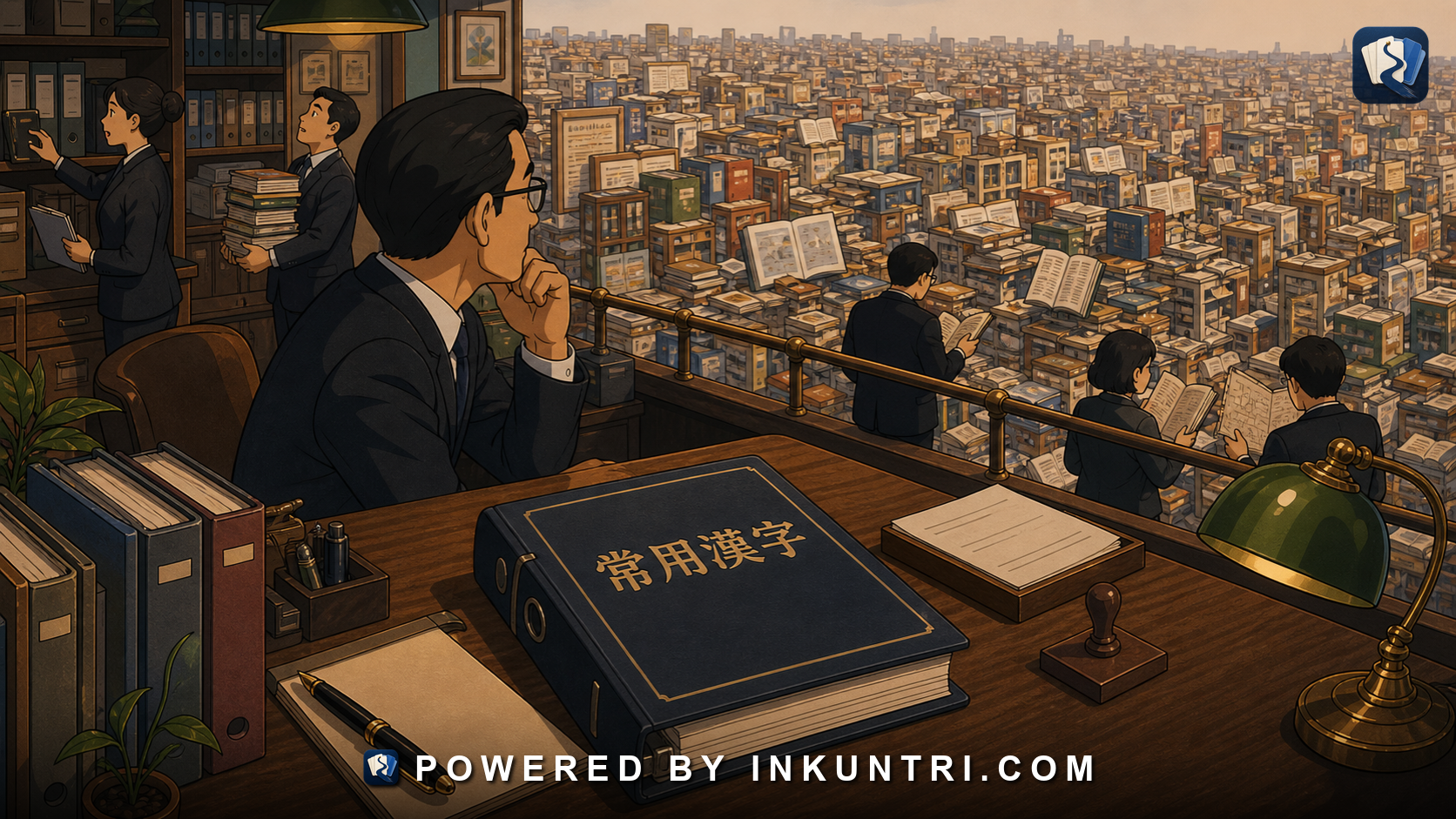
Core examples: 常用漢字, 表外字, 新聞, 学年別漢字, 交ぜ書き, 改定, 読み替え.
The useful list that becomes dangerous when misunderstood
The Jōyō Kanji list is one of the most important reference points in modern Japanese literacy. It shapes schooling, public documents, newspapers, tests, textbooks, style guides, and the learner’s sense of what “standard” written Japanese looks like.
It is also one of the easiest standards to misunderstand.
A learner hears “Jōyō Kanji” and often translates it mentally as “the kanji Japanese people know” or “the complete list of kanji needed for literacy.” That is not quite right. The Jōyō list is not a map of every character a literate adult may encounter. It is not a frequency list. It is not a promise that every important word will fit comfortably inside it. It is not a wall separating normal Japanese from exotic Japanese.
A better definition is this:
Jōyō Kanji are a public literacy standard: a policy list of characters and readings that ordinary written Japanese can generally assume, especially in education and official communication.
That sounds less romantic, but it is much more useful. It tells you what the list is for: shared readability. It does not tell you that everything outside the list is useless, rare, or forbidden.
The distinction matters because serious learners quickly meet words that do not behave like the textbook list. Newspapers use kana substitution. Novels use characters outside the standard. Names require special characters and special readings. Technical domains use specialized kanji. Historical writing uses older forms. Manga and games use furigana to force nonstandard readings. Public signs sometimes avoid rare characters, while temples, restaurants, surnames, product names, and place names preserve them.
The Jōyō list is real. It is useful. But it is a floor, a policy, and a planning tool—not the whole building.
What Jōyō Kanji actually are
常用漢字 literally means “regular-use Chinese characters” or “common-use kanji.” In modern Japanese policy, the list specifies characters considered suitable for general written communication in society. It is used as a standard for education, administration, and publishing practice.
The current list contains 2,136 characters. That number is famous among learners, partly because it feels like a finish line. But the number is only meaningful if you understand what is being counted.
The Jōyō list includes:
- characters,
- official readings associated with those characters,
- examples of usage,
- notes about public writing and readability,
- a relationship to school-grade learning through the educational kanji sequence.
It is not just a pile of symbols. It is a literacy-management system.
A Japanese schoolchild does not learn “the 2,136” all at once. Children first learn the kyōiku kanji—the educational kanji assigned across elementary school grades—and then continue into the larger Jōyō set. Adult readers build far beyond school lists through domain exposure: novels, news, work documents, contracts, medical forms, hobbies, names, and digital life.
This is why “knowing the Jōyō Kanji” can mean different things. A person may recognize a character but not know every reading. A learner may know the keyword meaning but not the compounds. A native reader may know the character in common words but be unsure of a rare reading. A writer may know a character but avoid it because the audience may not.
The list is not just about knowledge. It is about expected public usability.
Policy is not the same as reality
A policy list has to make boundaries. Reality does not.
Japanese uses kanji in at least four overlapping worlds:
- General public writing — newspapers, official documents, school materials, general books.
- Names — family names, given names, place names, company names, historical names.
- Specialized domains — medicine, law, religion, botany, literature, academic writing, technical terminology.
- Style and culture — novels, manga, games, calligraphy, menus, branding, older texts.
The Jōyō list is strongest in the first world. It is less complete in the other three.
For example, a public notice may avoid a rare kanji or add furigana so that more readers can understand it. A newspaper may write a difficult character in kana or use a different word. A school textbook may control kanji according to grade level. These are not signs that Japanese “does not use” the character. They are signs that the text is managing readability.
By contrast, a novel may use an outside character because it fits the tone. A shrine may preserve old forms. A surname may contain a character that is not productive in ordinary vocabulary. A medical document may use kanji that belong to a technical register. A restaurant may choose a traditional-looking spelling for flavor, prestige, or brand identity.
Learners should stop asking, “Is this character allowed?” and start asking, “What kind of text am I reading, and what literacy expectation does it assume?”
The false comfort of a fixed finish line
The Jōyō list is attractive because it gives learners a number. Language learning rarely offers clean numbers, so 2,136 feels like a mountain with a summit. Climb it and you are done.
That is not how reading works.
A learner can memorize 2,136 character meanings and still struggle to read a news article because news writing depends on compounds, abbreviations, nominal style, names, institutions, and topic knowledge. A learner can pass kanji quizzes and still fail to recognize inflected words because kana endings carry grammar. A learner can know a character’s common reading and still misread it in a name.
Conversely, a learner can read real materials well before mastering every Jōyō character if the domain is narrow. Someone reading cooking blogs needs a different high-frequency set from someone reading politics, manga, railway notices, or immigration forms.
Literacy is not “list completed.” Literacy is “can read the texts that matter for the task.”
The Jōyō list should be used for orientation, not as a religion.
Jōyō readings and the hidden second problem
The list is not only about which characters are included. It is also about which readings are considered standard for general use.
This is a subtle but important point. A character may be on the list, but a specific reading or word may fall outside the standard reading set. Japanese kanji are not merely characters with one pronunciation. They are attached to networks of on-readings, kun-readings, compounds, historical forms, and name readings.
For learners, this means “I know the character” is not enough.
Take a common character like 生. It appears in many words and readings: 生きる, 生まれる, 学生, 先生, 生じる, 生ビール, 生地, and many more. Some readings are central and common. Others are specialized, lexicalized, or name-related.
A policy list must draw lines somewhere. Real usage keeps going.
This is why furigana, dictionaries, and word-level learning remain essential even for characters that are “inside” the standard. A kanji list does not replace vocabulary. It organizes part of the writing system.
表外字: outside the table does not mean outside Japanese
表外字 means characters outside the official table/list. The term can sound like a warning label: outside, nonstandard, beyond the normal system.
But “outside the table” is not the same as “never used.”
You may encounter outside characters in names, place names, literary writing, historical texts, religious vocabulary, specialized writing, food terminology, manga, games, and stylized signage.
A serious learner should not panic when meeting 表外字. The correct response is not, “I failed because this is outside the list.” The correct response is, “This text assumes something beyond general public literacy, or it is using a form for style, identity, precision, or tradition.”
A useful analogy: English has words beyond basic vocabulary lists. Finding “habeas corpus,” “myocardial,” or “quixotic” does not mean the English alphabet failed. It means the domain changed.
交ぜ書き: when policy reshapes the look of words
One of the most visible effects of kanji policy is mixed writing inside words, often called 交ぜ書き. This happens when part of a word is written in kanji and part in kana, especially because a character is outside the standard, too difficult, or avoided for readability.
The result can look strange to learners who expect words to be written in their full kanji form.
A word that historically or technically has multiple kanji may appear with some kana substitution in general writing. This is not random sloppiness. It is often a readability compromise.
The pattern matters because Japanese writing does not simply ask, “What is the etymological kanji spelling?” It also asks:
- Will ordinary readers know this character?
- Is the full spelling too heavy?
- Is this public writing?
- Is this school-grade appropriate?
- Is kana clearer?
- Is the kanji form traditional, technical, literary, or intimidating?
- Does the style guide prefer one form?
For learners, 交ぜ書き is evidence that Japanese orthography is managed for readers, not just for historical purity.
Newspapers: Jōyō pressure in real time
Newspapers are one of the best places to see the practical effects of kanji standards. News writing wants to be dense, fast, and widely readable. It favors compact Sino-Japanese compounds, but it also has to respect readership norms.
That creates a tension. News wants kanji density because kanji compactly carries institutional and event information. But too many difficult or outside characters can slow readers down or violate house style.
So newspapers use several strategies:
- prefer Jōyō characters when possible,
- use kana for difficult or outside forms,
- add readings or explanations for names,
- use standard official terms,
- rely on widely known compounds,
- compress headlines but clarify in article leads.
A learner reading news should not treat every kana substitution as beginner writing. It may be a professional style choice.
This also explains why news literacy is not simply kanji literacy. You need to learn headline compression, institutional vocabulary, person and place names, abbreviations, passive reporting style, numbers, dates, and quotation patterns.
Jōyō knowledge helps. It does not do the whole job.
Names break the Jōyō mental model
Names are where the Jōyō-based learner often crashes.
A character can be common in names but less common in ordinary vocabulary. A familiar character can have a name reading that the learner would never guess. A legal name can preserve a variant form. A family name may reflect older regional or historical usage. A given name may use creative reading conventions.
This is not a failure of the Jōyō list. It is a reminder that names belong to a different literacy system. Japanese name literacy requires Jinmeiyō Kanji, nanori readings, family-name patterns, variant forms, and social caution.
A learner who tries to read names by Jōyō readings alone will make confident mistakes. The socially competent habit is simple: use furigana when available, confirm politely when needed, and avoid guessing aloud in important situations.
Why learners should still study the list
After all these warnings, it may sound like the Jōyō list is less important than advertised. That would be the wrong conclusion.
The list is extremely useful.
It gives learners a shared core. It aligns with school and publishing realities. It helps prioritize recognition. It provides a framework for kanji learning materials. It reduces the ocean of possible characters to a manageable public standard. It helps explain why some materials write a word one way and other materials write it another way.
The mistake is not studying Jōyō Kanji. The mistake is believing they are the whole of literacy.
Use the list for long-term planning, identifying common public-use characters, understanding school-grade sequence, comparing readings, choosing what to handwrite, recognizing why some texts add furigana, and understanding official or newspaper style.
Do not use the list to dismiss names, ignore outside characters, assume frequency, avoid word-level learning, treat every included character as equally urgent, or treat every excluded character as rare or unimportant.
A better kanji planning model
Instead of one giant checklist, divide kanji study into layers.
Layer 1: High-frequency survival kanji
These are characters you need constantly: numbers, days, directions, common verbs, public signs, school-level basics, common nouns, and core compounds.
Examples: 日, 月, 年, 人, 大, 小, 中, 上, 下, 行, 来, 見, 食, 飲, 駅, 店, 学, 生.
Learn these deeply. Know common words, readings, handwriting basics, and signs.
Layer 2: Jōyō core for adult public literacy
This is the broader standard layer. It includes characters needed for newspapers, official documents, essays, public notices, and general books.
Here, recognition may come before active handwriting. You need word families and compounds more than isolated keyword meanings.
Layer 3: Domain-specific kanji
These depend on your goals. A learner reading politics needs different words from a learner reading manga, medicine, literature, cooking, Buddhism, law, or railway documentation.
Do not let a generic list override your actual reading life.
Layer 4: Names and variants
Treat name literacy separately. Build habits around furigana, name dictionaries, official spellings, and confirmation. Do not assume normal vocabulary readings.
Layer 5: Historical, literary, and stylistic forms
These are important for serious cultural literacy but should be staged according to need. Kyūjitai, ateji, classical vocabulary, and specialized literary spellings belong here.
Example walkthroughs
常用漢字
This term itself is a good lesson. 常用 means regular or common use; 漢字 means kanji. It sounds like a natural category, but in policy terms it refers to an official list. Do not confuse the ordinary meaning of “common use” with the formal function of the list.
Learner action: treat 常用漢字 as a standard, not a claim that all other kanji are irrelevant.
表外字
表外字 are outside-table characters. They may be rare, specialized, literary, name-related, or simply outside the official general-use standard.
Learner action: when you meet one, ask what domain you are in before deciding whether to memorize it.
新聞
Newspapers are shaped by kanji policy but not limited to beginner simplicity. They combine standard characters with dense compounds, names, abbreviations, and institutional style.
Learner action: do not assume newspaper difficulty is only kanji difficulty. Study headline grammar and news vocabulary.
学年別漢字
Grade-level kanji ordering is built for Japanese children in school, not necessarily for adult foreign learners. It is still useful because it reflects educational progression and public literacy assumptions.
Learner action: borrow the structure, but do not become a slave to it. Adult learners can prioritize by domain and frequency.
交ぜ書き
Mixed writing inside words often reflects readability policy or style choices. It can look inelegant to some readers and helpful to others.
Learner action: notice when kana substitution is doing public-readability work.
改定
The list has been revised. That matters because standards are historical decisions, not eternal facts. A character can move into or out of official treatment over time.
Learner action: treat standards as living policy artifacts.
読み替え
A character’s reading can shift by word, context, or convention. Official readings are important but do not cover every name, technical term, or historical reading.
Learner action: learn readings through words, not just through character charts.
A strong tool for this article would avoid presenting the Jōyō list as a flat wall of 2,136 boxes. It should show layers.
Suggested functions:
- Grade view: Show educational sequence by school grade.
- Frequency overlay: Mark high-frequency characters versus lower-frequency Jōyō characters.
- Reading view: Show common readings and words for each character.
- Outside-list examples: Show common or culturally important 表外字 by domain.
- Name warning layer: Mark characters/readings that behave differently in names.
- Text-mode scanner: Paste a sentence and classify characters as learned grade, Jōyō, outside-list, name, or unknown.
- Study-plan export: Generate a learner plan based on domain: travel, news, manga, business, literature, or forms.
Final rule
The Jōyō list is a public literacy standard, not the border of Japanese.
Use it. Respect it. Learn from it. But do not let it flatten the language.
If a character is inside the list, you still need words, readings, contexts, and style. If a character is outside the list, you still need to ask whether it matters for names, domains, literature, history, or your own reading goals.
Japanese literacy is not one checklist. The Jōyō list is one powerful layer in a larger system.
Related reading
Why Japanese Mixed Script Is a Reading System, Not a Historical Accident
The reader can read Japanese mixed-script text as a designed system of roles rather than as a messy accumulation of scripts.
Japanese Wedding Language: ご祝儀, 披露宴, 招待状, 内祝い
The reader can understand Japanese wedding language around gift money, receptions, invitations, return gifts, speeches, and formal register.
How to Build a Kanji Component Notebook That Respects Japanese Readings
The reader can build a kanji component notebook that uses radicals and components without pretending they determine Japanese meanings or readings mechanically.
Tracking Japanese Listening Progress With Real Audio
The reader can track Japanese listening progress using real audio, transcripts, comprehension targets, error categories, and repeated measurement.
Chinese Classics in Japanese Education and Quotation
The reader can recognize Chinese-classics quotations and allusions in Japanese education, journalism, speeches, and public writing.
Japanese Bureaucratic Vocabulary: 実施, 対応, 検討, 周知, 徹底
The reader can unpack high-frequency bureaucratic Japanese and understand the institutional actions hidden behind neutral-sounding vocabulary.