
How Manga Uses Script Choice to Signal Voice
The reader can analyze how manga uses script choice to signal age, class, species, accent, emotion, artificiality, or character persona.
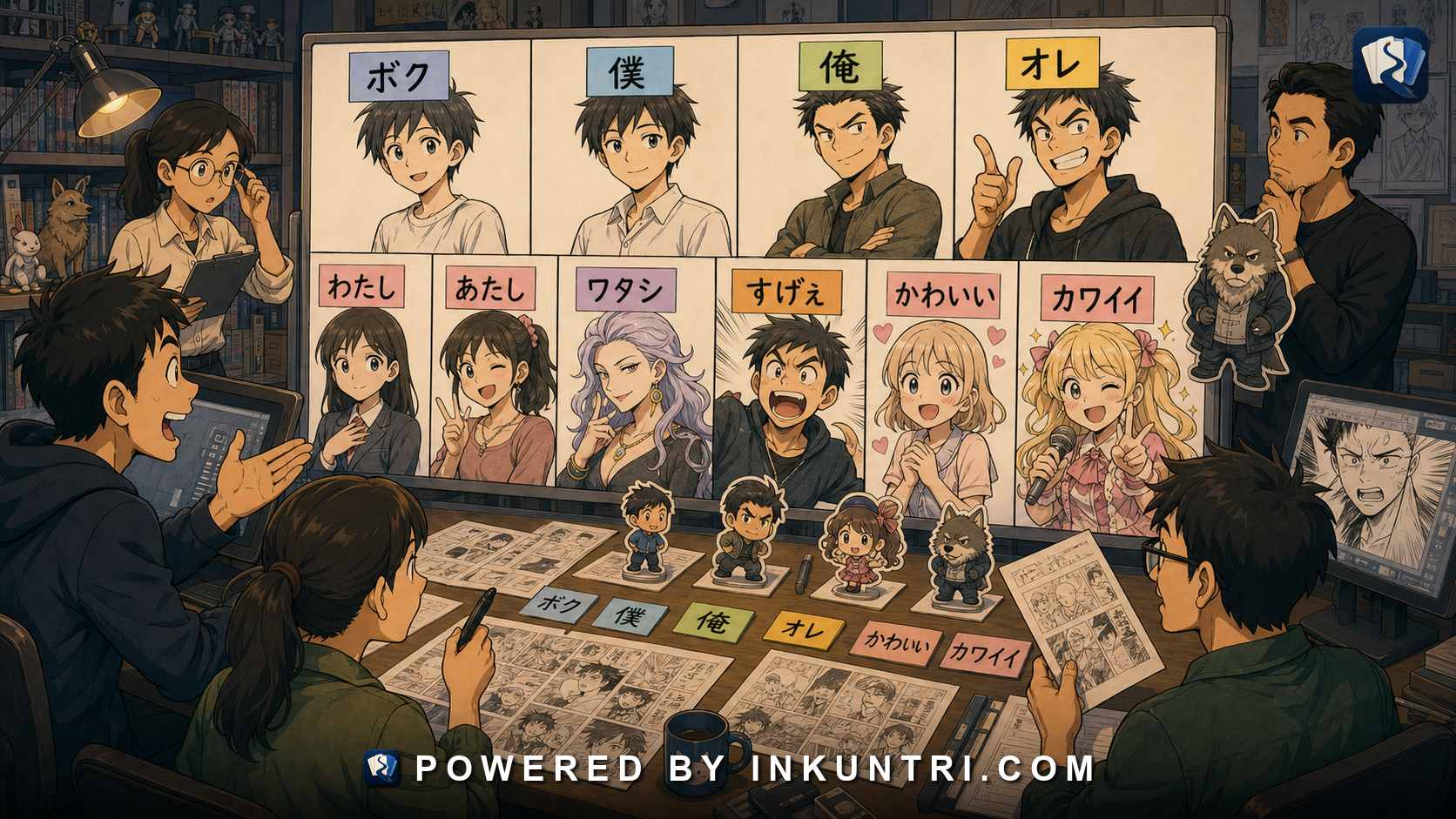
Core examples: ボク, 僕, 俺, オレ, わたし, あたし, ワタシ, すげぇ, かわいい/カワイイ.
The word is not always the whole message
In manga, a simple word can change personality depending on how it is written.
Take a first-person pronoun:
僕 ボク ぼく
All three can point to “I,” often associated with male or boyish speech depending on character and context. But they do not feel the same.
僕 is the ordinary kanji form. ボク may feel stylized, youthful, artificial, mascot-like, robotic, dramatic, or manga-coded. ぼく can feel softer, younger, or more innocent. The dictionary meaning overlaps, but the voice changes.
This is one of manga’s great literacy lessons: Japanese script choice is not just orthography. It is performance.
A manga panel has limited space. The writer and artist must convey age, attitude, class, species, emotional state, and relationship quickly. Japanese mixed script gives them tools: kanji for weight, hiragana for softness, katakana for markedness, furigana for double meaning, nonstandard kana for accent, and typography for volume or mood.
The key principle is:
In manga, script choice often tells you how a line is spoken before you translate what it means.
A learner who reads only the dictionary meaning misses half the scene.
Why manga is not “easy Japanese with pictures”
Manga can be easier than prose because pictures provide context. But it can also be harder because dialogue is compressed, stylized, emotional, genre-specific, and visually coded.
Manga may use:
- nonstandard spelling,
- regional dialect,
- character-specific pronouns,
- rough contractions,
- sentence-final particles,
- katakana for voice distortion,
- hiragana for childishness,
- furigana jokes,
- fantasy readings,
- sound effects integrated into art,
- handwritten or stylized lettering,
- punctuation as timing,
- incomplete sentences.
A textbook teaches standard sentences. Manga teaches written performance.
The learner’s task is not only “What does this sentence mean?” It is also “What kind of person says it this way?”
Pronouns as character design
Japanese first-person pronouns are rich signals in manga.
Examples:
私 わたし ワタシ 僕 ボク 俺 オレ あたし わし
Each carries possible associations, though none should be treated as a rigid real-world rule.
私 can feel neutral, formal, adult, or standard depending on context. わたし can feel softer, more personal, or less formal. ワタシ may feel foreign, artificial, robotic, comic, or emphasized. 僕 can feel polite-boyish, gentle, or ordinary male speech. ボク may stylize that identity. 俺 can sound rougher, masculine, intimate, or casual. オレ may heighten the roughness or manga voice. あたし often signals feminine casual speech in many media contexts. わし may signal old-man speech, professor-like persona, or regional/media archetype.
These are not just vocabulary entries. They are casting decisions.
A translator who renders all of them as “I” may convey the literal reference but lose the social texture. A learner should notice the original form even when English cannot carry it easily.
Katakana as marked voice
Katakana in manga frequently marks more than loanwords. It can signal:
- emphasis,
- foreignness,
- robotic speech,
- alien or monster voice,
- childish stylization,
- roughness,
- comic exaggeration,
- unnaturalness,
- emotional intensity,
- brand-like or pop-cultural tone.
Compare:
かわいい 可愛い カワイイ
In manga dialogue, カワイイ can feel louder, more self-conscious, more pop, more comic, or more exaggerated than かわいい. It may signal the speaker’s persona or the scene’s tone.
Compare:
俺 オレ
オレ can make the voice visually rougher or more stylized, especially in dramatic dialogue. It is not automatically a different word, but it can be a different performance.
Hiragana as softness, youth, or looseness
Hiragana can signal softness, childishness, intimacy, or emotional openness. A child character may use more hiragana. A gentle character may be written with softer forms. A character’s uncertain or vulnerable moment may shift toward kana.
Compare:
私は大丈夫です。 わたしはだいじょうぶ。
The second looks softer and less formal, even before considering grammar. In manga, such choices can support character age, mood, or genre.
But do not overgeneralize. Hiragana is also normal grammar infrastructure. Not every hiragana word is cute. The effect depends on what could have been written in kanji but was not.
Kanji as maturity, seriousness, and density
Kanji can give dialogue weight. A character who uses more kanji may appear older, educated, formal, serious, cold, or narratively grounded. A villain, scholar, official, or narrator may be given denser kanji-heavy speech.
Compare:
そんなこと、知らない。 そんな事、知らない。
The difference is small, but 事 adds a little visual weight. In heavier examples, the effect becomes stronger.
In fantasy or historical manga, kanji can also create archaic or dramatic atmosphere. Technical kanji can signal expertise. Dense compounds can make a character sound bureaucratic, military, academic, or pompous.
Nonstandard kana: accent, casualness, and sound
Manga often writes speech as it sounds, not as standard textbook spelling.
Examples:
すごい すげぇ
している してる
じゃない じゃねぇ
わからない わかんない
These spellings are not random errors. They represent casual contraction, rough speech, dialect flavor, emotional intensity, or character style.
A learner should learn to expand them:
- すげぇ → すごい
- してる → している
- じゃねぇ → じゃない
- わかんない → わからない
But after expanding, do not erase the effect. The rough form is part of the line.
Furigana as double voice
Manga uses furigana in powerful ways. Sometimes ruby gives the ordinary reading of difficult kanji. But manga also uses furigana to create double meaning.
For example, a kanji word may carry one meaning visually while the furigana gives a different spoken word. A fantasy term may be written with grand kanji and read as an invented English-like or katakana term. A character may say one thing while the kanji reveals the deeper concept.
This creates two layers:
- the written semantic layer,
- the spoken reading layer.
A learner should ask:
Is the furigana giving pronunciation, or is it creating an alternate reading?
If it is an alternate reading, the line cannot be understood by looking only at the base kanji.
Species, robots, monsters, and nonhuman voices
Manga often uses script choice to distinguish nonhuman speech.
A robot may speak in katakana. An alien may use stiff grammar and katakana pronouns. A monster may use rough katakana or distorted kana. A magical creature may use archaic pronouns or unusual kanji. A mascot may use childish hiragana and repeated sound effects.
This is not how every robot or alien “really” speaks. It is a visual convention.
Example-style contrast:
わたしはここにいます。 ワタシハ ココニ イマス。
The second immediately feels mechanical or unnatural because the script and spacing violate ordinary prose expectations.
Translation problem: English cannot carry all script signals
English translation often has to choose other tools: diction, contractions, typography, accent, punctuation, slang, or pronoun substitutions. But English cannot directly reproduce the kanji/hiragana/katakana contrast.
That means learners have an advantage when they read the original: they can see voice signals that translation may flatten.
A serious manga reader should keep a script-note habit:
- pronoun form,
- script choice,
- contractions,
- sentence-final particles,
- furigana effects,
- sound effects,
- typography.
This turns manga into a sophisticated language lab.
Example bank walkthrough
ボク / 僕
僕 is standard kanji. ボク is marked, stylized, youthful, artificial, or manga-coded depending on context.
Learner action: record both meaning and persona effect.
俺 / オレ
俺 is rough/casual masculine first-person speech. オレ can heighten the visual roughness or stylization.
Learner action: do not translate both blindly as “I” without noting voice.
わたし / ワタシ
わたし can feel soft or ordinary. ワタシ can feel foreign, robotic, emphatic, or comic.
Learner action: check speaker identity and genre.
あたし
Often feminine casual/media-coded speech.
Learner action: treat it as character voice, not just a pronoun variant.
すげぇ
Rough/casual form related to すごい.
Learner action: expand for grammar, preserve roughness for interpretation.
かわいい / カワイイ
The katakana version can be pop, emphatic, stylized, or self-conscious.
Learner action: ask why the writer avoided ordinary hiragana/kanji.
Manga dialogue annotation routine
When reading a manga line, annotate:
- Literal meaning: What does the sentence say?
- Pronoun choice: 私, 僕, 俺, あたし, わし, etc.
- Script choice: Kanji, hiragana, katakana, mixed?
- Spelling: Standard or contracted?
- Particles: よ, ね, ぞ, ぜ, わ, な, か?
- Furigana: Standard reading or alternate meaning?
- Typography: Bold, large, shaky, handwritten, silent?
- Character effect: Age, status, emotion, species, attitude?
A strong tool for this article would let users switch the script of a speech bubble and see how the voice changes.
Suggested functions:
- Pronoun switcher: 僕/ボク/ぼく, 俺/オレ, 私/ワタシ.
- Adjective style: かわいい/可愛い/カワイイ.
- Contraction expander: すげぇ → すごい, してる → している.
- Furigana layer: Standard reading vs dramatic alternate reading.
- Persona labels: childish, rough, robotic, formal, soft, comic.
- Translation challenge: Show what English loses.
- Panel mode: Place text in a bubble with typography changes.
Final rule
Manga uses Japanese writing as acting.
Do not read only the dictionary meaning. Read the script choice. A word in kanji, hiragana, or katakana may carry different age, tone, species, intensity, or persona.
In manga, the writing system is part of the character design.
Related reading
Tracking Japanese Listening Progress With Real Audio
The reader can track Japanese listening progress using real audio, transcripts, comprehension targets, error categories, and repeated measurement.
When CJK Comparison Helps Learners and When It Becomes Noise
The reader can decide when CJK comparison accelerates Japanese learning and when it creates noise, overconfidence, or bad habits.
The Real Function of Kana in Advanced Japanese
The reader can see kana as advanced grammar infrastructure, not just an introductory phonetic alphabet.
From Flashcards to Literacy: When Japanese Study Must Leave the Card
The reader can recognize when flashcards have stopped helping and transition toward reading, listening, domain literacy, writing, and real-context review.
Building a Tri-Language Kanji/Hanzi/Hanja Cognate Map
The reader can build a practical tri-language Kanji/Hanzi/Hanja cognate map for vocabulary learning and cross-language reading.
Modern Japanese Through Korean Eyes: What Cognates Reveal
The reader can use Korean-Japanese cognates to discover patterns in modern Japanese without flattening the two languages into the same system.