
The Real Function of Kana in Advanced Japanese
The reader can see kana as advanced grammar infrastructure, not just an introductory phonetic alphabet.
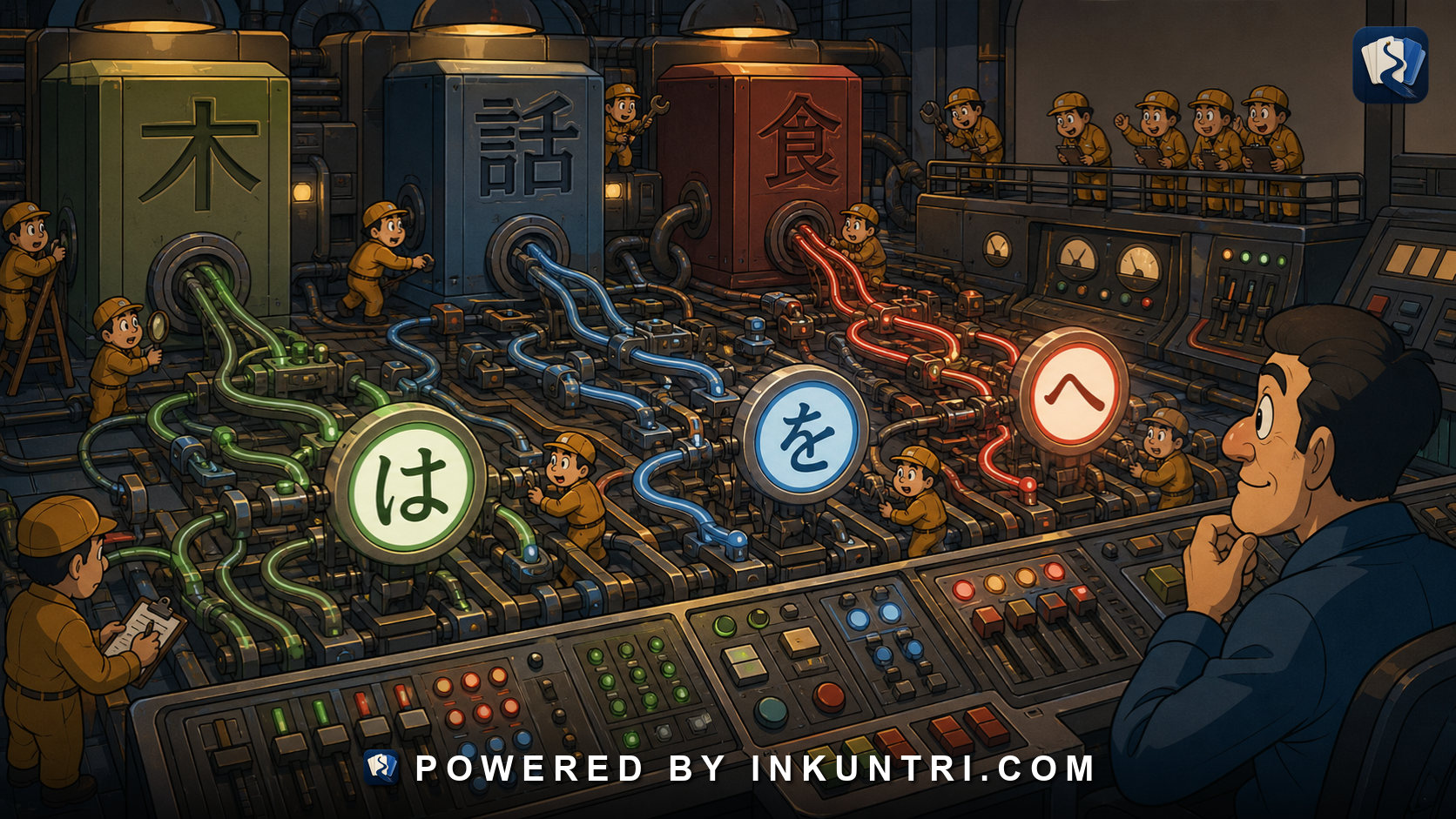
Core examples: は, を, へ, ない, たい, て, られる, そう, です, ます, から.
The beginner lesson that becomes a long-term blind spot
Most learners meet hiragana and katakana at the beginning of Japanese study. The usual message is simple: learn kana first, then move on to kanji.
That advice is necessary. It is also dangerous if learners internalize the wrong hierarchy.
Kana are often introduced as the “easy” part of Japanese writing: phonetic, small, finite, memorized in a week or two if you are determined. Kanji, by contrast, become the serious mountain. Because kanji are numerous, visually complex, and tied to meaning, learners start treating them as the real writing system. Kana become the training wheels.
That is backwards for advanced reading.
Kanji carry much of the lexical weight of Japanese. They tell you that a word is about school, government, weather, money, law, illness, motion, emotion, or time. But kana often tell you how the sentence works. They mark particles, inflection, auxiliaries, politeness, negation, desire, passive, causative, condition, quotation, topic flow, and clause connection.
In other words:
Kanji often tell you what the sentence is about. Kana often tell you what the sentence is doing.
A learner who stares only at kanji may know the dictionary meanings of the major nouns and verbs but still misread the sentence. The small kana between and after the kanji are not filler. They are the machinery.
Kana are not one thing
When people say “kana,” they usually mean hiragana and katakana together. But in real Japanese literacy, kana have several different jobs.
Hiragana commonly handles:
- particles,
- verb and adjective endings,
- auxiliary verbs,
- okurigana,
- native grammatical words,
- soft or accessible spelling choices,
- children’s and learner materials,
- words whose kanji are rare, heavy, or stylistically avoided.
Katakana commonly handles:
- loanwords,
- foreign names,
- scientific and species names,
- sound effects,
- emphasis,
- branding,
- machine-like or foreign-sounding voice,
- slang or stylized spelling.
This article focuses mainly on hiragana as grammar infrastructure, but the larger point applies to kana as a whole: kana are not merely “sound writing.” They are part of how Japanese organizes meaning, voice, structure, and style.
Particles: the smallest high-value words in the sentence
Particles are usually written in hiragana, and they are among the most important parts of Japanese grammar. A sentence can change dramatically when one small kana changes.
Consider:
- は
- が
- を
- に
- で
- へ
- と
- から
- まで
- より
- も
- の
A beginner may call these “little words.” That is fair visually. It is not fair grammatically.
In English, word order does much of the work. In Japanese, particles mark relationships around the predicate. They tell you topic, subject-like focus, object, destination, location, means, companion, source, limit, comparison, possession, and more.
Compare:
駅に行く。 Go to the station.
駅で会う。 Meet at the station.
駅を出る。 Leave the station.
駅へ向かう。 Head toward the station.
The kanji 駅 is the same. The kana after it changes the event architecture.
A kanji-focused learner sees “station” and “go/meet/leave/head.” A grammar-aware reader sees the particle and knows the station’s role in the event.
は, を, and へ: kana that do not sound like they look
Japanese particles also remind us that kana are not always a simple pronunciation guide. The particles は, を, and へ are written historically but pronounced differently in particle use:
- は as topic particle is pronounced wa.
- を as object marker is usually pronounced o.
- へ as direction particle is pronounced e.
This is not an advanced historical curiosity. It is daily Japanese.
私は学生です。 わたしは is pronounced watashi wa.
本を読む。 を is pronounced o.
東京へ行く。 へ is pronounced e.
The writing preserves grammatical identity. The pronunciation follows particle convention.
For learners, this is an early sign that kana are not just phonetic notation. They are part of an orthographic grammar system.
Okurigana: kana endings as morphology
Okurigana are kana endings attached to kanji stems:
- 食べる
- 書く
- 読む
- 正しい
- 正す
- 開く
- 開ける
These kana endings tell you grammar. They distinguish verb classes, adjective forms, transitive/intransitive contrasts, inflectional behavior, and sometimes meanings.
Take 正しい and 正す.
Both contain 正. But 正しい is an i-adjective meaning correct, right, proper. 正す is a verb meaning to correct or set right.
The kana ending is not decoration. It is the category label.
Take 開く and 開ける.
Depending on context and reading, 開く may mean to open, be open, or hold/open an event. 開ける often means to open something. The kana endings help signal verb type, reading, and transitivity pattern.
If you remove okurigana, you create ambiguity. If a learner ignores okurigana, the learner throws away one of the best clues Japanese gives.
Inflection lives in kana
Japanese verbs and adjectives inflect heavily through kana endings and auxiliary attachments.
The difference between these forms is not in the kanji 食:
- 食べる
- 食べます
- 食べた
- 食べない
- 食べたい
- 食べられる
- 食べさせる
- 食べている
- 食べてもいい
- 食べなければならない
The lexical base is stable. The grammatical life of the word unfolds through kana.
A learner who sees only 食 and thinks “eat” has barely begun reading. The real question is: eaten? eating? wants to eat? can eat? is made to eat? must eat? should not eat? may eat? did not eat? is being eaten? has been eating?
Kana answer those questions.
ない: negation is visible grammar
The kana form ない is one of the most common and important grammatical pieces in Japanese.
It appears in plain negative forms:
- 行かない — do not go
- 食べない — do not eat
- 分からない — do not understand
It appears in adjective negation:
- 高くない — not expensive / not high
- 新しくない — not new
It also participates in larger patterns:
- しなければならない — must do
- 行かなくてもいい — do not have to go
- 食べないでください — please do not eat
The kana are doing serious logical work. They mark negation, condition, permission, obligation, and request structure.
Learner mistake: looking up the kanji and skipping the negative tail.
If you read 行 as “go” but miss かない, you may reverse the sentence.
たい: desire attached to verbs
The form たい attaches to verb stems and expresses desire:
- 食べたい — want to eat
- 行きたい — want to go
- 見たい — want to see
- 勉強したい — want to study
The kanji or verb root gives the action. The kana gives the speaker’s stance toward the action.
This matters because Japanese desire grammar is not always a direct match for English “want.” It interacts with person restrictions, politeness, observation, and reported desire. But at the reading level, the key point is basic: たい changes the sentence from an action claim to a desire claim.
京都に行く。 I go / will go to Kyoto.
京都に行きたい。 I want to go to Kyoto.
One kana sequence changes the whole predicate.
て: the connector that runs Japanese prose
The て-form is one of the great engines of Japanese grammar. It connects actions, attaches auxiliaries, creates requests, marks ongoing states, gives reasons, permits, prohibits, and sequences events.
Examples:
- 読んでください — please read
- 食べている — eating / has eaten and is in that state, depending on verb
- 持っていく — take along
- 書いてある — is written / has been written and remains
- 見てもいい — may look
- 行ってから — after going
- 雨が降って、試合が中止になった — it rained, and the game was canceled
The form is short. Its reach is enormous.
A kanji-focused reader sees 読, 食, 持, 書, 見, 行, 雨, 降, 試合, 中止. A sentence reader watches the kana connections.
られる: possibility, passive, honorific, and ambiguity
The kana sequence られる is a good example of why advanced learners cannot treat kana as background noise.
Depending on verb and context, forms ending in られる may express:
- potential: 食べられる — can eat / edible
- passive: 食べられる — is eaten
- honorific: 先生が来られる — the teacher comes, respectfully
- spontaneous or natural occurrence with certain verbs: 思われる — it seems / is thought
The same surface form can do different work. You need context, verb type, particles, and sentence structure.
The kana sequence does not solve everything by itself, but it signals that you are in a grammatical zone where voice, possibility, respect, or perspective may be at stake.
Ignoring it is not an option.
そう: appearance, hearsay, and grammar traps
そう is another small kana form with large consequences.
It can express appearance:
雨が降りそう。 It looks like it will rain.
It can express hearsay:
雨が降るそうだ。 I hear it will rain.
It can be part of other structures and fixed expressions. The difference between 降りそう and 降るそうだ is not a detail. It changes the evidence source. One is based on appearance or prediction; the other reports information heard from elsewhere.
Kana-heavy grammar often encodes stance: how the speaker knows, feels, infers, softens, reports, or commits.
です and ます: politeness as visible form
です and ます are often introduced as polite endings. That is true, but too small.
They are part of how Japanese manages relationship, genre, and sentence style. They turn a bare predicate into a polite addressee-oriented form:
- 学生だ → 学生です
- 行く → 行きます
- 食べる → 食べます
- 高い → 高いです
A learner who treats desu/masu as “formal decoration” misses how deeply Japanese writing and speech manage social distance. Politeness is grammar, not garnish.
In written materials, the choice between plain form, desu/masu form, and da/dearu style tells you genre. A blog, essay, news article, children’s book, manual, email, and manga dialogue may choose different styles. Kana endings are where much of that style becomes visible.
から: cause, source, sequence, and range
から can mark cause:
雨だから行きません。 Because it is raining, I will not go.
It can mark source or starting point:
東京から来ました。 I came from Tokyo.
It can mark sequence with てから:
食べてから行きます。 I will go after eating.
The form is small, but the function depends on grammar and context. Kana forms like から, ので, まで, より, ても, のに, and ながら build the logical skeleton of Japanese prose.
Kana-first reading: the advanced habit
Beginners often attack a sentence by hunting kanji meanings. Advanced readers do something different: they notice the kana architecture early.
Try this sentence:
先生に言われたことを忘れないように、ノートに書いておきました。
A kanji hunt gives:
- 先生 — teacher
- 言 — say
- 忘 — forget
- ノート — notebook
- 書 — write
That is useful but incomplete.
Kana and grammar reveal the structure:
- 先生に — by/from the teacher
- 言われた — was told / was said to me
- ことを — the thing that...
- 忘れないように — so as not to forget
- ノートに — in a notebook
- 書いておきました — wrote down in preparation / wrote and kept
The sentence means something like:
I wrote down what the teacher told me in my notebook so I would not forget it.
The kanji supplied content. Kana supplied the relationships.
Kana are also style
Kana choices can soften, simplify, emphasize, or change the feel of a word.
A word that could be written in kanji may appear in hiragana because the writer wants a softer or more accessible tone. Children’s materials use more kana. Public notices may avoid difficult kanji. Advertisements may choose hiragana for warmth. Novels may use kana to reflect a character’s voice.
For example:
- ありがとう is normally written in hiragana.
- ください is often written in kana in requests.
- かわいい may feel softer than 可愛い in many contexts.
- こども and 子ども and 子供 can carry different institutional or stylistic preferences.
Kana are not only a pronunciation tool. They help regulate tone.
Practical learner routine: the kana pass
When reading a difficult sentence, do a kana pass before translating.
Step 1: Mark particles
Find は, が, を, に, で, へ, と, の, から, まで, より, も.
Ask: what role does each phrase play?
Step 2: Mark endings
Look for verb and adjective endings: ない, た, て, ます, たい, られる, させる, そう, よう, ば, なら.
Ask: what grammar is attached to the predicate?
Step 3: Mark auxiliaries
Notice patterns like ている, てある, ておく, てしまう, てもいい, なければならない.
Ask: is this ongoing action, result state, preparation, regret/completion, permission, or obligation?
Step 4: Mark clause boundaries
Use て, が, から, ので, と, ば, たら, のに, ながら, けれども to identify how clauses connect.
Step 5: Only then translate
Do not translate the kanji pile first and repair grammar later. Read the grammar spine as you go.
Example bank walkthrough
は
Topic marker, contrast marker, and one of the most important discourse tools in Japanese. Written は, pronounced wa as a particle.
Learner action: ask what topic or contrast the writer is establishing.
を
Object marker, usually pronounced o. It marks the affected object of many verbs and appears in path expressions like 公園を歩く.
Learner action: do not skip it because it is small. It often tells you what the verb acts on.
へ
Direction marker, pronounced e as a particle. It often marks direction or orientation rather than arrival point.
Learner action: compare with に when reading movement sentences.
ない
Plain negative and part of many larger negative patterns.
Learner action: check whether it negates a verb, adjective, noun predicate, or larger expression.
たい
Desire form attached to verb stems.
Learner action: identify whose desire is being expressed and whether the grammar marks direct desire, observed desire, or reported desire.
て
Connection form with many functions.
Learner action: ask whether it sequences, attaches an auxiliary, gives a reason, makes a request, or creates a larger construction.
られる
Potential, passive, honorific, or spontaneous depending on context.
Learner action: use particles and verb meaning to disambiguate.
そう
Appearance or hearsay depending on form and context.
Learner action: identify evidence source before translating as “seems.”
です / ます
Polite forms that manage addressee relationship and genre.
Learner action: treat them as part of style and social grammar.
から
Cause, source, starting point, or sequence component.
Learner action: identify whether it links reasons, locations, times, or actions.
A strong tool for this article would show learners a real sentence and color the kana by function.
Suggested functions:
- Particle layer: Highlight topic, object, location, direction, companion, source, and possessive particles.
- Inflection layer: Mark tense, negation, politeness, desire, passive, potential, causative, and conditional endings.
- Auxiliary layer: Identify ている, てある, ておく, てしまう, なければならない, and similar structures.
- Clause layer: Show how から, ので, が, と, て, ば, たら, and のに connect clauses.
- Kanji fade mode: Temporarily fade kanji so learners see the grammatical skeleton.
- Translation reveal: Show how missing one kana changes the translation.
Final rule
Kana are not beginner scaffolding. They are Japanese grammar made visible.
Kanji may carry the heavy nouns and verb stems, but kana control the sentence: particles, endings, auxiliaries, politeness, negation, desire, voice, condition, and clause connection.
If you want to read advanced Japanese, stop treating kana as the easy part you already finished. Read them as the operating system.
Related reading
Tracking Japanese Listening Progress With Real Audio
The reader can track Japanese listening progress using real audio, transcripts, comprehension targets, error categories, and repeated measurement.
When CJK Comparison Helps Learners and When It Becomes Noise
The reader can decide when CJK comparison accelerates Japanese learning and when it creates noise, overconfidence, or bad habits.
From Flashcards to Literacy: When Japanese Study Must Leave the Card
The reader can recognize when flashcards have stopped helping and transition toward reading, listening, domain literacy, writing, and real-context review.
Building a Tri-Language Kanji/Hanzi/Hanja Cognate Map
The reader can build a practical tri-language Kanji/Hanzi/Hanja cognate map for vocabulary learning and cross-language reading.
Modern Japanese Through Korean Eyes: What Cognates Reveal
The reader can use Korean-Japanese cognates to discover patterns in modern Japanese without flattening the two languages into the same system.
Light-Verb する Compounds in Japanese Technical Prose
The reader can recognize する compounds as a major engine of formal, technical, bureaucratic, and academic Japanese.