
How Japanese Dictionaries Sort Kana and Kanji
The reader can use Japanese dictionaries more intelligently by understanding kana order, kanji indexing, inflected forms, and reading-based lookup.
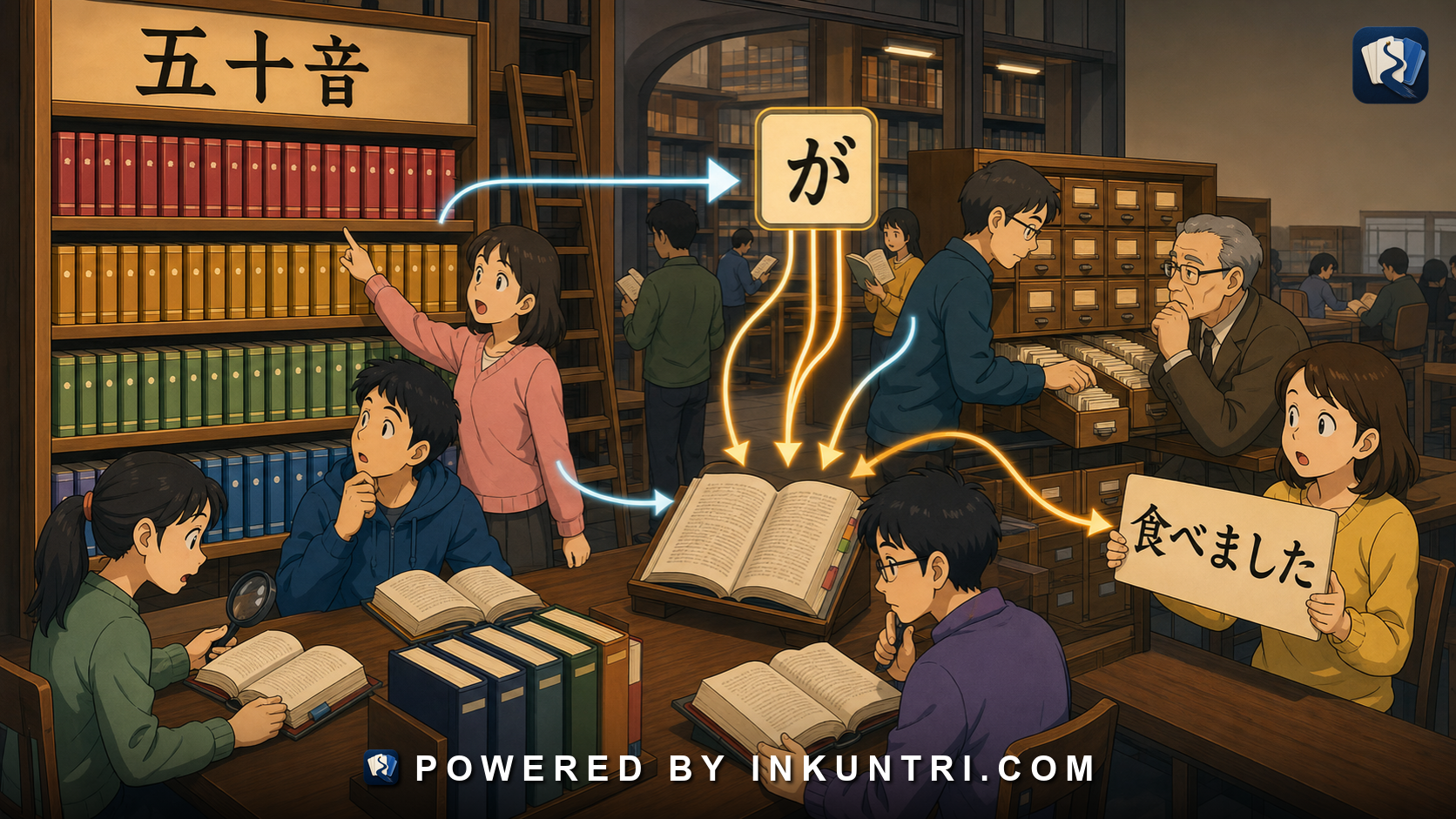
Core examples: 五十音, 部首, 音読み/訓読み, 送り仮名, 食べました→食べる, 辞書形.
The dictionary problem is not just “unknown words”
A learner opens a Japanese dictionary and cannot find the word.
The word is clearly there in the sentence. The learner copies a visible form, but the dictionary gives nothing useful. Or the learner searches a kanji and finds too many entries. Or the word is inflected. Or the kana ending is part of the clue. Or the reading is unknown. Or the same kanji has several readings. Or the word is a name. Or the learner is using a paper dictionary organized by kana order and does not know where dakuten fits.
The frustration feels like a vocabulary problem, but often it is a lookup problem.
Japanese dictionaries are built around several ordering systems at once:
- kana order,
- readings,
- dictionary forms,
- kanji radicals,
- stroke counts,
- components,
- on/kun readings,
- okurigana,
- headwords,
- name readings,
- modern digital search behavior.
A learner who understands those systems finds words faster, makes fewer false assumptions, and learns more from each lookup.
The key principle is:
Japanese lookup is usually a normalization problem before it is a translation problem.
You often have to turn the visible form into the form a dictionary expects.
Kana order: 五十音 is the alphabet you actually need
Japanese kana are commonly ordered in 五十音 order, the “fifty sounds” arrangement. It is not an alphabet in the Western sense, but it functions as the basic sorting order for kana.
The basic sequence begins:
あ い う え お か き く け こ さ し す せ そ た ち つ て と な に ぬ ね の は ひ ふ へ ほ ま み む め も や ゆ よ ら り る れ ろ わ を ん
A learner who only knows kana as flashcard shapes may still be slow in a dictionary because sorting order is a separate skill. Paper dictionaries, indexes, glossaries, vocabulary lists, and some digital interfaces assume you know it.
You need to know not just how kana sound, but where they live.
Dakuten and handakuten: が does not create a new universe
Dakuten marks voiced sounds: か becomes が, さ becomes ざ, た becomes だ, は becomes ば. Handakuten marks p-sounds: は becomes ぱ.
In dictionary order, these modified kana are typically sorted near their base kana. So が belongs with か, ぎ with き, ざ with さ, and so on.
This matters when using paper tools. If you search for がっこう, you should think of it under か-line ordering, not as a separate section after all plain kana.
Long vowels, small kana, and sokuon also affect lookup expectations. A dictionary may normalize certain marks or sort them in predictable ways. Digital search hides much of this, but paper order still teaches how Japanese indexing thinks.
Dictionary form: why 食べました is not the headword
Japanese verbs and adjectives appear in many inflected forms. Dictionaries normally list verbs under their dictionary form, also called 辞書形.
If you see:
食べました
the dictionary headword is:
食べる
If you see:
書きませんでした
the headword is:
書く
If you see:
高くなかった
the adjective headword is:
高い
This is obvious after you know it, but it is one of the biggest beginner lookup failures. Searching the exact visible form may work in modern digital tools, but understanding the normalization is still essential. It helps you parse grammar, not just find translations.
A learner should build the habit:
- Identify the inflection.
- Recover the dictionary form.
- Look up the base word.
- Return to the sentence and interpret the inflected meaning.
A dictionary can tell you 食べる means “to eat.” It is your grammar knowledge that tells you 食べました is polite past.
Okurigana: kana endings are lookup evidence
Okurigana are kana endings attached to kanji stems, as in 食べる, 書く, 正しい, 正す. They are not decoration. They tell you how the word inflects and often distinguish related words.
For lookup, okurigana are precious evidence.
Consider:
- 開く can be read あく or ひらく depending on word and context.
- 開ける is read あける and marks a different verb.
- 正しい is an adjective.
- 正す is a verb.
- 食べる tells you the stem and verb class.
- 書きます points toward 書く.
If you ignore the kana ending and look up only the kanji, you may get too many possibilities. If you preserve the okurigana, you narrow the search dramatically.
The workflow:
Keep the kana ending. It is part of the word’s dictionary identity.
On-readings and kun-readings: lookup by sound and word
Kanji have readings. Broadly, 音読み are Sino-Japanese readings, often used in compounds, and 訓読み are native Japanese readings, often used in standalone words or words with okurigana. This distinction is useful, but not absolute enough to replace dictionary work.
Examples:
- 学校 uses on-readings: がっこう.
- 山 can be やま as a kun-reading.
- 食べる uses a kun-reading with okurigana.
- 日本 can be にほん or にっぽん depending on word/context.
A kanji dictionary may list readings under a character. A word dictionary lists actual words. Learners often confuse these. Knowing that 生 has readings せい, しょう, なま, い, う, は, and others does not tell you which word you are looking at until you identify the full lexical item.
Use readings as clues. Use words as targets.
Kanji lookup by radical: 部首 as an index system
Before handwriting recognition, OCR, and copy-paste, learners had to look up unknown kanji by structure. The classic method is 部首, radical lookup.
A radical is an indexing component. It is not always the semantic “true meaning” of the character, and it is not always the component a learner personally notices first. It is the component under which a dictionary organizes the character.
For example, characters involving water often use 氵 as a radical: 海, 河, 洗, 酒. Characters involving speech may use 言 or 訁 in traditional contexts: 語, 話, 読. Many characters are organized by a conventional radical plus remaining stroke count.
The traditional paper lookup process:
- Identify the radical.
- Count the radical strokes.
- Go to the radical section.
- Count remaining strokes.
- Find the character.
- Use the listed readings to locate words.
This is slow at first, but it teaches character structure. Digital tools make lookup easier, but radical awareness still helps when OCR fails, fonts are stylized, or handwriting recognition cannot parse your input.
Why radical lookup feels unfair
Radical lookup can frustrate learners because the “obvious” component is not always the dictionary radical. A character may contain several visible components, and the official radical may not be the one you expect.
This is not a sign that radicals are useless. It is a sign that radicals are a historical indexing system, not a learner-friendly semantic map.
Modern tools often provide component lookup or SKIP-style lookup to reduce the pain. Component lookup lets you select visible pieces without knowing which is the radical. SKIP organizes characters by visual pattern. Handwriting input lets you draw approximately. OCR lets you scan. Copy-paste bypasses the problem entirely.
Still, radical literacy is worth having because it builds structural awareness. You do not need to become a paper-dictionary monk. You do need to know that kanji can be indexed by components and stroke counts.
Digital lookup is powerful, but it can make you lazy
Modern dictionary apps are astonishing. You can paste a sentence, tap a word, draw a kanji, scan a sign, search by romaji, search by kana, and sometimes let the app deinflect verbs automatically.
That is good. Use the tools.
But tool convenience can hide important skills:
- recognizing the dictionary form,
- preserving okurigana,
- distinguishing words from character strings,
- noticing name readings,
- identifying when OCR is wrong,
- understanding why multiple entries appear,
- checking whether a result is a word, name, suffix, counter, or expression.
A learner who blindly taps every word may collect translations without learning the lookup logic. That leads to shallow reading.
A better approach is to let the tool help, then ask why the result is the result.
Inflection normalization: practical examples
食べました → 食べる
Visible form: 食べました Clues: polite ending ました Dictionary form: 食べる Meaning: to eat Sentence meaning: ate / did eat, polite past
Learner note: the kanji plus okurigana 食べ points toward 食べる. Do not look up 食 alone and stop.
書きます → 書く
Visible form: 書きます Clues: masu stem 書き + ます Dictionary form: 書く Meaning: to write Sentence meaning: write / will write, polite
Learner note: 書き is not the dictionary headword. You must recover 書く.
読んでください → 読む
Visible form: 読んでください Clues: te-form 読んで + request ください Dictionary form: 読む Meaning: to read Sentence meaning: please read
Learner note: sound changes in te-form can obscure the base verb. Learn verb class patterns.
高くなかった → 高い
Visible form: 高くなかった Clues: i-adjective adverbial 高く + negative past なかった Dictionary form: 高い Meaning: high; expensive Sentence meaning: was not high/expensive
Learner note: adjective lookup also requires normalization.
Word segmentation: do not look up the wrong chunk
Japanese normally does not use spaces between words in ordinary prose. Mixed script helps segment text, but it does not solve every case.
Consider:
今日は学校で日本語を勉強しました。
A learner might see:
今日 | は | 学校 | で | 日本語 | を | 勉強 | しました
That segmentation is straightforward once you have experience. But beginners may over-split 日本語 into 日本 and 語, or fail to recognize 勉強しました as 勉強する in polite past.
Japanese lookup often requires deciding what the word is before using the dictionary.
Mixed script helps:
- kanji compounds often group lexical content,
- hiragana marks particles and endings,
- katakana marks loanwords or special writing,
- okurigana shows inflection,
- punctuation and context help clause structure.
A dictionary can help after you select the right span. Selecting the right span is a reading skill.
Names in dictionaries: a separate lookup mode
Names are dangerous in ordinary dictionaries. A string may be a common word, a surname, a given name, a place name, a company name, or several at once.
For example, a kanji compound may have a normal vocabulary reading and one or more name readings. A standard dictionary may not prioritize the name reading. A name dictionary may list many possibilities without telling you which one is correct for this person.
When you suspect a name:
- Look for suffixes: さん, 氏, 先生, 様, 君, ちゃん.
- Look for context: byline, roster, business card, address, title.
- Use a name dictionary or official source.
- Check furigana.
- Confirm if needed.
Do not treat name lookup as normal vocabulary lookup.
Paper dictionaries still teach useful discipline
Even if you never use a paper dictionary regularly, understanding paper order makes you better at Japanese.
Paper dictionaries force you to know kana order, dictionary form, readings, radicals, stroke counts, word boundaries, and headword conventions.
Digital tools can rescue you from gaps, but paper logic explains why entries are organized the way they are.
For advanced learners, occasionally doing manual lookup is like practicing handwriting: not always necessary for speed, but valuable for structure.
A practical lookup sequence
When you meet an unknown Japanese item, use this sequence.
Step 1: Identify the script mix
Is it kanji, hiragana, katakana, rōmaji, or mixed? Script choice gives clues.
Step 2: Segment the word
Decide the likely word boundary. Include okurigana. Do not automatically isolate kanji.
Step 3: Normalize inflection
For verbs and adjectives, recover the dictionary form.
- 食べました → 食べる
- 書いた → 書く
- 読んで → 読む
- 高くない → 高い
- 静かだった → 静か
Step 4: Search the whole word
Use kana, kanji, or copy-paste. Prefer whole-word lookup before character lookup.
Step 5: Inspect characters only after the word
If the word is important, study its kanji components and readings.
Step 6: Check context
Is the entry a word, name, suffix, counter, expression, archaic form, slang, or technical term?
Step 7: Return to the sentence
Do not stop at the dictionary gloss. Rebuild the sentence meaning with grammar.
Example bank walkthrough
五十音
五十音 is the basic kana ordering system. It is essential for dictionaries, indexes, and vocabulary lists.
Learner action: memorize kana order, not only kana shapes.
部首
部首 means radical. It is a kanji indexing category, not always a transparent meaning key.
Learner action: learn common radicals and accept that dictionary radicals may not always match your intuition.
音読み / 訓読み
On-readings and kun-readings help explain how kanji function in compounds and native words.
Learner action: learn readings through vocabulary, not as abstract lists only.
送り仮名
Okurigana are kana endings attached to kanji stems. They guide grammar and lookup.
Learner action: preserve okurigana when searching.
食べました → 食べる
This is the classic deinflection move: polite past back to dictionary form.
Learner action: build automatic recognition of masu forms.
辞書形
辞書形 is dictionary form. It is the form under which verbs are usually listed.
Learner action: when lookup fails, ask whether you are holding an inflected form.
A strong tool for this article would let users practice lookup as a process, not just receive answers.
Suggested functions:
- Kana order trainer: Drag kana into 五十音 order, including dakuten and handakuten.
- Deinflection mode: Convert 食べました, 書いた, 読んでください, 高くなかった into dictionary forms.
- Okurigana mode: Compare lookup results for 開, 開く, 開ける, 開いた.
- Radical/component mode: Look up kanji by 部首, component, stroke count, and handwriting.
- Name warning mode: Show when a string may be a name and requires a different lookup method.
- Sentence scanner: Paste a sentence and ask the learner to choose the correct word span before revealing dictionary entries.
- Paper dictionary simulation: Force lookup using kana order and radicals to teach indexing discipline.
Final rule
Japanese dictionaries are not hard because Japanese is chaotic. They are hard because Japanese lookup requires choosing the right level: kana, kanji, reading, word, inflected form, name, or component.
Do not merely search what you see. Normalize it.
Preserve okurigana. Recover dictionary forms. Use kana order. Understand radicals. Treat names separately. Look up whole words before isolated characters. Then return to the sentence and read.
That is how a dictionary becomes a literacy tool instead of a translation slot machine.
These drafts are written as publication-ready educational articles rather than academic papers. The following references are useful for technical sanity checks and future source-linking:
- Agency for Cultural Affairs, 常用漢字表 and related Japanese-language policy materials.
- Agency for Cultural Affairs, 送り仮名の付け方.
- Ministry of Justice materials on kanji permitted for names and changes to 人名用漢字.
- Japanese dictionary front matter and common dictionary conventions for 五十音 order, 辞書形, 部首, 音読み, and 訓読み.
- Japanese text-processing and learner-dictionary conventions around deinflection, kana order, radical lookup, and name lookup.
Related reading
Why Japanese Mixed Script Is a Reading System, Not a Historical Accident
The reader can read Japanese mixed-script text as a designed system of roles rather than as a messy accumulation of scripts.
Tracking Japanese Listening Progress With Real Audio
The reader can track Japanese listening progress using real audio, transcripts, comprehension targets, error categories, and repeated measurement.
Katakana Loans vs Chinese Transliterations of the Same Global Terms
The reader can compare how Japanese katakana loans and Chinese transliterations or semantic translations handle the same global terms.
Designing Japanese Anki Cards for Kanji, Vocabulary, Pitch, and Context
The reader can design Japanese Anki cards that train recognition, production, kanji, vocabulary, pitch accent, and context without creating bloated review debt.
The Sound of Japanese Newsreading vs Conversation
The reader can compare Japanese newsreading and conversation as different speech styles with different pacing, pronunciation, and information structure.
Polite Speech Prosody: Why 丁寧語 Has a Sound
The reader can notice that polite Japanese has prosodic conventions in addition to polite vocabulary and grammar.