
Furigana as Literacy Technology: Children, Names, Manga, and Accessibility
The reader can understand furigana as a literacy, accessibility, stylistic, and naming technology rather than a beginner-only crutch.
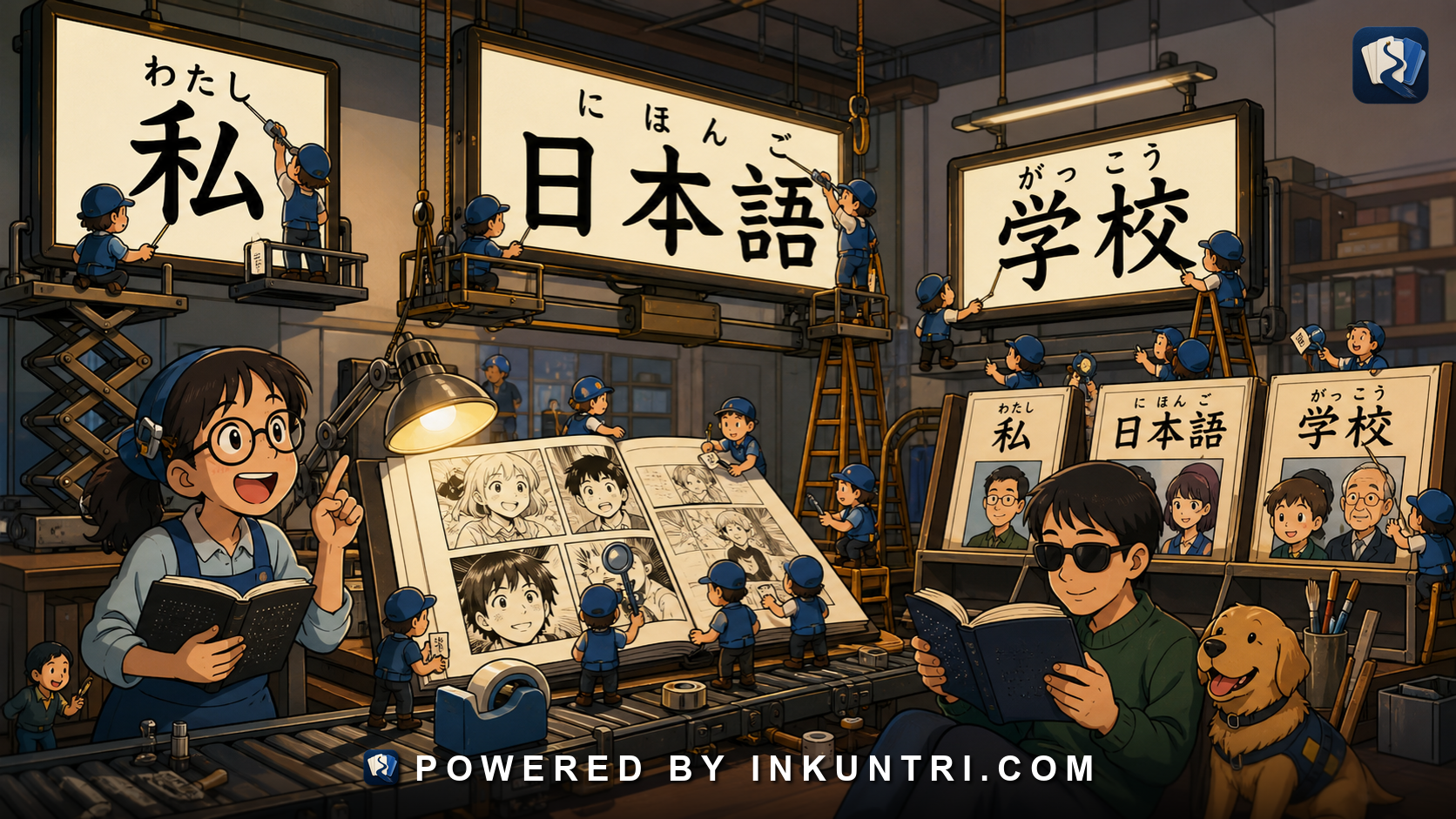
Core examples: 私(わたし), 大人(おとな), 東雲(しののめ), 宇宙(そら), 運命(さだめ), 名前のふりがな, 鈴木(すずき), 山田太郎(やまだたろう).
Furigana is not training wheels
Many learners first meet furigana as mercy.
A textbook prints a kanji word and places small kana above it. The learner breathes a little easier. The kanji no longer looks like a locked door. The pronunciation is right there.
私(わたし) 日本語(にほんご) 学校(がっこう)
So the beginner forms a reasonable but incomplete belief: furigana is a beginner aid. It tells children and foreign learners how to pronounce difficult kanji. Once you become “good,” you should not need it anymore.
That is only one use.
Furigana is much more than a pronunciation crutch. It is a general literacy technology. It supports children. It helps adults read rare kanji and names. It gives publishers a way to control pronunciation. It lets manga writers create double meanings. It gives official forms a way to capture name readings. It can make public text more accessible. It can also deliberately mislead the eye in a useful way: the kanji says one thing, the furigana tells you how the writer wants it read.
A better rule is this:
Furigana tells the reader how a written form should be voiced, interpreted, or handled.
Sometimes that means ordinary pronunciation. Sometimes it means a name reading. Sometimes it means a dramatic alternate reading. Sometimes it means “do not guess; here is the exact reading required for this person, place, brand, spell, slogan, joke, or document field.”
If you treat furigana as only beginner support, you will miss one of the most flexible pieces of Japanese writing.
What furigana actually is
Furigana is small phonetic text placed next to kanji or other characters. In horizontal writing, it usually appears above the main text. In vertical writing, it normally appears to the right. The broader typographic term is ruby text, but in Japanese-learning contexts furigana is the familiar word.
A simple example:
大人(おとな) adult
The kanji are 大 and 人. A learner might expect a reading like だいじん or おおひと if guessing mechanically. Furigana tells the reader that the word is read おとな.
Another simple example:
今日(きょう) today
今日 is historically and orthographically not transparent from the individual readings of 今 and 日. Furigana gives the actual word reading.
Furigana can appear over a single kanji:
私(わたし)
It can appear over a compound:
日本語(にほんご)
It can appear over a name:
東雲(しののめ)
It can appear over a made-up term, a fantasy word, a product name, a technical term, or a phrase whose official reading matters.
The small kana are not decorative. They are instructions.
Use 1: Children’s literacy scaffolding
Japanese children learn kana before they learn the full range of kanji used in adult texts. This creates an obvious problem: children can understand spoken words long before they can read every kanji used to write those words.
Furigana solves part of that problem.
A children’s book may use kanji that are useful for meaning and visual familiarity while providing furigana so the child can pronounce and understand the text. School materials, graded readers, manga for younger audiences, museum panels, public notices aimed at families, and educational websites may use furigana in this way.
This does not mean furigana makes reading effortless. A child still has to parse words, grammar, context, and story. But furigana lets the text include kanji without making the reading task impossible.
For learners, this is important because it shows that furigana is not a foreigner feature. It is part of native Japanese literacy development.
A child may see:
火山(かざん) volcano
The kanji 火 and 山 are meaningful. The furigana tells the reading. Over time, repeated exposure ties the written form to the spoken word. Furigana becomes a bridge from kana literacy into kanji literacy.
Use 2: Rare words and difficult readings
Even educated adult readers encounter kanji words whose readings are not obvious. Japanese has multiple layers of readings: on-readings, kun-readings, jukujikun, name readings, historical spellings, special literary readings, and domain-specific vocabulary. Some words are common enough in writing but not common enough for every reader to confidently pronounce them.
Furigana can prevent friction.
Examples:
| Written form | Reading | Why furigana helps |
|---|---|---|
| 大人 | おとな | The word reading is not a simple assembly of 大 + 人. |
| 今日 | きょう | Common word with special reading. |
| 明日 | あした / あす / みょうにち | Reading depends on register and context. |
| 東雲 | しののめ | Place/name/literary reading that is not predictable for many readers. |
| 五月雨 | さみだれ | Literary/seasonal reading; not simply ごがつあめ. |
| 海女 | あま | Occupational word with non-obvious reading. |
The existence of furigana is a warning against a bad habit: guessing all readings from individual kanji. Sometimes that works. Often it does not.
Kanji are not a simple pronunciation code. Furigana fills the gap when the printed form and the expected reading are too far apart for safe guessing.
Use 3: Japanese names
Names are where furigana becomes essential.
Japanese personal names and place names can use characters with readings that are rare, historical, family-specific, regional, creative, or simply unpredictable. The same character may be read several ways across different names. The same pronunciation may be written with many different kanji.
Consider:
| Name form | Possible issue |
|---|---|
| 翔 | Could be しょう, かける, つばさ, and more depending on name. |
| 愛 | Could be あい, めぐみ, まな, あ, and other name readings. |
| 陽菜 | Often ひな, but not mechanically guaranteed in every case. |
| 大翔 | Could have several modern name readings. |
| 東雲 | Often しののめ, but a learner would not derive it safely. |
| 小鳥遊 | A famous surname read たかなし. |
This is why Japanese forms often include a furigana field:
氏名 ふりがな
The form is asking not only “What is your name?” but “How should this name be read?”
For ordinary vocabulary, a dictionary can often settle the issue. For names, the person is the authority. Furigana records identity. If a résumé, business card, school roster, hospital form, event registration, or government application asks for furigana, it is not asking for optional learner help. It is asking for a reading that matters administratively and socially.
A serious learner should adopt a strict rule:
Do not guess names aloud when the reading matters. Confirm the furigana.
This is not timidity. It is competence.
Use 4: Manga, voice, and deliberate mismatch
Manga and light novels use furigana in ways that go beyond ordinary pronunciation.
One common device is to put a standard word in kanji and a different spoken reading in furigana. The kanji supplies meaning, weight, or atmosphere; the furigana supplies the word the character actually says.
A famous pattern looks like this:
宇宙(そら) “space” written as universe, read as sky/heavens
Or:
運命(さだめ) “fate” written as 運命, read with a poetic/native-style word
The reader sees both layers. The kanji gives one semantic signal. The furigana gives the voiced line. This can produce drama, irony, fantasy flavor, character voice, or worldbuilding.
In fantasy and science fiction, a writer may give a technical-looking kanji compound and assign it a foreign, invented, or stylized reading. A weapon, spell, kingdom, AI system, military unit, or supernatural concept can be written with meaningful kanji while read as a name-like term.
This is not a mistake. It is a two-channel writing technique.
For learners, the key is to ask:
Is the furigana giving the ordinary reading, or is it creating a second layer?
If the kanji and furigana do not seem to match, do not immediately blame your dictionary. The mismatch may be the point.
Use 5: Accessibility and public readability
Furigana can make text more accessible for readers who know spoken Japanese but cannot comfortably read all the kanji in the text. That includes children, some second-language learners, some readers with literacy difficulties, some elderly readers depending on the material, and people encountering rare names or specialized terms.
Public institutions, museums, schools, local governments, health campaigns, disaster-prevention materials, and children’s services may use furigana or kana-heavy writing to widen access.
A disaster notice that uses only dense kanji may fail its job if part of the intended audience cannot read it quickly. A museum panel may want to preserve the proper kanji for a historical term while still helping visitors pronounce it. A school notice may include kanji for parents and furigana for children.
Furigana, then, is not only a language-learning feature. It is an access feature.
Use 6: Editorial control
Publishers and writers sometimes use furigana because they want to control the reader’s voice.
Japanese contains many words with multiple possible readings or register-dependent readings:
| Written form | Possible readings / issue |
|---|---|
| 明日 | あした, あす, みょうにち |
| 一日 | いちにち, ついたち |
| 上手 | じょうず, うわて, かみて depending on context |
| 人気 | にんき, ひとけ |
| 生物 | せいぶつ, なまもの |
Sometimes context is enough. Sometimes an editor wants no ambiguity. Furigana selects the intended reading.
This is especially important in poetry, song lyrics, theater scripts, manga dialogue, children’s editions of novels, and materials where voice matters. The written form alone can be ambiguous; furigana chooses the performance.
Furigana is not always hiragana
Most ordinary furigana uses hiragana, especially for native Japanese words and general readings.
But katakana can also appear as ruby/furigana-like text, especially for foreign names, technical labels, emphasis, loanword readings, or stylized effects. In manga and games, ruby text may include katakana, Latin letters, symbols, or invented notation depending on the effect.
For example, a science-fiction text might write a kanji compound and give a katakana reading to make it feel like a system name or foreign technical term.
The broader point is that ruby text is a flexible annotation layer. Hiragana furigana is the most familiar form, but the technology is not limited to ordinary kana pronunciation.
How to read furigana intelligently
When you see furigana, do not simply “read the small text and ignore the big text.” That throws away half the information.
Use a four-question routine.
1. Is it giving the ordinary reading?
If you see:
日本語(にほんご)
The furigana is simply giving the standard reading. Good. Read it, connect it to the kanji, and move on.
2. Is it resolving an unpredictable reading?
If you see:
大人(おとな) 今日(きょう) 東雲(しののめ)
The furigana is protecting you from a bad mechanical guess. Pay attention. This word or name may not be predictable from the characters alone.
3. Is it identifying a name?
If the furigana appears on a form, business card, school roster, event list, or name plate, treat it as identity data. Record it exactly. Do not “correct” it to what you expected.
4. Is it creating a second meaning layer?
If the kanji and furigana do not align normally, ask whether the text is doing something artistic.
宇宙(そら) 運命(さだめ)
The kanji and reading together create the full effect. Translate the function, not just the surface.
A learner workflow: furigana as evidence
A useful reading routine looks like this:
- Read the furigana for pronunciation. Get the sound right first.
- Look at the kanji for meaning. Ask what semantic field the written form invokes.
- Check whether the reading is ordinary. If not, mark it as a special reading, name reading, literary reading, or stylized reading.
- Save the whole unit. Do not save only the individual kanji if the word is a fixed expression or name.
- Notice the genre. Children’s book, manga, official form, news article, museum panel, and fantasy novel use furigana differently.
Common learner mistakes
Mistake 1: Treating furigana as something to outgrow
Advanced readers still benefit from furigana when the text includes rare readings, names, literary words, or deliberate alternate readings. Outgrowing furigana is not the goal. Understanding its function is.
Mistake 2: Ignoring the kanji once furigana appears
If you only read the small kana, you may get the sound but miss the meaning layer. This is especially damaging in manga and literary writing.
Mistake 3: Assuming furigana always gives a dictionary-standard reading
In ordinary educational contexts, it usually does. In manga, fiction, advertising, and stylized writing, it may not. The mismatch can be meaningful.
Mistake 4: Guessing names from vocabulary readings
Name readings are their own problem. Confirm the furigana.
A strong tool for this article would let readers switch among furigana functions.
Suggested modes:
- Standard reading mode: 日本語(にほんご), 学校(がっこう), 私(わたし).
- Unpredictable reading mode: 今日(きょう), 大人(おとな), 五月雨(さみだれ).
- Name mode: 東雲(しののめ), 小鳥遊(たかなし), 山田太郎(やまだたろう).
- Manga alternate-reading mode: 宇宙(そら), 運命(さだめ), fictional examples with kanji/reading mismatch.
- Accessibility mode: A paragraph with furigana on/off for different learner levels.
- Layout mode: Horizontal vs vertical ruby placement.
The goal would not be to make furigana cute. The goal would be to show it as a serious annotation system.
Final rule
Furigana is not a confession that the reader is weak. It is a way for Japanese writing to carry more information than the main line alone can safely carry.
It can teach children, guide learners, protect name readings, resolve rare words, widen access, and create literary double vision. The small text is small only in size. Its job is large.
When you see furigana, ask what problem it is solving.
Related reading
Why Japanese Mixed Script Is a Reading System, Not a Historical Accident
The reader can read Japanese mixed-script text as a designed system of roles rather than as a messy accumulation of scripts.
Japanese Wedding Language: ご祝儀, 披露宴, 招待状, 内祝い
The reader can understand Japanese wedding language around gift money, receptions, invitations, return gifts, speeches, and formal register.
How to Build a Kanji Component Notebook That Respects Japanese Readings
The reader can build a kanji component notebook that uses radicals and components without pretending they determine Japanese meanings or readings mechanically.
Tracking Japanese Listening Progress With Real Audio
The reader can track Japanese listening progress using real audio, transcripts, comprehension targets, error categories, and repeated measurement.
Chinese Classics in Japanese Education and Quotation
The reader can recognize Chinese-classics quotations and allusions in Japanese education, journalism, speeches, and public writing.
Japanese Bureaucratic Vocabulary: 実施, 対応, 検討, 周知, 徹底
The reader can unpack high-frequency bureaucratic Japanese and understand the institutional actions hidden behind neutral-sounding vocabulary.