
Reading Public Signs in China: The Grammar of Warnings, Bans, and Instructions
The reader learns the compact grammar of signs, warnings, prohibitions, permissions, and procedural instructions.
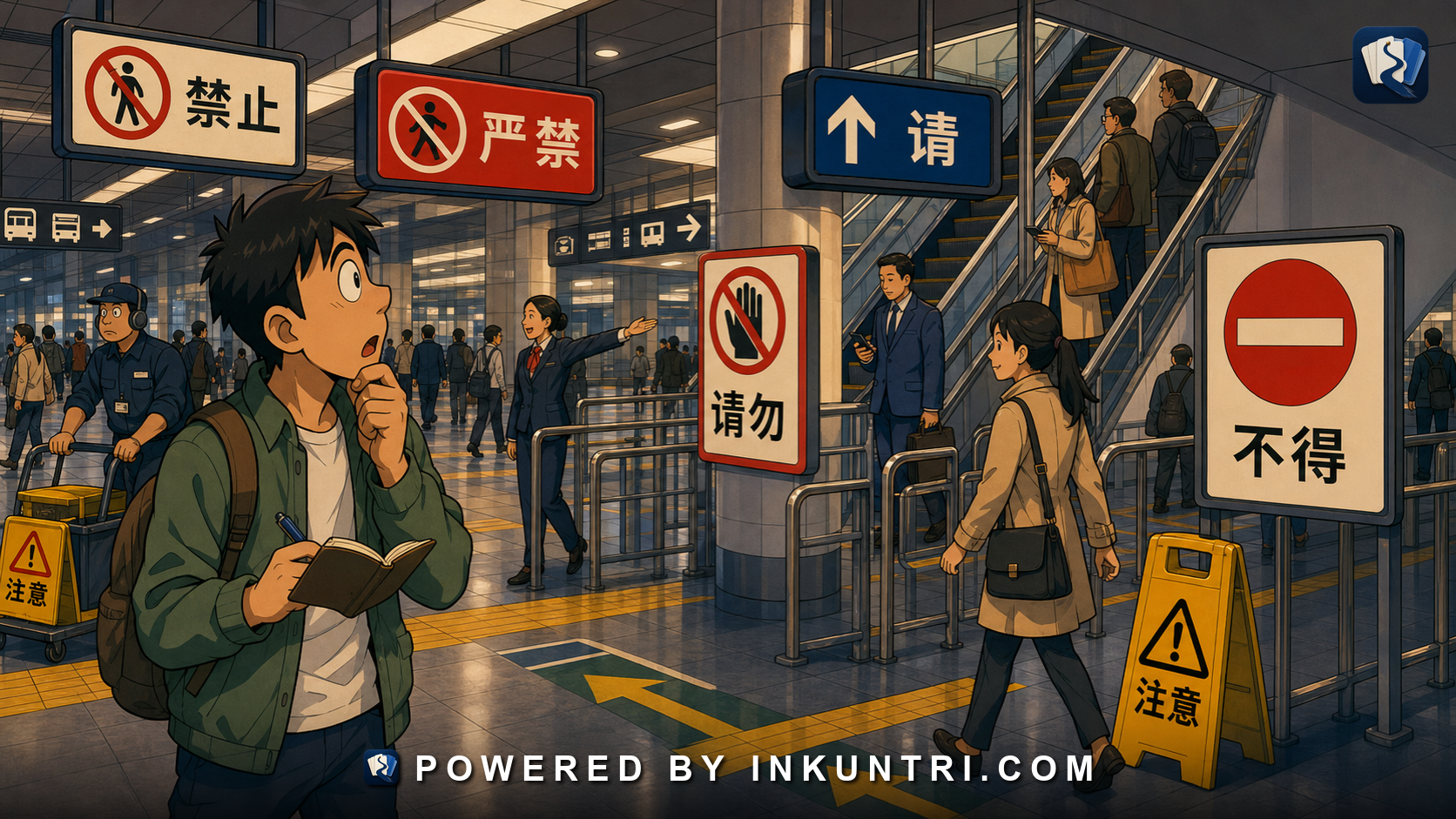
Core examples: 禁止吸烟, 请勿触摸, 小心地滑, 保持安静, 请排队等候, 非工作人员禁止入内, 严禁酒后驾车.
Public signs are short because they are a genre
Public signs are not ordinary conversation printed on walls.
They are compressed, formulaic, and often more formal than spoken Mandarin. A sign has to do a job quickly: warn, prohibit, direct, request, instruct, identify, or restrict access. It often has limited space. It may be read while walking, driving, queuing, boarding a train, entering a museum, using an elevator, or standing in a hospital corridor.
That is why sign Chinese often looks like this:
禁止吸烟
请勿触摸
小心地滑
保持安静
非工作人员禁止入内
There is no full conversational sentence:
请你不要在这里吸烟。
Please do not smoke here.
Instead, the sign uses a formula:
禁止 + actionSo 禁止吸烟 means “Smoking prohibited” or “No smoking,” not a word-for-word conversational sentence.
Once you learn the formulas, public signs become much easier. You do not need to parse each sign from scratch. You need to identify the sign type, the marker, the action, and the target audience.
The hidden subject is usually “you” or “the public”
Many signs omit the subject. The reader supplies it from context.
请排队等候。Literally:
Please line up and wait.Who should line up? The people reading the sign.
保持安静。Literally:
Maintain quiet.Who should keep quiet? Visitors, passengers, patients, students, or whoever is in that space.
非工作人员禁止入内。Literally:
Non-staff prohibited from entering.Who is prohibited? Anyone who is not staff.
This subject omission is not sloppy. It is genre economy. Public signs do not need to say 你, 大家, 游客, 乘客, or 顾客 every time because the physical situation supplies the audience.
Prohibition markers: 禁止, 严禁, 请勿, 不得, 谢绝
Chinese signs use several common markers for “do not” or “not allowed.” They differ in strength, register, and institutional tone.
禁止: prohibited
禁止 is the most direct general prohibition marker.
Pattern:
禁止 + action / behavior / entryExamples:
| Sign | Pinyin | Natural English | Note |
|---|---|---|---|
| 禁止吸烟 | jìnzhǐ xīyān | No smoking | Common in buildings, stations, offices. |
| 禁止拍照 | jìnzhǐ pāizhào | No photography | Common in museums, exhibitions, archives. |
| 禁止通行 | jìnzhǐ tōngxíng | No passage; no through traffic | Can apply to people or vehicles. |
| 禁止停车 | jìnzhǐ tíngchē | No parking | Traffic/public-space sign. |
| 禁止攀爬 | jìnzhǐ pānpá | No climbing | Parks, walls, railings, monuments. |
禁止 is not rude. It is institutional and clear.
严禁: strictly prohibited
严禁 is stronger than 禁止. It often appears where the behavior is dangerous, illegal, or has serious consequences.
Pattern:
严禁 + actionExamples:
| Sign | Pinyin | Natural English | Note |
|---|---|---|---|
| 严禁烟火 | yánjìn yānhuǒ | No open flames; fire strictly prohibited | Construction, fuel, storage, forest areas. |
| 严禁酒后驾车 | yánjìn jiǔhòu jiàchē | Driving after drinking is strictly prohibited | Road safety/legal register. |
| 严禁超载 | yánjìn chāozài | Overloading strictly prohibited | Elevators, vehicles, equipment. |
| 严禁入内 | yánjìn rù nèi | Entry strictly prohibited | Strong access restriction. |
严禁 is a good clue that the sign is not merely etiquette. It signals institutional enforcement, safety risk, or legal seriousness.
请勿: please do not
请勿 looks polite because it begins with 请, but in signs it is still a prohibition formula.
Pattern:
请勿 + actionExamples:
| Sign | Pinyin | Natural English | Note |
|---|---|---|---|
| 请勿触摸 | qǐng wù chùmō | Please do not touch | Museums, shops, displays. |
| 请勿喧哗 | qǐng wù xuānhuá | Please keep quiet; no loud noise | Libraries, hospitals, schools. |
| 请勿乱扔垃圾 | qǐng wù luànrēng lājī | Please do not litter | Parks, streets, campuses. |
| 请勿靠近 | qǐng wù kàojìn | Please keep away | Construction, danger zones, equipment. |
| 请勿倚靠车门 | qǐng wù yǐkào chēmén | Do not lean on the doors | Subway/train/bus contexts. |
Do not over-translate 请勿 as a personal request. It is often equivalent to “Do not…” in English signs.
不得: must not; may not
不得 is more formal and rule-like. It appears in regulations, notices, schools, workplaces, transport, and legal/institutional contexts.
Pattern:
不得 + actionExamples:
| Sign or notice | Pinyin | Natural English | Note |
|---|---|---|---|
| 不得入内 | bùdé rù nèi | No entry; may not enter | Formal restriction. |
| 未经许可不得入内 | wèijīng xǔkě bùdé rù nèi | No entry without permission | Common access-control formula. |
| 不得占用消防通道 | bùdé zhànyòng xiāofáng tōngdào | Do not occupy/block the fire lane | Safety/legal register. |
| 不得携带危险品 | bùdé xiédài wēixiǎnpǐn | Dangerous goods may not be carried | Transport/security. |
不得 often feels more official than 请勿. It is less about politeness and more about rules.
谢绝: politely decline/refuse
谢绝 means that the venue declines or does not accept something. It is often used in service, hospitality, exhibition, or semi-polite institutional contexts.
Pattern:
谢绝 + category/actionExamples:
| Sign | Pinyin | Natural English | Note |
|---|---|---|---|
| 谢绝参观 | xièjué cānguān | Not open to visitors | Polite refusal of visits. |
| 谢绝入内 | xièjué rù nèi | No entry; entry not permitted | Softer than 禁止入内 but still restrictive. |
| 谢绝自带酒水 | xièjué zìdài jiǔshuǐ | Outside drinks/alcohol not allowed | Restaurants/venues. |
| 谢绝推销 | xièjué tuīxiāo | No soliciting | Offices, residential areas. |
谢绝 does not mean “thank you for refusing.” It means “we politely decline / do not accept.”
Instruction and request markers: 请, 请先, 自觉, 注意, 小心, 保持
Not every sign is a ban. Many signs tell people what to do.
请: please do X
请 is the basic polite instruction marker.
Pattern:
请 + actionExamples:
| Sign | Pinyin | Natural English |
|---|---|---|
| 请排队等候 | qǐng páiduì děnghòu | Please line up and wait |
| 请出示证件 | qǐng chūshì zhèngjiàn | Please show ID/documents |
| 请随手关门 | qǐng suíshǒu guānmén | Please close the door behind you |
| 请走人行道 | qǐng zǒu rénxíngdào | Please use the sidewalk |
| 请保持距离 | qǐng bǎochí jùlí | Please keep distance |
请 makes the instruction polite, but it does not make it optional in a public-institutional setting. 请出示证件 at a checkpoint is not a casual invitation.
请先: please first do X
请先 introduces a required first step.
Examples:
| Sign | Natural English | Structure |
|---|---|---|
| 请先取号 | Please take a number first | 请先 + action |
| 请先付款 | Please pay first | 请先 + action |
| 请先登记 | Please register first | 请先 + action |
| 请先洗手 | Please wash your hands first | 请先 + action |
请先 is procedural. It tells you the order of operations.
自觉: voluntarily/compliantly do X
自觉 is hard to translate directly. In signs, it often means “please do this on your own initiative / comply voluntarily / be responsible about it.”
Examples:
| Sign | Natural English | Reading note |
|---|---|---|
| 自觉排队 | Please line up properly | Do it without being forced. |
| 自觉维护秩序 | Help maintain order | Common in public venues. |
| 自觉遵守规定 | Please follow the rules | Institutional/civic tone. |
| 自觉爱护公物 | Please take care of public property | School, park, public facility tone. |
Do not translate 自觉 mechanically as “consciously.” In sign Chinese, it is a civic-compliance word.
注意: pay attention to; be aware of
注意 introduces a warning, reminder, or focus of caution.
Examples:
| Sign | Pinyin | Natural English |
|---|---|---|
| 注意安全 | zhùyì ānquán | Pay attention to safety; Caution |
| 注意防火 | zhùyì fánghuǒ | Fire prevention; beware of fire |
| 注意车辆 | zhùyì chēliàng | Watch for vehicles |
| 注意台阶 | zhùyì táijiē | Watch your step |
| 注意保管随身物品 | zhùyì bǎoguǎn suíshēn wùpǐn | Watch your belongings |
注意 does not always need a full English verb phrase. In sign translation, “Caution,” “Watch,” “Beware,” or “Please take care of…” may be natural depending on the context.
小心: careful; beware
小心 is a warning marker. It usually points to a physical hazard.
Examples:
| Sign | Pinyin | Natural English | Note |
|---|---|---|---|
| 小心地滑 | xiǎoxīn dì huá | Caution: slippery floor | 地 means ground/floor here. |
| 小心台阶 | xiǎoxīn táijiē | Watch your step | Stairs/steps. |
| 小心碰头 | xiǎoxīn pèngtóu | Mind your head | Low ceiling/beam. |
| 小心烫伤 | xiǎoxīn tàngshāng | Caution: hot; risk of burns | Hot water/food/equipment. |
| 小心触电 | xiǎoxīn chùdiàn | Danger of electric shock | Electrical hazard. |
小心地滑 is a perfect sign-literacy example. The 地 is dì, “ground/floor,” not the adverbial particle de. The phrase means “be careful, the floor is slippery.”
保持: maintain
保持 tells the reader to maintain a state.
Examples:
| Sign | Pinyin | Natural English |
|---|---|---|
| 保持安静 | bǎochí ānjìng | Keep quiet |
| 保持清洁 | bǎochí qīngjié | Keep clean |
| 保持距离 | bǎochí jùlí | Keep distance |
| 保持通道畅通 | bǎochí tōngdào chàngtōng | Keep passage clear |
| 保持环境卫生 | bǎochí huánjìng wèishēng | Keep the environment clean |
保持 often appears in shared spaces: libraries, hospitals, elevators, classrooms, parks, residential compounds, public toilets, and transport hubs.
Access-control grammar: who may enter?
Many public signs are about entry and access. The grammar is compact.
非 + identity + 禁止入内
非工作人员禁止入内Breakdown:
| Part | Function |
|---|---|
| 非 | non-, not |
| 工作人员 | staff/personnel |
| 禁止 | prohibited |
| 入内 | enter inside |
Natural English:
Staff only.
No entry for unauthorized personnel.
This pattern is common:
| Sign | Natural English |
|---|---|
| 非工作人员禁止入内 | Staff only; no unauthorized entry |
| 非本单位人员禁止入内 | No entry for non-unit personnel |
| 非机动车禁止入内 | No non-motor vehicles allowed / No bicycles or e-bikes, depending on context |
| 非请勿入 | Do not enter without invitation/authorization |
未经 + permission + 不得 + action
未经许可不得入内Breakdown:
| Part | Function |
|---|---|
| 未经 | without having gone through/without obtaining |
| 许可 | permission |
| 不得 | may not; must not |
| 入内 | enter |
Natural English:
No entry without permission.Other examples:
| Sign | Natural English |
|---|---|
| 未经许可不得拍照 | Photography prohibited without permission |
| 未经允许不得进入 | No entry without authorization |
| 未经登记不得入内 | Registration required before entry |
凭 + document/ticket + action
凭 means “on the basis of / by presenting.” It often appears in access signs.
Examples:
| Sign | Natural English |
|---|---|
| 凭票入场 | Admission by ticket only |
| 凭证进入 | Entry with valid pass/certificate |
| 凭预约码取号 | Take a number with reservation code |
| 凭身份证办理 | Handle/process with ID card |
This is not a ban, but it functions as a condition. You may enter or proceed if you have the required document.
Procedural grammar: what order should you follow?
Public signs often tell you a sequence.
先 A 后 B
先下后上Natural English:
Let passengers exit before boarding.Structure:
| Part | Meaning |
|---|---|
| 先 | first |
| 下 | get off |
| 后 | then/after |
| 上 | get on |
Other examples:
| Sign | Natural English |
|---|---|
| 先取号后办理 | Take a number first, then proceed |
| 先付款后取餐 | Pay first, then collect food |
| 先登记后入场 | Register before entering |
请将 X + verb phrase
请将垃圾放入垃圾桶Natural English:
Please put trash in the bin.将 is a formal written marker that brings the object forward, similar in function to 把 in many contexts.
Examples:
| Sign | Natural English |
|---|---|
| 请将手机调至静音 | Please set your phone to silent mode |
| 请将车辆停放在指定区域 | Please park vehicles in the designated area |
| 请将门关好 | Please close the door properly |
| 请将随身物品带走 | Please take your belongings with you |
This pattern is common in notices, offices, classrooms, clinics, and public transport.
自助 and 自取
Chinese service signs often use compact self-service formulas.
| Sign | Natural English | Note |
|---|---|---|
| 餐具自取 | Self-service tableware | You take it yourself. |
| 发票自取 | Self-service invoice pickup | Often near checkout. |
| 饮用水自取 | Drinking water available; self-service | Common in waiting areas/restaurants. |
| 自助取票 | Self-service ticket pickup | Kiosks/machines. |
| 自助结账 | Self-checkout | Retail/service context. |
The grammar is often noun + 自取 or 自助 + action. It is not a complete sentence, but it is fully functional sign language.
Consequence formulas: what happens if you violate it?
Some signs add consequences. These are especially common in parks, housing compounds, schools, roads, workplaces, and safety-sensitive sites.
违者 + consequence
违者 means “those who violate [the rule].”
Examples:
| Sign | Natural English |
|---|---|
| 违者罚款 | Violators will be fined |
| 违者后果自负 | Violators bear responsibility for the consequences |
| 违者依法处理 | Violators will be handled according to law |
| 违者追究责任 | Violators will be held responsible |
Breakdown:
违者 = violators / those who violate it
罚款 = fine
后果自负 = bear the consequences yourself
依法处理 = handled according to law
These phrases are not conversational. They are rule-enforcement language.
后果自负
后果自负 literally means “the consequences are self-borne.” Natural English depends on context:
Enter at your own risk.
Violators bear responsibility for the consequences.
It often appears after warnings:
禁止翻越栏杆,后果自负。Natural English:
Do not climb over the railing. Entering/climbing at your own risk.The phrase is blunt, but common.
Category by category: where signs appear
Transit
Transit signs are full of formulaic instructions because people move quickly and safety matters.
| Sign | Natural English | Notes |
|---|---|---|
| 请排队上车 | Please line up to board | Bus/subway. |
| 先下后上 | Let passengers exit before boarding | Very common. |
| 请勿倚靠车门 | Do not lean on the doors | Subway/train. |
| 请给老弱病残孕让座 | Please give seats to the elderly, weak, ill, disabled, and pregnant | Formulaic priority-seat language. |
| 禁止携带易燃易爆物品 | Flammable and explosive items prohibited | Security/safety. |
| 请站稳扶好 | Please stand firm and hold on | Buses, trains, elevators/escalators. |
Priority-seat signs can be culturally dense. 老弱病残孕 is a compressed list:
| Character | Meaning in formula |
|---|---|
| 老 | elderly |
| 弱 | weak/frail |
| 病 | ill |
| 残 | disabled |
| 孕 | pregnant |
Do not translate it character by character in normal prose. Read it as a fixed public-service category.
Museums and exhibitions
| Sign | Natural English |
|---|---|
| 请勿触摸展品 | Please do not touch exhibits |
| 禁止拍照 | No photography |
| 请勿使用闪光灯 | No flash photography |
| 保持安静 | Keep quiet |
| 请按指定路线参观 | Please follow the designated route |
| 展厅内禁止饮食 | No eating or drinking in the exhibition hall |
Museum signs often combine 请勿 with cultural-property or object words such as 展品, 文物, 作品, 展柜.
Parks and scenic areas
| Sign | Natural English |
|---|---|
| 爱护花草 | Protect plants and flowers |
| 请勿踩踏草坪 | Please keep off the grass |
| 禁止攀爬 | No climbing |
| 注意防火 | Beware of fire / Fire prevention |
| 请勿投喂动物 | Do not feed the animals |
| 文明游览 | Please visit responsibly / Be a respectful visitor |
文明 is a common public-sign word. It does not usually mean “civilized” in a heavy anthropological sense. In signs, 文明 often means orderly, considerate, respectful, and socially appropriate.
Elevators and escalators
| Sign | Natural English |
|---|---|
| 严禁超载 | Overloading strictly prohibited |
| 请勿在电梯内蹦跳 | Do not jump in the elevator |
| 发生火灾时请勿乘坐电梯 | Do not use the elevator in case of fire |
| 请站稳扶好 | Stand firm and hold on |
| 小心夹手 | Mind your hands; risk of pinching |
| 请照看好儿童 | Please supervise children |
Elevator signs mix warning, prohibition, and instruction formulas.
Hospitals and clinics
| Sign | Natural English |
|---|---|
| 保持安静 | Keep quiet |
| 请按号就诊 | Please see the doctor when your number is called / in order by number |
| 请先挂号 | Please register first |
| 请出示医保卡 | Please show medical insurance card |
| 禁止吸烟 | No smoking |
| 请勿大声喧哗 | Please do not make loud noise |
Hospitals use many procedural signs: first register, then wait, then proceed by number, then pay or collect medicine.
Restaurants and service counters
| Sign | Natural English |
|---|---|
| 请排队点餐 | Please line up to order |
| 餐具自取 | Self-service tableware |
| 请先买单 | Please pay first |
| 禁止外带酒水 | Outside alcohol/drinks not allowed |
| 谢绝自带酒水 | Outside drinks/alcohol not accepted |
| 请节约用餐 | Please avoid food waste / Please order responsibly |
Restaurant signs can be surprisingly compressed. 菜品售出概不退换 means sold dishes/items are not returned or exchanged. Learners should treat these as service formulas, not ordinary conversation.
Construction and restricted zones
| Sign | Natural English |
|---|---|
| 施工重地,闲人免进 | Construction area. No unauthorized entry. |
| 注意安全 | Caution; pay attention to safety |
| 请勿靠近 | Keep away |
| 高空作业,注意安全 | Overhead work. Caution. |
| 禁止通行 | No passage |
| 严禁烟火 | No open flames |
施工重地 is a fixed, formal-sounding phrase. 闲人免进 does not mean “idle people are free to enter.” It means unauthorized/unrelated persons should not enter.
Reading a sign step by step
Take this sign:
非工作人员禁止入内,违者后果自负。Step 1: Identify the sign type
This is an access-control prohibition.
Step 2: Find the marker
禁止The sign prohibits something.
Step 3: Identify the target group
非工作人员People who are not staff.
Step 4: Identify the prohibited action
入内Entering.
Step 5: Identify consequence language
违者后果自负Violators bear the consequences.
Natural English:
Staff only. Unauthorized entry is prohibited. Violators enter at their own risk / bear responsibility for consequences.Now take another:
请勿触摸展品,保持一米距离。Breakdown:
| Segment | Function |
|---|---|
| 请勿 | polite prohibition formula |
| 触摸展品 | touch exhibits |
| 保持 | maintain |
| 一米距离 | one-meter distance |
Natural English:
Please do not touch the exhibits. Keep a one-meter distance.The sentence is not conversational, but it is transparent once you know the formulas.
Translation traps
Public signs should not be translated word by word. They should be read by function.
| Chinese | Bad literal reading | Better natural reading |
|---|---|---|
| 小心地滑 | carefully ground slippery | Caution: wet/slippery floor |
| 请勿触摸 | please do not touch | Do not touch / Please do not touch |
| 严禁烟火 | strictly prohibit smoke fire | No open flames / Fire strictly prohibited |
| 非工作人员禁止入内 | non-workers forbidden enter inside | Staff only / No unauthorized entry |
| 闲人免进 | idle people exempt enter | No unauthorized entry |
| 爱护花草 | love-protect flowers and grass | Protect plants / Keep off planted areas, depending on sign |
| 文明游览 | civilized tour | Please visit responsibly/respectfully |
| 后果自负 | consequences self-bear | Enter at your own risk / Violators bear responsibility |
| 凭票入场 | rely-on ticket enter venue | Admission by ticket only |
| 餐具自取 | tableware self-take | Self-service tableware |
The point is not to produce polished English for every sign. The point is to understand the Chinese sign’s function.
Compact words that appear everywhere
A small vocabulary core unlocks many public signs.
| Word | Pinyin | Meaning in signs |
|---|---|---|
| 禁止 | jìnzhǐ | prohibit |
| 严禁 | yánjìn | strictly prohibit |
| 请勿 | qǐng wù | please do not |
| 不得 | bùdé | may not; must not |
| 注意 | zhùyì | pay attention; caution |
| 小心 | xiǎoxīn | be careful; beware |
| 保持 | bǎochí | maintain; keep |
| 排队 | páiduì | queue; line up |
| 等候 | děnghòu | wait |
| 入内 | rù nèi | enter inside |
| 通行 | tōngxíng | pass through; traffic allowed |
| 触摸 | chùmō | touch |
| 喧哗 | xuānhuá | make noise; clamor |
| 倚靠 | yǐkào | lean on |
| 证件 | zhèngjiàn | ID/document |
| 许可 | xǔkě | permission |
| 工作人员 | gōngzuò rényuán | staff |
| 游客 | yóukè | tourist/visitor |
| 顾客 | gùkè | customer |
| 乘客 | chéngkè | passenger |
| 随身物品 | suíshēn wùpǐn | personal belongings |
| 消防通道 | xiāofáng tōngdào | fire passage/lane |
| 危险品 | wēixiǎnpǐn | dangerous goods |
Memorize these as sign vocabulary, not as isolated textbook words. Their use in public space is highly predictable.
A field method for reading signs
When you meet an unfamiliar sign, use this method.
Step 1: Classify the sign
Ask: is it a ban, warning, instruction, direction, service notice, or access condition?
- Ban: 禁止, 严禁, 请勿, 不得
- Warning: 小心, 注意, 当心
- Instruction: 请, 请先, 保持, 自觉
- Direction: 入口, 出口, 通道, 往, 向, 电梯
- Access condition: 凭, 未经, 非, 仅限
- Service notice: 自取, 自助, 办理, 登记, 取号
Step 2: Find the action
Look for the verb or verb phrase:
吸烟, 触摸, 入内, 通行, 拍照, 排队, 等候, 出示, 登记, 付款Step 3: Find the object or location
展品, 车门, 消防通道, 垃圾桶, 草坪, 证件, 随身物品Step 4: Find the target audience
游客, 乘客, 顾客, 非工作人员, 未成年人, 车辆, 行人Step 5: Watch for consequence or condition
违者罚款, 后果自负, 依法处理, 凭票, 未经许可This five-step method turns a dense sign into a small grammar puzzle.
Why sign Chinese matters for learners
Public signs are not minor vocabulary. They are one of the first types of written Chinese a visitor sees in the real world, and one of the most practical genres for learners.
They also teach core features of written Chinese:
- omitted subjects
- compact verb-object phrases
- formal prohibition markers
- noun-heavy instructions
- four-character and near-four-character rhythm
- institutional register
- formulaic repetition across contexts
A learner who can read signs gains more than travel convenience. They gain confidence with compressed written Mandarin.
Sign Chinese is a bridge between beginner survival reading and serious document literacy. The same patterns appear later in school notices, workplace rules, residential-compound announcements, museum labels, hospital procedures, public transport instructions, and official notices.
What to remember
Public signs are formulaic. They do not behave like textbook dialogues because they are not trying to. They are designed to instruct, prohibit, warn, and organize behavior in public space.
Learn the markers:
禁止 = prohibited
严禁 = strictly prohibited
请勿 = please do not
不得 = may not / must not
注意 = pay attention / caution
小心 = beware / careful
保持 = maintain
请先 = please first
凭 = by presenting / with
未经 = without permission/authorization
Then read the action, object, target audience, and consequence.
Once you know these patterns, signs like 禁止吸烟, 请勿触摸, 小心地滑, 保持安静, 请排队等候, 非工作人员禁止入内, and 严禁酒后驾车 stop looking like fragments. They become a compact grammar of public life.
Build a reader overlay that labels sign type and grammar.
Input examples
禁止吸烟
请勿触摸
小心地滑
保持安静
请排队等候
非工作人员禁止入内
严禁酒后驾车
Overlay labels
For each sign, label:
- sign type: ban, warning, instruction, access control, procedure
- marker: 禁止, 请勿, 小心, 保持, 非, 严禁
- action: 吸烟, 触摸, 排队等候, 入内, 驾车
- object/location: 展品, 地, 工作区域, 车门, 通道
- implied audience: visitors, passengers, staff, drivers, customers
- natural English function, not word-for-word gloss
Example overlay:
非工作人员禁止入内
[非工作人员] target group: non-staff
[禁止] prohibition marker
[入内] action: enter
Function: Staff only / No unauthorized entry
Sign-type filters
Let users filter examples by context:
- transit
- parks
- museums
- elevators
- hospitals
- restaurants
- construction zones
- campuses
- residential compounds
Practice mode
Show a sign without translation:
未经许可不得拍照Ask the user to choose:
- What type of sign is this?
- What is prohibited?
- What condition appears?
- What is a natural English equivalent?
Answer:
Type: formal prohibition/access rule
Prohibited action: taking photos
Condition: without permission
Natural English: Photography prohibited without permission.
This teaches sign Chinese as a genre, not as a pile of unrelated phrases.
For production fact-checking, consult:
- 全国标准信息公共服务平台, GB/T 10001.1-2023《公共信息图形符号 第1部分:通用符号》 project/standard information: https://std.samr.gov.cn/gb/search/gbDetailed?id=A43FF634EC72FC45E05397BE0A0A6483
- 全国标准信息公共服务平台, GB/T 15566.1-2020《公共信息导向系统 设置原则与要求 第1部分:总则》: https://std.samr.gov.cn/gb/search/gbDetailed?id=A24AF19F41425C2EE05397BE0A0A5E0D
- 国家标准全文公开系统, GB/T 30240 series《公共服务领域英文译写规范》 for bilingual public-service sign translation conventions: https://openstd.samr.gov.cn/bzgk/std/std_list?p.p1=0&p.p2=公共服务领域英文译写规范&p.p90=circulation_date&p.p91=desc
Articles 013–015 close the first writing-and-literacy cluster by moving from character/word structure into live reading conditions:
- 013 gives the conceptual model for 多音字: characters can represent multiple words, meanings, or grammatical functions, so pronunciation must be learned through word families.
- 014 turns that model into sentence-level practice: segment first, choose pronunciation second, and explain the evidence.
- 015 shifts from pronunciation ambiguity into public-space literacy: signs are formulaic, compressed written Chinese with predictable warning, prohibition, instruction, and access-control patterns.
Recommended cross-links:
- Link 013 to article 003 on 字, 词, and the limits of English categories.
- Link 013 and 014 to article 026 on Chinese search and segmentation.
- Link 014 to article 028 on subtitles, because rapid subtitle reading creates many 多音字 errors.
- Link 015 to article 020 on place-name and address literacy.
- Link 015 to article 034 on official document headers and article 095 on imperatives.
Reusable module opportunities:
- Pronunciation-cluster map: character → readings → word families → sentence examples → audio.
- Sentence disambiguation board: user marks word boundaries and chooses readings for characters such as 行, 重, 乐, 长, 好, 还, 得.
- Sign reader overlay: detects sign type, prohibition/instruction marker, action, object, target audience, and consequence phrase.
- Field reading deck: photos or mockups of real-world signs grouped by context: transit, museum, hospital, restaurant, elevator, park, construction.
Related reading
Building a Mandarin Reader Workflow From News, Documents, and Literature
The reader can build a sustainable Mandarin reading workflow that combines current news, practical documents, essays, and literature without drowning in vocabulary.
Chinese Characters Abroad: Hanzi, Kanji, Hanja, and the Shared Scriptworld
The reader understands the shared character tradition across China, Japan, and Korea while respecting each language’s independent grammar, pronunciation, and history.
Designing Chinese Anki Cards for Words, Characters, and Collocations
The reader can design Chinese flashcards that train recognition, pronunciation, meaning, collocation, character form, and contextual use without turning review into trivia.
The May Fourth Language Shift and the Rise of 白话
The reader understands how modern written Chinese emerged from debates over education, literature, modernization, and accessibility.
How Mandarin Expresses Collective Identity
The reader can identify how Mandarin builds collective identity through pronouns, group nouns, shared fate language, institutional wording, and emotional alignment.
A Serious Learner’s Guide to Chinese Dictionaries
The reader can use Chinese dictionaries more deeply by reading definitions, parts of speech, usage notes, examples, synonyms, variants, and register labels.