
Pinyin, Zhuyin, and the Politics of Pronunciation Notation
The reader understands pronunciation notation systems as tools with histories, institutions, and regional identities.
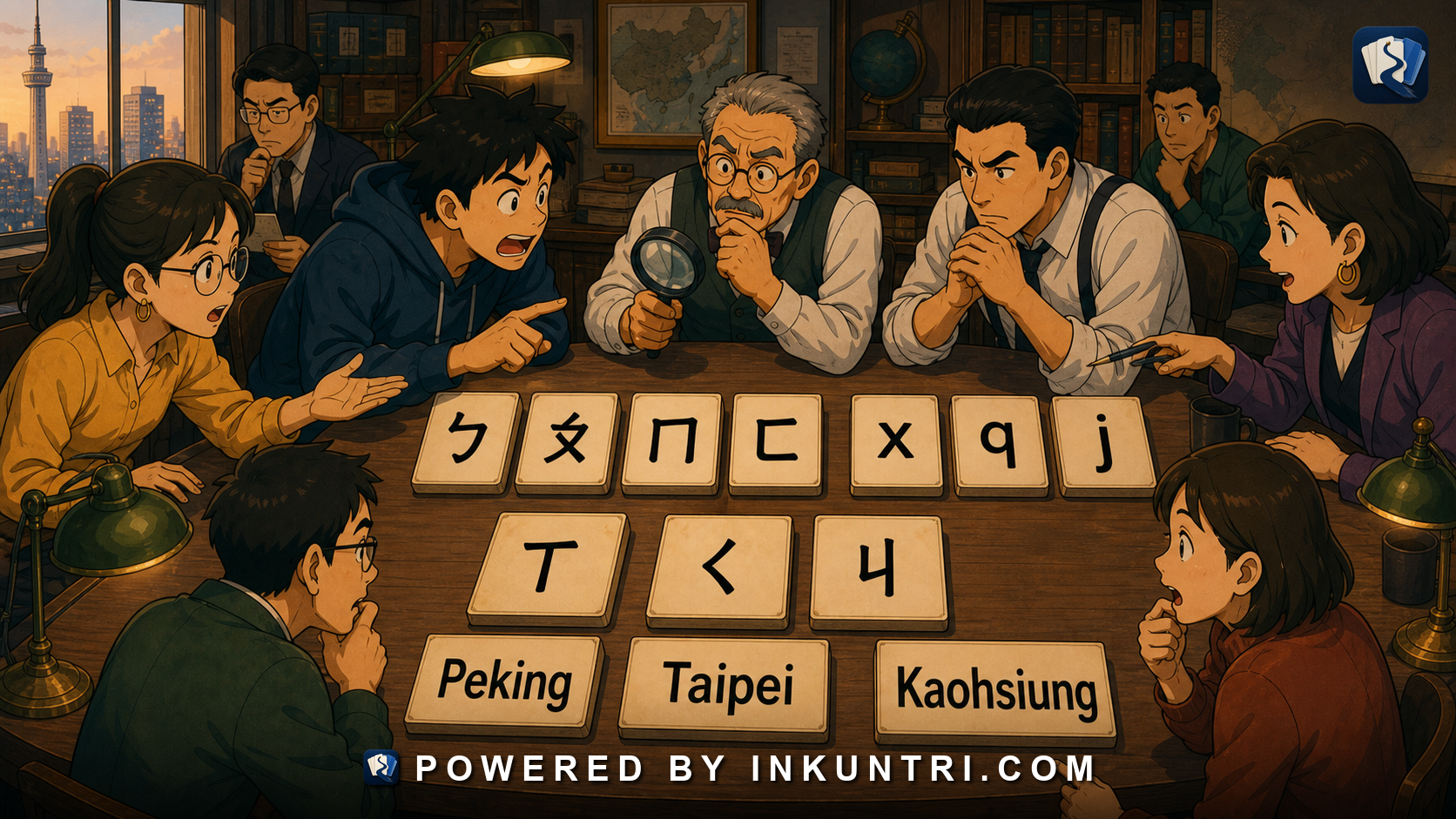
Core examples: ㄅㄆㄇㄈ, Pinyin tone marks, Wade-Giles spellings such as Peking/Taipei/Kaohsiung, x/q/j versus ㄒ/ㄑ/ㄐ. Recommended feature module: Notation overlay: same word shown as characters, Hanyu Pinyin, Zhuyin, broad IPA-style hints, and legacy romanizations where useful. Related internal articles: 008, 010, 013, 024, 036, 041, 048, 050, 053, 063.
Pronunciation notation is never just notation
A beginner asks a practical question: “How do I pronounce this character?”
The answer may appear in Pinyin, Zhuyin, Wade-Giles, a local romanization, a dictionary respelling, an IPA transcription, or a teacher’s improvised English-like hint. At first, these systems look like neutral ways of writing sound. They are not neutral in use.
They are tools, but they are also institutional choices. Pinyin is connected to Mainland education, international standards, dictionaries, passports, road signs, input methods, and the global teaching of Putonghua. Zhuyin, often called Bopomofo, is tied deeply to Taiwan schooling, children’s materials, dictionaries, and input habits. Wade-Giles survives in older scholarship, historical spellings, personal names, place names, and English words that entered global usage before Pinyin became dominant.
A serious learner does not need to turn this into a political argument. But ignoring the politics is also a mistake. Pronunciation notation systems carry histories of education policy, national identity, language standardization, library practice, signage, and diaspora habit.
The useful learner stance is:
Pronunciation notation tells me how to read.
It also tells me where a text, institution, teacher, dictionary, or name may be coming from.
This article explains the major systems you are likely to meet and how to use them without getting trapped by them.
1. Hanyu Pinyin: the global default, but not “Chinese spelling”
Hanyu Pinyin is the romanization system most learners encounter first. It uses Latin letters plus tone marks to represent Standard Mandarin pronunciation:
| Characters | Pinyin | Basic meaning |
|---|---|---|
| 中国 | Zhōngguó | China |
| 汉语 | Hànyǔ | Chinese language |
| 学生 | xuésheng | student |
| 北京 | Běijīng | Beijing |
| 去 | qù | to go |
| 学 | xué | to study; learn |
For beginners, Pinyin is enormously useful. It gives you a way to write pronunciation, look up characters, type Chinese, organize vocabulary, and talk about initials, finals, and tones.
But Pinyin is not “the Chinese alphabet” in the way English spelling is an alphabetic writing system. Mandarin is normally written with characters. Pinyin is a pronunciation notation and romanization system. It can represent whole sentences, children’s teaching material, dictionaries, and foreign-facing signage, but it does not replace character literacy for ordinary reading.
That distinction matters because learners can become visually fluent in Pinyin while still weak at Chinese listening and reading. Seeing qīng on a page is not the same as hearing 清, 青, 轻, 氢, 倾, or 卿 in speech. Pinyin tells you a syllable and tone; Chinese vocabulary still lives in words, characters, contexts, and collocations.
A better way to treat Pinyin:
Pinyin is scaffolding for pronunciation, lookup, typing, and early literacy.
It is not a substitute for listening, characters, or word knowledge.
2. Why Pinyin spellings can mislead English speakers
Pinyin uses familiar letters, but many letter values are not English values. That is part of its genius and part of its trap.
Consider these spellings:
| Pinyin | Common learner mistake | Better first approximation |
|---|---|---|
| q | “kw” or English q | aspirated alveolo-palatal, close to “ch” with a fronted tongue |
| x | English x | a soft fronted “sh”-like sound |
| zh | English “zh” as in measure | unaspirated retroflex affricate |
| c | English c/k/s | aspirated “ts” |
| r | English r | Mandarin retroflex/apical sound, not American r |
| ü | English u | front rounded vowel, like saying “ee” with rounded lips |
The spellings j, q, x are a classic learner trap. They do not represent English j, q, x. They mark a Mandarin sound series that only combines with certain front-vowel environments. This is why qu is not pronounced like English “choo” and xu is not “zoo” or “ksu.” The written u after j/q/x hides an ü-like pronunciation because there is no contrast there.
Tone marks also mislead if you treat them as decoration. Tone marks are not optional accents. They are part of the phonological identity of the syllable:
| Pinyin | Character | Meaning |
|---|---|---|
| mā | 妈 | mother |
| má | 麻 | hemp; numb |
| mǎ | 马 | horse |
| mà | 骂 | scold |
A beginner often asks, “Can I just write numbers instead of tone marks?” For notes, yes: ma1, ma2, ma3, ma4. But for real pronunciation, the number is only a label. You still have to hear and produce the contour.
3. Zhuyin/Bopomofo: not childish, not obsolete
Zhuyin Fuhao is often called Bopomofo after its first four symbols: ㄅ ㄆ ㄇ ㄈ.
If you mainly study Mainland materials, Zhuyin may look exotic. If you study in Taiwan or use Taiwan dictionaries and children’s books, it is ordinary. It appears in primary education, dictionaries, children’s readers, ruby text beside characters, pronunciation guides, and input methods.
A few basic correspondences:
| Zhuyin | Pinyin approximation | Example |
|---|---|---|
| ㄅ | b | ㄅㄚ = ba |
| ㄆ | p | ㄆㄚ = pa |
| ㄇ | m | ㄇㄚ = ma |
| ㄈ | f | ㄈㄚ = fa |
| ㄐ | j | ㄐㄧ = ji |
| ㄑ | q | ㄑㄧ = qi |
| ㄒ | x | ㄒㄧ = xi |
| ㄓ | zh | ㄓ = zhi |
| ㄔ | ch | ㄔ = chi |
| ㄕ | sh | ㄕ = shi |
| ㄖ | r | ㄖ = ri |
For learners, Zhuyin has one big advantage: it is not visually contaminated by English spelling. A learner who sees ㄑ does not instinctively pronounce it like English q. A learner who sees ㄒ does not try to say “ex.” The symbols force you to learn the Mandarin sound system on its own terms.
Zhuyin also represents Mandarin syllable structure elegantly. It makes initials, medials, finals, and tones visible without pretending Chinese words are spelled with Latin letters.
For example:
好 = ㄏㄠˇ
學 = ㄒㄩㄝˊ
中 = ㄓㄨㄥ
國 = ㄍㄨㄛˊ
In Taiwan children’s books, Zhuyin may be printed beside characters as ruby text. That gives children a bridge from spoken language to character reading. Adult learners can benefit from the same bridge, especially if they are working with Taiwan Mandarin.
The mistake is to dismiss Zhuyin as “just for kids.” In Taiwan, it is a durable literacy tool.
4. Pinyin versus Zhuyin: what each makes visible
Pinyin and Zhuyin both represent Mandarin pronunciation, but they make different things easy and hard.
| Question | Pinyin helps because… | Zhuyin helps because… |
|---|---|---|
| How do I type on a QWERTY keyboard? | Latin letters are already on the keyboard. | Zhuyin input is common in Taiwan but requires knowing the symbol layout. |
| How do I avoid English spelling interference? | You must train against English habits. | The symbols do not look like English. |
| How do I communicate with international learners? | Pinyin is globally recognized. | Zhuyin may be unfamiliar outside Taiwan-focused contexts. |
| How do I use Taiwan children’s readers? | Sometimes provided, often not primary. | Zhuyin is central. |
| How do I read Mainland dictionaries and textbooks? | Pinyin is the default. | Usually secondary or absent. |
| How do I see syllable structure? | Initial/final analysis is learnable but hidden by Roman letters. | The system maps directly to Mandarin phonetic categories. |
Neither system is “more Chinese” in the simple sense. Both are notation systems. Characters remain the mainstream writing system. Spoken Mandarin remains the language being represented.
A practical learner path:
- Learn Pinyin well if you use Mainland, international, or standard Mandarin learning resources.
- Learn at least passive Zhuyin if you use Taiwan materials.
- Never let either notation substitute for listening.
- Use notation to confirm pronunciation, not to invent it from your native-language spelling habits.
5. Wade-Giles: old spellings that still live in names
Before Pinyin became the global default, older romanization systems shaped how Chinese names appeared in English. The best-known is Wade-Giles.
You still meet Wade-Giles or related legacy spellings in:
- older books and academic works
- personal names in Taiwan and diaspora contexts
- place names with established English spellings
- historical figures
- older museum labels
- martial arts terms
- family records
Examples:
| Legacy spelling | More Pinyin-like spelling | Notes |
|---|---|---|
| Peking | Beijing | Legacy English place name still seen in historical/institutional names. |
| Taipei | Taibei | Taiwan’s capital is internationally known as Taipei. |
| Kaohsiung | Gaoxiong | Common official/international spelling for 高雄. |
| Tao | Dao | Seen in Taoism, Tao Te Ching. |
| Mao Tse-tung | Mao Zedong | Older spelling for 毛泽东/毛澤東. |
| Chiang Kai-shek | Jiang Jieshi | Established historical spelling for 蔣介石. |
Wade-Giles uses apostrophes to mark aspiration. This is important, but often lost in practice. For example, p and p’ in Wade-Giles do not correspond neatly to English p/b expectations. When the apostrophes disappear, the system becomes harder to interpret correctly.
Learner advice: do not “correct” people’s names into Pinyin automatically. A person’s romanized name may be a legal, family, political, regional, or personal choice. Tsai Ing-wen is not a mistake just because Pinyin would give a different form. Taipei is not simply “wrong Pinyin”; it is an established romanized name with its own history.
The respectful habit is:
Use Pinyin for learning and lookup.
Use the person’s or institution’s chosen romanization for names.
6. Pronunciation notation and identity
Why does this become political? Because notation systems travel with institutions.
A system used in school becomes emotionally familiar. A system printed on road signs becomes public identity. A system used in passports affects international recognition. A system used in textbooks shapes how outsiders imagine the language. A system used in input methods becomes muscle memory.
That is why debates about romanization can become debates about:
- Mainland versus Taiwan standards
- national language policy
- local autonomy
- international legibility
- historical continuity
- diaspora identity
- education reform
- technical convenience
A learner does not need to take a side in every debate. But you should know what signals you are reading.
For example:
| You see… | It may signal… |
|---|---|
| Hanyu Pinyin with tone marks | Mainland/international learning context, dictionary entry, textbook notation. |
| Zhuyin beside characters | Taiwan education, children’s reading, Taiwan dictionary material. |
| Unmarked Pinyin in signage | Place-name romanization, tourism, transit, maps. |
| Wade-Giles-style spellings | Older scholarship, Taiwan/diaspora names, historical conventions. |
| Mixed romanizations | Local history, inconsistent policy, older signs, personal choice. |
This awareness prevents a common mistake: treating every non-Pinyin spelling as ignorant or outdated. Some are outdated. Some are intentional. Some are legal names. Some are institutional compromises. Some are simply fossilized into English.
7. What Pinyin and Zhuyin obscure
Every notation system makes choices.
Pinyin can make Mandarin seem more alphabetic than it is. It may encourage learners to read Chinese through English letter habits. It hides the character and word distinction if you stare only at syllables. It can also hide the fact that many syllables correspond to many characters and words.
Zhuyin can feel more phonetically native to Mandarin, but it can be less accessible to learners who rely on international resources. It also does not automatically solve tone production, listening, word segmentation, or vocabulary acquisition.
Both systems can obscure connected speech. A word written clearly in notation may sound reduced, neutral-toned, sandhi-affected, or rhythmically compressed in real speech.
Example:
很好
Pinyin: hěn hǎo
Zhuyin: ㄏㄣˇ ㄏㄠˇ
Natural pronunciation: the first third tone usually changes before another third tone.
Notation gives you the citation form. Speech gives you the living form.
8. Practical advice for serious learners
Use this framework:
| Task | Best tool |
|---|---|
| Beginner pronunciation | Pinyin or Zhuyin plus audio. |
| Mainland textbook study | Pinyin. |
| Taiwan textbook and children’s readers | Zhuyin. |
| Dictionary lookup | Pinyin, Zhuyin, radical/stroke, handwriting, and character search. |
| Names and places | Respect established romanization; do not force everything into Pinyin. |
| Historical reading | Learn common Wade-Giles correspondences. |
| Typing | Use the input method that supports your study environment. |
| Pronunciation improvement | Audio, shadowing, minimal pairs, tone pairs, and recording. |
For Pinyin users, learn these trouble zones early:
j q x
zh ch sh r
z c s
ü and hidden ü after j/q/x/y
-i after z/c/s/zh/ch/sh/r
-an vs -ang
-en vs -eng
-ian, -uan, -ong
For Zhuyin users, learn how Zhuyin maps to Pinyin, because most international reference tools still use Pinyin.
For everyone: do not learn Chinese pronunciation from spelling alone. Learn it from sound.
9. Example walkthrough: 学习中文
Take the phrase:
学习中文In Pinyin:
xuéxí ZhōngwénIn Zhuyin:
ㄒㄩㄝˊ ㄒㄧˊ ㄓㄨㄥ ㄨㄣˊA beginner using English spelling may misread xue as “ksyoo” or zhong as “zong.” A Pinyin-trained learner knows that x is a Mandarin sound, not English x, and zh is not the same as z.
A Zhuyin-trained learner sees ㄒ and ㄓ as distinct symbols from the start. That can reduce English interference.
A character-literate learner sees more:
| Word | Characters | Pronunciation | Meaning |
|---|---|---|---|
| 学习 | 学 + 习 | xuéxí | to study; learn |
| 中文 | 中 + 文 | Zhōngwén | Chinese language; Chinese writing/culture depending context |
The mature learner connects all layers:
sound → notation → character → word → usageThat is the goal.
10. Tool concept: notation overlay
A strong Inkuntri interactive module for this article would let users enter a word or sentence and toggle:
- characters only
- Pinyin with tone marks
- Pinyin with tone numbers
- Zhuyin
- broad IPA-style hints
- audio
- word segmentation
- legacy romanization notes for selected names
Example output:
| Layer | Display |
|---|---|
| Characters | 北京大学 |
| Segmentation | 北京 / 大学 |
| Pinyin | Běijīng Dàxué |
| Zhuyin | ㄅㄟˇ ㄐㄧㄥ ㄉㄚˋ ㄒㄩㄝˊ |
| Note | “Peking University” preserves an older English institutional name. |
The key design principle: notation should illuminate the language, not replace it.
11. Advanced notation traps: spelling rules, names, and archives
The first-pass learner problem is usually sound: “How do I pronounce q, x, ü, and tones?” The advanced learner problem is more subtle: notation systems create search habits, naming habits, citation habits, and identity assumptions.
Consider three different tasks:
| Task | Best default | Why |
|---|---|---|
| Learning modern Standard Mandarin pronunciation | Hanyu Pinyin plus audio | It is the dominant international teaching and lookup standard. |
| Reading Taiwan children’s materials | Zhuyin plus characters | Zhuyin is built into school literacy, dictionaries, and ruby-text practice. |
| Searching old scholarship | Wade-Giles or legacy romanization awareness | Older books and catalog records may not use Pinyin spellings. |
| Respectfully writing a living person’s name | The person’s chosen romanization | Names are identity markers, not just pronunciation exercises. |
| Reading passports, institutions, and place names | The official/local form | Public romanization can preserve historical, legal, or political convention. |
A learner who insists on converting everything to Pinyin will get better at one kind of lookup but worse at another kind of literacy. Peking University is not a failure to say Beijing University. Taipei is not simply “wrong Taibei.” Kaohsiung is not a typo for Gaoxiong. These are established romanized names with institutional history.
The more rigorous habit is to separate four questions:
1. What is the Mandarin pronunciation?
2. What notation system is being used?
3. What community or institution uses that notation?
4. Is this a vocabulary item, a place name, a legal name, or a historical citation?
Those questions stop learners from flattening the landscape into “Pinyin versus everything else.”
12. Pinyin orthography: syllables are not the whole story
Many learners first meet Pinyin as isolated syllables:
zhong1 guo2
xue2 sheng5
bei3 jing1
That is useful for flashcards, but proper Pinyin orthography is not just “put a space after every character.” Pinyin can also represent words, compounds, proper names, and phrases. This matters because Pinyin is used not only in classrooms but also in indexes, signage, dictionaries, passports, maps, computer input, and bibliographic systems.
Compare:
| Character text | Character-by-character Pinyin | Word-based Pinyin | Why the second is better |
|---|---|---|---|
| 中国人 | Zhōng guó rén | Zhōngguórén | 中国 is a country name; 中国人 is a lexical unit. |
| 北京大学 | Běi jīng dà xué | Běijīng Dàxué | Proper-name and institution conventions matter. |
| 我爱中文 | Wǒ ài zhōng wén | Wǒ ài Zhōngwén | 中文 is a word, not just 中 + 文. |
| 人民银行 | rén mín yín háng | Rénmín Yínháng / rénmín yínháng depending use | Segmentation and capitalization change readability. |
A common beginner habit is to write Pinyin as one unspaced string:
woxiangxuezhongwenThat may help typing in an input method, but it is bad notation for humans. It hides word boundaries and makes the learner less aware of Chinese word structure.
The mature use of Pinyin is not:
characters are hard, so I will live in PinyinIt is:
Pinyin helps me hear words, verify pronunciation, and notice word boundaries.
Then I connect those words back to characters and real usage.
13. Apostrophes, hyphens, and the ambiguity problem
Pinyin sometimes needs punctuation to prevent misreading. The classic example is the apostrophe before syllables beginning with a, o, or e when ambiguity is possible.
| Without apostrophe | Possible confusion | Clear form |
|---|---|---|
| Xian | could be read like xian | Xi’an |
| Changan | could be misparsed | Chang’an |
| Tiananmen | conventionally fused in English | Tiān’ānmén in strict Pinyin contexts |
Most learners do not need to obsess over this on day one. But they should understand the principle: Roman letters create their own ambiguity. A notation system has to mark where one syllable ends and the next begins when spelling alone does not make it obvious.
Hyphens also appear in names, older romanizations, and teaching materials. They can mark syllable divisions, personal-name conventions, or legacy systems rather than “Chinese grammar.” For example, Sun Yat-sen, Chiang Kai-shek, and Lee Teng-hui are not written that way because Mandarin requires hyphens. They reflect romanization history and naming convention.
That is why a serious learner’s romanization notes should include a small “notation field”:
Characters: 蔡英文
Common romanization: Tsai Ing-wen
Pinyin: Cài Yīngwén
Context: Taiwan political/legal name; do not replace chosen spelling in running text.
This does not mean every article must explain romanization politics. It means the learner should stop treating all Latin-letter Chinese as one system.
14. What to do when systems disagree
When two systems disagree, do not panic. Classify the disagreement.
| Situation | Example | What to do |
|---|---|---|
| Same Mandarin sound, different notation | ㄒㄩㄝˊ vs xué | Learn the mapping. |
| Legacy spelling versus Pinyin | Peking vs Běijīng | Recognize both; preserve official names. |
| Regionally chosen romanization | Taipei vs Taibei | Use the public/local form unless doing linguistic analysis. |
| Personal-name romanization | Tsai, Hsiao, Chou, Wang | Use the person’s chosen/legal spelling. |
| Different underlying Mandarin variety | Mainland/Taiwan pronunciation differences | Listen to the speaker; avoid forcing one standard onto all materials. |
| Non-Mandarin source | Cantonese, Hokkien, Hakka names | Do not “Pinyin-ize” a non-Mandarin name. |
The last row is important. A Chinese-character name may not be romanized from Mandarin at all. Chan, Cheung, Wong, Ho, Ng, Leung, and Yip may reflect Cantonese or other Sinitic-language romanization traditions. Converting them into Mandarin Pinyin can erase the actual linguistic and family history behind the name.
A useful Inkuntri-style warning box:
Do not treat Pinyin as a universal name-normalizer.
Pinyin is a Mandarin romanization system.
Chinese-character communities are bigger than Mandarin alone.
For learners, that warning is not political correctness. It is practical literacy.
15. Stronger tool spec: notation overlay with provenance
The notation overlay should not merely show four rows of spelling. It should explain why the rows differ.
Suggested fields:
| Field | Example | Purpose |
|---|---|---|
| Characters | 高雄 | Primary written form. |
| Mandarin Pinyin | Gāoxióng | Pronunciation under Hanyu Pinyin. |
| Zhuyin | ㄍㄠ ㄒㄩㄥˊ | Taiwan-style pronunciation support. |
| Common public romanization | Kaohsiung | Public/international place-name form. |
| System note | not Hanyu Pinyin | Prevents learners from calling it a typo. |
| Search note | try both Kaohsiung and 高雄 | Helps with real lookup. |
The module should also distinguish learning notation from public naming. For example:
For pronunciation practice: Gāoxióng.
For travel search and maps: Kaohsiung / 高雄.
For Taiwan materials: ㄍㄠ ㄒㄩㄥˊ may appear.
That is the level at which pronunciation notation becomes culturally and technically useful.
Final learner takeaway
Pinyin, Zhuyin, Wade-Giles, and other romanizations are not competing magical keys. They are historically situated tools. Pinyin is essential for most global learners. Zhuyin is essential for Taiwan literacy contexts. Wade-Giles and legacy spellings are essential for names, archives, and older scholarship.
Do not ask, “Which system is the real one?” Ask:
What does this notation help me hear?
What does it hide?
What institution or community uses it?
How do I connect it back to actual spoken Mandarin and written Chinese?
That is how pronunciation notation becomes literacy instead of trivia.
Related reading
A Serious Learner’s Guide to Chinese Dictionaries
The reader can use Chinese dictionaries more deeply by reading definitions, parts of speech, usage notes, examples, synonyms, variants, and register labels.
Chinese Pronunciation Self-Diagnosis With Recording and Native Models
The reader can diagnose Mandarin pronunciation problems through recording, comparison, targeted drills, and structured feedback rather than vague “tone practice.”
Emoji, Homophones, and Character Play in Chinese Digital Writing
The reader can interpret common mechanisms of online character play without reducing Chinese internet language to memes.
A Research Stack for Chinese Learners: Dictionaries, Corpora, Standards, and Archives
The reader can assemble a serious Chinese research stack for verifying words, usage, standards, historical context, public documents, and domain terminology.
How to Track Mandarin Listening Progress With Real Audio
The reader can measure Mandarin listening progress using real audio, transcripts, dictation, shadowing, comprehension logs, and targeted diagnosis.
How to Compare Mainland, Taiwan, and Diaspora Usage Responsibly
The reader can compare Mainland, Taiwan, Hong Kong, Singapore, and diaspora Chinese usage without collapsing everything into “same Chinese” or exaggerating difference.