
How Menus Use Characters Differently From Textbooks
The reader learns to read menu Chinese as a compressed domain language built from ingredients, methods, textures, regions, and dish names.
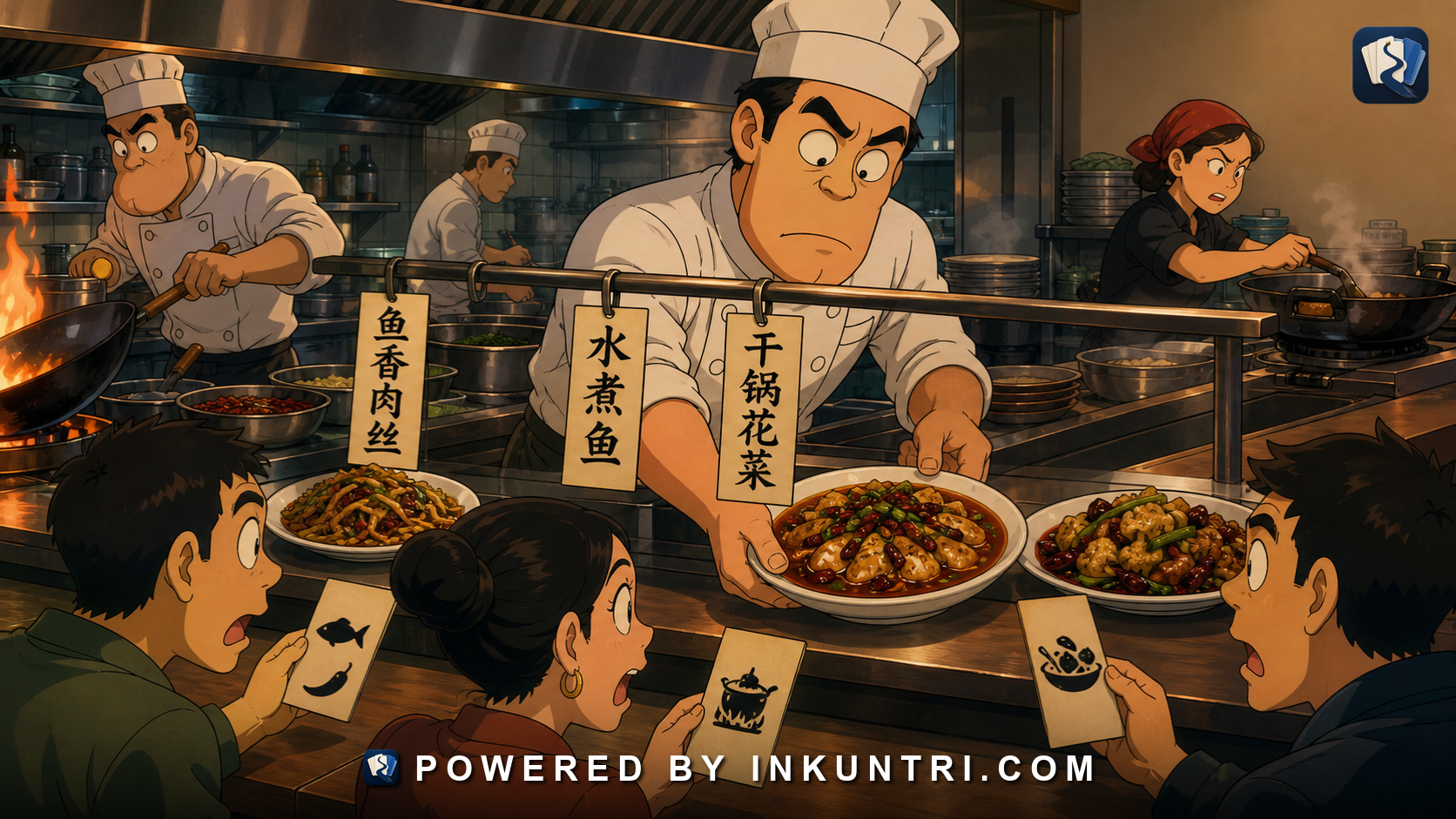
Recommended feature module: Menu parser: users click characters in a menu item and label ingredient, cooking method, flavor, region/style, vessel, texture, and dish category. Related internal articles: 003, 015, 016, 017, 020, 021, 032.
Summary for readers
Chinese menus do not behave like textbook dialogues. A textbook sentence might tell you who does what to whom. A menu entry usually gives you a compact label: ingredient + cooking method + flavor profile + shape + regional style + dish type. There may be no subject, no verb in the ordinary sentence sense, and no obvious grammatical glue.
That is why a learner can know every character in a dish name and still not know what will arrive at the table. 鱼香肉丝 does not contain fish. 水煮鱼 is not merely “boiled fish” in the bland English sense. 干锅花菜 is not simply “dry pot cauliflower” as a literal phrase; it names a style of serving and seasoning. Menu literacy is its own skill.
The good news is that menu Chinese is highly patterned. Once you learn the recurring slots, you can decode much more than isolated vocabulary lists allow.
1. A menu item is usually a label, not a sentence
A beginner Mandarin textbook naturally emphasizes complete, teachable sentences:
我要一碗牛肉面。 I want a bowl of beef noodles.
A real menu is more likely to show:
红烧牛肉面 酸辣汤 干锅花菜 鱼香肉丝 清蒸鲈鱼
These entries are not full sentences. They are labels made from compact compounds. The grammar is closer to a product catalog, ingredient tag, or newspaper headline than to a conversation.
The entry 红烧牛肉面 can be read as:
- 红烧 — red-braised / soy-braised cooking style
- 牛肉 — beef
- 面 — noodles
No character says “with,” “served as,” or “cooked in.” The reader supplies those relationships from menu convention.
This is the first rule of menu literacy:
Do not ask first, “What is the sentence?” Ask, “What slots are being filled?”
Most Chinese menu entries are built from a small number of slots:
- main ingredient
- cut or shape
- cooking method
- flavor or sauce
- region, person, or style name
- dish type, vessel, or serving format
A single dish may use only two slots. A more descriptive dish may use five.
2. The six main slots in Chinese menu names
Menu Chinese is compressed, but it is not random. The same characters recur because restaurants need to tell diners a few practical things quickly: What is it made of? How is it cooked? What will it taste like? What form will it take?
Slot 1: Ingredient
Ingredient characters are often the anchor of the dish. If you can find the ingredient, you can usually orient yourself.
| Character or word | Pinyin | Common meaning on menus | Notes |
|---|---|---|---|
| 鸡 | jī | chicken | Often appears as 鸡丁, 鸡片, 鸡翅. |
| 牛肉 | niúròu | beef | 牛 alone may appear in compounds but 牛肉 is clearer. |
| 猪肉 | zhūròu | pork | Often shortened by context; 肉 alone often means pork in many menu contexts. |
| 羊肉 | yángròu | lamb or mutton | Common in northern, Muslim, hotpot, and skewer contexts. |
| 鱼 | yú | fish | May be a real ingredient, unlike 鱼香. |
| 虾 | xiā | shrimp | Also 虾仁 for shelled shrimp meat. |
| 豆腐 | dòufu | tofu | Appears in 麻婆豆腐, 家常豆腐, 红烧豆腐. |
| 蛋 | dàn | egg | 鸡蛋 is chicken egg; 蛋花 in soup means egg ribbons. |
| 菜 | cài | vegetable; dish | Context decides whether it means “vegetable” or “dish.” |
| 花菜 / 菜花 | huācài / càihuā | cauliflower | Regional preference varies. |
| 土豆 | tǔdòu | potato | In Taiwan, 马铃薯 is more common in formal contexts. |
| 茄子 | qiézi | eggplant | Common in 鱼香茄子, 肉末茄子. |
| 青菜 | qīngcài | leafy greens | Exact vegetable may vary by region and restaurant. |
A practical warning: menu ingredients can be implicit. 麻婆豆腐 names tofu, but the standard restaurant version often contains minced meat unless marked vegetarian. 酸辣汤 may contain egg, meat stock, tofu, mushroom, or other ingredients depending on the kitchen. A dish name is not always an allergen list.
Slot 2: Cut, shape, or texture
Chinese menu names frequently say not just what the ingredient is, but what shape it has been cut into. These characters are small but useful.
| Character | Pinyin | Menu meaning | Example |
|---|---|---|---|
| 丁 | dīng | diced cubes | 宫保鸡丁 — Kung Pao diced chicken |
| 丝 | sī | thin shreds | 鱼香肉丝 — fish-fragrant shredded pork |
| 片 | piàn | slices | 水煮肉片 — Sichuan “water-boiled” meat slices |
| 块 | kuài | chunks / pieces | 土豆烧牛肉块 — potato-braised beef chunks |
| 条 | tiáo | strips | 薯条 — fries; 鱼条 — fish strips |
| 末 | mò | minced bits | 肉末茄子 — eggplant with minced meat |
| 泥 | ní | mash / paste | 蒜泥白肉 — pork with garlic paste |
| 丸 | wán | balls | 鱼丸汤 — fish ball soup |
| 排 | pái | cutlet / rib portion | 猪排, 排骨 |
These characters can prevent bad guesses. A learner may know 肉 as “meat,” but 肉丝, 肉片, 肉末, and 肉丸 describe different eating experiences.
Slot 3: Cooking method
Cooking-method characters are among the highest-value menu characters. They tell you whether the dish is stir-fried, steamed, roasted, braised, stewed, boiled, deep-fried, served cold, or served in broth.
| Character or word | Pinyin | Rough meaning | What it often signals |
|---|---|---|---|
| 炒 | chǎo | stir-fry | Hot wok, oil, quick cooking; often dry-ish rather than soupy. |
| 煮 | zhǔ | boil / cook in liquid | Can be plain, but in Sichuan names 水煮 often means spicy oil-broth style. |
| 炖 | dùn | stew / simmer | Longer cooking, broth or sauce, softer texture. |
| 蒸 | zhēng | steam | Often light, whole fish or buns; 清蒸 means plain/clear steaming. |
| 烤 | kǎo | roast / grill / bake | Dry heat; skewers, duck, breads, meats. |
| 煎 | jiān | pan-fry | Contact with hot pan and oil; browned surface. |
| 炸 | zhá | deep-fry | Crisp texture, more oil. |
| 爆 | bào | quick high-heat stir-fry | Fast, intense heat; common in 爆炒. |
| 卤 | lǔ | braise in master stock | Soy-spice braising liquid; often served sliced or cold/warm. |
| 烧 | shāo | braise / cook down | Broad term; 红烧 is a major style. |
| 拌 | bàn | mix / toss | Often cold dishes: 凉拌黄瓜. |
| 煲 | bāo | clay-pot or pot-cooked dish | Also appears in soups and rice dishes. |
| 干锅 | gānguō | dry-pot style | Served in a heated vessel; usually strongly seasoned. |
This table is not a technical culinary taxonomy. It is a learner’s reading map. Different regions and kitchens use terms differently, and some dish names are conventional rather than descriptive. Still, method characters are often the fastest way to predict what kind of dish you are ordering.
Slot 4: Flavor or sauce
Flavor words can be literal, regional, poetic, or conventional. They often describe a sauce profile more than a single ingredient.
| Flavor term | Pinyin | Likely meaning | Example |
|---|---|---|---|
| 酸辣 | suānlà | sour-spicy | 酸辣汤 |
| 麻辣 | málà | numbing-spicy | 麻辣香锅 |
| 香辣 | xiānglà | fragrant-spicy | 香辣虾 |
| 鱼香 | yúxiāng | “fish-fragrant” Sichuan flavor profile | 鱼香肉丝, 鱼香茄子 |
| 糖醋 | tángcù | sweet-sour | 糖醋排骨 |
| 蒜蓉 | suànróng | minced garlic sauce/paste | 蒜蓉粉丝蒸扇贝 |
| 咖喱 | gālí | curry | 咖喱牛肉 |
| 酱爆 | jiàngbào | stir-fried with sauce/paste | 酱爆鸡丁 |
| 椒盐 | jiāoyán | pepper-salt | 椒盐排骨 |
| 葱油 | cōngyóu | scallion oil | 葱油拌面 |
The trap is assuming that every flavor term is literal. 鱼香 is the classic example. In modern menu usage, it points to a seasoning profile associated with Sichuan cooking, often involving pickled chili, garlic, ginger, scallion, soy sauce, sugar, and vinegar. The dish need not contain fish.
Slot 5: Region, person, or style
Many dish names contain a place, person, school, or style label.
| Label | Pinyin | What it can signal | Example |
|---|---|---|---|
| 川 | Chuān | Sichuan style | 川味, 川菜, 川北凉粉 |
| 湘 | Xiāng | Hunan style | 湘菜, 湘味小炒 |
| 粤 | Yuè | Cantonese / Guangdong style | 粤菜 |
| 京 | Jīng | Beijing style | 京酱肉丝 |
| 本帮 | běnbāng | Shanghai local style | 本帮红烧肉 |
| 东北 | Dōngběi | Northeast China style | 东北乱炖 |
| 宫保 | gōngbǎo | Kung Pao style | 宫保鸡丁 |
| 麻婆 | mápó | Mapo style / story-associated name | 麻婆豆腐 |
| 扬州 | Yángzhōu | Yangzhou-associated style/name | 扬州炒饭 |
Region labels help, but they are not guarantees. A restaurant outside Sichuan may put 川味 on a dish to mean “Sichuan-ish” or “spicy.” A dish that originated in one region may be adapted nationwide.
Slot 6: Dish type, vessel, or serving format
A final slot often tells you what kind of item it is: soup, noodles, rice, hotpot, clay pot, cold dish, snack, or main dish.
| Word | Pinyin | Meaning | Example |
|---|---|---|---|
| 汤 | tāng | soup | 酸辣汤 |
| 面 | miàn | noodles | 牛肉面 |
| 饭 | fàn | rice / meal | 炒饭, 盖饭 |
| 粥 | zhōu | congee | 皮蛋瘦肉粥 |
| 锅 | guō | pot / wok / hotpot-like serving | 干锅花菜 |
| 煲 | bāo | pot / casserole | 砂锅煲, 煲仔饭 |
| 砂锅 | shāguō | clay pot | 砂锅米线 |
| 凉菜 | liángcài | cold dish | 凉拌黄瓜 |
| 小吃 | xiǎochī | snack / small eat | 成都小吃 |
| 套餐 | tàocān | set meal | 商务套餐 |
A menu often groups items under category headers such as 凉菜, 热菜, 主食, 汤类, 饮品. Those headers are part of the reading context. If you ignore them, you lose information.
3. Why textbook vocabulary can mislead you on menus
Textbooks teach stable meanings first. Menus use conventional meanings that may be narrower, broader, or more idiomatic.
鱼香 does not mean “fish is in it”
A learner sees:
鱼香肉丝
and may parse:
- 鱼 = fish
- 香 = fragrant
- 肉 = meat
- 丝 = shreds
That is not a terrible character-level reading, but it is not enough. 鱼香 is a named flavor profile. The dish is usually shredded pork, not fish. It may taste sweet, sour, savory, garlicky, and mildly or moderately spicy depending on the kitchen.
The practical reading is:
鱼香 + 肉丝 fish-fragrant-style sauce + shredded pork
水煮 does not always mean bland boiling
The phrase 水煮 literally contains 水 “water” and 煮 “boil.” But in a Sichuan restaurant, 水煮鱼 or 水煮肉片 usually means a spicy dish served in a vivid broth or oil-laced sauce with chili and Sichuan pepper. Translating it as “boiled fish” underpredicts the dish dramatically.
The practical reading is:
水煮 + 鱼 Sichuan water-boiled style + fish
干锅 is not just “dry pot”
干锅花菜 is a famous learner trap because 干 means “dry,” 锅 means “pot,” and 花菜 means “cauliflower.” The literal pieces are useful, but the menu phrase refers to a style: a strongly seasoned dish served in a small wok or pot, often kept warm, often with chili, aromatics, and sometimes pork or bacon unless specified otherwise.
The practical reading is:
干锅 + 花菜 dry-pot style + cauliflower
肉 can mean pork unless specified
In many ordinary Mainland menu contexts, 肉 without a modifier often means pork. 肉丝 is likely shredded pork; 肉末 is likely minced pork. But this is not a universal rule across all cuisines, regions, religious contexts, or translated menus. In halal restaurants, 肉 may be used differently, and 羊肉 or 牛肉 will be more explicit.
The practical rule is:
When the animal matters, look for 鸡, 牛, 猪, 羊, 鱼, 虾, or ask.
4. A menu parser for real dish names
Below are common dishes from the example bank, parsed by slot.
| Dish | Slot-by-slot parse | What to expect | Learner warning |
|---|---|---|---|
| 宫保鸡丁 | 宫保 style + 鸡 chicken + 丁 diced | Diced chicken, often with peanuts and chili-sweet-savory sauce | 宫保 is a named style, not a transparent everyday word. |
| 鱼香肉丝 | 鱼香 flavor profile + 肉 pork + 丝 shreds | Shredded pork in fish-fragrant Sichuan-style sauce | Usually no fish. 肉 likely pork. |
| 红烧牛肉 | 红烧 red-braised + 牛肉 beef | Beef braised in soy-based sauce | 红烧 is a method/flavor family, not simply “red.” |
| 清蒸鲈鱼 | 清 plain/clear + 蒸 steamed + 鲈鱼 sea bass/perch | Steamed whole fish with light seasoning | 清 suggests clean/light preparation, not “green.” |
| 麻婆豆腐 | 麻婆 named style + 豆腐 tofu | Tofu in spicy/numbing sauce, often with minced meat | Not automatically vegetarian. |
| 干锅花菜 | 干锅 dry-pot style + 花菜 cauliflower | Spicy/savory cauliflower served in a pot | May contain pork/bacon unless marked 素. |
| 酸辣汤 | 酸 sour + 辣 spicy + 汤 soup | Sour-spicy soup | Ingredients vary widely. |
| 炒饭 | 炒 fried/stir-fried + 饭 rice | Fried rice | Exact ingredients depend on modifier or house style. |
The goal is not to memorize one English translation per dish. That is brittle. The better goal is to see how the dish name is assembled.
5. How category headers change interpretation
Menu entries live inside sections. The section title often tells you what kind of item the restaurant thinks it is.
| Header | Pinyin | Meaning | What it tells you |
|---|---|---|---|
| 凉菜 | liángcài | cold dishes | Often appetizers or small plates; may include cucumber, tofu, meats. |
| 热菜 | rècài | hot dishes | Main cooked dishes. |
| 主食 | zhǔshí | staple foods | Rice, noodles, buns, dumplings, congee. |
| 汤类 | tānglèi | soups | Soups; may be clear, thick, spicy, or medicinal-style. |
| 小吃 | xiǎochī | snacks | Dumplings, buns, regional snacks, street-food-like items. |
| 饮品 | yǐnpǐn | drinks | Tea, juice, soft drinks, alcohol-free beverages, sometimes alcohol elsewhere. |
| 特色菜 | tèsècài | specialties | House or regional specialties; not necessarily “special” in price. |
| 推荐 | tuījiàn | recommended | Restaurant recommendation, not a guarantee of popularity. |
| 时价 | shíjià | market price | Price varies; common for seafood or seasonal items. |
If 拍黄瓜 appears under 凉菜, it is smashed cucumber as a cold dish. If 黄瓜炒蛋 appears under 热菜, it is cucumber stir-fried with egg. The ingredient is similar; the menu category changes the expected dish.
6. Character clues for heat, spice, and dietary risk
A menu does not always tell you everything you need to know, but certain characters deserve attention.
Spice and heat
| Character or word | Pinyin | Meaning | Notes |
|---|---|---|---|
| 辣 | là | spicy | General spice marker. |
| 麻 | má | numbing | Often Sichuan peppercorn effect. |
| 麻辣 | málà | numbing-spicy | Stronger warning than 辣 alone. |
| 香辣 | xiānglà | fragrant-spicy | Often chili-forward. |
| 酸辣 | suānlà | sour-spicy | Common in soups and noodles. |
| 微辣 | wēilà | mildly spicy | “Mild” varies by region. |
| 中辣 | zhōnglà | medium spicy | Restaurant-specific. |
| 特辣 | tèlà | extra spicy | Take seriously. |
Vegetarian and allergy terms
| Term | Pinyin | Meaning | Caveat |
|---|---|---|---|
| 素 | sù | vegetarian / meatless | May still include egg, dairy, oyster sauce, or animal stock depending on context. |
| 全素 | quánsù | fully vegetarian/vegan-like in some contexts | Still confirm if strict vegan. |
| 清真 | qīngzhēn | halal | Common in Muslim restaurants; pork avoided. |
| 花生 | huāshēng | peanut | Common in 宫保 dishes and cold dishes. |
| 芝麻 | zhīma | sesame | Appears as oil, paste, seeds. |
| 海鲜 | hǎixiān | seafood | May include shrimp, shellfish, fish. |
| 过敏 | guòmǐn | allergy | Use in questions: 我对花生过敏. |
A serious dietary restriction requires asking. Menus are dish labels, not legal ingredient disclosures.
Useful questions:
- 这个辣吗? — Is this spicy?
- 里面有肉吗? — Is there meat inside?
- 有花生吗? — Are there peanuts?
- 可以不放香菜吗? — Can you leave out cilantro?
- 这是素的吗? — Is this vegetarian?
- 我对海鲜过敏。 — I am allergic to seafood.
7. The practical menu-reading workflow
Use this when a menu item looks dense.
Step 1: Read the category header
Before you decode a dish, look above it. Is it under 凉菜, 热菜, 主食, 汤类, 小吃, 饮品, or 特色菜?
This tells you whether you are dealing with a cold appetizer, hot dish, staple, soup, snack, drink, or specialty.
Step 2: Find the anchor ingredient
Look for characters such as 鸡, 牛, 羊, 鱼, 虾, 豆腐, 蛋, 茄子, 土豆, 青菜, 面, 饭, 汤. If you cannot identify the ingredient, the dish may be conventional, poetic, seasonal, or region-specific.
Step 3: Find the method
Look for 炒, 蒸, 煮, 炖, 煎, 烤, 炸, 卤, 烧, 拌, 煲, 干锅. This predicts texture and serving style.
Step 4: Find flavor words
Look for 酸, 辣, 麻, 香, 糖醋, 鱼香, 蒜蓉, 咖喱, 椒盐. These predict taste better than the ingredient alone.
Step 5: Identify shape and portion clues
Look for 丁, 丝, 片, 块, 末, 丸, 排, 条. These help you picture the dish and distinguish similar names.
Step 6: Treat famous names as names
If a dish name contains 宫保, 麻婆, 扬州, 东坡, 佛跳墙, 回锅, or another conventional label, do not translate character by character and stop. Look up the dish as a named dish.
Step 7: Ask when it matters
Machine translation can help, but it often fails on conventional dish names. If spice level, meat, alcohol, seafood, peanuts, or animal stock matters, ask a direct question.
8. Why machine translation often fails on menus
Menu translation is hard because the name can encode history, method, region, metaphor, and restaurant branding at once.
A machine may produce a literal translation such as:
- “fish-flavored shredded pork” for 鱼香肉丝
- “water boiled fish” for 水煮鱼
- “dry pot cauliflower” for 干锅花菜
- “old godmother tofu” if it misreads a brand or name
These translations can be useful as hints, but they are not enough for ordering. A good human menu reading asks:
- Is this a dish name or a literal description?
- What is the main ingredient?
- What is the cooking method?
- What is the flavor profile?
- Is there a hidden ingredient implied by convention?
- What does this restaurant category tell me?
A menu is not a dictionary test. It is a practical decoding task.
9. What serious learners should memorize first
Do not start with hundreds of dish names. Start with reusable menu characters.
High-value method characters
炒, 蒸, 煮, 炖, 烤, 煎, 炸, 卤, 烧, 拌, 煲, 干锅
High-value ingredient words
鸡, 牛肉, 羊肉, 猪肉, 鱼, 虾, 豆腐, 蛋, 茄子, 土豆, 青菜, 面, 饭, 汤
High-value flavor words
酸, 辣, 麻, 香, 糖醋, 鱼香, 蒜蓉, 咖喱, 椒盐, 红烧, 清蒸
High-value shape words
丁, 丝, 片, 块, 末, 丸, 条, 排
Once these are familiar, menus become less like walls of unknown characters and more like compact formulas.
10. Practice: parse the dish before translating it
Try parsing before looking up a finished English translation.
Example 1: 蒜蓉粉丝蒸扇贝
- 蒜蓉 — minced garlic paste/sauce
- 粉丝 — glass noodles
- 蒸 — steamed
- 扇贝 — scallops
Natural reading: steamed scallops with garlic and glass noodles.
Example 2: 香辣虾
- 香辣 — fragrant-spicy
- 虾 — shrimp
Natural reading: spicy aromatic shrimp. The method may not be explicit; the restaurant category or photo may help.
Example 3: 肉末茄子
- 肉末 — minced meat, likely pork in many ordinary contexts
- 茄子 — eggplant
Natural reading: eggplant with minced meat.
Example 4: 凉拌黄瓜
- 凉拌 — cold mixed/tossed
- 黄瓜 — cucumber
Natural reading: cold cucumber salad.
Example 5: 红烧排骨
- 红烧 — red-braised
- 排骨 — ribs
Natural reading: red-braised ribs.
Module goal: Let readers learn menu structure by labeling real dish names rather than memorizing translations.
Input: A dish name, category header, optional restaurant type, optional photo.
User actions:
- Click characters or character groups.
- Assign labels: ingredient, method, flavor, cut/shape, style/region, vessel, dish type.
- Flag possible hidden risks: spicy, meat, peanuts, seafood, alcohol, cold dish.
- Compare a literal character gloss with a natural dish reading.
Example module state:
Dish: 鱼香肉丝 Labels:
- 鱼香 = flavor profile
- 肉 = likely pork ingredient
- 丝 = cut/shape
Warnings:
- Not fish by default.
- Likely contains pork.
- Often mildly or moderately spicy.
Expansion idea: Add a “confidence meter” for machine translation. Named dishes and poetic menu items should be marked lower confidence than fully descriptive items like 清蒸鲈鱼.
Editorial notes for Article 019
- Avoid presenting dish descriptions as universal recipes. Chinese restaurant menus vary by region, restaurant level, country, religious context, and house style.
- Treat famous names as conventional labels. Do not over-etymologize 鱼香, 宫保, 麻婆, 回锅, 东坡, or similar dish names in the main article.
- Add photos only if rights are clear. A clean diagram of dish-name slots is more reusable than borrowed food photography.
Related reading
Building a Mandarin Reader Workflow From News, Documents, and Literature
The reader can build a sustainable Mandarin reading workflow that combines current news, practical documents, essays, and literature without drowning in vocabulary.
Designing Chinese Anki Cards for Words, Characters, and Collocations
The reader can design Chinese flashcards that train recognition, pronunciation, meaning, collocation, character form, and contextual use without turning review into trivia.
The May Fourth Language Shift and the Rise of 白话
The reader understands how modern written Chinese emerged from debates over education, literature, modernization, and accessibility.
A Serious Learner’s Guide to Chinese Dictionaries
The reader can use Chinese dictionaries more deeply by reading definitions, parts of speech, usage notes, examples, synonyms, variants, and register labels.
Chinese Pronunciation Self-Diagnosis With Recording and Native Models
The reader can diagnose Mandarin pronunciation problems through recording, comparison, targeted drills, and structured feedback rather than vague “tone practice.”
How to Mine Chinese Sentences Without Collecting Bad Examples
The reader can collect useful Chinese example sentences while avoiding decontextualized, mistranslated, unidiomatic, outdated, or register-mismatched examples.