
How Chinese Dictionaries Index Characters: Radical, Stroke, Pinyin, and Digital Search
The reader can choose the right lookup method for unknown characters in print, handwriting, and digital contexts.
Core examples: 语, 部, 街, 餐, 龟/龜, 赢/贏, 鬱, 麟.
Lookup is part of Chinese literacy
A learner who reads alphabetic languages often assumes that dictionary lookup is a solved problem: find the first letter, then the second, then the third. Chinese breaks that expectation.
A Chinese character does not tell you its place in an alphabet. It may contain a phonetic component, but that component does not always give the modern pronunciation. It may contain a semantic component, but that component is not always the dictionary index. The character may also be printed, handwritten, stylized, simplified, traditional, rare, variant, blurred in a screenshot, or embedded inside a word whose meaning is not obvious from the individual characters.
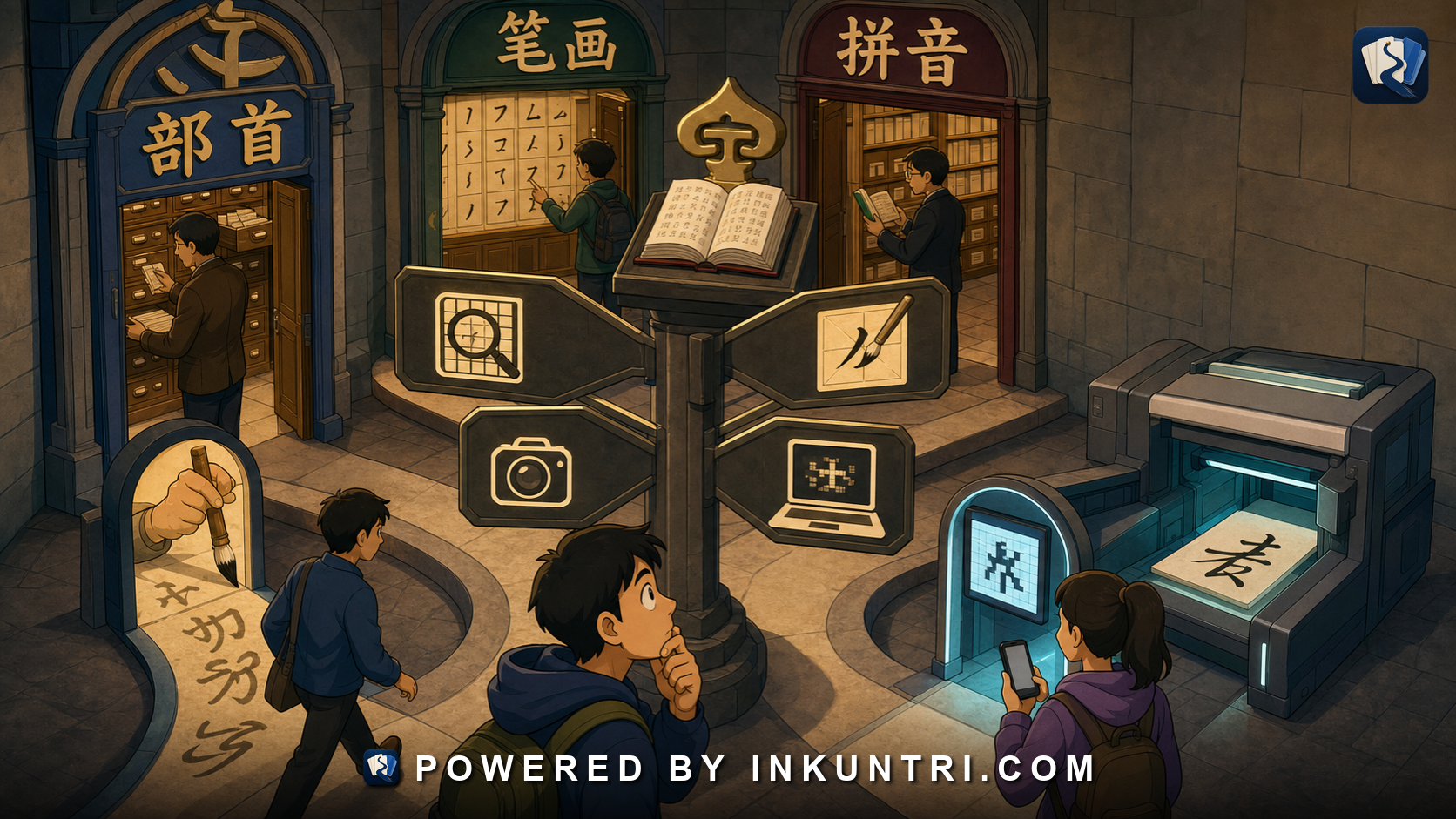
That is why Chinese dictionaries grew more than one front door. You can enter through sound, shape, stroke count, components, handwriting, OCR, or copy-paste. Each method answers a different practical situation.
The main skill is not memorizing one “correct” lookup method. The main skill is choosing the method that matches what you actually know.
If you know how a character is pronounced, Pinyin lookup is fast. If you can see the character but do not know the sound, radical-and-stroke lookup is still powerful. If the character is in a photo, OCR may work. If the printed form is too complex, handwriting input or component search may be better. If the character is already digital text, copy-paste is usually the fastest path.
Chinese lookup is not a single staircase. It is a building with several doors.
Character dictionary, word dictionary, reader tool
Before talking about indexing, separate three related tools.
A character dictionary explains a single written character: pronunciation, stroke count, radical, variant forms, meanings, and example compounds. This is the traditional world of 字典.
A word dictionary explains lexical units: words, compounds, idioms, technical terms, names, and set phrases. This is closer to 词典. If you look up 经济, you need an entry for the word, not just separate entries for 经 and 济.
A reader tool or digital annotation tool sits on top of a text and tries to segment words, display pronunciation, translate, and connect each character or word to dictionary entries.
Learners often mix these up. They tap one character and expect the full word meaning. They look up a two-character word and expect each character to explain it. They search a dictionary by Pinyin but forget that many characters share the same syllable. Good lookup means knowing which layer you are asking about.
Consider:
语言学习很有意思。A character lookup can tell you:
| Character | Basic information |
|---|---|
| 语 | yǔ; language, speech; often under 讠/言-related indexing |
| 言 | yán; speech, words; traditional form appears in many speech-related characters |
| 学 | xué; study, learning |
| 习 | xí; practice, habit |
A word lookup gives different units:
| Word | Meaning |
|---|---|
| 语言 | language |
| 学习 | to study; learning |
| 有意思 | interesting; meaningful, depending on context |
A reader tool should ideally show both: characters as written evidence, words as units of use. That distinction will matter again when a dictionary asks you to identify a radical or count strokes.
Why graphic indexing existed before alphabetic lookup
Chinese dictionaries historically could not simply alphabetize characters by modern Mandarin pronunciation. There was no single national alphabetic spelling system used for general character order, and the same written character may have different pronunciations across time, region, and language variety. Even within modern Mandarin, many characters share the same syllable and tone.
So traditional Chinese lexicography depended heavily on the shape of the character. Shape can be organized. A character can be grouped under a radical. The remaining strokes can be counted. Characters can be sorted by graphic features even when the reader does not know the sound.
This is the logic behind 部首检字法, radical lookup.
The system is not perfect. Characters are historical objects, and their modern shapes do not always advertise their structure clearly. But radical-and-stroke lookup solves a real problem: “I can see this character, but I do not know how to say it.”
That is still a live problem. It happens with old books, menus, calligraphy, names, street signs, scanned documents, product labels, subtitles, and screenshots.
The radical-and-stroke method
A traditional radical-and-stroke lookup works like this.
Step 1: Choose the likely indexing radical
The radical is the component under which the dictionary files the character. It may be a meaningful part of the character. It may also be an indexing convention.
For 语, the likely radical is 讠, the simplified side form of 言. That is a good learner-friendly case: speech-related character, speech-related radical.
语 = 讠 + 吾For 餐, the likely radical in many traditional systems is 食, because the character is food-related and contains a food component. This is also friendly once you know what to look for.
For 街, the story is trickier. The visible form suggests several possible components: 行 on the outside, 圭 in the middle, and perhaps left-side movement-like elements. Different dictionary traditions can treat such characters differently. Modern school dictionaries may not match older philological dictionaries. A learner should not panic when one source indexes a character differently from another.
For 鬱, radical choice becomes a real test of tool design. The character is complex, dense, and not beginner-friendly. A paper dictionary forces you to choose and count. A modern app should let you search by handwriting, OCR, components, total strokes, or copy-paste.
Step 2: Count the radical strokes
In a paper radical index, radicals are usually grouped by the number of strokes in the radical.
For example:
| Radical | Common name | Stroke count in simplified form | Typical learner association |
|---|---|---|---|
| 讠 | 言字旁 | 2 | speech, language, words |
| 氵 | 三点水 | 3 | water, liquid |
| 扌 | 提手旁 | 3 | hand/action |
| 忄 | 竖心旁 | 3 | heart, feeling, mental state |
| 贝 | 贝字旁 | 4 | money, value, shell-derived meanings |
| 食 / 饣 | 食字旁 | varies by form | food, eating |
Stroke count depends on the form. A traditional form such as 言 has more strokes than simplified 讠. A printed dictionary tells you which form it is using.
Step 3: Count the remaining strokes
After choosing the radical, count the strokes outside the radical. This is often called the “residual” or “remaining” stroke count.
For 语:
语 = 讠 + 吾The radical is 讠. The remaining part is 吾. In a simplified-character lookup, you would look under 讠 and then under the residual stroke count for 吾.
For 赢/贏, the situation is harder. The simplified form 赢 still contains several internal pieces. The traditional form 贏 is visually heavier. A dictionary may index the character under 贝/貝 or route it according to a standard radical assignment. If the learner chooses the wrong visible piece first, the paper search may fail.
That failure does not mean the learner is stupid. It means character indexing is conventional.
Step 4: Find the candidate list
Within the chosen radical and residual stroke count, a dictionary gives a list of characters. You scan the list until the character appears, then go to the page or entry.
This is where stroke-count errors matter. If you miscount by one stroke, you may be in the wrong list. Common traps include:
- treating connected printed strokes as one stroke when they are two
- counting a radical form by its full independent form instead of its side form
- not knowing whether a dot is separate
- confusing traditional and simplified stroke counts
- choosing a component that is not the indexing radical
Digital dictionaries soften this problem by letting you try multiple paths.
Step 5: Verify with pronunciation and words
Once you find the character, do not stop at the first gloss. Check pronunciation, example words, and usage.
A character entry for 语 may show:
语 yǔ: language; speech; words
语 yù: to tell, in some older or literary uses
For everyday modern Mandarin, 语言 yǔyán and 汉语 Hànyǔ are more important than an isolated gloss. Serious lookup ends with words, not only characters.
Radical lookup is not a morality test
Learners sometimes treat radical lookup as if it were an exam in “real Chinese.” That is the wrong attitude.
Paper radical lookup is a useful literacy skill, especially for print, school materials, older dictionaries, and archival work. But it is also slow. Native readers do not always enjoy it either. Modern readers use Pinyin input, handwriting input, OCR, online dictionaries, and search engines because those tools are efficient.
The point is not to suffer through the hardest method. The point is to know which method will rescue you when the easy method fails.
A learner who can use only Pinyin lookup is vulnerable. If the character is unknown, Pinyin is unavailable. A learner who can use only handwriting input is also vulnerable. If the font is stylized or the character is partially hidden, handwriting may fail. A robust reader has several fallback methods.
Pinyin lookup
Pinyin lookup is the easiest method when you know the standard Mandarin pronunciation.
You hear or know the sound:
yǔThen you search under yu or yǔ and find candidates such as:
与, 予, 语, 雨, 羽, 宇, 玉, 遇, 欲...Pinyin lookup is powerful for vocabulary review and known characters. It is less useful when:
- you do not know the pronunciation
- the character has multiple readings
- you know a regional pronunciation but the dictionary is organized by standard Mandarin
- you heard the word unclearly
- the syllable has many homophones
- you need a rare name character
Pinyin lookup also tempts learners to think sound-first even when the text is visual. That can be good for pronunciation practice, but it is not enough for serious reading.
A common beginner mistake is to look up a word by typing what they think they heard, find a plausible character, and accept it too quickly. In Chinese, plausible homophones are everywhere. Confirm with context and written form.
Total-stroke lookup
Some dictionaries let you search by total stroke count. This method is useful when you cannot identify the radical.
For a character like 鬱, total-stroke lookup may still be painful, because counting a dense character accurately is difficult. But for moderately complex characters, total strokes can narrow the field.
Total-stroke lookup is also useful in digital tools. If you know that a character has about 16 strokes and contains 贝, you can combine filters. If you are wrong by one stroke, a good tool should let you browse nearby counts.
Four-corner and shape-based systems
Chinese lexicography also developed shape-based methods that are not simple radical lookup. The four-corner method indexes characters according to shapes at the four corners. Shape-based input methods such as Wubi use component and stroke patterns to type characters.
Most foreign learners of Mandarin do not need to master four-corner or Wubi early. But they should know these systems exist because they explain a broader point: Chinese lookup can be graphic without being radical-based.
Shape-based systems are especially useful when pronunciation is unknown or irrelevant. They also show why “Chinese has no alphabet” is not the same as “Chinese has no order.” Chinese has many ordering systems. They just do not all behave like ABC order.
Handwriting input
Handwriting input is the modern learner’s emergency tool. You draw the character with a finger, stylus, or mouse, and the software guesses candidates.
It works best when:
- the character is printed clearly
- you understand the approximate stroke order
- you can reproduce the overall shape
- the character is common enough for the recognizer
It works poorly when:
- the source is calligraphic or cursive
- the character is rare or a variant
- you draw components in the wrong relative positions
- you confuse simplified and traditional forms
- the recognizer aggressively autocorrects to common characters
Handwriting input is a lookup method, not a substitute for character knowledge. If you can draw only a vague box with lines inside, the recognizer may give you a plausible but wrong character.
A good practice habit is to use handwriting input, then confirm with example words. If you drew 麟 and the tool returns 麟, check 麒麟, 凤毛麟角, or a dictionary entry before accepting it.
OCR and camera lookup
OCR can read characters from images: menus, signs, screenshots, scanned books, subtitles, packaging, and forms. It is often the fastest method when you cannot copy text.
OCR is excellent for clean modern print. It struggles with:
- low resolution
- glare or shadows
- handwriting
- calligraphy
- vertical text
- decorative fonts
- old print
- rare variants
- mixed simplified/traditional text
- complex layouts with tables or stamps
A serious reader should treat OCR as a first pass, not a verdict. If an OCR result makes no sense, compare the character shapes manually. One wrong character can break a name, address, medicine label, or legal phrase.
For example, OCR may confuse visually similar characters when the image is blurry. In ordinary entertainment reading, this is annoying. In addresses, names, finance, medicine, or law, it matters.
Component search
Component search lets you search for characters by visible parts. This is one of the best modern bridges between old radical lookup and digital convenience.
Suppose you see a character containing:
鹿 + 粦A component search can lead you to:
麟This is more flexible than radical lookup because you do not have to know which component is the indexing radical. You can search by pieces you recognize.
Component search also helps with characters like 赢/贏. You may see 贝/貝, 月-like shapes, 亡, 口, or 凡-like pieces. A component tool can narrow the search even if you do not know the official radical assignment.
The limitation is that component databases differ. One tool may break a character into modern printed components. Another may use historical or encoding-based components. A third may normalize simplified and traditional forms. Do not assume that every component search uses the same decomposition.
Copy-paste is not cheating
If the character is already digital text, copy it. Paste it into a dictionary, search engine, or reader tool.
This sounds obvious, but learners sometimes avoid copy-paste because they think they are “supposed” to know the radical. That is wasted time. Use the fastest reliable method first. Then use the dictionary entry to learn what you need.
Copy-paste can fail when:
- the text is actually an image
- the page blocks selection
- the copied character is a compatibility form or rare variant
- the font displays one form while the underlying Unicode character is another
- the text contains OCR errors
When copy-paste produces strange results, inspect the character in multiple fonts or use a dictionary that shows code point, variant, and radical data.
Dictionaries are linguistic artifacts
A good Chinese dictionary entry does more than answer “what does this character mean?” It encodes a view of the language.
A character entry may include:
| Field | Why it matters |
|---|---|
| 字形 | Shows the written form and sometimes variants. |
| 拼音 / 注音 | Gives pronunciation in a notation system. |
| 部首 | Shows how the dictionary indexes the character. |
| 笔画 | Helps lookup and handwriting. |
| 释义 | Gives meanings, often ordered by usage or history. |
| 词语 | Shows compounds and modern words. |
| 例句 | Shows usage in context. |
| 异体字 | Helps with names, archives, and old print. |
| 繁简关系 | Helps with cross-region reading and conversion. |
| 量词 / classifiers | Important for nouns and real usage. |
Learners should care about this because dictionary entries are not interchangeable. A school dictionary, a historical dictionary, a learner dictionary, a Taiwan dictionary, a Mainland dictionary, a Cantonese resource, and a Unicode database may answer different questions.
If you are reading a modern Mainland menu, you need modern simplified entries and food vocabulary. If you are reading a Taiwan birth record, variant and traditional forms matter. If you are reading an old inscription, a normal learner app may not be enough.
Example walkthroughs
语
语Useful lookup paths:
| What you know | Best method |
|---|---|
| You know yǔ | Pinyin lookup. |
| You see 讠 + 吾 | Radical/component lookup. |
| You see it in 语言 | Word lookup for 语言. |
| You have digital text | Copy-paste. |
Learner note: 语 is a friendly example because the radical 讠 aligns with the speech/language domain. Do not assume every character will be this nice.
部
部Useful lookup paths:
| What you know | Best method |
|---|---|
| You know bù | Pinyin lookup. |
| You see a right-side 阝 | Radical lookup may work, depending on dictionary assignment. |
| You see it in 部首, 部门, 全部 | Word lookup. |
Learner note: 部 is a good reminder that a character used to talk about radicals is itself a character with ordinary word uses: 部首, 部门, 一部分, 全部.
街
街Useful lookup paths:
| What you know | Best method |
|---|---|
| You know jiē | Pinyin lookup. |
| You recognize 行/彳-like structure | Try radical or component lookup. |
| You see it in 街道, 小吃街 | Word lookup. |
Learner note: 街 is a warning against treating radical assignment as self-evident. Older and modern indexing traditions can differ. Use the dictionary’s own index rules.
餐
餐Useful lookup paths:
| What you know | Best method |
|---|---|
| You know cān | Pinyin lookup. |
| You recognize 食 | Radical lookup. |
| You see 早餐, 午餐, 晚餐, 餐厅 | Word lookup. |
Learner note: Here the semantic domain is visible: food and eating. This helps memory, but the word-level compounds matter more than the isolated character.
龟 / 龜
龟 / 龜Useful lookup paths:
| What you know | Best method |
|---|---|
| You know guī | Pinyin lookup. |
| You see simplified 龟 or traditional 龜 | Script-aware dictionary lookup. |
| You meet a name or place | Check pronunciation carefully. |
Learner note: Traditional 龜 is visually much more complex than simplified 龟. This is a good example of why script awareness matters in lookup.
赢 / 贏
赢 / 贏Useful lookup paths:
| What you know | Best method |
|---|---|
| You know yíng | Pinyin lookup. |
| You recognize 贝/貝 | Component or radical lookup. |
| You see 输赢, 赢得, 赢利 | Word lookup. |
Learner note: The simplified form is still complex. Do not assume simplified means easy.
鬱
鬱Useful lookup paths:
| What you know | Best method |
|---|---|
| You know yù | Pinyin lookup. |
| You can copy it | Copy-paste. |
| You see it in a scan | OCR plus manual confirmation. |
| You only see the shape | Component search or total-stroke/radical lookup. |
Learner note: This character is a stress test. It shows why modern digital lookup methods matter even for serious traditional literacy.
麟
麟Useful lookup paths:
| What you know | Best method |
|---|---|
| You know lín | Pinyin lookup. |
| You recognize 鹿 | Radical lookup. |
| You see 麒麟 | Word lookup. |
Learner note: 麟 shows a semantic-plus-phonetic structure: 鹿 relates to the animal domain; the other side helps historically with sound. Use both clues cautiously.
A real-world decision tree
Use this lookup sequence in the field.
1. Is the text selectable?
If yes, copy-paste into a dictionary or reader.
If no, continue.
2. Is the image clean modern print?
If yes, try OCR.
If OCR gives nonsense, verify manually.
3. Can you draw the character?
If yes, use handwriting input.
If the results are close but not exact, compare components and stroke order.
4. Do you recognize a component?
Use component search. Search for 鹿, 貝/贝, 食/饣, 言/讠, 氵, 扌, 忄, 辶, or another visible piece.
5. Can you identify a likely radical?
Use radical-and-stroke lookup. Count remaining strokes carefully. Try nearby stroke counts if you fail.
6. Do you know or suspect the pronunciation?
Use Pinyin lookup, but confirm the written form because homophones are common.
7. Is the character in a word, name, or address?
Look up the whole unit, not just the character. Names and addresses often require special handling.
Lookup conditions: what to do where
| Situation | Best first method | Backup method | Warning |
|---|---|---|---|
| Printed sign | OCR or handwriting | radical/component lookup | Fonts and glare can confuse OCR. |
| Restaurant menu | OCR or word lookup | component search | Dish names may be poetic or regional. |
| Screenshot | OCR | manual component search | Low resolution creates false characters. |
| Scanned old book | OCR if clean | radical/stroke, variant dictionary | Traditional and variant forms matter. |
| Typed web text | copy-paste | reader tool | Check if text is simplified/traditional/mixed. |
| Handwritten note | handwriting input | ask a reader, compare components | Handwriting may omit or merge strokes. |
| Name on document | copy-paste or OCR | variant dictionary | Do not guess pronunciation from ordinary words. |
| Rare character | Unicode/variant dictionary | component search | Normal learner apps may not cover it. |
What learners should practice
A serious learner does not need to become a paper-dictionary monk. But the following drills are worth doing.
Drill 1: Radical rescue
Take ten unknown printed characters. For each one:
- guess the radical
- count the remaining strokes
- look it up
- record whether the radical guess was correct
- write the word in which you found the character
The goal is not perfection. The goal is to learn how dictionaries classify shapes.
Drill 2: Pinyin trap
Choose a syllable such as shi, yi, yu, or qing. Search it in a dictionary and list ten characters. Then write one common word for each.
This teaches why pronunciation alone is not enough.
Drill 3: Component search
Pick complex characters such as 赢, 麟, 餐, 鬱. Search by visible components. Compare the component breakdown across two tools.
This teaches that components are practical search handles, not always official structural truth.
Drill 4: OCR skepticism
Take a photo of a menu or sign. OCR it. Then manually check five characters against a dictionary. Mark any error.
This trains the habit of trusting OCR only after verification.
What to remember
Chinese dictionary lookup is a literacy system, not a single trick. Radical-and-stroke lookup exists because readers often see characters whose pronunciation they do not know. Pinyin lookup is fast when the sound is known. Handwriting input, OCR, component search, and copy-paste are modern extensions of the same basic problem: how do you enter a character into a reference system?
The best readers are flexible. They do not worship old methods or blindly trust new ones. They choose the fastest reliable path, then confirm at the word level.
Build a reader overlay and lookup simulator with four modes.
Mode 1: Radical-and-stroke challenge
The user sees a character and chooses:
- likely radical
- radical stroke count
- residual stroke count
- candidate from a list
The tool should show alternate dictionary assignments when relevant.
Example:
Character: 语
Likely radical: 讠
Remaining component: 吾
Result: 语 yǔ, as in 语言, 汉语, 语法
Mode 2: Search-method comparison
For each character, show which methods work best:
| Character | Pinyin | radical | handwriting | OCR | component search |
|---|---|---|---|---|---|
| 语 | easy if yǔ known | easy | easy | easy | easy |
| 鬱 | easy if yù known | hard | medium | variable | useful |
| 麟 | easy if lín known | medium | medium | medium | useful |
Mode 3: Field lookup scenarios
Users choose a scenario:
You saw 餐 on a sign but do not know the sound.
What do you do first?
The tool accepts multiple good answers but explains tradeoffs.
Mode 4: Word confirmation
After finding the character, the user must choose the word-level meaning.
语 in 语言 ≠ “speech” alone; 语言 = language.
赢 in 输赢 = win/loss outcome, not just “win” in isolation.
For production fact-checking, consult:
- Unicode Standard Annex #38, Unicode Han Database (Unihan): https://www.unicode.org/reports/tr38/
- 商务印书馆, 《新华字典》第12版 APP feature description: https://www.cp.com.cn/Content/2020/08-27/0956542091.html
- 中国社会科学网, 《〈新华字典〉〈现代汉语词典〉的收字和查字》: https://www.cssn.cn/wx/xslh/202212/t20221231_5576998.shtml
- GF 0011-2009, 《汉字部首表》: https://archive.org/details/GF0011-2009
- GF 0012-2009, 《GB13000.1字符集汉字部首归部规范》: https://archive.org/details/GF0012-2009
- 教育部异体字字典 / 重編國語辭典修訂本 radical search pages for examples such as 鬱, 麟, 贏, 龜: https://dict.revised.moe.edu.tw/ and https://dict.variants.moe.edu.tw/
Related reading
Memes, Homophones, and Political Caution in Chinese Online Culture
The reader can understand how Chinese online users use homophones, euphemisms, abbreviations, and layered jokes to manage sensitivity, moderation, and community recognition.
Designing Chinese Anki Cards for Words, Characters, and Collocations
The reader can design Chinese flashcards that train recognition, pronunciation, meaning, collocation, character form, and contextual use without turning review into trivia.
From Flashcards to Literacy: When Chinese Study Must Leave the Card
The reader can recognize when flashcards are helping and when they are delaying real Chinese literacy, then shift toward connected reading and listening.
A Serious Learner’s Guide to Chinese Dictionaries
The reader can use Chinese dictionaries more deeply by reading definitions, parts of speech, usage notes, examples, synonyms, variants, and register labels.
Chinese Pronunciation Self-Diagnosis With Recording and Native Models
The reader can diagnose Mandarin pronunciation problems through recording, comparison, targeted drills, and structured feedback rather than vague “tone practice.”
Chinese Handwriting in the Age of Phones: Recognition, Forgetting, and Recall
The reader understands why character recognition can outpace handwriting ability and how to train the two separately.