
Character Simplification and Semantic Compression: What Was Gained and Lost
The reader sees simplification as a tradeoff between writing efficiency, standardization, historical transparency, and semantic distinction.
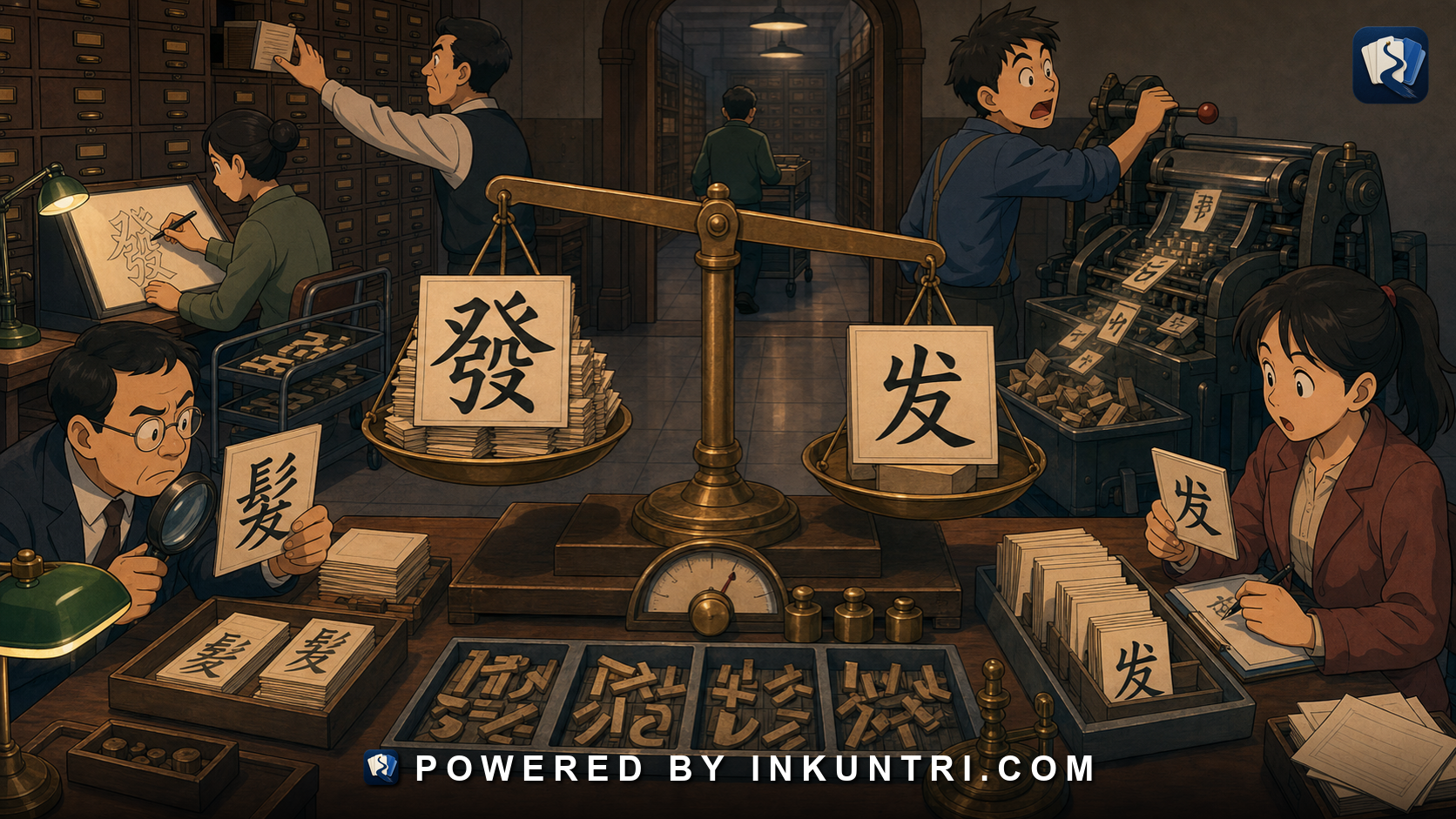
Core examples: 发/發/髮, 云/雲, 后/後, 里/裏, 面/麵, 干/乾/幹, 谷/穀.
Simplification did more than remove strokes
A shallow explanation of simplified Chinese says:
Simplified characters are traditional characters with fewer strokes.
That is partly true and badly incomplete.
Some simplifications are indeed mostly graphic:
門 → 门
馬 → 马
貝 → 贝
言 → 讠
The learner sees a complex form and a simpler form. The relationship is visible.
But other simplifications changed the mapping between written form and meaning. Several distinct traditional characters were merged into one simplified character. That means the simplified character carries more than one historical job.
This article calls that semantic compression: a practical label for cases where different traditional forms, often with different meanings or usage domains, collapse into a single simplified form.
Semantic compression is not inherently “bad.” It can make handwriting and standardization easier. But it creates tradeoffs. It hides distinctions that traditional text keeps visible. It makes simplified-to-traditional conversion context-dependent. It changes what learners must notice when they move across regions, archives, names, literature, subtitles, and digital text.
The real question is not whether simplification was good or bad in the abstract. The real question is: what information moved from the character shape into context?
Graphic simplification vs semantic compression
Start with a clean contrast.
Graphic simplification
A single traditional form maps to a simplified form.
門 → 门
馬 → 马
貝 → 贝
魚 → 鱼
The simplified character is easier to write, and the conversion is mostly predictable. A reader learning both scripts can pair the forms.
Semantic compression
Multiple traditional forms map to one simplified form.
發 / 髮 → 发
後 / 后 → 后
裏 / 里 → 里
麵 / 面 → 面
乾 / 幹 / 干 → 干
穀 / 谷 → 谷
Now the simplified form is not just a shorter version of one traditional form. It is doing multiple jobs. Context must disambiguate.
This is why automated conversion from traditional to simplified is easier than simplified to traditional. If 發 and 髮 both become 发, the original distinction is lost in the simplified character alone. To convert 发 back, software must read the word or sentence.
发生 → 發生
头发 → 頭髮
The same simplified character 发 becomes different traditional characters depending on the word.
What was gained
1. Handwriting efficiency
The most obvious gain is physical. Fewer strokes can make characters faster to write, especially in high-frequency forms.
Compare:
髮 → 发
後 → 后
裏 → 里
雲 → 云
穀 → 谷
For students writing thousands of characters by hand, stroke reduction matters. It also matters for chalkboards, handwritten forms, note-taking, and everyday literacy before phones became dominant.
The gain is not uniform. Some simplified characters are still complicated, such as 赢. Some traditional forms are not very hard. But in many high-frequency cases, simplification clearly reduces writing burden.
2. Standardization
Simplification was not only about individual characters. It was part of a broader effort to standardize modern written usage in education, publishing, printing, and administration.
A stable standard lets schools teach, printers print, publishers edit, and government agencies issue documents consistently. This matters even when individual simplification choices are debatable.
Standardization is a social technology. It makes large-scale literacy and administration easier by reducing variation.
3. Basic print and display convenience
In the era of metal type, movable type, typewriters, telegraphy, early computing, and low-resolution displays, character complexity was a real design constraint. Simpler forms could be easier to reproduce, distinguish, and standardize.
Modern high-resolution screens reduce some of that pressure, but they do not erase it. Dense characters still become harder to read at small sizes. This matters in subtitles, mobile interfaces, labels, maps, and signage.
4. A single Mainland school path
For learners whose main target is modern Mainland China, simplified characters provide a direct path into school materials, newspapers, apps, government documents, popular media, and most Mainland digital text.
That practical fact should not be buried under ideological argument. If your reading world is mostly Mainland modern text, simplified literacy is not optional.
What was lost or moved into context
1. Visible semantic distinctions
Traditional forms often preserve distinctions that simplified forms compress.
發: to send, issue, develop, occur
髮: hair
In simplified text:
发Context distinguishes:
发展     develop
发生     happen
发票     invoice
头发     hair
理发     haircut
A skilled simplified reader has no problem in ordinary context. But the character alone no longer shows the 發/髮 distinction.
2. Etymological and component transparency
Traditional forms sometimes keep older semantic components visible.
雲 contains 雨, the rain component.Simplified cloud:
云The simplified form 云 existed historically with other functions, including “to say” in classical-style contexts. When 雲 becomes 云, the rain/weather component disappears from the standard simplified cloud form.
The modern reader can still learn 云 as “cloud” in words like 白云 and 云南, but the graphic weather clue has been removed.
3. Easier traditional-to-simplified conversion than simplified-to-traditional conversion
Many-to-one mapping creates a one-way compression problem.
Traditional to simplified:
發展 → 发展
頭髮 → 头发
Simplified to traditional:
发展 → 發展
头发 → 頭髮
The second direction requires context. A character-by-character swap will fail.
This is not a minor technical issue. It affects subtitles, archives, OCR, web pages, names, product listings, and mixed-script documents.
4. Harder cross-region reading
A Mainland-only reader may never need to produce traditional characters. But reading Taiwan, Hong Kong, Macau, older overseas Chinese materials, Japanese kanji-adjacent forms, family documents, temple inscriptions, shop signs, or historical texts requires recognizing forms that simplified education may not teach deeply.
The problem is not that simplified readers cannot learn traditional forms. They can. The problem is that some distinctions must be added later.
5. More work for serious literary and historical study
Historical and literary study often requires traditional forms, variant forms, and premodern conventions. Simplification can hide distinctions relevant to older texts.
This does not make simplified characters illegitimate. It means the script needed for modern newspapers is not the same as the script knowledge needed for paleography, classical literature, archival research, or textual criticism.
Case study: 发 / 發 / 髮
This is the classic example.
| Simplified | Traditional source | Domain | Examples |
|---|---|---|---|
| 发 | 發 | send, issue, develop, occur | 发展/發展, 发生/發生, 发表/發表 |
| 发 | 髮 | hair | 头发/頭髮, 理发/理髮, 头发长/頭髮長 |
In simplified script:
他发现自己的头发白了。A traditional conversion must separate the two jobs:
他發現自己的頭髮白了。The first 发 in 发现 corresponds to 發. The second 发 in 头发 corresponds to 髮.
A learner who knows only “发 = fa” misses the important point. 发 is not one traditional character made shorter. It is a compressed simplified form covering at least two major traditional forms in ordinary reading.
Case study: 云 / 雲
Traditional script distinguishes:
云: to say, in literary/classical-style uses
雲: cloud
Simplified script uses:
云: cloud, and also older/literary uses where appropriateExamples:
| Simplified | Traditional | Meaning |
|---|---|---|
| 白云 | 白雲 | white clouds |
| 云南 | 雲南 | Yunnan |
| 子曰诗云 | 子曰詩云 | “the Master said, the Odes say” style literary phrase |
| 人云亦云 | 人云亦云 | repeat what others say |
The semantic compression is not always symmetrical in everyday modern vocabulary. Most modern learners meet 云 first as cloud. But traditional text keeps cloud as 雲, visibly connected to 雨.
Case study: 后 / 後
Traditional script distinguishes:
后: queen, empress, sovereign-related historical uses
後: behind, after, later
Simplified script uses 后 for both.
Examples:
| Simplified | Traditional | Meaning |
|---|---|---|
| 皇后 | 皇后 | empress |
| 后来 | 後來 | later |
| 后面 | 後面 | behind; back side |
| 前后 | 前後 | front and back; before and after |
In simplified text:
皇后后来回到后宫。Traditional:
皇后後來回到後宮。The first 后 stays 后 because it means empress. The later 后 forms become 後 because they involve after/behind.
This example shows why context is not optional.
Case study: 里 / 裏
Traditional script often distinguishes:
里: village, li as a distance unit, neighborhood/place element
裏: inside
Simplified script uses 里 for both.
Examples:
| Simplified | Traditional | Meaning |
|---|---|---|
| 里面 | 裏面 / 裡面 | inside |
| 这里 | 這裏 / 這裡 | here |
| 里程 | 里程 | mileage; distance measure |
| 乡里 | 鄉里 | native place/village community |
Traditional usage may vary between 裏 and 裡 depending on region and standard. The important learner point is that simplified 里 carries multiple jobs.
A sentence like this is easy for a simplified reader:
他在村里走了三里路。Traditional conversion must separate inside/place from the distance unit:
他在村裏走了三里路。The first 里 becomes 裏/裡; the second stays 里.
Case study: 面 / 麵
Traditional script distinguishes:
面: face, surface, side, aspect
麵: noodles, flour-based food
Simplified script uses 面 for both.
Examples:
| Simplified | Traditional | Meaning |
|---|---|---|
| 面子 | 面子 | face, reputation |
| 面前 | 面前 | in front of |
| 方面 | 方面 | aspect, side |
| 面条 | 麵條 | noodles |
| 牛肉面 | 牛肉麵 | beef noodles |
| 面粉 | 麵粉 | flour |
In simplified text:
他面前有一碗牛肉面。Traditional:
他面前有一碗牛肉麵。The first 面 remains 面. The second becomes 麵.
This example matters for menus. A learner traveling between Mainland China and Taiwan will see both forms in food contexts.
Case study: 干 / 乾 / 幹
干 is one of the densest simplification traps.
Traditional and inherited uses include:
干: shield; interfere; concern; dry-related inherited uses in some contexts
乾: dry; also qián in 乾坤, 乾隆, etc.
幹: trunk; main part; do/work; cadre-related uses
Simplified script uses 干 for many of these, but not every occurrence of 乾 disappears in modern standard usage. Some proper names and classical/cultural terms retain 乾, such as 乾坤 and 乾隆.
Examples:
| Simplified | Traditional | Meaning |
|---|---|---|
| 干净 | 乾淨 | clean |
| 干燥 | 乾燥 | dry |
| 干部 | 幹部 | cadre |
| 干活 | 幹活 | do work |
| 树干 | 樹幹 | tree trunk |
| 乾坤 | 乾坤 | heaven and earth; not simplified to 干坤 in standard use |
| 乾隆 | 乾隆 | Qing emperor era/name; retained |
This is a good place to abandon simplistic rules. The correct conversion depends on word, meaning, and sometimes convention.
Case study: 谷 / 穀
Traditional script distinguishes:
谷: valley
穀: grain, cereal crops
Simplified script uses 谷 for both.
Examples:
| Simplified | Traditional | Meaning |
|---|---|---|
| 山谷 | 山谷 | valley |
| 谷物 | 穀物 | grain/cereal |
| 稻谷 | 稻穀 | unhusked rice/grain |
| 五谷 | 五穀 | the five grains |
In simplified text:
山谷里种着谷物。Traditional:
山谷裏種著穀物。The first 谷 stays 谷. The second becomes 穀.
This is semantic compression in a clean form: valley and grain are graphically distinct in traditional writing but merged in simplified writing.
Why context repairs most of the loss
It is easy to exaggerate the practical damage of semantic compression. Native readers of simplified Chinese do not usually misread 头发 as “head sends” or 牛肉面 as “beef face.” Words and context repair ambiguity.
Chinese already relies heavily on compound words. Characters rarely float alone in serious reading. When a simplified character is part of a familiar word, the word identifies the meaning.
头发 → hair
发展 → development
牛肉面 → beef noodles
方面 → aspect
谷物 → grain
山谷 → valley
So the loss is not usually immediate comprehension. The loss is in visible distinction, historical transparency, and automatic reversibility.
A useful analogy is compression in a digital file. If the receiving system has enough context, it can reconstruct the intended meaning. But if you remove context, some information is gone.
Why conversion software fails
A naive converter might use a table:
发 → 發
后 → 後
面 → 面
That fails immediately:
头发 → 頭發  ❌
皇后 → 皇後  ❌
牛肉面 → 牛肉面  ❌ if target traditional food orthography expects 麵
A better converter uses word segmentation and dictionaries:
头发 → 頭髮
发展 → 發展
皇后 → 皇后
后来 → 後來
牛肉面 → 牛肉麵
方面 → 方面
Even good conversion software can struggle with:
- names
- rare words
- classical quotations
- deliberate mixed-script text
- typos
- OCR errors
- technical terms
- regional preferences
- playful or poetic usage
This is why serious editing still requires human review.
What different learners need
Mainland-only practical reading
If your goal is modern Mainland life, simplified characters should be primary. Learn high-frequency traditional forms passively when they appear in names, branding, signage, or cross-region materials.
Priority:
simplified fluency → common traditional recognition → conversion trapsTaiwan/Hong Kong/Macau reading
If your main reading world is Taiwan, Hong Kong, or Macau, traditional characters should be primary. Learn simplified recognition for Mainland media, apps, academic materials, and cross-border communication.
Priority:
traditional fluency → simplified recognition → Mainland vocabulary/register differencesPan-Sinitic literacy
If you want to read across regions, you need both scripts and a mental map of one-to-one and many-to-one correspondences.
Priority:
core script fluency → high-frequency pairs → semantic compression families → regional standardsHistorical, literary, archival, or calligraphic study
Traditional forms, variants, and historical forms become essential. Simplified literacy alone will not carry the load.
Priority:
traditional literacy → variants → classical vocabulary → specialized dictionariesA staged learning path
Stage 1: Become fluent in one standard
Do not try to learn every simplified and traditional form at the beginning unless you have a specific need. Choose the script that matches your target environment and get fluent.
For many learners, that means simplified first. For others, especially Taiwan-focused learners, it means traditional first.
Stage 2: Learn high-frequency one-to-one pairs
Start with visible component changes:
門/门
馬/马
貝/贝
魚/鱼
車/车
言/讠
食/饣
金/钅
These build confidence and let you recognize families.
Stage 3: Learn semantic compression families
Now study the many-to-one cases as families, not isolated characters.
发: 發 / 髮
后: 後 / 后
里: 裏 / 里
面: 麵 / 面
干: 乾 / 幹 / 干
谷: 穀 / 谷
云: 雲 / 云
Use word pairs:
发展 / 發展
头发 / 頭髮
后来 / 後來
皇后 / 皇后
里面 / 裏面
里程 / 里程
牛肉面 / 牛肉麵
方面 / 方面
Stage 4: Read mixed real materials
Use menus, subtitles, product labels, book covers, signs, and short news passages. Mark only the forms that cause real confusion.
Stage 5: Practice conversion manually
Take ten simplified sentences and convert high-risk words to traditional. Then check with a dictionary or reliable converter.
The goal is not to become software. The goal is to see where software needs context.
Practice: classify the simplified character
For each simplified word, choose the likely traditional form.
| Simplified word | Traditional | Reason |
|---|---|---|
| 发展 | 發展 | develop/expand uses 發. |
| 头发 | 頭髮 | hair uses 髮. |
| 皇后 | 皇后 | empress uses 后. |
| 后来 | 後來 | later uses 後. |
| 里面 | 裏面 / 裡面 | inside uses 裏/裡 in traditional usage. |
| 里程 | 里程 | distance/measure use remains 里. |
| 牛肉面 | 牛肉麵 | noodles use 麵. |
| 方面 | 方面 | aspect/side remains 面. |
| 干活 | 幹活 | do work uses 幹. |
| 干燥 | 乾燥 | dry uses 乾. |
| 山谷 | 山谷 | valley uses 谷. |
| 谷物 | 穀物 | grain uses 穀. |
Now try a sentence:
他后来发现,山谷里的谷物因为天气干燥长得不好。One possible traditional conversion:
他後來發現,山谷裏的穀物因為天氣乾燥長得不好。Breakdown:
| Simplified | Traditional | Why |
|---|---|---|
| 后来 | 後來 | later/after |
| 发现 | 發現 | discover/issue/develop family, not hair |
| 山谷 | 山谷 | valley |
| 里 | 裏 | inside/in |
| 谷物 | 穀物 | grain |
| 干燥 | 乾燥 | dry |
This is the practical heart of semantic compression.
What not to conclude
Do not conclude that simplified characters are “illogical.” That is too crude. Simplified writing has its own standard logic, and millions of highly literate readers use it without confusion.
Do not conclude that traditional characters are “just harder.” That is also too crude. Traditional forms often preserve useful distinctions and component information.
Do not conclude that one script is always better for every learner. Better for what? Mainland daily life, Taiwan publishing, historical documents, calligraphy, software conversion, handwriting speed, etymological study, or pan-regional literacy? Different goals produce different answers.
The honest conclusion is that simplification redistributed information. Some information became easier to write. Some became less visible in the character. Some moved into word context. Some must be recovered later by learners who cross scripts.
What to remember
Character simplification is not only stroke reduction. It includes component simplification, variant adoption, standardization, and many-to-one mergers. Semantic compression occurs when one simplified form covers multiple traditional forms with distinct meanings or histories.
For ordinary reading, context usually resolves the ambiguity. For conversion, historical study, cross-region literacy, and careful editing, the compressed distinctions matter.
The serious learner should avoid ideology and build a map.
Learn the script you need most. Then learn the high-impact conversion families. Treat simplified forms as efficient modern standards and traditional forms as essential for broader historical and regional literacy. You do not need to fight the script war to become a stronger reader.
Build an annotated character-family chart with two display modes.
Mode 1: One-to-one simplification
Neutral color.
門 → 门
馬 → 马
貝 → 贝
魚 → 鱼
Label:
Mostly graphic simplification. Conversion is usually direct.Mode 2: Many-to-one semantic compression
Highlight merged forms.
發 ┐
髮 ├→ 发
後 ┐
后 ├→ 后麵 ┐
面 ├→ 面For each merged family, show example words:
| Simplified | Traditional option A | Traditional option B | Context question |
|---|---|---|---|
| 发 | 發展 | 頭髮 | Is it develop/send/occur, or hair? |
| 后 | 後來 | 皇后 | Is it after/behind, or empress? |
| 面 | 方面 | 牛肉麵 | Is it face/surface/aspect, or noodles/flour? |
| 干 | 乾燥 | 幹活 | Is it dry, doing/work/trunk, or inherited 干? |
| 谷 | 山谷 | 穀物 | Is it valley, or grain? |
Practice mode
The user enters simplified text. The tool highlights characters that require contextual disambiguation for traditional conversion.
Example:
Input: 他发现头发白了。
Output: 他發現頭髮白了。
Notes: 发 in 发现 → 發; 发 in 头发 → 髮.
Add a warning label:
Do not convert character by character. Convert by word and meaning.For production fact-checking, consult:
- 《简化字总表(1986年版)》: https://zh.wikisource.org/wiki/简化字总表(1986年版)
- 华东师范大学学报 page, 《简化字总表(1986年新版)及说明》: https://www.xb.ecnu.edu.cn/de/8e/c40743a515726/page.htm
- 国务院关于公布《通用规范汉字表》的通知: https://zh.wikisource.org/wiki/国务院关于公布《通用规范汉字表》的通知
- 《通用规范汉字表》, 附件1《规范字与繁体字、异体字对照表》: https://zh.wikisource.org/wiki/通用规范汉字表
- 光明日报 / 新华网, 《传承下来的简体字》: https://www.xinhuanet.com/politics/2016-03/20/c_128814573.htm
- Unicode Standard Annex #38, Unicode Han Database (Unihan) for cross-reference and variant data: https://www.unicode.org/reports/tr38/
Articles 010–012 continue the writing-and-literacy track by moving from character forms into reference systems and standards:
- 010 teaches lookup as an applied literacy skill across paper, digital, image, and field contexts.
- 011 corrects the oversimplified radical-as-meaning-part story and replaces it with a layered model: dictionary radical, semantic hint, phonetic component, and actual word usage.
- 012 frames simplification as a tradeoff and gives learners a practical map of many-to-one semantic compression.
Recommended cross-links:
- Link 010 to article 003 on 字/词 and article 006 on variants.
- Link 010 to article 024 on input methods and article 026 on search segmentation.
- Link 011 to article 004 on phono-semantic compounds and article 005 on sound components that lie.
- Link 012 to article 001 on simplification and article 002 on traditional-simplified conversion.
Reusable module opportunities:
- Lookup simulator: choose radical, count residual strokes, compare Pinyin, handwriting, OCR, and component search.
- Layered component tree: toggle dictionary radical, semantic hint, phonetic component, and “not useful literally.”
- Semantic-compression converter: highlight simplified characters that require word-level context to convert into traditional forms.
Related reading
Building a Mandarin Reader Workflow From News, Documents, and Literature
The reader can build a sustainable Mandarin reading workflow that combines current news, practical documents, essays, and literature without drowning in vocabulary.
Chinese Characters Abroad: Hanzi, Kanji, Hanja, and the Shared Scriptworld
The reader understands the shared character tradition across China, Japan, and Korea while respecting each language’s independent grammar, pronunciation, and history.
Designing Chinese Anki Cards for Words, Characters, and Collocations
The reader can design Chinese flashcards that train recognition, pronunciation, meaning, collocation, character form, and contextual use without turning review into trivia.
The May Fourth Language Shift and the Rise of 白话
The reader understands how modern written Chinese emerged from debates over education, literature, modernization, and accessibility.
How Mandarin Expresses Collective Identity
The reader can identify how Mandarin builds collective identity through pronouns, group nouns, shared fate language, institutional wording, and emotional alignment.
A Serious Learner’s Guide to Chinese Dictionaries
The reader can use Chinese dictionaries more deeply by reading definitions, parts of speech, usage notes, examples, synonyms, variants, and register labels.